

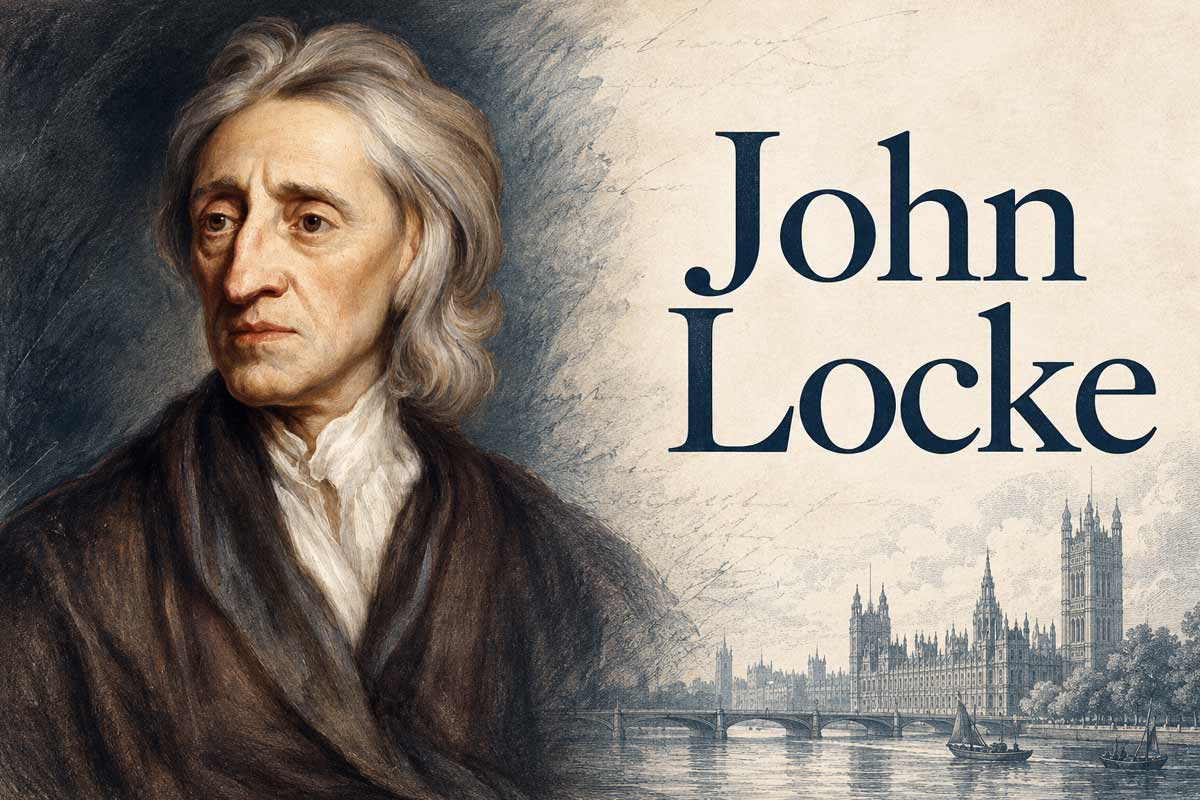
Most of us would object if the government told us which church to attend, which doctrines to believe, and which books we were allowed to read. We’d also object if a ruler claimed that our rights existed only because he was generous enough to grant them. John Locke helped give those objections a philosophical foundation. He argued that political authority has limits, that genuine faith requires personal conviction, and that inherited ideas deserve examination. Those positions helped shape the modern world, although Locke didn’t always apply his own principles as consistently as we might wish.
Locke also complicates the familiar story that modern freedom emerged when people finally got religion out of the way. His defense of human equality depended heavily on the belief that God created people and that no human being therefore has unlimited ownership over another. He believed Christianity could withstand reasonable examination and devoted serious attention to Scripture. Christians can appreciate much of that while questioning parts of his theology and recognizing the failures in his account of toleration. Reading him fairly requires more than making him either a secular hero or an honorary member of our church.
An English Thinker in a Divided Country
John Locke was born in England in 1632 and died in 1704. He studied at Oxford, developed an interest in medicine and experimental science, and became associated with Anthony Ashley Cooper, later the Earl of Shaftesbury. That relationship brought him into political affairs as well as medical work. England had endured civil war, the execution of a king, republican government, and the restoration of the monarchy during his lifetime. Questions about obedience, religious uniformity, and the limits of royal authority had consequences considerably more serious than losing an argument at dinner.
Locke spent several years in the Netherlands during a period of political danger and returned to England after the revolution of 1688. His major works appeared around 1689 and 1690, including An Essay Concerning Human Understanding, Two Treatises of Government, and A Letter Concerning Toleration. These books addressed different subjects, but they shared a concern with the proper limits of authority. How much can the mind know? What powers can government legitimately exercise? What can a church require, and what happens when the state tries to produce belief by force?
Where Our Ideas Come From
In the Essay, Locke challenged the claim that the mind comes equipped with innate ideas or principles already stamped into it. He compared the mind, before acquiring ideas, to blank paper. The comparison concerns the origin of our ideas; it doesn’t mean that infants lack natural abilities or that people are identical products of their surroundings. Locke’s point was that we acquire the materials of thought through experience. A belief’s familiarity doesn’t prove that we were born knowing it, especially when we learned it so early that we can’t remember the lesson.
He identified two sources of experience: sensation and reflection. Sensation supplies ideas through our contact with the world, such as the warmth of a fire or the taste of an apple. Reflection supplies ideas through awareness of our own mental activities, including remembering, doubting, and choosing. The mind can then combine, compare, and abstract from what it receives. We can imagine a golden mountain without having seen one because we’ve encountered gold and mountains and can join those ideas together. On Locke’s account, the mind does plenty of work, but it works with materials that experience supplies.
This approach made Locke a major figure in empiricism, the tradition that gives experience a central place in explaining knowledge. It differs from the emphasis on innate ideas associated with thinkers such as Descartes. However, empiricism shouldn’t be confused with the claim that only things we can touch or photograph are real. Locke believed reason could establish God’s existence, and he allowed a place for revelation. His disagreement with innate ideas concerned how we come to understand things, rather than a blanket rejection of spiritual reality.
Locke also distinguished between primary and secondary qualities. Primary qualities, such as shape, solidity, and motion, belong to physical objects themselves. Secondary qualities, such as color and taste, involve an object’s power to produce particular sensations in us. An apple has a physical structure whether anyone looks at it, but our experience of its redness involves the interaction between that structure and our perception. Locke wasn’t saying the apple is imaginary. He was asking how the world outside us relates to the world as we experience it, a question that later philosophers would push much further.
Knowing Our Limits
Locke distinguished knowledge from judgments that rest on probability. Some truths are grasped directly, while others require a chain of reasoning, and our awareness of particular external things comes through sensation. Much of ordinary life, however, depends on evidence that gives us reasonable confidence without absolute certainty. Historical testimony, reports from other people, and expectations about what will happen tomorrow belong largely in that territory. We couldn’t function if we refused to act until every possibility of error had disappeared. We also shouldn’t pretend that being very sure of ourselves makes the evidence stronger.
That distinction has practical value for religious discussion. We need to ask what supports a claim and whether the confidence we’re expressing fits that support. Locke’s treatment of language also reminds us that people can use the same word while attaching different ideas to it. Christians discussing freedom, faith, or salvation can argue for quite a while before discovering that they haven’t been discussing quite the same thing. Careful definitions won’t settle every disagreement, but they can keep us from spending an afternoon defending a position the other person never actually held.
Locke’s account of personal identity raised another enduring question: what makes you the same person over time? He emphasized consciousness extending back to earlier experiences and actions, rather than treating personal identity as simply the continued existence of the same body or soul. His discussion connected identity with moral responsibility, because the person who answers for an action must in some meaningful sense be the person who performed it. This doesn’t reduce easily to the claim that forgetting something makes it disappear from your moral history, and philosophers continue to dispute how his account should be understood. It does show why memory and consciousness matter when we ask about responsibility, survival after death, and resurrection.
Rights That Come Before Government
Locke’s political philosophy begins with people who are naturally free and equal. Their equality doesn’t mean that everyone has the same abilities, wealth, or responsibilities. It means that no one is born with an automatic right to exercise absolute political dominion over everyone else. Locke opposed the attempt to derive a king’s unlimited authority from Adam’s supposed rule over his descendants. Even if someone could establish that original authority, proving which seventeenth-century king had inherited it would present a fairly substantial paperwork problem.
For Locke, natural freedom exists within natural law. People have obligations to preserve themselves and, when their own preservation isn’t in conflict, to preserve others. They must respect other people’s lives, liberty, and possessions. He grounded these duties in humanity’s relationship to God: we are God’s creatures, rather than property available for another person’s unrestricted use. Freedom therefore doesn’t mean permission to do anything we happen to want. It carries moral limits that exist before a legislature writes them into a statute book.
This produces a different picture from Hobbes’s explanation of political authority. Locke’s state of nature, where there is no common political authority, isn’t necessarily a condition of constant war. People can recognize duties and cooperate without a government standing over them. The problem is that they lack a settled, impartial way to interpret the law, judge disputes, and enforce decisions. Someone who has been wronged may exaggerate his claim, while someone who has caused harm may find his own conduct surprisingly easy to excuse. Government becomes necessary because rights need reliable protection against those predictable failures.
Government as a Trust
People establish political society to secure the rights they already possess. Government receives authority through consent and must exercise it for the public good. Within the community, majority decision makes collective action possible, but the majority doesn’t acquire unlimited moral permission to abuse a minority. Political power remains subject to the purposes for which it was entrusted. Locke’s account therefore gives us a standard by which to judge a government beyond the bare fact that it can make people obey.
This helps explain his rejection of absolute monarchy. If the difficulty in the state of nature is that people judge their own cases, appointing one person who can never be held accountable doesn’t solve the underlying problem. It makes that person’s judgment final while leaving everyone else without an effective remedy. Locke defended government under established laws and distinguished legislative authority from the work of executing those laws. His approach helped develop constitutional thinking, though we shouldn’t assume he had already designed every feature of a modern democratic system.
Locke also defended resistance when government seriously betrayed its trust. This wasn’t an invitation to overthrow the authorities every time a tax increase became unpopular. He recognized that people generally tolerate mistakes and inconveniences rather than risk the upheaval of revolution. His concern was with sustained abuse, arbitrary power, and the destruction of the rights government was established to protect. If rulers turn their authority against those purposes, they cannot reasonably demand obedience simply by reminding everyone that they are the rulers.
Property and the Problem of Slavery
Locke argued that labor can establish a claim to property. If the earth is initially available in common, a person who gathers its fruits or cultivates land contributes something through personal effort. That effort helps explain why the result can become his possession. Locke placed conditions on the argument, including avoiding waste and leaving sufficient resources of comparable quality for others. His discussion of money then explained how durable wealth and larger inequalities could develop. The theory raises difficult questions about what those conditions require once resources are scarce and opportunities are unequally distributed.
His writings use property both for material possessions and, in broader contexts, for people’s lives and liberties. Nevertheless, his account of productive labor could support troubling judgments about land occupied by peoples whose practices differed from European agriculture. We should be careful about a theory that appears to recognize ownership most readily when the owner uses the land as we would use it. Rights that are supposed to precede government shouldn’t quietly depend on adopting the customs of the people with the strongest government. That problem becomes especially serious when philosophical arguments accompany colonial expansion.
Locke’s own involvement with the slave-trading Royal African Company makes the contradiction more concrete. In the Second Treatise, he rejected voluntary submission to unlimited, arbitrary power while permitting enslavement in a narrow case involving an aggressor who had forfeited his life in a just war. That argument doesn’t establish a right to kidnap innocent people or enslave their children. His investment in a company engaged in the slave trade therefore belongs in any honest assessment of his defense of liberty. We can recognize the force of his arguments without overlooking how far his conduct and the institutions around him fell short of them.
Religious Toleration and Its Exceptions
In A Letter Concerning Toleration, Locke argued that civil government and religious societies have different responsibilities. Government protects people’s civil interests, while a church is a voluntary association concerned with worship and salvation. A church may determine its membership and exclude someone who refuses its rules, but that authority doesn’t entitle it to seize property, imprison dissenters, or turn disagreement into a civil offense. Political power likewise doesn’t equip a ruler to save souls. A magistrate can compel someone to attend a service, but attendance under threat tells us very little about what that person believes.
Locke supported this distinction with Christian arguments as well as philosophical ones. Saving faith involves inward conviction, and the example of Jesus doesn’t authorize persecution as a method of producing it. He also challenged the selective zeal of people who were eager to punish doctrinal differences while tolerating obvious moral wrongdoing. His argument wasn’t that all religions are equally true or that doctrine is unimportant. It was that confidence in our religion doesn’t give us the right to make another person’s conversion a police matter.
His toleration had serious exceptions. Locke excluded atheists because he believed that removing belief in God undermined the reliability of promises and oaths. He also denied toleration to religious bodies whose members owed allegiance to a foreign ruler, a restriction directed particularly against Roman Catholics and papal authority. Those exclusions expose a weakness in his defense of conscience. Governments can punish actual breaches of trust or political betrayal without presuming that every member of a disliked religious group is guilty of them. Locke helped formulate an argument for religious liberty whose implications extend beyond the limits he himself accepted.
Christianity and Reason
Locke’s The Reasonableness of Christianity, published in 1695, presented Christianity as a faith intelligible to ordinary people. He emphasized belief that Jesus is the Messiah, together with repentance and obedience to Christ. He was concerned that elaborate theological systems could make the gospel appear accessible only to people capable of navigating academic disputes. That concern will sound familiar to Christians who have watched a straightforward biblical conversation disappear into a disagreement over terminology. However, making the gospel understandable still requires care about what Scripture says and which teachings are essential to its meaning.
Locke’s approach drew criticism because readers questioned whether his account gave adequate attention to doctrines traditionally considered central. We don’t have to settle every dispute about his precise theological position to recognize the issue. Trusting Jesus as Messiah raises further questions about who Jesus is, what he accomplished, and why salvation requires him. Those questions deserve biblical answers, even when we want to avoid making every denominational distinctiveness a condition of Christian fellowship. A useful distinction exists between explaining what conversion requires and explaining the fuller body of teaching through which believers grow.
He also distinguished truths that reason can discover from truths that are beyond its unaided reach. Revelation could disclose something, such as the resurrection of the dead, that ordinary reasoning couldn’t establish on its own. But the claim that a message comes from God still needs examination; intense inward confidence cannot serve as its own proof. Christians can appreciate that warning without concluding that God never speaks or that spiritual experience has no place in Christian life. Scripture itself calls us to test spiritual claims, and the person making the claim doesn’t get an exemption simply because he sounds certain.
Why Locke Still Matters
Locke belongs in Modern Philosophy, with close connections to Epistemology, Political Philosophy, and Philosophy of Religion. His account of experience helped set the stage for later empiricists, while his defense of rights and consent influenced the political language of the American founding. He wasn’t the sole source of those ideas, and later societies didn’t reproduce his thought without changes. Even so, questions about government accountability and religious liberty still bear the marks of arguments he helped develop. People who have never read a page of Locke often use principles associated with him when they object to arbitrary power.
For Christians, his strongest challenge may be the question of how we use authority when we’re convinced we’re right. We can teach doctrine, defend the faith, and hold members accountable without assuming that political coercion will produce genuine discipleship. We can also defend human dignity while examining whether our own loyalties and interests keep us from extending that dignity consistently. Locke’s failures don’t make his arguments worthless, but they make selective application harder to excuse. If people belong to God, the protection of their conscience and humanity cannot depend on whether protecting them happens to benefit us.