

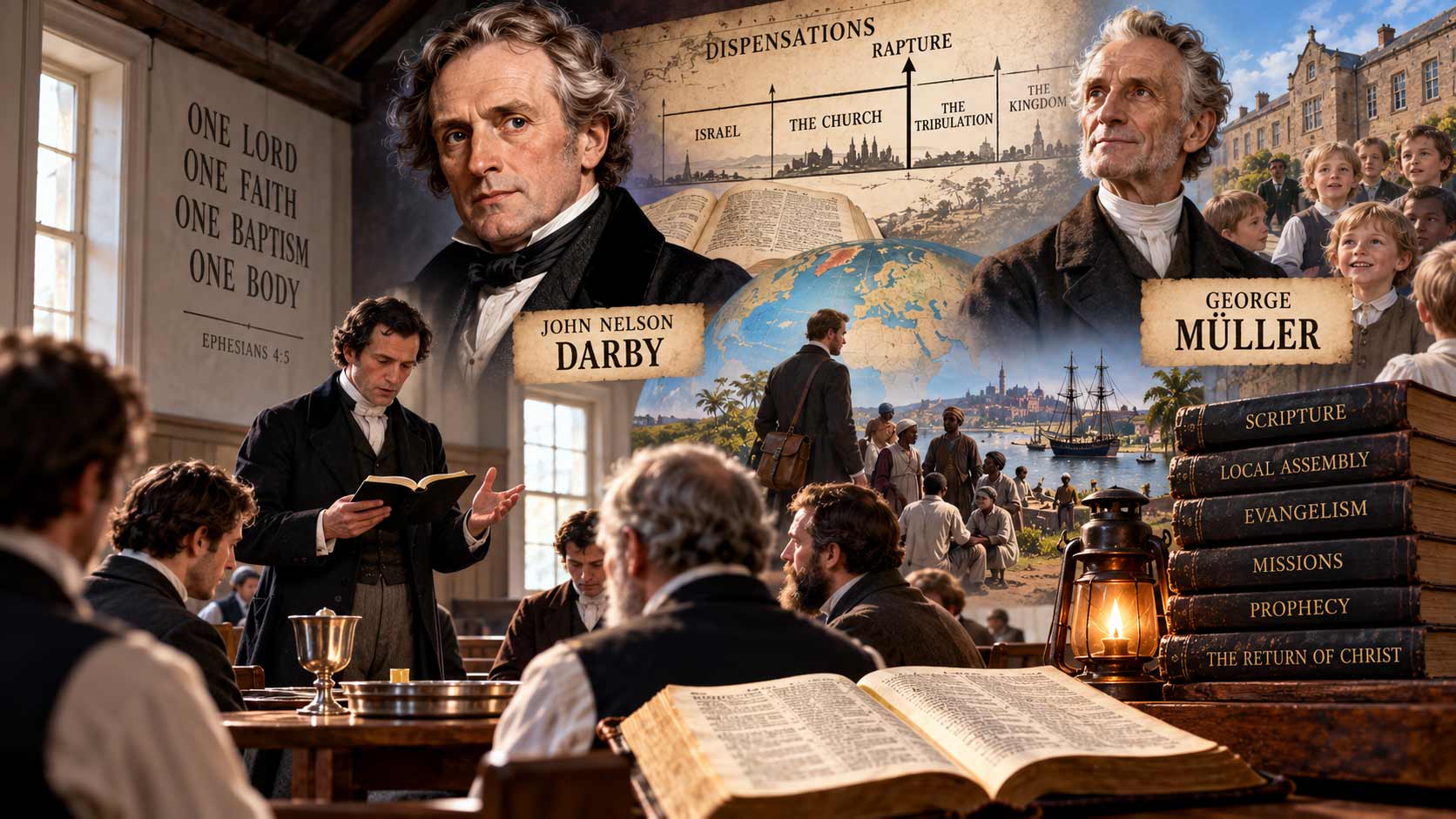
The Plymouth Brethren are a good example of a relatively small Christian movement having an influence far beyond its size. Most Christians have never attended a Brethren assembly, and many have never knowingly met a Plymouth Brethren believer. Yet millions of evangelicals have encountered ideas that passed through the movement, particularly dispensationalism, the distinction between Israel and the Church, intense interest in biblical prophecy, the expectation of Christ’s imminent return, and a strong suspicion of denominational machinery. The Brethren also produced influential Bible teachers, missionaries, and evangelists whose work reached well beyond their own assemblies.
They didn’t originally set out to establish another denomination. In fact, establishing another denomination was almost exactly what they were trying not to do. Early Brethren believed denominational divisions obscured the unity Christians already possessed in Christ. Their solution was to gather simply as believers, without denominational labels, ordained clergy, elaborate church government, or a creed functioning as a membership boundary. The difficulty, as church history repeatedly demonstrates, is that Christians who organize themselves around not being an organization eventually have to decide how the non-organization is going to operate.
The Beginnings of the Brethren
The movement emerged during the late 1820s and early 1830s, particularly in Ireland and England. This was a period of considerable religious ferment in the British Isles. Evangelicalism was growing, interest in biblical prophecy was increasing, and some Christians were dissatisfied with what they regarded as the spiritual lethargy and rigid structures of established churches. Small groups began meeting outside normal denominational structures for prayer, Bible study, and the Lord’s Supper.
Dublin became an important early center. Among the people associated with the emerging movement were Anthony Norris Groves, John Nelson Darby, Edward Cronin, and John Gifford Bellett. Similar gatherings developed elsewhere, including an important assembly in Plymouth, England. The Plymouth congregation became so prominent that outsiders began referring to participants in the movement as the “Plymouth Brethren,” although many Brethren have never particularly liked the name. Calling themselves Plymouth Brethren seemed dangerously close to admitting that they had become precisely the sort of denomination they were trying to avoid.
Their original vision was straightforward. Instead of Christians identifying themselves primarily as Anglicans, Baptists, Methodists, Presbyterians, or members of some other denomination, believers should gather around Christ Himself. The Lord’s Table became especially important because Communion visibly expressed the unity of the body of Christ. Ideally, any genuine Christian should be welcomed as a brother or sister regardless of denominational background.
John Nelson Darby
No person became more important to the development of Brethren theology than John Nelson Darby. Born in 1800, Darby was trained as a lawyer before becoming an Anglican clergyman in Ireland. He eventually became deeply dissatisfied with the established church, particularly with the relationship between church and state. Darby came to believe that the institutional church had departed so badly from the New Testament pattern that attempting to repair the existing structures was the wrong approach.
His answer was separation. Christians should gather simply in the name of Christ and recognize the leadership of the Holy Spirit rather than relying upon an ordained clergy. Darby’s influence within the Brethren became enormous, although the movement was never simply his creation. Other early leaders sometimes disagreed sharply with him, and those disagreements eventually produced one of the most important divisions in Brethren history.
Darby’s influence reached much farther through his teaching about biblical prophecy. He developed a systematic form of dispensationalism that divided biblical history according to different administrations or “dispensations” in God’s dealings with humanity. More importantly for later evangelicalism, he made a strong distinction between Israel and the Church. God’s promises to Israel hadn’t simply been transferred to the Christian Church; Israel still had a future role in God’s prophetic plan.
Darby also taught that Christ would remove the Church before the period of end-times judgment commonly called the Tribulation. The exact history of pretribulational rapture teaching has generated plenty of debate, and claims that Darby simply invented the idea out of nowhere are too simplistic. What can safely be said is that Darby became the most important nineteenth-century systematizer and promoter of the dispensational framework that included a pretribulational rapture. Through his travels and writings, particularly his repeated visits to North America, those ideas entered a much larger evangelical world.
Dispensationalism and the American Evangelical World
Brethren prophetic teaching found particularly fertile ground in the United States and Canada. Bible conferences in the late nineteenth century brought together Christians from different evangelical traditions who shared an interest in prophecy and the return of Christ. Darby’s distinction between Israel and the Church and his understanding of the prophetic timetable increasingly circulated outside Brethren assemblies.
The movement’s influence became even greater through later teachers who weren’t themselves simply reproducing Darby’s system. Cyrus I. Scofield incorporated dispensational interpretations into the notes of the enormously influential Scofield Reference Bible, first published in 1909. Once those notes were sitting beside the biblical text in the hands of pastors and laypeople, dispensationalism could travel much farther than the relatively small Brethren movement ever could.
Eventually, dispensational thinking became deeply embedded in parts of American fundamentalism and evangelicalism. Institutions such as Dallas Theological Seminary developed more sophisticated versions of the system, and popular prophecy teachers carried its basic framework into churches, radio ministries, books, and eventually television. By the twentieth century, Christians who had never heard of Darby could nevertheless hold views about Israel, the Tribulation, the Antichrist, and the Rapture that owed a substantial historical debt to the theological world he helped create.
George Müller
Another famous figure associated with the Brethren was George Müller, although he represented a very different personality and emphasis from Darby. Müller was born in Germany in 1805 and eventually settled in Bristol, England, where he became famous for establishing orphanages that cared for thousands of children during his lifetime.
Müller believed strongly in God’s providential provision. He became known for refusing to solicit money directly for his orphanage work, choosing instead to pray and trust God to provide what was needed. Stories of unexpected donations arriving precisely when food or money was required became central to his reputation. Whether one shares every aspect of Müller’s approach to guidance and provision or not, his life became one of the best-known evangelical examples of what Christians called “living by faith.”
Müller was associated with the Bethesda Chapel in Bristol, which became central to the dispute that eventually divided the Brethren. Unlike Darby, Müller favored greater independence for local assemblies and a broader approach to receiving Christians into fellowship. The conflict between those approaches helped produce the distinction between Open and Exclusive Brethren.
Open and Exclusive Brethren
The major Brethren division developed during the 1840s. A theological controversy involving Benjamin Wills Newton at the Plymouth assembly became entangled with a larger disagreement about fellowship and church discipline. Darby believed assemblies had a corporate responsibility to maintain separation from doctrinal and ecclesiastical evil. If one assembly tolerated serious error, other assemblies couldn’t simply treat that as an entirely local matter.
The Bethesda assembly in Bristol, associated with George Müller and Henry Craik, took a less centralized approach. The controversy became increasingly bitter, and by 1848 the movement had effectively divided. Those who followed the more independent congregational approach became known as Open Brethren, while those associated with Darby’s stricter interconnected discipline became known as Exclusive Brethren.
The labels can be misleading if they’re taken too literally. “Open” didn’t mean doctrinally liberal, and “Exclusive” didn’t originally mean that members wanted no contact with anyone outside their group. The dispute concerned how assemblies recognized one another, administered discipline, and determined who could participate in the Lord’s Supper. Nevertheless, the two traditions developed separately, and the Exclusive side subsequently experienced numerous additional divisions.
Today, the term “Exclusive Brethren” can create another problem because one particular branch eventually adopted the name Plymouth Brethren Christian Church and has attracted considerable public attention. It shouldn’t simply be treated as representing every historically Exclusive Brethren group. Brethren history contains enough divisions that keeping track of everyone who separated from everyone else can begin to resemble a denominational genealogy chart drawn during an earthquake.
The Local Assembly
The Open Brethren tradition became especially known for the autonomy of the local congregation, usually called an “assembly.” Historically, assemblies had no ordained clergy and no denominational headquarters controlling them. Local elders provided leadership, while spiritually gifted men participated in preaching, teaching, prayer, and worship. Some contemporary Brethren churches now employ full-time pastors or other staff, but the traditional suspicion of a sharp clergy-laity distinction remains part of the movement’s heritage.
The weekly Breaking of Bread, or Lord’s Supper, occupies a central place in Brethren worship. Traditionally, men in the congregation participate spontaneously by praying, reading Scripture, suggesting hymns, or offering brief devotional thoughts focused on Christ. Rather than following a predetermined liturgy, worship is intended to develop under the direction of the Holy Spirit.
Women have historically participated differently from men in many Brethren assemblies. Traditional Brethren churches generally restricted public teaching and leadership roles to men, and some required women to cover their heads during worship based on their understanding of 1 Corinthians 11. Practices vary considerably today, particularly among Open Brethren churches that have become more integrated into the wider evangelical world.
The Bible and the New Testament Church
Brethren Christianity is strongly biblicist. Early members believed the New Testament provided not only the doctrines Christians should believe but also a pattern for how churches should function. Their rejection of ordained clergy, emphasis on multiple elders, weekly Communion, believer’s baptism among most Open Brethren, and congregational participation in worship grew out of their attempt to recover that pattern.
In that respect, the Brethren shared something with several other restorationist movements without being historically part of the American Restoration Movement associated with Alexander Campbell and Barton Stone. Both looked at inherited Christianity and asked whether centuries of tradition had accumulated practices that weren’t actually required by the New Testament. They reached different conclusions, but the impulse was similar: if the apostles didn’t need an elaborate denominational structure, perhaps Christians didn’t either.
Brethren Bible teaching became one of the movement’s greatest strengths. Assemblies often placed enormous emphasis on serious biblical study, and generations of laypeople became unusually knowledgeable about Scripture. That strength could also produce a weakness when a particular interpretation became so deeply embedded in the movement that it functioned almost like the tradition Brethren originally claimed to be escaping. Rejecting creeds doesn’t eliminate tradition; sometimes it merely makes the tradition harder to identify.
Evangelism and Missions
Brethren were intensely evangelistic. Many assemblies held separate Gospel Meetings specifically intended for non-Christians, and itinerant evangelists traveled widely preaching conversion through faith in Christ. The movement’s decentralized structure made evangelism remarkably flexible because missionaries and evangelists didn’t necessarily have to wait for a denominational bureaucracy to approve a new work.
Foreign missions became especially important. Anthony Norris Groves, one of the earliest figures associated with the movement, became a pioneering missionary in Baghdad and India. Brethren missionaries subsequently established works throughout Africa, Asia, Latin America, Europe, and other parts of the world. The proportion of Brethren believers involved in missionary activity became unusually high for a movement of its size.
That missionary emphasis helps explain why Brethren influence can’t be measured simply by counting churches with “Plymouth Brethren” on the sign. Many congregations don’t use the name at all. A Brethren assembly may be called a Gospel Hall, Bible Chapel, Christian Assembly, Gospel Chapel, or simply Community Bible Church. Some congregations have gradually become almost indistinguishable from other independent evangelical churches while retaining parts of their Brethren heritage.
F. F. Bruce and Brethren Scholarship
One of the most respected twentieth-century biblical scholars associated with the Open Brethren tradition was F. F. Bruce. His career is particularly interesting because the Brethren movement didn’t possess the sort of formal clerical or academic hierarchy found in many denominations. Nevertheless, its intense commitment to Bible study produced an environment in which serious biblical scholarship could flourish.
Bruce became an internationally respected New Testament scholar and wrote extensively on Paul, Acts, biblical history, and the reliability of the New Testament documents. His scholarship reached Christians across denominational lines. He also remained connected to Brethren assemblies and wrote about the movement from within it.
Bruce illustrates something important about Brethren influence. The movement’s contribution to evangelicalism wasn’t limited to prophecy charts and discussions of the Rapture. It also included careful biblical scholarship, missionary work, evangelism, publishing, and a deeply ingrained expectation that ordinary Christians should know the Bible for themselves.
The Brethren Today
There is no single worldwide Plymouth Brethren denomination, which makes precise numbers difficult to establish. Open Brethren assemblies remain the largest and most widespread part of the movement and are found throughout the world. Some retain very traditional forms of worship and church government, while others have adopted pastors, contemporary music, youth programs, and other features common to modern evangelical churches.
The Exclusive traditions remain separate and themselves contain multiple branches. Some maintain conservative evangelical theology while differing from Open Brethren primarily over church order and fellowship. Others have developed much stronger boundaries between members and the surrounding society. Treating all of them as though they were one organization produces about as much clarity as treating every Baptist church as though it answered to the same headquarters.
The movement’s lack of denominational branding also makes its continuing influence easy to miss. Churches with Brethren roots may simply identify themselves as Bible churches, evangelical churches, assemblies, or independent congregations. Some members may know a great deal about the movement’s history, while others may barely recognize the name Plymouth Brethren.
A Small Movement With a Large Footprint
The Plymouth Brethren began with an attractive idea: Christians already belong to one body in Christ, so why should denominational institutions divide them? Their attempt to recover simple New Testament Christianity produced assemblies centered on Scripture, the Lord’s Supper, lay ministry, evangelism, and missionary work. It also produced divisions serious enough to demonstrate that removing denominational structures doesn’t remove the human disagreements that created denominations in the first place.
Their larger historical importance, however, is difficult to miss. Darby’s prophetic system helped reshape evangelical thinking about Israel and the end times. George Müller became one of evangelicalism’s classic examples of faith and prayer. Brethren missionaries carried the gospel around the world, while teachers such as F. F. Bruce contributed to serious biblical scholarship. Even the modern independent Bible church owes something to the ecclesiastical instincts the Brethren helped popularize.
Most Christians will never become Plymouth Brethren, and many will disagree with parts of Brethren theology and church practice. But anyone trying to understand modern evangelicalism, particularly its approach to Bible prophecy, Israel, local-church independence, and lay Bible teaching, eventually runs into their influence. The name may be unfamiliar, but the theological footprints are all over the place.