

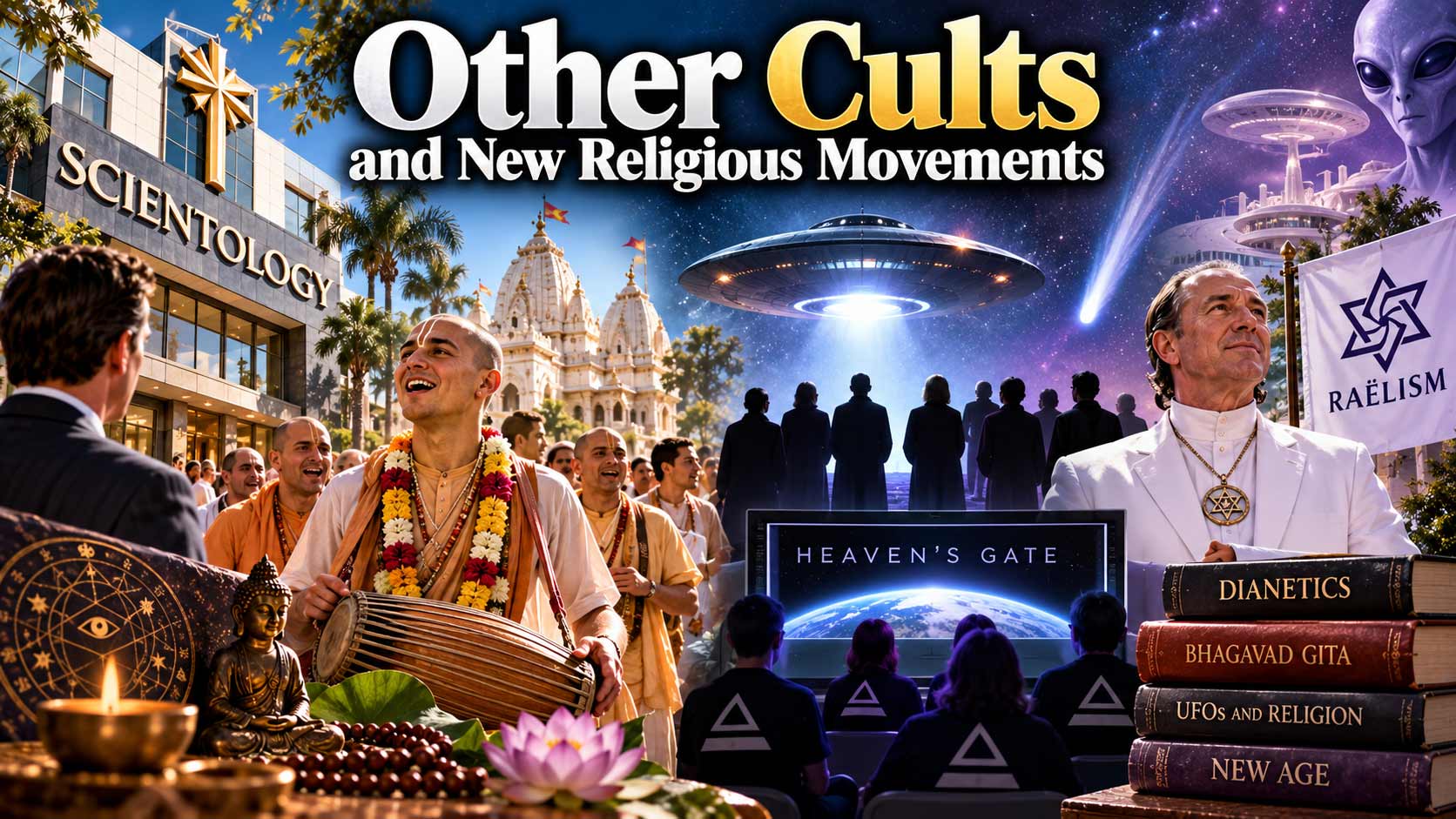
Not every group commonly called a cult has anything particularly Christian about it. Some developed from Eastern religions, some from occult or esoteric traditions, some from the ideas of a charismatic founder, and a few seem to have been assembled from pieces of several religions with science fiction thrown in for good measure. Putting all of them under the heading “Christian Cults” would tell us almost nothing about where they came from or what they actually believe.
That is why Jew & Greek separates Christian-derived cults from other cults and new religious movements. Jehovah’s Witnesses, Mormonism, and Christian Science arose within a Christian environment and make claims that can be compared directly with historic Christian doctrine. Scientology and Hare Krishna require a different approach. So do movements such as Heaven’s Gate, Raëlism, and various modern esoteric groups. They may occasionally borrow Christian language, but Christianity isn’t the theological foundation from which they developed.
The word cult still requires some care. Religious scholars often prefer terms such as new religious movement because cult has accumulated so many negative meanings that it can become more accusation than description. At the same time, the popular term hasn’t disappeared, and sometimes it points to genuine concerns involving authoritarian leadership, manipulation, isolation, exploitation, or extreme control over members. The sensible approach isn’t to pretend the word has no meaning, but to explain exactly what we mean when we use it.
What Is a Cult?
There are at least two different ways people use the word. The theological definition asks whether a movement arose from an established religion while substantially changing its essential beliefs. That’s the sense commonly used in Christian apologetics when Jehovah’s Witnesses or Mormonism are described as Christian cults.
The sociological definition asks different questions. How much authority does the leader possess? Can members disagree without serious consequences? Are relationships with outsiders discouraged? Is information controlled? Are members pressured financially, sexually, psychologically, or socially? What happens when someone tries to leave?
Those questions can apply to almost any religion, including Christianity. A church doesn’t become healthy simply because its statement of faith passes an orthodoxy test. A pastor who controls members’ marriages, finances, friendships, medical decisions, and access to family doesn’t become harmless because he can explain the Trinity correctly.
The reverse is also true. A religion can hold beliefs Christianity considers completely false without necessarily functioning as an abusive high-control group. We therefore shouldn’t use cult as though it automatically answers both theological and sociological questions. Sometimes both categories apply. Sometimes only one does.
Scientology
Scientology is probably the best-known American example of a new religious movement that doesn’t fit comfortably within traditional religious categories. It was founded by science-fiction writer L. Ron Hubbard, whose 1950 book Dianetics: The Modern Science of Mental Health introduced a system Hubbard claimed could address psychological problems by eliminating harmful mental impressions called engrams. Dianetics initially presented itself more as a system of mental improvement than a religion.
Scientology developed from those ideas during the 1950s. Its understanding of the human person eventually became explicitly spiritual. Human beings are essentially immortal spiritual entities called thetans who have lived through numerous previous existences. Through Scientology practices, individuals are supposed to overcome the limitations and accumulated problems that prevent them from realizing their spiritual abilities.
One of the movement’s central practices is auditing. During auditing, a person works with a trained auditor to examine experiences and reactions, traditionally with the assistance of an electronic device called an E-meter. Progress through Scientology involves increasingly advanced levels of training and auditing, with the state of Clear representing an important milestone and higher levels known as Operating Thetan levels extending beyond it.
Scientology has become almost as famous for its controversies as for its teachings. Former members, journalists, governments, and courts have raised allegations over the years involving aggressive treatment of critics, financial demands, treatment of defectors, and internal disciplinary practices. The Church of Scientology has disputed many accusations and has frequently responded vigorously to critics. Because claims surrounding the organization can be highly contested, individual allegations need to be examined on their evidence rather than repeated simply because Scientology has an unusual reputation.
From a Christian perspective, however, the basic theological difference isn’t difficult to identify. Scientology doesn’t begin with the biblical story of creation, sin, incarnation, atonement, and resurrection. Its understanding of humanity involves immortal thetans and past existences rather than creatures made by God who have fallen into sin and require reconciliation through Christ. Jesus can appear within Scientology-related discussion, but He doesn’t occupy anything resembling His position in historic Christianity.
Hare Krishna and ISKCON
The International Society for Krishna Consciousness, commonly known as the Hare Krishna movement or ISKCON, presents an entirely different case. It was founded in New York City in 1966 by A. C. Bhaktivedanta Swami Prabhupada, but the religion itself wasn’t something Prabhupada invented in Manhattan. ISKCON emerged from the much older Gaudiya Vaishnava tradition of Hinduism associated particularly with the sixteenth-century teacher Chaitanya Mahaprabhu.
That background matters. Describing Hare Krishna merely as a 1960s cult can give the false impression that someone created the theology at roughly the same time Americans discovered tie-dye shirts. Prabhupada brought an established Indian devotional tradition to the West and organized it in a form capable of spreading internationally.
Krishna occupies the center of the movement’s devotion. Followers understand Krishna as the Supreme Personality of Godhead and practice bhakti, or devotional service, directed toward Him. The famous Hare Krishna mantra — “Hare Krishna, Hare Krishna, Krishna Krishna, Hare Hare; Hare Rama, Hare Rama, Rama Rama, Hare Hare” — is chanted as a central spiritual practice. Public chanting made Hare Krishna devotees particularly visible in Western cities and airports during the movement’s rapid growth in the 1960s and 1970s.
ISKCON also teaches reincarnation and karma, accepts sacred writings such as the Bhagavad Gita, and follows devotional practices involving worship, vegetarianism, chanting, and disciplined spiritual life. These teachings place the movement squarely within a Hindu-derived religious framework rather than a Christian one.
ISKCON experienced serious internal problems after Prabhupada’s death in 1977, including leadership crises and scandals that damaged the movement’s reputation. Reforms followed, and contemporary ISKCON is considerably more complicated than the stereotype of young Americans with shaved heads handing out literature at airports. Whatever Christians think of its theology, it should be understood as a modern international expression of a much older Vaishnava religious tradition rather than simply as an eccentric American cult.
Heaven’s Gate
Heaven’s Gate represents a very different kind of new religious movement. It was founded by Marshall Applewhite and Bonnie Nettles during the 1970s and combined elements of Christianity, apocalypticism, New Age spirituality, and beliefs about extraterrestrial life.
Applewhite and Nettles taught that human beings could advance beyond their present level of existence into what they called the “Evolutionary Level Above Human.” Biblical language was reinterpreted within this framework. Jesus was understood in relation to beings from this higher evolutionary level, and salvation became connected with leaving ordinary human existence behind.
After Nettles died in 1985, Applewhite continued leading the group. Its worldview became increasingly separated from ordinary society, and members adopted a highly regimented communal lifestyle. The movement eventually connected the appearance of the Hale-Bopp comet with the belief that a spacecraft associated with the higher level was approaching.
In March 1997, thirty-nine members of Heaven’s Gate, including Applewhite, died by suicide in a house near San Diego. They believed that leaving their physical bodies would allow them to reach the spacecraft and advance to the next level of existence. The deaths made Heaven’s Gate one of the most recognizable examples of a destructive cult in modern American history.
The tragedy also demonstrates why the behavioral definition of cult sometimes becomes unavoidable. Heaven’s Gate wasn’t simply a collection of people holding unconventional religious opinions. Its beliefs, authority structure, isolation, and expectations eventually produced a situation in which followers surrendered their lives to the movement’s apocalyptic vision.
Raëlism
Raëlism demonstrates how modern religious movements can replace supernatural creation with extraterrestrial creation while retaining many of the functions traditionally associated with religion. The movement was founded in the 1970s by Claude Vorilhon, a Frenchman who adopted the name Raël.
Raël claimed to have encountered extraterrestrial beings called the Elohim. According to Raëlian teaching, these technologically advanced beings created life on Earth through genetic engineering. The biblical word Elohim, normally translated in relation to God, is therefore interpreted not as referring to the Creator God of Judaism and Christianity but to extraterrestrial scientists.
Within this system, figures such as Jesus, Moses, Buddha, and Muhammad can be understood as messengers associated with the Elohim. What traditional religions interpreted as miracles or divine interventions are reinterpreted through advanced technology. The movement consequently combines UFO beliefs, scientific-sounding explanations, sexuality, human immortality through technological development, and religious expectations concerning humanity’s creators.
From a Christian standpoint, the disagreement couldn’t be more basic. Christianity begins with an eternal God who created the universe. Raëlism begins with advanced beings inside the universe who engineered life on Earth. Calling both explanations “creation” doesn’t make them versions of the same idea.
UFO Religions and Modern Mythology
Raëlism and Heaven’s Gate belong to a broader phenomenon sometimes described as UFO religions. These movements are particularly interesting because they often take functions once filled by angels, gods, spirits, or heavenly beings and reinterpret them through the imagery of advanced extraterrestrial civilizations.
That shouldn’t be surprising. Religions don’t develop in cultural isolation. Ancient people described extraordinary beings using the conceptual world available to them, while people living after airplanes, rockets, nuclear weapons, and science fiction naturally possess a different imaginative vocabulary. For some modern movements, the visitor from heaven arrives in a spacecraft rather than on a cloud.
This doesn’t mean every person interested in UFOs belongs to a religion. Nor does believing extraterrestrial life may exist constitute a religious belief. The religious element appears when extraterrestrials become humanity’s creators, saviors, judges, spiritual guides, or the source of revelation explaining human destiny.
Christianity can evaluate those claims without pretending that the possibility of extraterrestrial life itself threatens Christian theology. The question isn’t whether life could exist elsewhere in God’s creation. The question is whether someone claiming contact with advanced beings has actually received a revelation that should replace what Christianity says about God, Christ, and humanity.
Charismatic Leaders
Many new religious movements begin around an unusually persuasive leader. That fact by itself proves very little. Christianity had influential leaders from the beginning, and virtually every religious movement can point to founders, missionaries, reformers, teachers, or saints who shaped its development.
The danger appears when the leader becomes functionally unaccountable. A founder may claim unique revelation unavailable to ordinary members, reinterpret failed predictions without consequences, demand unusual financial or personal sacrifices, regulate intimate relationships, or portray criticism as evidence of spiritual rebellion. Over time, loyalty to the movement can become inseparable from loyalty to the leader.
This dynamic helps explain why intelligent people can remain inside groups outsiders find incomprehensible. People usually don’t join something thinking, “I believe I’ll surrender control of my life to a cult today.” They form friendships, experience community, become persuaded by portions of the teaching, invest time and identity in the group, and gradually accept commitments they might have rejected at the beginning.
Understanding that process is more useful than assuming cult members are gullible. Intelligent people are perfectly capable of rationalizing beliefs when relationships, identity, hope, fear, and enormous personal investment are involved. That observation applies well beyond cults.
When a Movement Becomes Dangerous
Unusual beliefs aren’t enough to make a religious movement dangerous. People are entitled to believe strange things, and history provides no shortage of beliefs that one generation considered ridiculous and another considered respectable. Religious liberty necessarily includes liberty for religions most of us think are wrong.
Danger appears when authority becomes coercive. Members may be isolated from family, taught that outsiders are enemies, discouraged from accessing critical information, threatened with catastrophic spiritual consequences for leaving, pressured to surrender substantial assets, or subjected to sexual or psychological exploitation. In extreme cases, the leader’s authority can override the ordinary instinct for self-preservation.
Jonestown remains perhaps the most horrifying modern example, although the Peoples Temple began within a Christian setting and therefore doesn’t fit neatly into our non-Christian category. Jim Jones gradually transformed a church with Christian roots into an authoritarian community centered increasingly on himself. In 1978, more than 900 people died at the Peoples Temple settlement in Guyana. The event is commonly described as a mass suicide, but that description is incomplete because children were killed and some adults were coerced or forcibly poisoned.
Cases like Jonestown are reminders that categories can become messy. Religions evolve. A movement may begin with recognizable Christian beliefs and eventually move so far from them that its original identity becomes difficult to recognize. Taxonomy is useful, but human beings rarely organize themselves as neatly as website menus do.
Leaving a High-Control Group
Leaving a tightly controlled religious movement can be considerably harder than simply deciding that its doctrine is false. Former members may lose friends, family relationships, employment, housing, or the only community they have known. Someone raised inside a movement may have little social network outside it and may have been taught from childhood that leaving means spiritual destruction.
This is one reason ridicule is such a poor response. Mocking a person’s former beliefs can reinforce exactly what a controlling group may already have taught: outsiders are hostile, arrogant, and incapable of understanding us. A person questioning a movement may need accurate information, but he may also need patience and relationships that don’t depend on immediately winning an argument.
Christians engaged in apologetics should understand that distinction. Refuting a doctrine and helping a person leave a religious system aren’t necessarily the same task. Theology matters, but people aren’t collections of propositions waiting for somebody to correct them.
How Christians Should Approach New Religious Movements
Christianity doesn’t require pretending that contradictory religious claims are equally true. If Jesus is who historic Christianity says He is, then a system that replaces Him with Krishna, an extraterrestrial messenger, an enlightened spiritual teacher, or one figure among many can’t simultaneously be giving the same account of reality.
But disagreement doesn’t require caricature. Christians should be able to describe another religion accurately enough that an informed member of that religion recognizes what is being described. Only then does criticism become meaningful. Attacking a version of someone’s religion that he doesn’t actually believe may feel like apologetics, but mostly it demonstrates that we didn’t do our homework.
These movements are also worth studying because they expose enduring human desires. People want healing, certainty, community, transcendence, secret knowledge, contact with something greater than themselves, and assurance that history is going somewhere. Scientology, Hare Krishna, Heaven’s Gate, Raëlism, and hundreds of smaller movements offer radically different answers, but they’re often answering recognizable human questions.
Christianity claims that those questions ultimately lead not to hidden levels of spiritual advancement, extraterrestrial creators, secret knowledge, or the authority of a charismatic teacher, but to the God revealed in Jesus Christ. Understanding other religious movements doesn’t weaken that claim. It helps us understand what we’re actually comparing it with.