

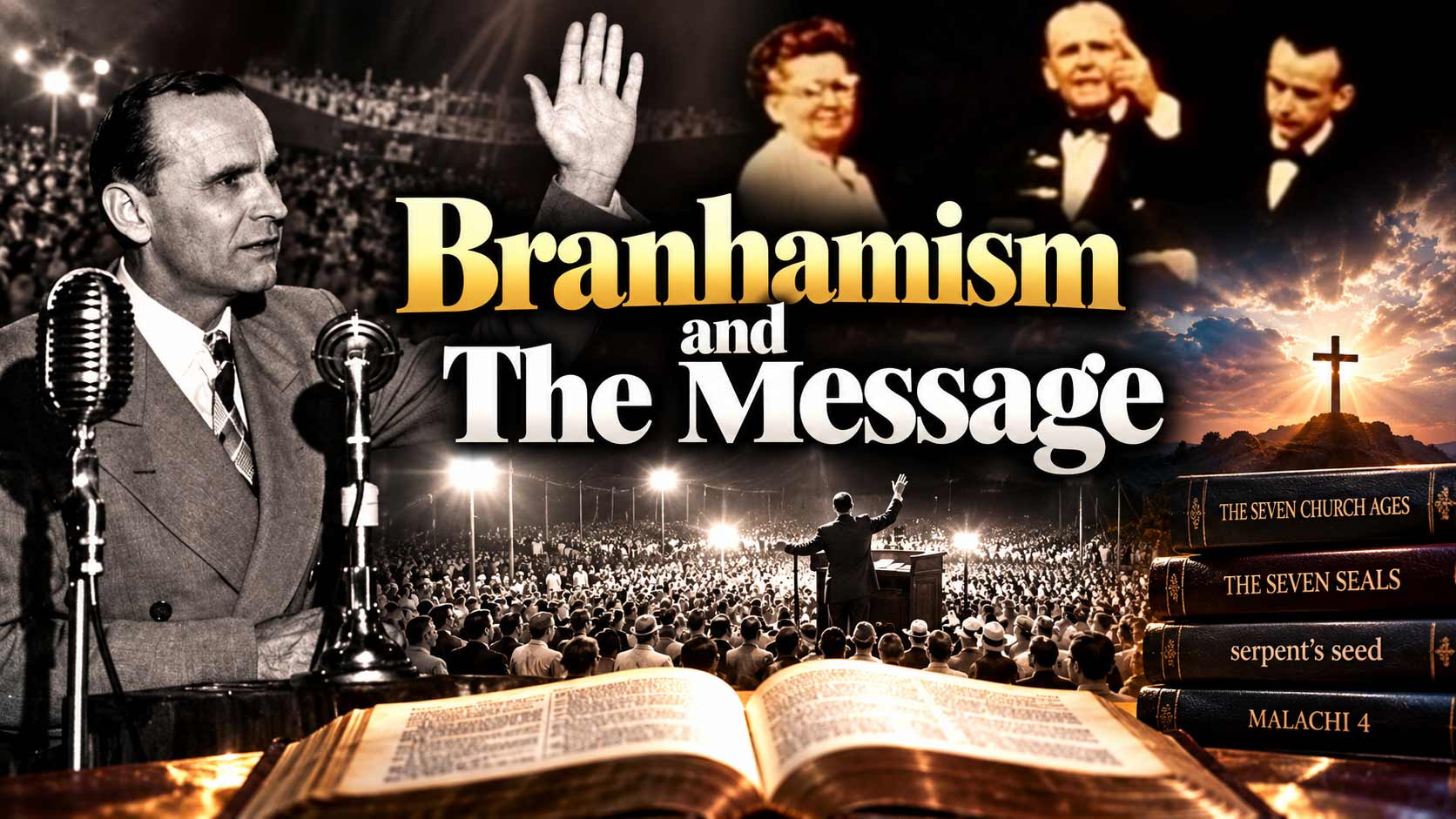
William Branham occupies an unusual place in Pentecostal history. To some Christians, he was one of the remarkable healing evangelists who helped launch the great postwar healing revival. To followers of what is commonly called The Message, he was considerably more than that. Branham was God’s prophet for the final church age, the messenger whose ministry fulfilled biblical prophecy and restored truths Christianity had lost before the return of Christ.
Those two ways of remembering Branham shouldn’t be confused. A Pentecostal who believes God healed people through Branham’s early ministry isn’t necessarily a Branhamite, and Branham wasn’t the only healing evangelist attracting enormous crowds during the late 1940s and 1950s. Oral Roberts, Jack Coe, A. A. Allen and others belonged to the same broad revival environment. Branhamism developed when Branham’s increasingly distinctive doctrines and prophetic claims became the foundation for a religious movement that continued after his death.
Followers generally speak of “The Message” rather than Branhamism, and many would object strongly to being called Branhamites. They regard themselves as Bible-believing Christians who have received the end-time Message God sent through His prophet. That distinction is worth respecting even while asking whether the movement’s claims can withstand biblical and historical examination.
William Branham
William Marrion Branham was born in Kentucky in 1909 and grew up in poverty in southern Indiana. His accounts of his childhood included unusual supernatural experiences that he later interpreted as indications that God had set him apart for a special ministry. By the 1930s he was preaching and pastoring, but his international reputation came later.
In 1946 Branham said that an angel appeared to him and commissioned him to take a gift of divine healing to the world. His healing campaigns soon attracted enormous crowds. Reports of healings, supernatural discernment, and Branham’s ability to reveal details about people for whom he prayed created a sensation.
Branham’s public ministry helped ignite the postwar healing revival that swept through American Pentecostalism. Gordon Lindsay became closely associated with his campaigns and eventually founded The Voice of Healing, an influential publication that promoted healing evangelists. Branham’s ministry also reached internationally, making him one of the best-known healing preachers of his generation.
His manner helped distinguish him from some of the flamboyant personalities who later became associated with healing evangelism. Branham could appear quiet, humble, and almost reluctant about the attention surrounding him. People who heard him preach often encountered a man who seemed considerably less polished than a conventional evangelist but intensely convinced that supernatural events were occurring around his ministry.
That combination proved powerful.
The Healing Ministry
Branham became particularly famous for what he described as supernatural signs accompanying his ministry. One involved a physical reaction in his hand that he said enabled him to detect disease. Another involved extraordinary knowledge about people standing before him, including illnesses and personal details he seemingly couldn’t have known naturally.
Followers regarded these manifestations as divine confirmation of Branham’s prophetic calling. Many testimonies circulated concerning people who claimed to have been healed through his ministry, and Branham’s reputation spread rapidly through Pentecostal networks.
Evaluating individual healing claims decades later is difficult. Some testimonies may have involved genuine recoveries, others may have been exaggerated in retelling, and some claims associated with Branham have been challenged when researchers attempted to document them. The historical importance of the healing ministry doesn’t depend upon proving or disproving every testimony. Thousands of people believed they were witnessing supernatural ministry, and that belief gave Branham extraordinary influence.
For charismatic Christians, this distinction is important. Rejecting Branhamism doesn’t require believing God stopped healing people after the apostolic age. Nor does accepting the possibility that Branham sometimes operated in genuine spiritual gifts require accepting everything he later taught. The New Testament itself requires prophecy and supernatural claims to be tested rather than treating supernatural phenomena as automatic confirmation of every doctrine taught by the person involved.
That’s particularly relevant in Branham’s case because the controversy eventually moved far beyond healing.
From Healing Evangelist to End-Time Prophet
During the 1950s and early 1960s, Branham increasingly emphasized doctrine and biblical prophecy. His sermons developed an elaborate understanding of church history, denominational Christianity, the Trinity, Genesis, Revelation, predestination, the end times, and his own role in God’s plan.
This shift cost him support among some Pentecostal leaders who had welcomed his healing ministry. Branham was moving outside the boundaries of ordinary Pentecostal disagreement and into teachings many of his former supporters regarded as serious doctrinal error.
Followers interpreted the development differently. Branham wasn’t wandering away from Christianity; he was progressing into the deeper purpose for which God had raised him up. The healings and supernatural signs had attracted people’s attention so they would eventually hear the Message.
That interpretation remains crucial within Branhamism. The healing ministry becomes evidence validating the later prophetic ministry. If God really sent an angel, revealed people’s secrets, healed the sick, and surrounded Branham’s ministry with supernatural signs, followers reason, then Christians should pay attention when the same man explains what God is doing at the end of the age.
The question is whether that conclusion necessarily follows.
The Seven Church Ages
One of Branham’s most important interpretive frameworks came from the seven churches addressed in Revelation 2–3. Rather than viewing Ephesus, Smyrna, Pergamum, Thyatira, Sardis, Philadelphia, and Laodicea simply as seven first-century congregations with broader spiritual applications, Branham understood them prophetically as representing seven successive periods of church history.
Each church age had a messenger. Branham associated figures such as Paul, Irenaeus, Martin of Tours, Columba, Martin Luther, and John Wesley with various stages in the development of the church.
The final period was the Laodicean Church Age.
Within The Message, Branham is identified as the messenger to that final age. This gives his ministry an importance far beyond that of a particularly gifted evangelist. He becomes part of the prophetic structure of church history itself.
The concept wasn’t entirely invented by Branham. Earlier dispensational interpreters had already connected Revelation’s seven churches with successive historical periods. Branham adopted and developed that framework, but the crucial addition was placing his own ministry at the culmination of the sequence.
Once that identification is accepted, listening to Branham becomes more than studying an interesting Pentecostal preacher. It becomes listening to the messenger God specifically sent to prepare the final church before Christ’s return.
Malachi 4 and Elijah
Another passage central to Branhamism is Malachi 4:5–6: “Behold, I will send you Elijah the prophet before the great and terrible day of Yahweh comes.”
The New Testament explicitly connects Elijah imagery with John the Baptist, who came “in the spirit and power of Elijah.” Branham taught, however, that the Malachi prophecy had an additional end-time fulfillment involving another Elijah ministry before the second coming of Christ.
His followers came to identify Branham with that role.
This interpretation became connected with the Laodicean messenger doctrine. Branham was the seventh church-age messenger and the Elijah-like prophet sent to restore the faith of God’s people before the end.
The restoration theme should sound familiar by now. Joseph Smith claimed that apostolic authority and lost truth had to be restored. Charles Taze Russell believed traditional Christianity had fallen into serious doctrinal corruption. Sun Myung Moon taught that Jesus’ mission required completion. The details differ enormously, but the recurring pattern is striking: Christianity has gone badly wrong, and God raises a uniquely authorized latter-day messenger to recover what everyone else lost.
A restoration claim isn’t automatically false. The Protestant Reformers themselves accused the medieval church of serious corruption. The question is what supposedly disappeared, how we know it disappeared, and why accepting a modern leader’s authority becomes necessary for recovering it.
The Message
Followers commonly refer to Branham’s body of teaching simply as The Message. Thousands of recorded sermons have been preserved, transcribed, translated, and distributed internationally. Modern technology has allowed a preacher who died in 1965 to continue speaking with remarkable immediacy to congregations around the world.
In some Message churches, recordings of Branham’s sermons occupy an extraordinary place in congregational life. His words are studied closely, compared across sermons, quoted extensively, and treated as the authoritative explanation of difficult biblical passages.
Followers will ordinarily insist that the Bible remains the supreme authority and that Branham merely directed people back to Scripture. That claim should be represented fairly. Most Message believers don’t think they have replaced the Bible with another holy book.
The practical question is more complicated. If Branham is God’s uniquely appointed end-time prophet and his interpretation provides the divinely authorized restoration of biblical truth, disagreement with Branham can become functionally indistinguishable from disagreement with God’s Message. The Bible remains on top of the bookshelf, but Branham increasingly determines how it must be read.
That is where the authority question becomes unavoidable.
The Serpent’s Seed
One of Branham’s best-known distinctive teachings concerns the Fall. He rejected the traditional interpretation that Genesis 3 describes Adam and Eve eating literal forbidden fruit and developed what became known as the serpent’s seed doctrine.
According to Branham, Eve’s sin involved a sexual relationship with the serpent. Cain was the offspring of that union, while Abel came through Adam. The serpent was understood as a creature much closer to humanity before God’s curse transformed it.
The teaching becomes part of a larger explanation for two spiritual lineages running through human history. Branham connected Cain’s lineage with corruption and unbelief, while the godly line continued through Adam’s descendants.
Sexual interpretations of the Fall existed before Branham, so the basic idea wasn’t entirely unprecedented. What matters for The Message is the authority with which the doctrine becomes part of Branham’s restored revelation.
Genesis itself identifies Adam as Cain’s father in the ordinary reading of the text: “Adam knew Eve his wife. She conceived, and gave birth to Cain.” Nothing in the passage says Eve had sexual relations with the serpent or that Cain was physically descended from it. The doctrine therefore requires an interpretive system considerably more elaborate than the text itself appears to provide.
Branham and the Trinity
Branham strongly rejected the traditional formulation of the Trinity. He frequently attacked the idea of “three persons” in the Godhead and regarded traditional Trinitarianism as a departure from biblical monotheism.
His own teaching doesn’t fit neatly into every standard theological category. Message believers may object when outsiders simply label Branham a conventional Oneness Pentecostal because his language and Christology developed distinctive features of their own. Nevertheless, Branham clearly rejected the historic Nicene understanding of Father, Son, and Holy Spirit as three distinct persons eternally sharing the one divine being.
He also rejected the traditional Trinitarian baptismal formula as commonly practiced and emphasized baptism in the name of the Lord Jesus Christ. In that respect his practice resembled Oneness Pentecostalism, although his overall doctrine shouldn’t simply be equated with every Oneness denomination.
For Jew & Greek, this is one of the reasons Branhamism belongs under Christian Cults rather than merely under Charismatic Christianity. Belief in healing and prophecy isn’t the dividing line. Neither is speaking in tongues, expecting miracles, or believing God can still call prophets.
The issue is what happens to historic Christian doctrine about God and Christ while a modern prophet simultaneously acquires extraordinary interpretive authority.
Denominations and the Mark of the Beast
Branham’s attitude toward denominations became increasingly severe. He believed denominational systems had imprisoned genuine Christianity within human organizations and creeds. God’s true Bride had to come out of those systems and return to the pure Word.
There is a legitimate criticism hiding somewhere inside that argument. Churches can become more committed to denominational traditions than Scripture, and religious institutions have an impressive ability to defend themselves. Protestants have been making that observation about one another for five hundred years.
Branham went considerably farther. He connected organized denominational religion with the end-time apostasy and eventually with the religious system associated with the mark of the beast. The Roman Catholic Church occupied a particularly negative role in his prophetic scheme, but Protestant denominations weren’t safely outside the problem. They were daughters of the same corrupt system when they organized themselves around creeds and denominational authority.
That creates a powerful boundary around Message believers. Leaving The Message for an ordinary Baptist, Pentecostal, Methodist, or other church isn’t simply changing congregations. It can be understood as returning to the denominational system from which God’s end-time Bride has been called out.
Theology and group identity reinforce one another very effectively at that point.
The Seven Seals
In March 1963, Branham preached a famous series of sermons on the Seven Seals of Revelation. Within The Message, these sermons hold enormous importance and are often treated as a climactic stage in Branham’s prophetic ministry.
Branham connected the opening of the seals with mysteries hidden in Scripture and revealed in the end time. Followers understood the sermons as a fulfillment of the promised restoration of truths concealed through the church ages.
The events surrounding 1963 also became associated with Branham’s account of supernatural experiences and a distinctive cloud photographed over Arizona. Message literature has frequently connected that cloud with Branham’s ministry and the opening of the seals.
The details have generated extensive debate, including questions about dates, locations, astronomical or atmospheric explanations, and whether later retellings correspond precisely to documented events. Those questions are worth examining separately because they involve historical claims that can, at least in principle, be checked.
But the theological significance is more important than the cloud itself. The Seven Seals sermons helped establish the idea that Branham wasn’t merely interpreting prophecy. He was participating in its fulfillment.
Predictions and Prophetic Claims
Branham made numerous statements concerning visions, predictions, and events he believed God had revealed to him. Followers point to examples they regard as remarkably accurate, while critics have documented cases they believe were mistaken, altered in later retellings, vague enough to permit flexible fulfillment, or never verified independently.
This creates one of the most important tests of Branham’s ministry. A healing testimony can be difficult to investigate decades later. A prophetic claim tied to a specific historical event can sometimes be examined much more directly.
Christians shouldn’t apply one standard to prophets they dislike and another to prophets they admire. If someone claims God revealed a future event, the claim deserves to be tested. If the prediction fails, explaining afterward that we misunderstood what the prophet meant shouldn’t automatically settle the matter.
Branham’s followers often interpret apparent discrepancies through the larger conviction that his ministry was divinely vindicated. Critics work in the opposite direction, interpreting disputed claims as evidence that the prophetic office itself was constructed around Branham after the fact.
That is why individual claims matter. If Branham’s authority rests partly on supernatural verification, supernatural claims aren’t decorative details in his biography. They are evidence offered in support of the central proposition.
Branham’s Death
William Branham’s ministry ended abruptly in December 1965. While traveling in Texas, the car in which he was riding was struck by another vehicle. Branham was severely injured and died several days later, on December 24. He was fifty-six.
His death created a crisis for followers who believed his ministry occupied a unique place in end-time prophecy. Some apparently hoped or expected that he might be raised from the dead, although the extent and nature of those expectations have sometimes been exaggerated in hostile retellings.
What unquestionably happened is more significant: the movement survived him.
Without Branham physically present to settle disputes, his recorded sermons became even more important. Followers could preserve his voice with unusual precision because hundreds of hours of preaching had been recorded. A movement centered on a prophet who had died therefore possessed something earlier prophetic movements rarely had: an enormous audio archive allowing the founder to continue addressing followers in his own voice.
That has helped make The Message unusually durable.
The Message After Branham
Branhamism never developed into a single denomination with one international headquarters controlling every congregation. Message churches are decentralized and can differ significantly from one another. Some are comparatively moderate, while others make extremely strong claims about Branham and enforce rigid standards concerning doctrine, dress, entertainment, marriage, gender roles, and separation from outside churches.
This diversity needs to be kept in mind. Not every person who appreciates Branham’s sermons believes every claim made by the most extreme Message congregation. Some followers resist language that appears to elevate Branham excessively and insist that worship belongs to Jesus Christ alone.
Other expressions have gone considerably farther. Branham’s words can become the decisive authority for interpreting Scripture, and some followers have attributed extraordinary titles or roles to him. Critics sometimes quote the most extreme examples as though every Message believer thinks identically, which doesn’t help anyone understand the movement.
The common denominator isn’t a single administrative organization. It is the conviction that William Branham’s ministry delivered God’s special end-time Message.
Message Churches Around the World
The Message didn’t remain an American phenomenon. Branham’s sermons have circulated extensively throughout Africa, Asia, Latin America, Europe, and other regions, often through missionary networks and translated recordings or transcripts.
The movement can flourish particularly well without expensive denominational infrastructure. A local preacher needs access to Branham’s sermons and a congregation convinced of his prophetic role. Recordings and digital distribution make those materials available almost anywhere.
This has created an unusual international religious network. Congregations may have no formal organizational relationship with one another yet recognize the same prophet, listen to the same sermons, use the same vocabulary, and interpret Scripture through the same theological framework.
In that sense, The Message behaves like a denomination while frequently rejecting denominationalism. Religious history has a sense of humor about these things.
Is The Message a Christian Cult?
Followers of The Message identify themselves as Christians. They believe the Bible is God’s Word, proclaim Jesus Christ as Savior, preach repentance and conversion, expect Christ’s return, and often live serious and morally disciplined Christian lives. Describing them as though they had abandoned Jesus for William Branham would be both inaccurate and unnecessarily insulting.
But the theological definition of a Christian cult isn’t determined by whether people are sincere or whether they use Christian language. Branhamism arose within Christianity and claims to restore authentic biblical faith while rejecting important elements of historic Christian doctrine and assigning extraordinary prophetic authority to a modern religious leader.
The authority issue is especially important. Branham isn’t merely remembered as a gifted preacher whose sermons are still worth hearing. Within The Message, his ministry is commonly placed inside an end-time prophetic structure involving the Laodicean church age, Malachi’s Elijah, the restoration of the Word, and preparation of Christ’s Bride.
That changes the nature of disagreement. If Branham was simply a preacher, Christians are free to conclude that he was right about some things and badly wrong about others. If he was God’s final church-age messenger, rejecting his Message can become rejecting what God specifically revealed for the last days.
Jew & Greek therefore places Branhamism and The Message under Christian Cults, while distinguishing it carefully from the larger Pentecostal and charismatic traditions from which Branham emerged. The problem isn’t believing that God heals, speaks prophetically, or gives supernatural gifts. Christians can debate those questions without coming anywhere near Branhamism.
The real question is whether God gave William Branham a unique prophetic authority through which the church must recover end-time truth. Branham’s healing ministry may explain why thousands of people were willing to consider that claim. It doesn’t settle whether the claim was true.
And that is ultimately where Branhamism has to be examined: not by asking whether remarkable things happened in William Branham’s meetings, but whether those remarkable things gave one twentieth-century preacher the authority to redefine Christian doctrine for the entire church.