

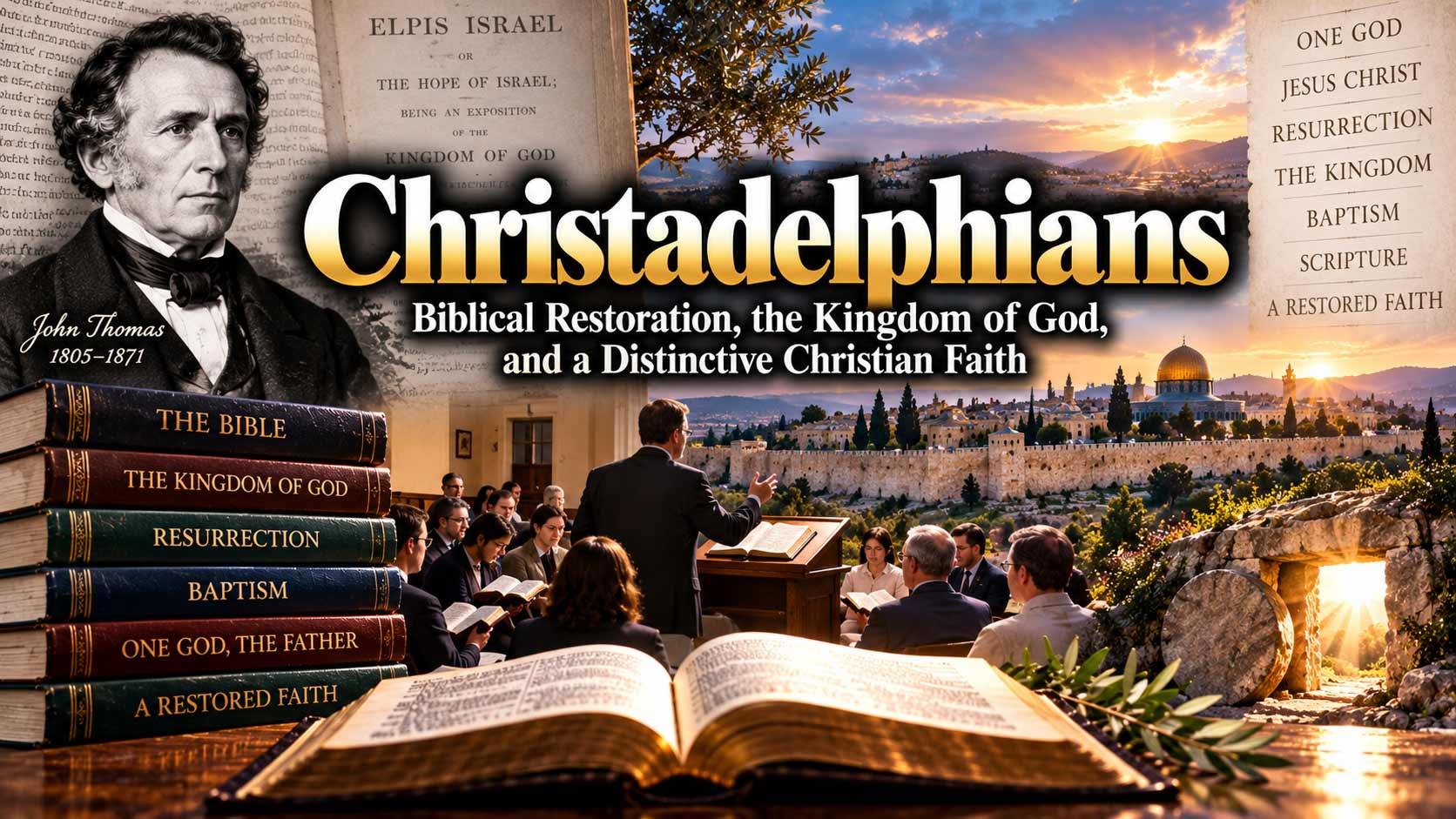
Christadelphians are one of those religious groups most Christians could probably walk past for years without realizing they’re there. They don’t send missionaries door to door on the scale of Jehovah’s Witnesses or Latter-day Saints, they aren’t built around a living prophet, and they haven’t produced the sort of spectacular scandal that guarantees a movement a documentary series. What they have done is quietly maintain a distinctive nineteenth-century restorationist form of Christianity for more than 150 years.
The name means essentially “brothers in Christ,” and Christadelphians see themselves as a community of serious Bible students who have recovered teachings obscured by centuries of traditional Christianity. They believe in one God, believe Jesus is the Son of God and Messiah, accept the Bible as God’s inspired revelation, practice baptism by immersion, celebrate communion, expect Jesus to return personally to the earth, and take Christian discipleship seriously. At first glance, quite a bit of that sounds comfortably evangelical.
Then come the differences. Christadelphians reject the Trinity, deny that Jesus existed personally before His conception, deny that the Holy Spirit is a distinct divine person, reject the immortal soul and eternal conscious torment, deny the existence of a personal supernatural devil, and teach that God’s kingdom will be established literally on earth with Jerusalem at its center. Those doctrines aren’t miscellaneous eccentricities added around the edges. Together they form a coherent alternative to historic Christianity.
John Thomas and the Search for Apostolic Christianity
The movement began with John Thomas, a British physician born in London in 1805. Thomas emigrated to the United States in 1832, and the voyage nearly ended his life before his American career had begun. His ship encountered a severe storm, and Thomas, fearing death, reportedly promised God that if he survived he would devote himself to discovering the truth about life, death, and the Bible.
After arriving in America, Thomas became associated with the Restoration Movement connected with Alexander Campbell. That makes Christadelphian history particularly interesting for Jew & Greek because we’ve already encountered the restorationist impulse in the Churches of Christ and Christian Churches. The original idea was attractive: instead of endlessly multiplying denominations and inherited creeds, Christians should return to the New Testament and recover apostolic Christianity.
Thomas took that principle considerably farther than Campbell wanted to go.
He became convinced that even the Restoration Movement retained doctrines inherited from post-biblical Christianity. Thomas questioned traditional teaching concerning human nature, baptism, resurrection, the kingdom of God, the Trinity, and other subjects. His disagreements with Campbell became increasingly serious, and the two eventually separated.
Thomas continued studying, lecturing, debating, traveling, and writing. His best-known book, Elpis Israel, published in 1849, laid out much of the prophetic and theological framework that would shape the developing movement.
Like several restorationist leaders of the nineteenth century, Thomas didn’t think he was inventing a new religion. He believed Christianity had drifted away from the Bible and needed to be recovered.
The difficulty with restoration movements is always deciding exactly when Christianity disappeared and who has successfully restored it.
Where the Name Came From
Thomas’s followers didn’t initially organize themselves under the name Christadelphian. The American Civil War forced the issue.
Members of the movement were conscientious objectors who believed Christians shouldn’t participate in warfare. When the United States introduced military conscription, they needed an identifiable religious name under which they could seek recognition as conscientious objectors.
Thomas adopted Christadelphian, constructed from Greek words conveying the idea of brothers or brethren in Christ. The name remained after the immediate legal need had passed.
Local Christadelphian congregations are commonly called ecclesias, using the Greek word normally translated as church or assembly in the New Testament. The terminology reflects the movement’s desire to distance itself from what it regards as accumulated ecclesiastical traditions.
There is no pope, denominational president, worldwide prophet, or centralized hierarchy governing Christadelphians. Local ecclesias are largely autonomous while maintaining fellowship with other ecclesias that share the same basic understanding of Scripture.
That decentralized structure is one reason Christadelphians don’t fit the popular image of a cult built around a controlling leader. If we’re going to use the word cult here, it needs to be the theological definition we’ve been using throughout this section.
The Bible and the Restoration of Truth
Christadelphians have an extremely high view of Scripture. They regard the Bible as God’s inspired revelation and reject the idea that another sacred book or modern prophet is needed to complete it.
This distinguishes them immediately from Mormonism and Branhamism. There is no Christadelphian equivalent of the Book of Mormon, and John Thomas isn’t supposed to function as an end-time prophet whose sermons carry divine authority.
Christadelphians would actually turn the accusation around. From their perspective, traditional Christianity is the system that departed from Scripture by importing philosophical ideas into biblical teaching. The Trinity, immortal soul, conscious existence after death, supernatural devil, and heaven as the destination of the righteous are among the doctrines they believe developed outside the original apostolic faith.
That makes Christadelphianism an unusually Bible-intensive movement. Members have historically placed great emphasis on systematic reading, personal study, lectures, Bible classes, and detailed examination of prophecy.
The disagreement with historic Christianity therefore isn’t Bible versus no Bible. It is a disagreement over how the Bible should be read and whether doctrines developed and clarified during the early centuries of Christianity faithfully express what Scripture teaches.
One God, the Father
Christadelphians are strongly monotheistic and identify the one true God specifically with the Father. They reject the Christian doctrine that the one God eternally exists as Father, Son, and Holy Spirit.
From the Christadelphian perspective, the Trinity unnecessarily complicates the straightforward biblical declaration that there is one God. Jesus prays to God, obeys God, is sent by God, sits at God’s right hand, and serves as mediator between God and humanity. Christadelphians argue that those statements make perfectly good sense if Jesus is God’s Son and become unnecessarily difficult if Jesus is simultaneously God Himself. They therefore reject the Nicene doctrine of Christ as eternally God the Son sharing the same divine nature as the Father.
Historic Christianity answers that the doctrine of the Trinity didn’t arise because Christians were bored with simple monotheism and decided it needed improvement. It developed because early Christians were trying to account simultaneously for Scripture’s insistence that there is one God and its extraordinary claims about the Father, Jesus Christ, and the Holy Spirit.
Christadelphians resolve that tension by denying the personal preexistence and full deity of Christ.
Jesus Christ
Christadelphians have a considerably higher view of Jesus than the phrase “they don’t believe Jesus is God” might suggest. Jesus is the uniquely begotten Son of God, born of the Virgin Mary through the power of the Holy Spirit. He lived without sin, died for humanity, was physically raised from the dead, ascended to heaven, now serves as mediator and high priest, and will return personally to establish God’s kingdom.
They don’t regard Jesus as an ordinary religious teacher who happened to understand God better than everyone else. But Jesus didn’t personally exist before His conception in Mary. Christadelphians interpret biblical passages concerning Christ’s preexistence in terms of God’s foreknowledge, purpose, or plan rather than the literal existence of a divine Son before Bethlehem.
That puts them outside historic Christian Christology. The Gospel of John doesn’t merely say that God had an idea about Jesus before creation; it speaks of the Word being with God and being God, followed by the Word becoming flesh. Paul similarly describes Christ in ways historic Christians understood as requiring a preexistent divine identity.
Christadelphians read those passages differently because their starting point is uncompromising identification of the one God with the Father alone.
This is one of the central theological reasons Jew & Greek places Christadelphians under Christian Cults rather than simply listing them as another Protestant denomination.
The Holy Spirit
Christadelphians also reject the historic Christian understanding of the Holy Spirit as a distinct divine person.
The Holy Spirit is understood primarily as God’s power, the means through which God acts in creation and accomplishes His purposes. The virgin conception of Jesus, biblical miracles, prophetic inspiration, and other supernatural events occur through this divine power.
Christadelphians therefore don’t deny the Holy Spirit. They deny that the Holy Spirit is someone distinct from the Father.
That distinction follows naturally from their rejection of the Trinity. If God is one person, the Father, then references to God’s Spirit are understood as references to God’s presence, energy, or power rather than another divine person within the Godhead.
Historic Christianity again sees the biblical evidence differently, particularly passages in which the Holy Spirit speaks, teaches, guides, can be grieved, distributes gifts, and acts with apparent personal agency.
The argument isn’t over whether the Holy Spirit exists. It is over who, or what, the Holy Spirit is.
Human Nature and the Immortal Soul
Christadelphians reject the widespread Christian idea that every human being possesses an inherently immortal soul that continues consciously after physical death. Human beings are mortal. When people die, they are genuinely dead and unconscious. They don’t immediately travel to heaven or hell as disembodied souls.
This teaching is sometimes called conditional immortality. Immortality isn’t something human beings naturally possess. It is something God grants to the redeemed.
Christadelphians point out that Genesis describes Adam as becoming a living soul rather than receiving an immortal soul as a separate spiritual component. They also emphasize biblical language describing death as sleep and resurrection as the believer’s hope.
On this particular issue, Christadelphians aren’t completely alone outside their own movement. Seventh-day Adventists and some evangelical Christians also reject the traditional doctrine of the naturally immortal soul, although their larger theological systems differ considerably from Christadelphianism.
For Christadelphians, however, this belief fits into a much larger framework. If the dead are unconscious, the Christian hope isn’t going to heaven immediately after death. It is resurrection when Jesus returns.
Heaven Isn’t the Destination
Ask many Christians what happens when a believer dies and the immediate answer will be, “They go to heaven.” Christadelphians think the question has already been framed incorrectly.
God’s promises to Abraham concern the earth. Israel’s prophets anticipate God’s reign over the nations. Jesus promises that the meek will inherit the earth. Revelation speaks of God’s people reigning upon the earth. Christadelphians therefore believe the biblical hope is resurrection and eternal life in God’s kingdom on a renewed earth.
Jesus will return physically and visibly. The dead who are responsible to judgment will be raised, and those found faithful will receive immortality and participate with Christ in His kingdom.
This produces one of the movement’s most distinctive emphases: the gospel includes the things concerning the Kingdom of God and the name of Jesus Christ.
Christadelphians believe much of Christianity has concentrated on sending souls to heaven while neglecting the Bible’s repeated promises concerning God’s kingdom on earth.
Whatever else one thinks of Christadelphian theology, that criticism can occasionally make Christians realize how little attention they themselves have paid to resurrection and the renewed creation.
Israel and the Kingdom of God
Christadelphian eschatology gives Israel an unusually prominent role.
They believe God’s covenant promises to Abraham and David haven’t been canceled. Jesus will return and establish God’s kingdom, understood as the restoration and fulfillment of the kingdom associated with David, with Jerusalem at its center.
The Jewish people therefore continue to have a place in God’s prophetic purpose. The church hasn’t simply replaced Israel in such a way that God’s promises to Abraham’s physical descendants become irrelevant.
This emphasis appeared long before the establishment of the modern State of Israel in 1948. Christadelphians anticipated a significant Jewish return to the land because of their reading of biblical prophecy, and twentieth-century developments naturally reinforced their confidence in that interpretation.
Their theology in this area bears some resemblance to later dispensationalism, but the systems shouldn’t be confused. Christadelphians developed their own prophetic framework and reject numerous doctrines associated with evangelical dispensationalism.
They also don’t teach that believers permanently leave the earth while God’s plan continues somewhere else. The earth is precisely where the biblical story is headed.
The Devil and Satan
Another striking Christadelphian doctrine concerns Satan and the devil. Christadelphians reject the existence of a supernatural fallen angel named Satan who leads other demonic beings in rebellion against God. They interpret biblical language concerning Satan and the devil primarily in terms of adversaries, sin, and the evil impulses of human nature.
The Hebrew word satan can indeed mean adversary, and Scripture sometimes uses it in ways that don’t refer to the devil as Christians ordinarily understand him. Christadelphians extend that observation into a broader interpretation of biblical passages traditionally understood as referring to a personal supernatural enemy.
The serpent in Genesis isn’t understood as Satan inhabiting or disguising himself as an animal. Human temptation arises from sinful desires rather than from a supernatural devil whispering suggestions from outside.
Historic Christianity sees passages such as Jesus’ temptation, Satan entering Judas, Satan demanding to sift Peter, and Revelation’s identification of the dragon with “the ancient serpent” as evidence that the biblical picture can’t be reduced simply to personified human evil.
Christadelphians disagree and regard the traditional devil as another doctrine Christianity acquired through misunderstanding Scripture.
One consequence is that Christadelphian theology places responsibility for sin squarely on human beings. “The devil made me do it” wasn’t going to get us very far anyway.
Hell and the Fate of the Wicked
Because Christadelphians reject the immortal soul, they also reject eternal conscious torment. The wicked don’t possess immortal souls that must remain alive forever somewhere. Death means death. Those rejected at judgment ultimately perish in what Scripture calls the second death. Hell passages are interpreted according to their biblical terminology and context rather than as descriptions of an eternal realm where immortal souls are consciously tortured forever.
Again, Christadelphians aren’t alone in rejecting eternal conscious torment. Annihilationism or conditional immortality has gained acceptance among some otherwise orthodox evangelical Christians as well.
The Christadelphian difference is cumulative. Rejecting eternal torment by itself doesn’t place someone outside historic Christianity. Rejecting the Trinity, the deity and personal preexistence of Christ, the personality of the Holy Spirit, the immortal soul, and the personal devil as part of a restored alternative Christianity creates a substantially different theological system.
The whole matters more than any one item on the list.
Baptism and Salvation
Christadelphians practice baptism by full immersion and regard it as necessary rather than optional. A person must understand and believe the gospel, repent, and be baptized into Christ. Infant baptism therefore doesn’t qualify because an infant can’t understand and personally believe the gospel.
Baptism joins the believer symbolically with Christ’s death and resurrection and brings the person into the covenant promises associated with Christ. It isn’t simply a public testimony that can be postponed indefinitely after conversion because someone hasn’t gotten around to scheduling it.
Christadelphians also place considerable emphasis on correct belief before baptism. Because the gospel includes specific truths concerning God, Jesus, resurrection, and the kingdom, accepting doctrines Christadelphians regard as false can become a barrier to genuine biblical baptism.
This is where their restorationism has practical consequences. If Christianity has fundamentally misunderstood the gospel, simply being a sincere Christian within traditional Christianity isn’t enough. The truth must be understood, believed, and obeyed.
The Breaking of Bread
Christadelphian ecclesias ordinarily gather each week for what they call the Breaking of Bread, their observance of the Lord’s Supper. Bread and wine commemorate the death and resurrection of Jesus and reinforce the fellowship shared by baptized believers. Depending upon the ecclesia and fellowship, participation may be limited to people recognized as sharing Christadelphian faith and baptism.
Services also commonly involve Bible readings, hymns, prayers, exhortation, and study. Christadelphians don’t have a professional priesthood standing between ordinary believers and God. Leadership is generally provided by members of the ecclesia, with responsibilities distributed among various brothers and committees. Historically, male leadership has predominated, although practices concerning women’s roles can vary.
The overall atmosphere is much closer to a serious Bible fellowship than to the popular stereotype of a strange religious sect. That’s one reason people can encounter Christadelphians and initially wonder why anyone would classify them outside ordinary Christianity.
The answer comes from doctrine rather than appearance.
Military Service and Politics
Christadelphians have historically practiced conscientious objection to military service. Their refusal to fight was important enough that it contributed to the adoption of the Christadelphian name during the American Civil War.
The reasoning follows from Jesus’ teachings concerning love of enemies and from the conviction that Christians ultimately belong to the coming Kingdom of God rather than the political kingdoms of the present age.
Many Christadelphians have therefore also maintained a degree of separation from partisan politics and other forms of political involvement. Practices can vary, but the traditional ideal emphasizes allegiance to Christ’s kingdom rather than attempting to transform the present world through political power.
This has occasionally put Christadelphians in difficult positions during wartime, especially where governments required military participation.
Whatever theological disagreements one has with them, conscientious objection carries considerably more weight when someone maintains it while the government is handing out draft notices rather than when discussing pacifism over coffee.
No Central Headquarters
Christadelphians are organizationally unusual because there is no worldwide central authority governing the movement.
Local ecclesias govern themselves while associating with other ecclesias through shared doctrine and fellowship. Various organizations coordinate missionary activity, publications, Bible schools, charitable work, and other projects, but they don’t function as a universal denominational government.
Over time, disagreements have produced different Christadelphian fellowships, particularly concerning questions of doctrine, fellowship, resurrectional responsibility, and the precise boundaries of acceptable belief. The largest worldwide body is commonly associated with the Central Fellowship, while smaller fellowships and independent ecclesias also exist.
The movement’s decentralized structure can make exact membership numbers difficult to establish and can also produce some variation in practice. What holds Christadelphians together isn’t obedience to an international leader. It is a shared interpretation of Scripture.
That makes Christadelphianism particularly useful for understanding why cult can’t always mean “organization controlled by a charismatic dictator.” There isn’t one.
Are Christadelphians Christians?
Christadelphians unquestionably consider themselves Christians. They worship the God of the Bible, confess Jesus as God’s Son and Messiah, believe He was born of a virgin, affirm His sinless life, death and bodily resurrection, expect His return, practice baptism and communion, and devote extraordinary attention to Scripture.
This makes them considerably closer to historic Christianity than movements that introduce entirely new scriptures, reincarnation, extraterrestrial creators, or a replacement messiah.
The dividing line is nevertheless substantial. Historic Christianity has regarded the identity of Jesus and the nature of God as foundational rather than optional. The Nicene confession that Jesus is truly divine wasn’t developed as an interesting theological accessory. It emerged from the conviction that the New Testament identifies Jesus in ways that can’t be explained adequately by calling Him merely a uniquely begotten human Son.
Christadelphians consciously reject that conclusion. Their own materials explicitly reject God as three persons, the co-eternity of the Son with the Father, the personality of the Holy Spirit, the immortal soul, eternal torment, heaven as the destination of the righteous, and a supernatural devil.
For that reason, Jew & Greek places Christadelphians under Christian Cults, using the term in its theological rather than sociological sense. Christadelphians aren’t being accused of belonging to a secretive organization controlled by John Thomas from beyond the grave. Their congregations are decentralized, their Bible is the same Bible used by other Christians, and their teachings are openly available for anyone to examine.
The real disagreement is much more straightforward. Christadelphians believe they recovered biblical Christianity after traditional Christianity became corrupted by doctrines such as the Trinity and the immortal soul. Historic Christianity responds that in rejecting those traditions, Christadelphians didn’t simply remove later additions. On the central question of who Jesus is, they removed something the earliest Christians were already struggling to express long before anyone had heard of John Thomas.
Restoration is only restoration if what you recover was actually there in the beginning.