

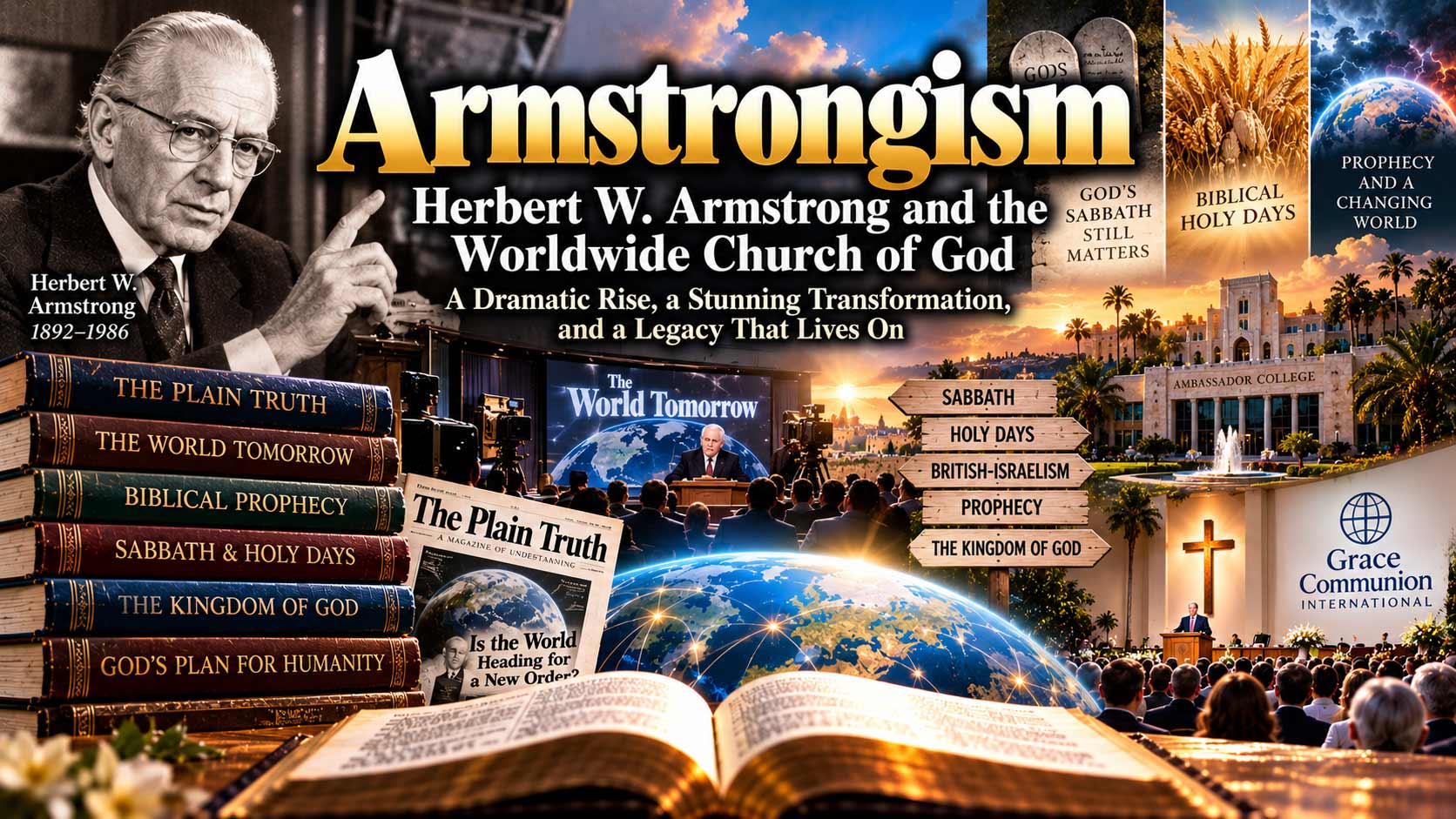
Few religious movements have experienced a reversal quite like the Worldwide Church of God. Under Herbert W. Armstrong, the church taught that most of traditional Christianity had lost essential biblical truth. It rejected the Trinity, worshiped on Saturday rather than Sunday, observed Old Testament festivals instead of Christmas and Easter, taught British-Israelism, emphasized end-times prophecy, and proclaimed the coming Kingdom of God through one of the most sophisticated religious media operations of the twentieth century. Then Armstrong died, his successors began reconsidering his doctrines, and within about a decade the denomination was teaching many of the very things Armstrong had spent his life opposing.
That makes Armstrongism slightly different from most of the movements in our Christian Cults section. The original Worldwide Church of God no longer teaches Armstrongism. The denomination eventually became Grace Communion International and entered mainstream evangelical Christianity, while numerous breakaway churches continued various forms of Armstrong’s theology. To understand Armstrongism today, we therefore have to follow both stories: the movement Armstrong created and the remarkable transformation that followed his death.
Herbert W. Armstrong
Herbert W. Armstrong was born in Des Moines, Iowa, in 1892. He didn’t begin his career as a preacher or theologian but worked in advertising and business, an experience that would later prove extremely useful. Armstrong understood presentation, publishing, marketing, and the emerging power of mass media considerably better than the average minister of his generation.
His religious direction changed during the 1920s after his wife, Loma, became convinced that Christians should observe the seventh-day Sabbath. Armstrong initially set out to prove her wrong, which turned into a considerably longer project than he expected. Intensive Bible study convinced him that Saturday was indeed the biblical Sabbath and that conventional Christianity had departed from Scripture on this and many other subjects.
Armstrong became associated with the Church of God (Seventh Day) and was ordained to the ministry in 1931. He eventually separated from that church as his own doctrinal system developed, particularly his emphasis on biblical festivals and his understanding of prophecy. Like many restorationist leaders, Armstrong came to believe that the Christianity surrounding him wasn’t merely mistaken on a few secondary issues. Much of the truth once possessed by the apostolic church had been lost and needed to be restored.
That conviction became the foundation of his life’s work.
From Radio to a Worldwide Church
Armstrong began broadcasting a radio program in Oregon in 1934. Originally called the Radio Church of God, it eventually became The World Tomorrow, a program that carried Armstrong’s voice far beyond the small congregation he could reach personally. That same year he began publishing The Plain Truth, a magazine combining biblical teaching, world affairs, and prophetic interpretation.
The combination was remarkably effective. Armstrong didn’t simply preach sermons over the radio; he built an integrated media ministry in which broadcasts offered literature, literature promoted additional teaching, and readers and listeners could study Armstrong’s interpretation of world events and Scripture at home. By the time television became dominant, The World Tomorrow had moved there as well.
The church incorporated as the Radio Church of God and changed its name to the Worldwide Church of God in 1968, a name better suited to what Armstrong believed had become a global work. Headquarters moved to Pasadena, California, where the church developed Ambassador College, a substantial publishing operation, television facilities, and an impressive campus.
Armstrong’s advertising background hadn’t gone to waste. Long before churches discovered websites, streaming video, and social media, he understood that a religious movement could enter millions of homes without waiting for people to walk into a church.
Restoring the Original Christianity
Armstrong taught that the Christianity practiced by most churches was a mixture of biblical truth and ideas inherited from pagan religion and later church tradition. Sunday worship, Christmas, Easter, the Trinity, the immortal soul, and the popular picture of heaven and hell all came under criticism.
He believed God’s true church had continued through history as a relatively small and often persecuted body rather than through the large institutions normally associated with Christian history. The Worldwide Church of God represented a restoration and continuation of that faithful church.
This restorationist framework explains why Armstrong’s teachings formed such an interconnected system. If historic Christianity had fundamentally departed from apostolic teaching, simply correcting one doctrine wouldn’t be enough. The calendar, worship, human nature, salvation, prophecy, Israel, church authority, and even diet needed to be reconsidered from Scripture.
Members consequently developed a strong sense of being different from the surrounding Christian world. They weren’t simply Baptists who happened to attend church on Saturday. They believed they had been called into a restored understanding of God’s plan that conventional Christianity had largely missed.
The Sabbath and Holy Days
One of the most visible features of Armstrongism was observance of the seventh-day Sabbath, from Friday sunset until Saturday sunset. Armstrong believed the Sabbath was established by God and never abolished for Christians. The widespread Christian practice of Sunday worship represented a later departure from biblical teaching.
Armstrong extended the same reasoning to the annual festivals described in Leviticus 23. Members observed Passover, the Days of Unleavened Bread, Pentecost, the Feast of Trumpets, the Day of Atonement, the Feast of Tabernacles, and the Last Great Day. These weren’t treated simply as Jewish historical observances. Armstrong believed they formed a prophetic outline of God’s plan of salvation.
Passover pointed to Christ’s sacrifice, Unleavened Bread to putting sin out of one’s life, Pentecost to the church and the Holy Spirit, Trumpets to Christ’s return, Atonement to the removal of Satan, Tabernacles to Christ’s millennial reign, and the Last Great Day to God’s future purpose for those who had never genuinely received an opportunity for salvation.
The Feast of Tabernacles became particularly important in Worldwide Church of God life. Families traveled to designated festival sites and spent more than a week worshiping, hearing sermons, and enjoying fellowship. For members, the annual calendar created a rhythm of religious life very different from the Christmas-and-Easter calendar of surrounding Christianity.
Christmas, Easter, and Paganism
Armstrong taught that Christians shouldn’t celebrate Christmas or Easter because neither observance was commanded in Scripture and both incorporated customs he associated with pre-Christian pagan religion. Birthdays were also generally rejected.
The church’s criticism went beyond arguing that December 25 probably wasn’t Jesus’ actual birthday. Armstrong believed adopting religious customs from paganism was itself contrary to biblical worship. Calling a practice Christian didn’t sanctify something God had never commanded.
This concern with pagan influence extended into numerous areas of church life. The cross was generally rejected as a Christian symbol, and traditional religious artwork and customs could be viewed suspiciously because of their historical associations.
Some of Armstrong’s historical arguments about pagan origins were much stronger than others. The broader point, however, was consistent with his restorationist approach: Christianity should be determined by Scripture rather than by what Christians had gradually become accustomed to doing.
If that meant being the only house on the block without Christmas lights, Armstrongism wasn’t particularly worried about fitting in.
God and the Trinity
The most important theological issue separating Armstrongism from historic Christianity concerned the nature of God. Armstrong rejected the Trinity, but he didn’t simply teach that God is one person and Jesus is merely human.
Armstrong taught that God is a divine family. The Father is God, and Jesus Christ is God. Christ existed before His human birth as the Word and participated in creation. The Holy Spirit, however, isn’t a third divine person but the power and presence of God.
This means Armstrongism shouldn’t be confused with Christadelphianism or Jehovah’s Witness theology. Armstrong affirmed the personal preexistence and deity of Christ in a way those systems don’t. His disagreement with historic Christianity centered on the Trinity and on his understanding of God’s family.
That family concept becomes especially important when we turn to salvation, because Armstrong believed God’s purpose for human beings was far more extraordinary than merely allowing them to live forever.
Born into the Family of God
Armstrong taught that human beings were created with the potential ultimately to become members of the God Family. Christians who receive God’s Spirit are spiritually begotten during this life but aren’t yet fully “born again.” The new birth reaches its fulfillment at the resurrection, when believers become immortal spirit beings.
This teaching was one of Armstrongism’s most controversial doctrines because critics heard it as the claim that human beings would become gods. Armstrong did indeed use remarkably strong language about the destiny of redeemed humanity, although he maintained that the Father and Christ would always remain supreme and that redeemed human beings would never replace them.
The idea was tied to Armstrong’s understanding of human purpose. God wasn’t merely rescuing people from punishment. He was reproducing His character within them and preparing them for membership in His divine family and rulership in the coming Kingdom.
Historic Christianity has its own doctrine of participation in divine life, especially in the Eastern Christian doctrine of theosis, but it maintains an absolute distinction between the uncreated God and created human beings. Armstrong’s formulation went beyond that distinction in ways most Christian theologians regarded as incompatible with orthodox teaching.
The Holy Spirit
Armstrong taught that the Holy Spirit is God’s divine power, mind, and presence rather than a distinct divine person. Receiving the Holy Spirit begins the process through which God’s character is developed within the believer.
This understanding allowed Armstrong to speak constantly about the Holy Spirit while continuing to reject the Trinity. The Spirit was real and active but wasn’t someone alongside the Father and Son.
Historic Christianity sees the biblical descriptions of the Spirit as requiring more than an impersonal power. The Spirit speaks, teaches, guides, distributes gifts, can be grieved, and acts with personal agency throughout the New Testament. Armstrong interpreted those passages within his larger understanding of the God Family. Father and Son were divine persons; the Holy Spirit was the power through which they acted.
The Gospel of the Kingdom
Armstrong repeatedly argued that traditional Christianity had misunderstood the gospel itself. Jesus came preaching the gospel of the Kingdom of God, but churches had replaced that message with a gospel primarily about the person of Jesus.
Armstrong certainly believed Jesus’ death and resurrection were essential. His complaint was that Christianity had concentrated on Christ as Savior while neglecting the message Christ preached about a literal kingdom that would rule the earth.
In Armstrong’s teaching, Jesus will return visibly, overthrow human systems of government, establish God’s rule over the nations, and reign for a thousand years. Resurrected believers will share in that government under Christ.
This emphasis explains the title The World Tomorrow. Armstrong’s message wasn’t simply that individuals could be saved. The present political, economic, and religious order was temporary, and an entirely different government was coming. That gave world news an enormous role in Armstrong’s ministry.
Prophecy and The Plain Truth
Armstrong interpreted international events through biblical prophecy, particularly Daniel, Revelation, and the prophetic books of the Old Testament. European political developments, the Middle East, Israel, Britain, the United States, war, economic instability, and the possibility of global catastrophe all became part of the prophetic picture.
This made The Plain Truth unusual among religious magazines. A reader might encounter an article about international economics beside an explanation of Revelation or a warning about the decline of Western civilization. Armstrong’s message was that the two belonged together because contemporary events were moving toward the prophetic climax described in Scripture.
Specific prophetic expectations didn’t always develop as Armstrong anticipated, and critics have pointed to failed or revised predictions throughout the movement’s history. The church’s literature sometimes conveyed a degree of urgency about particular periods that later required reinterpretation when events didn’t unfold as expected.
Yet prophecy was extraordinarily effective in building the movement because it made the Bible feel immediately connected to the newspaper. Members weren’t simply studying ancient predictions. They believed they were watching those predictions move toward fulfillment.
British-Israelism
One of Armstrong’s most distinctive teachings was British-Israelism, sometimes called Anglo-Israelism. Armstrong taught that many of the peoples of northwestern Europe descended from the so-called lost ten tribes of Israel and that the British and American peoples inherited important promises given to biblical Israel.
This allowed biblical prophecies addressed to Israel to be applied directly to modern nations such as Britain and the United States. Their extraordinary material prosperity could be interpreted as fulfillment of promises made to Abraham’s descendants, while warnings of national judgment could be applied to their contemporary moral decline.
Armstrong didn’t invent British-Israelism; versions of the theory circulated in Britain and America before his ministry. He incorporated it into a much larger prophetic system and gave it enormous exposure through The Plain Truth and church literature.
The theory lacks credible historical, archaeological, and genetic support, and the Worldwide Church of God eventually rejected it after Armstrong’s death. Several Armstrong-derived groups, however, continued to teach some version of the idea.
Human Nature, Death, and Hell
Armstrong rejected the doctrine that human beings possess an inherently immortal soul. People are mortal, and immortality is a gift God grants through resurrection.
The dead are therefore unconscious rather than immediately living in heaven or hell. Armstrong also rejected the idea that God eternally tortures immortal souls in a fiery hell. Those who are finally lost are destroyed rather than kept alive forever for the purpose of punishment.
This places Armstrongism within the conditionalist tradition on human immortality. As we’ve already seen with Christadelphians and Seventh-day Adventists, that doctrine by itself doesn’t define a movement as a Christian cult. Christians who otherwise affirm historic orthodoxy can and do argue for conditional immortality from Scripture.
Armstrong combined it, however, with his rejection of the Trinity, distinctive understanding of the God Family, Old Testament observances, prophetic system, British-Israelism, and restorationist claims. Once again, the theological system has to be evaluated as a whole rather than by taking one unusual doctrine at a time.
The Resurrections and Those Who Never Had a Chance
Armstrong’s teaching about judgment included an idea many people found surprisingly hopeful. He didn’t believe the billions of people who lived and died without genuinely understanding the gospel were automatically condemned.
His interpretation of Revelation and Ezekiel included multiple resurrections. Those called by God during the present age have a particular responsibility and opportunity now. Others will be raised in a future resurrection and receive a genuine opportunity to understand God’s truth.
This allowed Armstrong to reject both universalism and the idea that someone born in a place where Christianity was virtually unknown was necessarily consigned to eternal punishment for failing to accept a gospel he never understood.
The teaching fit naturally with the annual Holy Days, especially the Last Great Day, which Armstrong interpreted as representing this future opportunity for salvation.
Whatever one thinks of the interpretation, it addressed a question Christians have wrestled with for centuries: what does a just God do with people who never meaningfully encountered the gospel?
Tithing, Diet, and Daily Life
Armstrongism regulated everyday religious life more extensively than most evangelical churches. Members practiced tithing, and the Worldwide Church of God historically taught a system involving more than one tithe for different purposes. One supported the church’s work, another helped members finance attendance at annual festivals, and provisions associated with a third tithe supported people in need during particular years.
Members also followed biblical dietary restrictions, avoiding pork, shellfish, and other foods classified as unclean in Leviticus. These practices weren’t treated as Jewish ethnic customs but as continuing principles revealed by God for human benefit.
Sabbath observance affected employment and weekly schedules, while the annual festivals could require travel and time away from work or school. Christmas, Easter, and birthdays separated members from common social customs. Armstrongism therefore wasn’t simply a collection of unusual ideas discussed at church; it created a distinct way of life.
For many members, that distinctiveness reinforced the conviction that they belonged to God’s called-out people. For critics and former members, it could also make leaving the church socially and psychologically difficult because so much of ordinary life had been organized around the movement.
Church Government and Armstrong’s Authority
The Worldwide Church of God under Armstrong was strongly hierarchical. Armstrong taught what was often described as government from the top down, with authority flowing from God through Christ and through appointed church leadership.
Armstrong served as Pastor General and exercised extraordinary influence over doctrine, administration, ministers, institutions, and the overall direction of the church. Ministers in turn exercised significant authority within congregations.
Supporters regarded this structure as biblical government rather than democratic religion. Critics described the system as authoritarian and argued that members could be subjected to excessive ministerial control over personal decisions.
The movement’s centralized structure becomes especially important when we reach the years after Armstrong’s death. A system designed to transmit authority downward made it possible for Armstrong to build an unusually unified church. Ironically, it also gave his successors enough institutional authority to dismantle much of Armstrongism from the same headquarters.
Ambassador College and a Global Work
Armstrong founded Ambassador College in Pasadena in 1947 to educate members and train ministers. Additional campuses later operated in Texas and England. The Pasadena campus became closely identified with the church and with Armstrong’s vision of cultural refinement, education, and excellence.
Armstrong also cultivated relationships with political leaders and international figures, presenting himself increasingly as an unofficial ambassador for world peace. The church supported humanitarian projects, and Armstrong traveled extensively meeting heads of state and other prominent people.
Meanwhile, the media ministry continued reaching an enormous audience. The Plain Truth circulated internationally, The World Tomorrow appeared on radio and television, and the church offered books and booklets without charge.
By the time Armstrong died, the Worldwide Church of God had grown from a tiny radio ministry into an international denomination with well over 100,000 people attending services. Its influence was considerably larger than its membership because millions encountered Armstrong through broadcasting and publishing.
Then everything changed.
Armstrong Dies and Joseph Tkach Takes Over
Herbert W. Armstrong died in January 1986 at the age of 93. He had designated Joseph W. Tkach as his successor.
At first, the changes under Tkach appeared relatively modest. Some restrictions involving cosmetics, medical treatment, and other practices were relaxed. Certain prophetic claims and historical arguments were reconsidered, and some Armstrong literature was withdrawn or revised.
But the process didn’t stop there. Church leaders increasingly concluded that several of Armstrong’s foundational teachings couldn’t be supported adequately from Scripture. Once they began reconsidering one doctrine, other doctrines connected to it also came under examination.
By the early 1990s, the Worldwide Church of God was moving toward doctrines Armstrong had explicitly rejected. The church accepted the divinity and personality of the Holy Spirit and, in 1993, accepted the Trinity. It abandoned its opposition to the cross as a Christian symbol and acknowledged that genuine Christians existed outside the Worldwide Church of God.
For longtime members, this wasn’t a minor denominational adjustment. Their church was reversing the theological reason it believed it existed.
The Christmas Eve Sermon
The decisive moment came in late 1994 when Joseph Tkach delivered what became known as the Christmas Eve sermon. He explained that Christians weren’t required to keep Old Covenant laws such as the seventh-day Sabbath, annual festivals, dietary restrictions, and the church’s distinctive tithing system as conditions of Christian faithfulness.
This struck directly at the identity of the Worldwide Church of God. The Sabbath wasn’t merely one practice among many; Armstrong’s own journey had begun with the Sabbath, and Sabbath observance separated the church visibly from conventional Christianity.
The theological transformation accelerated. The church rejected British-Israelism, permitted Christmas and Easter observance, emphasized salvation by grace through faith, and increasingly identified itself with evangelical Christianity. Thousands of members couldn’t accept the changes. From their perspective, the leadership had abandoned truths God restored through Herbert Armstrong. From the leadership’s perspective, the church was finally abandoning errors Armstrong had sincerely but incorrectly taught.
It is difficult to think of another major American religious body that intentionally dismantled so much of its founder’s theological system while continuing as the same legal denomination.
The Armstrong Movement Splinters
The doctrinal transformation produced numerous breakaway churches committed to preserving some or most of Armstrong’s teachings.
The Philadelphia Church of God, founded by Gerald Flurry in 1989, became one of the early Armstrongist groups and explicitly presents itself as continuing Armstrong’s work and legacy. The Global Church of God, founded by former Worldwide Church of God evangelist Roderick C. Meredith, emerged in the 1990s; subsequent divisions eventually produced the Living Church of God.
The largest organizational break occurred in 1995 with the formation of the United Church of God, an International Association. Ministers and members who rejected the Worldwide Church of God’s doctrinal transformation organized a new church that retained the seventh-day Sabbath, biblical Holy Days, dietary laws, the coming Kingdom of God, and other teachings associated with Armstrong’s tradition. United Church of God itself acknowledges its historical connection to the Worldwide Church of God while grounding its beliefs in Scripture rather than claiming Armstrong as an infallible authority.
Additional groups include the Church of God, a Worldwide Association and numerous smaller organizations and independent congregations. Disagreements about doctrine, leadership, church government, and who most faithfully preserved Armstrong’s legacy have produced a family tree complicated enough to keep anyone interested in denominational charts occupied for quite a while.
For our purposes, the important point is that Armstrongism survived even though Armstrong’s own denomination stopped teaching it.
Worldwide Church of God Becomes Grace Communion International
The original organization continued its transformation after Joseph Tkach Sr. died in 1995. His son, Joseph Tkach Jr., became president and continued moving the denomination into evangelical Christianity.
The church eventually affirmed the Trinity, the full deity of Christ and personality of the Holy Spirit, salvation by grace through faith, and other doctrines associated with historic evangelical Christianity. It joined the National Association of Evangelicals and developed relationships with Christians who had once regarded the Worldwide Church of God as a cult.
In 2009, the denomination changed its name from the Worldwide Church of God to Grace Communion International. The new name reflected just how far the organization had traveled from its former identity. Grace Communion International today explicitly acknowledges that Armstrong taught doctrines outside Christian orthodoxy and describes its subsequent history as a theological transformation.
That means it would be inaccurate to classify Grace Communion International today as Armstrongist or as a Christian cult on the basis of Herbert Armstrong’s teachings. Whatever one thinks about particular features of the modern denomination, it has repudiated the doctrines that originally created that classification.
The distinction matters because religious organizations can change. A history page shouldn’t become a permanent theological sentence imposed on people who no longer believe what their predecessors taught.
Is Armstrongism Christian?
Armstrongism presents a more complicated classification problem than Mormonism, Christian Science, or the Unification Church. Armstrong believed deeply in the Bible, affirmed Jesus’ preexistence, deity, virgin birth, death, resurrection, and future return, and preached repentance, baptism, and the Kingdom of God. Many teachings associated with the movement, such as conditional immortality, a future earthly kingdom, or criticism of popular assumptions about heaven, can be defended by Christians who remain within historic orthodoxy.
The dividing line comes from the complete system. Armstrong rejected the Trinity, denied the personality of the Holy Spirit, redefined God’s nature as a growing divine Family into which redeemed humans would eventually be born, taught that the historic church had lost crucial truth restored through his ministry, and developed an extensive theological structure involving Sabbaths, festivals, British-Israelism, prophecy, and distinctive claims about the identity and mission of the true church.
For that reason, Jew & Greek places historic Armstrongism under Christian Cults, using the term theologically rather than merely as a description of organizational control. That classification applies to the religious system developed by Herbert W. Armstrong and to groups that substantially preserve that system. It should not simply be transferred to every organization with historical roots in the Worldwide Church of God.
The ending of the story is what makes Armstrongism especially worth studying. Most movements in this section claim that historic Christianity became corrupted and that their founder recovered the truth. The Worldwide Church of God eventually did something almost unheard of: it reconsidered its founder’s restoration, concluded that many of the doctrines he had restored were themselves wrong, and returned to the Christianity he had taught his followers to reject.
Whether one views that as apostasy or repentance depends almost entirely on which side of Armstrong’s theology one is standing. But either way, it is one of the most remarkable reversals in modern church history.