

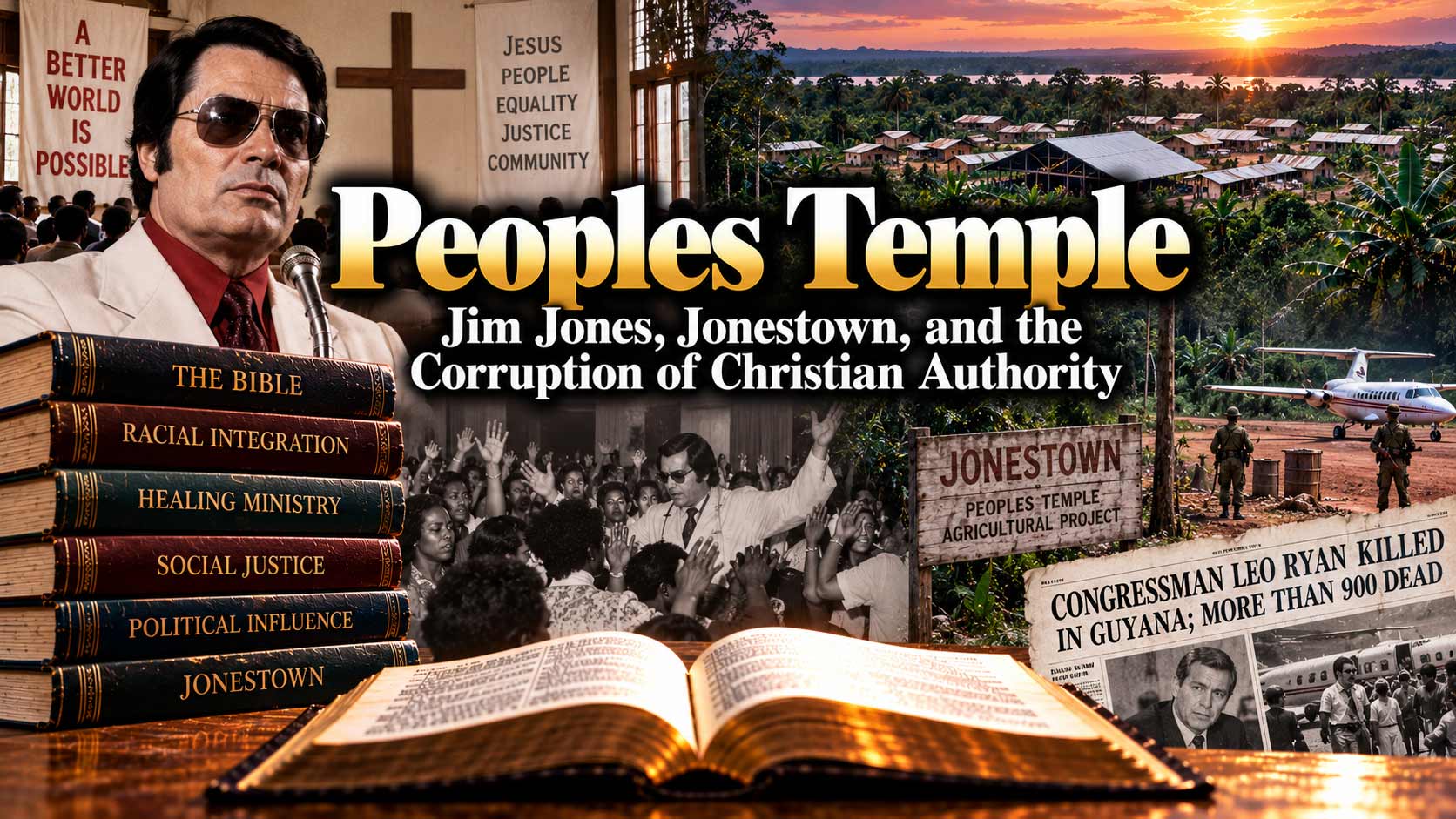
Peoples Temple is remembered almost entirely for what happened at Jonestown on November 18, 1978. More than 900 people died in a remote settlement in Guyana, Congressman Leo Ryan and four other people were murdered at a nearby airstrip, and Jim Jones became one of the most notorious religious leaders in American history. The horror of the ending is so overwhelming that it can obscure the part of the story Christians most need to understand: Peoples Temple began as a church.
Jones preached from the Bible, conducted healing services, talked about Jesus, attracted people from Pentecostal backgrounds, became an ordained minister in the Christian Church (Disciples of Christ), and built an interracial congregation committed to helping the poor and confronting racism. People didn’t join because Jones introduced himself as a dangerous cult leader who would eventually take them to a jungle settlement in South America. They joined because much of what they initially saw appeared compassionate, courageous, Christian, and even admirable. That is precisely what makes Peoples Temple so important from an apologetics standpoint.
Jim Jones and the Beginning of Peoples Temple
James Warren Jones was born in Indiana in 1931 and grew up in a poor family during the Depression. Religion fascinated him from an early age, as did powerful public speakers and political movements. By his twenties he was preaching in Indianapolis, where he encountered Pentecostal Christianity and the healing-revival culture that flourished during the 1950s.
Jones’s early ministry combined several elements that didn’t normally sit comfortably together in mid-century America. He preached a socially radical message about racial equality while conducting emotionally charged services that included healings, prophecy, and other charismatic manifestations. He also became increasingly committed to socialism, eventually interpreting Christianity through a political vision in which economic inequality and racial injustice were among the great evils society needed to overcome.
In 1955 Jones established the congregation that became Peoples Temple. He deliberately built an interracial church at a time when much of American Christianity remained racially segregated. Jones and his wife, Marceline, also adopted children from different racial backgrounds, describing their household as a “rainbow family.” His opposition to segregation wasn’t merely a later public-relations invention; it was one of the genuine features of his early ministry that attracted people to him.
That fact is important because the story becomes too easy if everything Jones ever did is interpreted backward from Jonestown. A manipulative person can advocate something morally right, and people can be attracted to a dangerous leader for legitimate reasons. Jones’s commitment to racial integration gave him credibility, particularly among people who had seen churches preach Christian brotherhood on Sunday while practicing segregation the rest of the week.
Pentecostalism, Healing, and Religious Authority
Jones’s services drew heavily from Pentecostal and healing-revival traditions. He claimed supernatural knowledge about individuals, conducted dramatic healing services, and created the impression that extraordinary divine power accompanied his ministry.
Some of the supposed miracles were fraudulent. Former insiders later described techniques used to manufacture healings and apparently supernatural revelations. Information about people could be gathered beforehand and then presented publicly as supernatural knowledge, while dramatic displays reinforced Jones’s reputation as a man possessing unusual spiritual power.
The apologetic lesson isn’t that healing or spiritual gifts must therefore be false. That conclusion would make about as much sense as arguing that counterfeit money proves there is no real money. The lesson is that claims of supernatural power don’t exempt a teacher from biblical and moral scrutiny. If anything, extraordinary claims require greater discernment because they can give a leader authority that ordinary preaching never would.
The New Testament doesn’t tell Christians to believe every spiritual claim made in the name of God. It repeatedly tells them to test teachers, prophecy, doctrine, and spiritual manifestations. A spectacular testimony may get everyone’s attention, but it doesn’t get to overrule Scripture or character.
The Disciples of Christ
Peoples Temple eventually affiliated with the Christian Church (Disciples of Christ), a historic American denomination rooted in the Restoration Movement. Jones was ordained within the denomination in 1964, which gave him additional institutional legitimacy.
That connection sometimes surprises people who know only the Jonestown story. Peoples Temple wasn’t operating from the beginning as an isolated religious commune with no connection to established Christianity. It had denominational credentials, Christian worship, clergy status, and the outward appearance of a functioning church.
The Disciples of Christ shouldn’t be held responsible for everything Jones eventually became, any more than a denomination can guarantee the character of every minister it ordains. But the connection illustrates an important limitation of institutional credentials. Ordination can tell us that someone passed through a church’s process; it can’t guarantee that the person will remain faithful, truthful, or psychologically healthy for the rest of his ministry.
No denominational certificate can substitute for continuing accountability.
California and the Growth of the Temple
During the 1960s Jones became increasingly concerned about nuclear war and social upheaval. Peoples Temple eventually relocated to northern California, establishing itself in Redwood Valley before expanding into San Francisco and Los Angeles.
California provided fertile ground for the movement. The Temple’s commitment to racial integration, care for elderly people, social programs, communal life, and political activism attracted a remarkably diverse membership. African Americans formed a substantial portion of the congregation, including many older women who brought with them the language and worship culture of the Black church.
Members worked long hours for Temple projects. Some turned over property, income, or savings to the organization. Communal commitment was presented as an alternative to the selfishness and inequality of American capitalism, and Jones increasingly fused religious language with socialist ideology.
At its best, the Temple could appear to be doing things churches ought to do: feeding people, caring for the elderly, crossing racial barriers, and creating community among people society often neglected. The problem wasn’t that feeding hungry people was secretly evil. The problem was that good works increasingly became part of the moral capital Jones used to justify his growing authority.
A leader who does admirable things is still capable of doing terrible things. Christians forget that at considerable risk.
Politics and San Francisco
Peoples Temple became politically influential after establishing itself in San Francisco. Jones could mobilize members for rallies, campaigns, and public events, which made the Temple attractive to politicians seeking organized support.
Jones cultivated relationships with prominent political figures and received appointments and public recognition. In 1976 he was appointed to San Francisco’s Housing Authority Commission and eventually became its chairman. Photographs of Jones with politicians and civic leaders strengthened the impression that Peoples Temple was a respected progressive religious organization rather than a dangerous fringe movement.
For Jones, political recognition provided another layer of legitimacy. Members could look at his relationships with public officials as confirmation that critics were wrong about him. Outsiders could look at the same relationships and assume that someone else must already have checked him out.
That is one of the recurring problems in institutional life: everybody assumes somebody else has done the discernment.
Jones and the Bible
As Jones’s ideology developed, his relationship with historic Christianity deteriorated dramatically. He increasingly attacked the Bible, particularly passages he regarded as supporting slavery, oppression, inequality, or an unjust picture of God. At times he ridiculed Scripture publicly and encouraged followers to trust his interpretation of truth over the biblical text.
Christian vocabulary remained useful, but Jones was no longer functioning under Christian authority in any meaningful sense. His concept of God became increasingly fluid, and socialism took on a religious character. He sometimes spoke as though the divine principle was expressed through himself and eventually encouraged an extraordinary degree of personal devotion.
This is one of the clearest points at which Peoples Temple crossed from an unorthodox church into something centered on Jones himself. A Christian leader can criticize another Christian’s interpretation of Scripture. He can argue that churches have misunderstood passages or used the Bible wickedly. What he can’t do while remaining meaningfully Christian is place himself above Scripture and make his own authority the standard by which revelation is judged.
Once the question changes from “What has God said?” to “What does the leader say God meant?” the congregation has entered dangerous territory.
The Leader Becomes the Message
Jones’s authority extended increasingly into the personal lives of Temple members. Loyalty to the community became loyalty to Jones, and criticism of Jones could be interpreted as betrayal of the movement’s larger mission.
Former members and later investigations described humiliation, manipulation, punishments, sexual exploitation, surveillance, financial control, and pressure against defectors. Jones cultivated an atmosphere in which the outside world was portrayed as hostile and critics were treated as enemies determined to destroy everything the Temple had accomplished.
This is where theological error and high-control behavior begin reinforcing each other. If the leader possesses unique truth, opposition to the leader becomes opposition to truth. If the community represents the only genuinely righteous alternative to a corrupt world, leaving the community becomes moral betrayal. If critics are agents of persecution, criticism itself becomes evidence that the leader was right about the persecution.
The system gradually becomes self-sealing. Evidence against the leader becomes evidence for the leader.
Christianity provides a very different model of authority. Peter could be confronted publicly by Paul. Churches were instructed to evaluate prophecy. Elders were given qualifications and could be held accountable. Even the apostles appealed to the resurrection of Jesus and the revelation of God rather than demanding that Christians believe simply because an apostle possessed an impressive personality.
A leader who can’t be questioned has acquired an authority the New Testament doesn’t give pastors.
The Move to Guyana
During the 1970s scrutiny of Peoples Temple increased. Former members and relatives began making allegations about financial manipulation, abuse, coercion, fraudulent healings, and Jones’s control over followers. Journalists also began investigating the organization.
Jones increasingly presented the United States as racist, fascist, and headed toward catastrophe. Peoples Temple had already begun developing an agricultural settlement in Guyana, a small English-speaking country on the northern coast of South America. The settlement was officially called the Peoples Temple Agricultural Project but became universally known as Jonestown.
In 1977 Jones moved there permanently, and hundreds of followers followed him. The settlement was promoted as a multiracial socialist community where people could escape racism, capitalism, and the corruption of American society.
Geographic isolation changed the balance of power dramatically. In California, members still lived within reach of relatives, journalists, government agencies, other churches, and ordinary social institutions. In the Guyanese jungle, Jones and the Temple leadership controlled far more of the environment through which members understood the world.
Isolation doesn’t automatically create a cult, and religious communities have lived apart from broader society throughout Christian history. The danger comes when isolation combines with authoritarian leadership, restricted information, fear of outsiders, and severe consequences for dissent. Jonestown increasingly contained all of them.
Life at Jonestown
Life in Jonestown was considerably harsher than the paradise presented in Temple propaganda. Residents worked long hours in difficult tropical conditions, and the settlement struggled to become economically self-sufficient. Jones’s voice was broadcast over loudspeakers for extended periods, reinforcing his constant psychological presence even when residents weren’t gathered for meetings.
Jones’s health deteriorated, and his drug use became increasingly serious. His speeches grew more paranoid, with repeated warnings that enemies were preparing to destroy the community and take away its children.
Residents participated in exercises commonly called White Nights, during which Jones presented supposed crises and tested whether members were prepared to die rather than allow the community to be defeated. At least some rehearsals involved the possibility of collective suicide.
By this point the movement that had once promised racial reconciliation and Christian community had become a place where loyalty could be measured by willingness to die at the leader’s command. The distance between those two points wasn’t crossed in one dramatic leap. It was crossed through a long succession of concessions in which Jones acquired more authority and his followers surrendered more of their ability to challenge him.
That gradual progression may be the most disturbing part of the story.
Concerned Relatives and Congressman Leo Ryan
Not everyone accepted Jones’s control. Former members and relatives organized opposition, with a group known as the Concerned Relatives pressing authorities to investigate conditions at Jonestown. They alleged that people were being held there against their will and subjected to serious abuses.
California Congressman Leo Ryan decided to investigate. Ryan had a reputation for taking an unusually hands-on approach to congressional oversight, and in November 1978 he traveled to Guyana accompanied by staff members, journalists, and relatives of Temple members.
Ryan’s delegation reached Jonestown on November 17. The visit initially appeared relatively peaceful, and Temple leaders attempted to demonstrate that residents were happy. But some members quietly indicated that they wanted to leave.
That changed everything. For Jones, defections threatened not only the community but the carefully maintained claim that people were living at Jonestown voluntarily and happily. Ryan agreed to take defectors with his party when they departed.
On November 18, the group traveled to the airstrip at Port Kaituma to leave Guyana.
They didn’t all make it onto the planes.
The Port Kaituma Murders
As Ryan’s party prepared to depart, armed Peoples Temple members arrived at the airstrip and opened fire. Congressman Ryan was killed along with NBC correspondent Don Harris, NBC cameraman Bob Brown, San Francisco Examiner photographer Greg Robinson, and Temple defector Patricia Parks. Several other people were wounded.
The murder of a sitting member of Congress meant there was no plausible return to normal life at Jonestown. Jones gathered the community and told his followers that the end had arrived.
What followed is frequently described as the Jonestown mass suicide. That description is incomplete.
November 18, 1978
Jones urged the community to participate in what he called “revolutionary suicide.” A drink containing cyanide and other substances was prepared and distributed. Children were poisoned first, many receiving the mixture from adults with syringes or cups, and adults followed.
More than 900 people died, including more than 200 children. Jones himself died from a gunshot wound. The FBI subsequently undertook an enormous investigation into the deaths and the murder of Congressman Ryan.
Some adults clearly participated in the final act and supported Jones’s rhetoric. Others objected, were under extraordinary psychological pressure, or were living in an armed community from which meaningful freedom of choice had become severely compromised. The children obviously made no such choice at all.
For that reason, describing Jonestown simply as a mass suicide can hide as much as it reveals. Mass murder-suicide is a better description of the event because it recognizes both voluntary participation by some adults and the murder and coercion of others.
It also makes the popular expression “drink the Kool-Aid” considerably less amusing once you know what actually happened. Jonestown wasn’t a story about gullible people making a foolish consumer choice. It was the destruction of hundreds of human beings, including children, inside a community whose leader had spent years making himself progressively harder to question and progressively harder to escape.
Why Didn’t They Just Leave?
One of the easiest questions to ask about cults is also one of the least useful: Why didn’t these people simply leave?
By the time a movement becomes obviously dangerous to outsiders, insiders may have spent years reorganizing their relationships, finances, beliefs, identities, and understanding of the world around it. Family relationships may have been damaged. Property may have been surrendered. Critics may have been portrayed as enemies. The leader may have become the person’s primary source for understanding both God and reality.
Jonestown added physical isolation to all of those pressures. Leaving a church across town is one thing. Leaving an authoritarian agricultural settlement in the Guyanese jungle while leadership controls transportation, information, resources, and much of your social world is something else.
None of this means members had no moral agency. Some people resisted Jones, some defected, and some actively helped sustain his system. But understanding coercive control requires more than imagining what we would do after reading the entire story with the ending already known.
The people joining an interracial church in Indianapolis in the 1950s didn’t know they were signing up for Jonestown in 1978.
The Problem of Charisma
Jim Jones demonstrates why charisma is morally neutral. The ability to inspire people tells us nothing about whether the direction in which they’re being inspired is true or good.
Jones could preach. He could persuade. He could make people believe they were participating in something larger than themselves. He could speak convincingly about racial justice and economic inequality, identify genuine hypocrisy in American Christianity, and create a community in which people who had been marginalized elsewhere felt valued.
Those abilities didn’t disappear when Jones became corrupt. They became instruments of the corruption.
Christians are especially vulnerable when spiritual effectiveness is confused with spiritual character. A growing church, dramatic testimony, apparent healing, successful ministry, social influence, or gifted speaker can easily become evidence in our minds that God must approve of the person producing those results.
The New Testament places considerably more emphasis on character. Leaders are supposed to be self-controlled, faithful, hospitable, respectable, not greedy, and not domineering. Those qualifications are considerably less exciting than supernatural revelations, but Jim Jones is a fairly strong argument for why God might have included them.
Good Causes Don’t Sanctify Bad Leaders
Peoples Temple also presents a harder apologetic lesson because some of the causes Jones championed really were good.
Racial segregation was wrong. Racism was wrong. Neglecting poor and elderly people was wrong. Churches that tolerated those things while criticizing Jones gave him ammunition he could use against Christianity itself.
That means the Christian response to Peoples Temple can’t simply be that Jones cared too much about social justice. The problem was never that he wanted Black and white Christians worshiping together. The problem was that a righteous cause became attached to an unrighteous authority structure.
Christians should be capable of holding both ideas at once. Jones could be right about racism and catastrophically wrong about Jim Jones. A movement can identify a genuine injustice without thereby acquiring divine authority over everyone who joins it.
When people become convinced that questioning the leader means betraying the cause, the cause has become a shield protecting the leader.
Christianity and the Right to Test a Leader
Peoples Temple eventually became almost the opposite of the Christianity it claimed to represent. Jesus directed attention toward the Father; Jones increasingly directed attention toward himself. Christian leaders are supposed to shepherd people; Jones manipulated and controlled them. Scripture places teachers under the Word of God; Jones increasingly placed the Bible beneath his own judgment.
The distinction matters because apologetics isn’t only about answering atheists or explaining the Trinity. Christians also need an apologetic inside the church, a framework for recognizing when Christian language is being used to create authority Christianity itself doesn’t authorize.
No pastor becomes the mediator between a Christian and God. No prophet becomes immune from testing. No miracle makes doctrine irrelevant. No political cause makes character irrelevant. No ministry success turns accountability into persecution.
And no leader gets to become Jesus.
Was Peoples Temple a Christian Cult?
Peoples Temple clearly belongs in the Christian Cults section of Jew & Greek, but for somewhat different reasons than Christadelphians or Swedenborgianism. It began within Christianity and maintained Christian forms and vocabulary while Jones increasingly rejected biblical authority, historic Christian doctrine, and ultimately the authority of Christianity itself.
It also became a cult in the popular sociological sense of the term. Jones exercised extraordinary control over followers, discouraged dissent, cultivated fear of outsiders, manipulated information, demanded intense loyalty, and eventually presided over a community in which leaving could become dangerous.
The movement effectively ended with Jonestown. FBI records from the subsequent investigation describe Peoples Temple as having dissolved in January 1979. FBI There is therefore no significant contemporary Peoples Temple religion for Christians to encounter in the way they might encounter Jehovah’s Witnesses or Latter-day Saints.
But that doesn’t make the story irrelevant. In some ways it makes the story easier to study because we can see the entire trajectory from beginning to end.
Peoples Temple began with a preacher, a Bible, healing meetings, an interracial congregation, and a message about building a better world. It ended with armed guards, murdered defectors, poisoned children, a dead congressman, and hundreds of bodies lying in the Guyanese jungle.
The apologetic lesson isn’t that every strong pastor becomes Jim Jones or that every unusual church is headed toward Jonestown. That kind of paranoia would teach us nothing. The lesson is that Christianity deliberately places every human leader beneath a higher authority, and the moment a church loses the right to test its leader, it has surrendered one of its most important protections against spiritual abuse.
The most dangerous question Peoples Temple leaves us with isn’t how Jim Jones became Jim Jones. It is how so many reasonable and idealistic people gradually became convinced that they were no longer allowed to tell him no.