

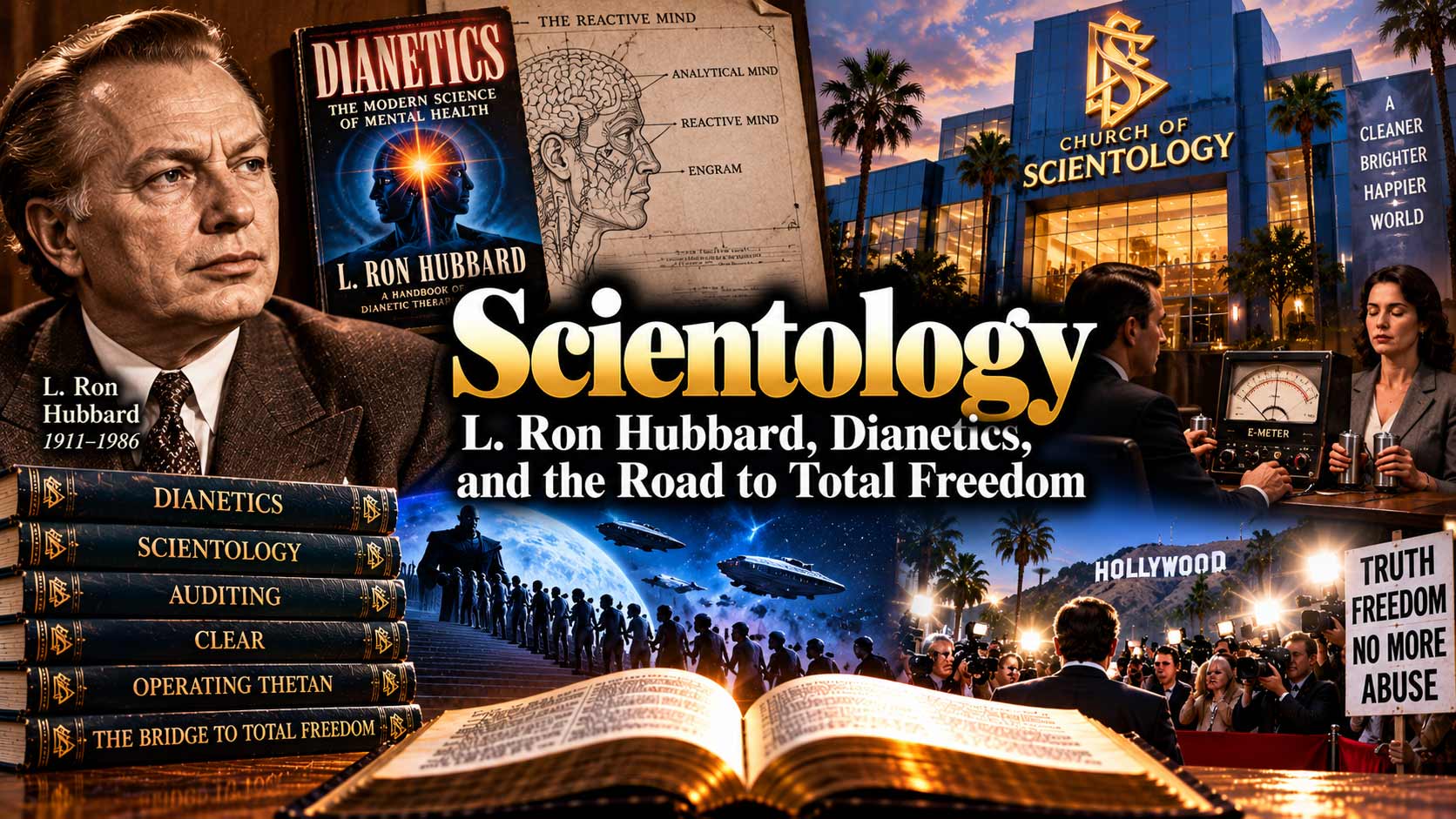
Scientology may be the easiest religion in America to recognize and one of the hardest to explain. Most people know something about celebrities, E-Meters, expensive courses, secret teachings, or the name L. Ron Hubbard, but those pieces don’t necessarily tell you what Scientologists believe they’re actually doing. From the inside, Scientology presents itself as a practical spiritual technology designed to free human beings from the limitations that have accumulated over countless lifetimes.
That last part is important. Scientology isn’t a strange branch of Christianity, despite calling its buildings churches, displaying a cross, and using ministers and Sunday services. Its understanding of humanity, salvation, God, and spiritual existence comes from an entirely different framework. That’s why it belongs under our Other Cults and New Religious Movements category rather than Christian Cults.
And to understand how anybody arrived at this particular religious system, we have to begin with a science-fiction writer named L. Ron Hubbard.
L. Ron Hubbard
Lafayette Ronald Hubbard was born in Nebraska in 1911 and became a prolific writer of pulp fiction during the 1930s and 1940s. He wrote adventure, fantasy, westerns, and particularly science fiction, producing stories at the astonishing pace demanded by pulp magazines of the period. He also served in the United States Navy during World War II.
Hubbard’s later accounts of his life presented him as an unusually accomplished traveler, explorer, military officer, philosopher, and researcher. Some of those biographical claims became subjects of considerable dispute, particularly descriptions of his military service and early experiences. What isn’t disputed is that Hubbard possessed an extraordinary ability to create elaborate systems of ideas and communicate them with tremendous confidence.
In 1950 he published the book that changed his life: Dianetics: The Modern Science of Mental Health. It wasn’t initially presented as a religion. Hubbard claimed to have discovered principles governing the human mind and a method capable of removing psychological barriers that prevented people from reaching their full potential.
The book became a sensation.
Dianetics and the Reactive Mind
Dianetics divides the mind into different components, most importantly what Hubbard called the analytical mind and the reactive mind. The analytical mind handles conscious thought and rational decision-making. The reactive mind stores painful experiences in a way that can later influence behavior without the person consciously understanding why.
Hubbard called these harmful mental recordings engrams. An engram might originate during an experience involving pain or unconsciousness and then produce irrational fears, emotional reactions, psychosomatic problems, or other difficulties later in life.
Dianetics offered a method for addressing these engrams through a process that developed into what Scientology calls auditing. A person works with an auditor who asks structured questions intended to help the individual examine experiences and remove their harmful effects.
The ultimate Dianetic goal was the state of Clear, in which the individual was said to be free from the reactive mind. Hubbard attributed impressive capabilities to this state, and people formed Dianetics groups across the country hoping to achieve it.
But Dianetics created a problem Hubbard’s original psychological model hadn’t anticipated. People undergoing auditing began reporting experiences that appeared to come from lives before their present one.
Hubbard followed the idea wherever it led him, and that road eventually left psychology behind and entered religion.
From Dianetics to Scientology
By the early 1950s Hubbard was teaching that human beings were fundamentally spiritual rather than merely physical creatures. Scientology developed from this expanded system, and the first Church of Scientology was established in Los Angeles in 1954.
The central spiritual being in Scientology is called the thetan. The term derives from the Greek letter theta, which Hubbard associated with thought, life, and spirit. Scientology doesn’t teach that a person has a thetan in the way Christianity teaches that a human being has a spiritual dimension. The person fundamentally is the thetan.
The thetan is immortal and has existed through countless lifetimes. Bodies come and go, but the spiritual being continues. Unfortunately, enormous numbers of experiences accumulated over those lifetimes have reduced the thetan’s awareness of its true nature and abilities.
Scientology therefore describes humanity’s problem very differently from Christianity. The fundamental problem isn’t sin separating humanity from a holy God. It is spiritual ignorance, limitation, and the accumulated effects of experiences that prevent the thetan from functioning with its original freedom.
Salvation consequently looks very different as well.
Auditing and the E-Meter
Auditing became the central religious practice of Scientology. During a typical auditing session, an auditor asks the participant, called a preclear, a series of questions while the person holds two metal cylinders connected to an electronic device called an E-Meter.
The E-Meter measures changes in electrical resistance through the body. Scientology teaches that its readings help the auditor identify spiritually significant areas of distress or “charge” that should be examined. The device doesn’t itself tell the auditor what happened; it is used as an aid during the auditing process.
Scientology distinguishes auditing from psychotherapy and strongly rejects the idea that the two are equivalent. Auditors follow detailed procedures developed by Hubbard, and Scientology describes those procedures as a precise spiritual technology rather than an improvised counseling method.
The terminology is revealing. Scientology frequently speaks of technology, procedures, levels, processes, training, and measurable progress. Hubbard developed a religious system that often sounds less like traditional theology and more like an engineering manual for the human spirit.
For someone coming from Christianity, Judaism, or Islam, the vocabulary can initially feel very strange. For someone attracted to the idea that spiritual development should have an exact procedure rather than depending on vague religious experience, that precision can be part of the appeal.
The Bridge to Total Freedom
Scientology organizes spiritual advancement through what it calls the Bridge to Total Freedom. Members progress through auditing and training levels intended to increase spiritual awareness and ability.
Early stages address communication, personal problems, emotional barriers, and the reactive mind. Reaching Clear represents a major milestone, but it isn’t the end of the process. Beyond Clear are advanced levels known as Operating Thetan, usually abbreviated OT.
An Operating Thetan is understood to be increasingly capable of functioning as a spiritual being independent of the limitations ordinarily imposed by the body and physical universe. The ultimate goal is restoration of the spiritual freedom and abilities the thetan once possessed.
The structure of the Bridge is one reason Scientology can become an extensive commitment. Spiritual progress isn’t presented as a single conversion experience followed by ordinary religious life. There is always another level, another course, another auditing process, or another area of spiritual ability to develop.
The journey is systematic, and it can be long.
Engrams, Past Lives, and the Time Track
As Scientology expanded beyond Dianetics, Hubbard developed the idea of the time track, the enormous sequence of experiences through which a thetan has passed during its existence.
That means auditing need not stop with childhood. A participant might encounter experiences understood as originating in previous lives or extremely distant periods of spiritual existence. Scientology accepts past-life experiences as part of the broader reality auditors may encounter.
This gives Scientology certain superficial similarities to religions that teach reincarnation, but the systems aren’t identical. Scientology doesn’t simply borrow the Hindu cycle of samsara or Buddhist teachings about rebirth. Hubbard created his own cosmology in which immortal spiritual beings have existed across vast stretches of time and have become increasingly entangled with the physical universe.
The result sounds at times like religion expressed through the imagination of twentieth-century science fiction, which isn’t particularly surprising considering who wrote it.
Xenu and the Confidential Teachings
No discussion of Scientology can avoid Xenu, although this is where discussions frequently become more interested in mockery than explanation.
Material associated with the advanced level known as Operating Thetan III describes a catastrophic event in the distant past involving a galactic ruler commonly rendered as Xenu. According to this account, enormous numbers of beings were brought to Earth, destroyed, and became associated with spiritual entities whose effects continue to trouble human beings.
The story has become one of the most famous features of Scientology largely because it sounds extraordinary when removed from the religious system surrounding it. Scientology has historically treated advanced OT materials as confidential and objects strongly to unauthorized publication or distorted presentation of them.
It is fair to point out that Christianity also contains supernatural claims that sound extraordinary to someone encountering them without context: angels, demons, resurrection, miracles, and a man returning from the dead. “That sounds weird to me” isn’t much of an apologetic argument.
The better question is why anyone should believe the claim is true. Christianity places its central claims about Jesus in public proclamation tied to people, places, documents, and events that can be historically investigated. Scientology’s advanced cosmological teachings depend overwhelmingly on revelations and discoveries attributed to Hubbard. The issue isn’t merely that the story is unusual. It is the source of authority behind the story.
God in Scientology
Scientology does recognize a concept of the Supreme Being, but God doesn’t occupy the central position found in Christianity. Hubbard described existence through Eight Dynamics, representing increasingly broad areas of survival and concern.
They move from the individual to family and sexual existence, groups, humanity, living things, the physical universe, spiritual existence, and finally infinity or the Supreme Being. Scientology teaches that spiritual progress can eventually bring someone toward a fuller understanding of that eighth dynamic.
This approach deliberately leaves considerable room for personal discovery. Scientology doesn’t begin by requiring converts to subscribe to a detailed creed defining God’s nature. Its emphasis falls instead on spiritual practice and personal experience.
That creates another fundamental difference from Christianity. Christianity begins with God acting in creation and history and revealing Himself to humanity. Scientology begins much more strongly with the individual spiritual being discovering its own nature and progressively expanding its awareness.
The direction of travel is almost reversed.
Jesus and Christianity
Scientology doesn’t generally present Jesus as false or irrelevant. Hubbard referred to Jesus within a larger history of religious teachers, and Scientology can speak respectfully about Christianity alongside Buddhism and other religious traditions.
But Jesus doesn’t occupy anything approaching the position He occupies in Christianity. Scientology doesn’t center salvation on Christ’s death and resurrection, doesn’t teach that reconciliation with God depends upon Christ, and doesn’t organize its spiritual system around the biblical story of creation, fall, redemption, and resurrection.
A Scientologist can therefore appreciate Jesus without accepting historic Christian claims about Him. The spiritual technology developed by Hubbard, rather than the saving work of Christ, provides the path toward freedom.
That is why placing Scientology under Christian Cults would be misleading. Mormonism and Jehovah’s Witnesses arose from Christian environments and claim to represent the true or restored form of Christianity. Scientology is better understood as an independent new religious movement that uses some Christian forms without being fundamentally Christian in origin or theology.
The presence of a cross on the building doesn’t change the religion happening inside it.
Psychiatry: Scientology’s Great Enemy
Few subjects have generated more conflict between Scientology and the wider culture than psychiatry. Hubbard strongly opposed psychiatry, and that opposition became deeply embedded in Scientology.
Scientology distinguishes the mind and spirit from the brain and rejects psychiatric explanations that reduce human problems to physical or biochemical processes. The church has campaigned aggressively against practices it regards as abusive, including involuntary treatment, psychiatric medication, and electroconvulsive therapy.
Scientology-associated organizations have publicized genuine abuses in psychiatric history, and psychiatry certainly has chapters worth criticizing. Lobotomies, institutional mistreatment, coercive practices, and unethical experimentation aren’t inventions of Scientology.
The problem comes when legitimate criticism of abuses becomes a sweeping rejection of an entire field. Mental illness can be devastating, and responsible medical and psychological treatment shouldn’t be dismissed simply because psychiatry has sometimes gotten things terribly wrong.
Scientology’s longstanding hostility toward psychiatry remains one of its sharpest points of conflict with medicine and mental-health professionals.
Ethics, Suppressive Persons, and Disconnection
Scientology has an extensive system of ethics, which in its own terminology involves improving a person’s ability to make choices that promote survival across the dynamics. Within that system, certain individuals can be designated Suppressive Persons, or SPs.
A Suppressive Person is understood as someone whose actions are destructive or who actively opposes Scientology or a Scientologist’s spiritual progress. The related practice of disconnection involves ending or restricting relationships considered harmful in this way.
The Church of Scientology defends disconnection as a voluntary religious practice and compares it to the right people have to remove destructive relationships from their lives. Critics and former members have described situations in which disconnection resulted in painful separation between spouses, parents, children, friends, or other relatives.
Those perspectives need to be distinguished rather than collapsed into a slogan. Every person has the right to establish boundaries with abusive or destructive people. The apologetic concern arises when a religious organization becomes the authority determining that continued relationships with critics threaten a member’s spiritual advancement.
Once disagreement with an organization can become evidence that the dissenter is spiritually dangerous, meaningful criticism becomes much harder to hear.
The Sea Organization
The most committed Scientologists may serve in the Sea Organization, commonly called the Sea Org. Hubbard created it during the 1960s while he was operating Scientology from ships, and the maritime terminology survived long after most of its work moved onto land.
Sea Org members famously sign contracts pledging service for one billion years. Scientology explains this symbolically in light of the belief that the thetan lives through repeated lifetimes. The contract therefore expresses long-term spiritual dedication rather than the practical expectation that somebody will remain at the same desk until the year 1,000,001,968.
Sea Org members occupy important positions within Scientology’s organizational structure and traditionally live under considerably more demanding conditions than ordinary parishioners. Their lives can involve long working hours, communal arrangements, strict discipline, and intense commitment to Scientology’s mission.
Critics and former Sea Org members have made serious allegations about working conditions, disciplinary practices, family separation, and treatment of members. Scientology has disputed many accusations and strongly contests portrayals it considers misleading or hostile. Because the allegations are serious and sometimes contested, they should be evaluated individually rather than treated as though every story circulating on the internet has automatically been established.
There is enough documented controversy surrounding Scientology without needing to improve the story.
Scientology and Money
Scientology is also unusual in the extent to which religious services are connected with specified donations. Auditing and training normally involve payments, and progressing through extensive levels of Scientology can require substantial financial commitment.
The church describes these as fixed donations supporting the delivery of religious services and compares them to financial practices found in other religious traditions. Critics argue that the system commercializes spiritual advancement and can place considerable pressure on members to spend increasingly large amounts as they move up the Bridge.
The issue isn’t simply that a church receives money. Churches require buildings, employees, utilities, publications, and other resources, and almost every religious institution asks supporters to contribute financially.
Scientology is distinctive because spiritual advancement itself is organized through an extensive sequence of services and courses that can carry substantial costs. That makes money and spiritual progress more directly connected than they are in most Christian churches.
Operation Snow White
Scientology’s conflicts with governments and critics produced one of the strangest episodes in modern American religious history.
During the 1970s, Scientology’s Guardian’s Office carried out an operation intended to locate and remove unfavorable government records about Hubbard and Scientology. What became known as Operation Snow White involved infiltrating government offices, stealing or copying documents, and interfering with government records and investigations.
Federal authorities eventually uncovered the operation. Eleven Scientology officials, including Hubbard’s wife Mary Sue Hubbard, were convicted or pleaded guilty to federal offenses connected with the conspiracy.
This isn’t merely an allegation from former members or anti-cult activists. It resulted in federal criminal prosecutions and convictions.
Scientology subsequently dismantled the Guardian’s Office and created different organizational structures. But Operation Snow White remains an important part of its history because it demonstrates how far elements within the organization were prepared to go when they believed government institutions threatened Scientology.
Hubbard’s Death and David Miscavige
L. Ron Hubbard withdrew increasingly from public view during the later years of his life and died in California in 1986.
Scientology survived him, which isn’t always the case with movements built around a charismatic founder. Leadership eventually consolidated around David Miscavige, who became the most prominent institutional leader in post-Hubbard Scientology and serves as Chairman of the Board of the Religious Technology Center.
Hubbard’s writings and recorded lectures remain foundational. Scientology isn’t a religion in which each generation of leaders is expected to rewrite the founder’s theology. Hubbard’s “technology” is supposed to be preserved and applied correctly.
That makes control of Hubbard’s materials extraordinarily important. The Religious Technology Center exists in significant part to protect and preserve Scientology’s religious technologies and trademarks.
Hubbard may be gone, but the system remains very much his.
The IRS and Religious Recognition
Scientology fought the United States government for decades over its tax status. The conflict finally changed dramatically in 1993, when the Internal Revenue Service recognized the Church of Scientology and numerous related organizations as tax-exempt religious and charitable organizations.
That decision didn’t settle every argument about whether Scientology should be considered a religion. Different countries have treated Scientology differently, and scholars, governments, courts, critics, and former members have debated how the movement should be categorized.
For our purposes, the terminology doesn’t need to do all the theological work. Scientology plainly deals with immortal spiritual beings, ultimate reality, spiritual liberation, religious practices, clergy, churches, and a path toward transcendent freedom. Calling it a new religious movement is perfectly reasonable.
Calling it Christianity isn’t.
Celebrities and Scientology
Scientology’s association with celebrities has made the movement far more culturally visible than its size alone would suggest. Hubbard deliberately recognized the potential value of attracting artists, entertainers, and influential public figures, and Scientology established Celebrity Centres intended particularly for people in creative professions.
Over the years several prominent actors, musicians, and entertainers have publicly identified with Scientology, while others have publicly left it. That visibility has ensured that controversies involving Scientology receive attention far beyond what most relatively small religious movements could expect.
Celebrity involvement can also distort the way outsiders understand Scientology. The religion isn’t fundamentally about movie stars. Ordinary Scientologists are pursuing auditing, training, Clear, and Operating Thetan for the same reason members of other religions pursue their practices: they believe those things reveal something true about reality and improve their spiritual condition.
Whether they’re correct is the more interesting apologetic question.
Why Scientology Appeals to People
Scientology is easy to ridicule if we begin with its most unusual advanced teachings. That doesn’t help us understand why someone walks through the door in the first place.
People are generally introduced to much more ordinary concerns: communication problems, relationships, anxiety, personal effectiveness, unhappiness, unresolved experiences, or the feeling that they aren’t living up to their potential. Scientology offers a structured system that promises improvement in precisely those areas.
It also offers certainty. Hubbard didn’t generally present his ideas as tentative possibilities. Scientology describes itself as a workable technology whose results can be personally demonstrated. For people frustrated with vague spirituality, the promise that spiritual growth can be approached systematically can be extremely attractive.
The early benefits people report may also feel real to them. Having someone listen carefully while you discuss painful experiences can be meaningful regardless of the larger theological framework surrounding the practice. Improved communication skills can genuinely improve relationships. A person doesn’t have to accept every claim of Scientology before finding some individual exercise useful.
That’s precisely why apologetics has to examine the whole worldview rather than dismissing every experience a Scientologist reports.
Scientology and Christianity
The deepest disagreement between Scientology and Christianity isn’t Xenu, the E-Meter, celebrities, or even the cost of auditing. It is the answer each gives to the question, What is wrong with us, and what can make us right?
Scientology says the human being is fundamentally an immortal spiritual being whose true abilities have become obscured through accumulated experiences extending across countless lifetimes. Through Hubbard’s spiritual technology, the individual can progressively recover awareness, ability, and freedom.
Christianity tells a different story. Human beings are creatures made by God, not immortal thetans who have forgotten their true powers. Our deepest problem isn’t merely accumulated spiritual trauma or ignorance but sin and alienation from God. We don’t need to recover our original godlike abilities; we need reconciliation with our Creator.
And Christianity places that reconciliation somewhere Scientology never can: in Jesus Christ. Salvation isn’t a Bridge we climb through increasingly advanced levels of spiritual technology. It is something God has done for us through the death and resurrection of Christ, received by faith and followed by a life of discipleship.
That distinction is more important than all the sensational stories surrounding Scientology.
Is Scientology a Cult?
Scientology is routinely called a cult, but as we’ve seen throughout this section, the word needs definition before it becomes useful. Scientology isn’t a Christian cult because it isn’t fundamentally a Christian movement. It is an independent new religious movement founded in the twentieth century around the teachings and practices developed by L. Ron Hubbard.
Critics also use cult in the sociological sense, pointing to allegations involving disconnection, treatment of defectors and critics, intense organizational control, the Sea Org, financial pressure, confidential teachings, and the enormous authority attached to Hubbard’s system. Scientology vigorously disputes many descriptions offered by former members and critics and maintains that participation in its religious practices is voluntary.
Jew & Greek therefore places Scientology under Other Cults and New Religious Movements, where both sides of the classification can be kept clear. Theologically, it presents a religious worldview radically different from Christianity. Organizationally, it has generated enough documented controversy to make questions about authority, information, dissent, and institutional control impossible to ignore.
Scientology is worth studying because underneath the celebrities, lawsuits, E-Meters, spaceships, and tabloid stories is a serious religious claim. Hubbard said he had discovered a workable path by which human beings could recover their true spiritual identity and ultimately achieve freedom.
Christian apologetics eventually has to move past asking whether that story sounds strange. It has to ask the question that matters for every religion, including our own: What reason do we have to believe it’s true?