

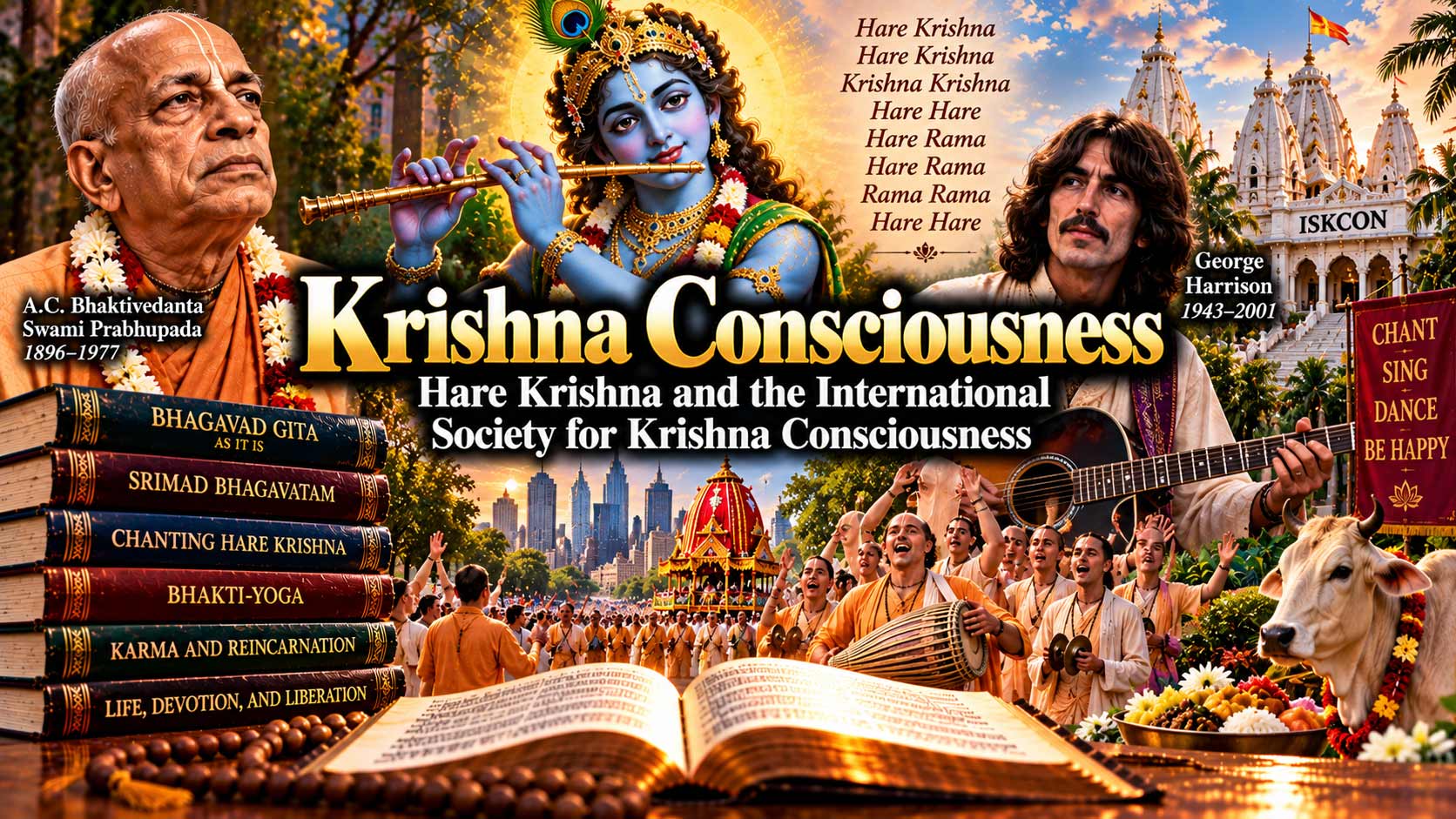
For many Americans, the words Hare Krishna still produce an image from the 1970s: shaved heads, saffron robes, cymbals, chanting, and devotees handing out books in airports. The movement became so visible that it eventually turned into a cultural stereotype, which is unfortunate because the stereotype tells you almost nothing about what Krishna devotees actually believe. Hare Krishna isn’t simply a strange meditation movement invented during the counterculture. It is a modern missionary expression of a much older Hindu devotional tradition.
Its formal name is the International Society for Krishna Consciousness, usually abbreviated ISKCON. It was founded in New York City in 1966 by A.C. Bhaktivedanta Swami Prabhupada, an elderly Indian teacher who arrived in the United States with little money and an enormous ambition: to bring devotion to Krishna to the Western world. Within little more than a decade, the movement had temples, farms, publishing operations, restaurants, and disciples around the world.
Theologically, Krishna Consciousness couldn’t be much farther from Christianity while still sharing some surprisingly familiar religious themes. It teaches devotion to a personal God, stresses moral discipline, calls people away from materialism, encourages prayer and worship, and offers salvation through a loving relationship with the divine. But the God, human problem, path of salvation, and nature of ultimate reality behind those similarities are profoundly different.
Krishna Consciousness Before the Hare Krishnas
ISKCON didn’t begin with Prabhupada, and Krishna devotion certainly didn’t begin in a storefront in New York. The movement belongs to the Gaudiya Vaishnava tradition of Hinduism, a devotional movement associated particularly with the Bengali teacher Chaitanya Mahaprabhu, who lived from 1486 to 1534.
Vaishnavism is one of the major streams within Hinduism and centers worship on Vishnu and his manifestations. Gaudiya Vaishnavas place particular emphasis on Krishna, whom they understand not merely as one manifestation among many but as the supreme form of God Himself.
Chaitanya taught an intensely devotional form of spirituality centered on loving Krishna. Singing and chanting the divine names became especially important because devotion wasn’t supposed to remain an abstract philosophical exercise. God was to be loved, remembered, praised, and experienced personally.
This tradition is known as bhakti, meaning devotion. It helps explain why Hare Krishna worship can appear much more emotionally recognizable to Christians than some forms of Eastern religion. People sing, pray, bow, worship, testify to God’s goodness, and speak about developing love for Him. The metaphysics are Hindu, but the devotional impulse is unmistakably personal.
A.C. Bhaktivedanta Swami Prabhupada
The man who brought this tradition to the Western counterculture was born Abhay Charan De in Calcutta in 1896. He was educated in British India, married, worked in business, and became associated with the Gaudiya Vaishnava teacher Bhaktisiddhanta Sarasvati.
Bhaktisiddhanta encouraged him to spread Krishna devotion in the English-speaking world. That calling eventually became the central mission of his life, although it took decades before he was able to carry it out fully. He entered the renounced stage of religious life and became known as A.C. Bhaktivedanta Swami.
In 1965, at nearly seventy years old, Prabhupada traveled by cargo ship from India to the United States. He arrived with little institutional support and entered a country undergoing one of the greatest cultural upheavals in its history. Young Americans were questioning traditional Christianity, experimenting with drugs, exploring Eastern religions, protesting war, and looking for alternatives to conventional middle-class life.
If someone had designed a historical moment specifically for an Indian guru preaching spiritual liberation from material civilization, 1966 Manhattan wouldn’t have been a bad choice.
New York and the Birth of ISKCON
Prabhupada eventually began teaching on New York’s Lower East Side, where he attracted young people interested in Eastern spirituality. He lectured from Hindu scriptures, led chanting, prepared vegetarian food, and taught a disciplined form of Krishna devotion that was considerably more demanding than the free-form spirituality surrounding him.
In July 1966 he formally incorporated the International Society for Krishna Consciousness. The movement spread rapidly, first through the American counterculture and then internationally.
Prabhupada’s followers called him Srila Prabhupada, treating him as their spiritual master. He translated and commented extensively on sacred texts, established temples, trained disciples, and sent followers to open centers in other cities and countries.
By the time he died in 1977, ISKCON had become a worldwide religious movement. Considering that he began his Western mission at an age when most people are considering retirement, the achievement was remarkable.
Who Is Krishna?
Krishna Consciousness begins with a very different understanding of God from the one found in Christianity. ISKCON teaches that Krishna is the Supreme Personality of Godhead. God isn’t ultimately an impersonal cosmic force into which individual consciousness disappears. Krishna possesses personality, attributes, beauty, relationships, desires, and activities. He can be known and loved.
This is an important distinction because Western descriptions of Hinduism sometimes reduce the entire religion to pantheism: everything is God and God is everything. Hinduism is much more complicated than that, and Gaudiya Vaishnavism represents a strongly personal form of Hindu devotion.
Krishna is associated with countless divine manifestations and expansions. Vishnu, Rama, and other divine forms fit within a much larger theological system, but ISKCON insists that Krishna Himself is the original and supreme source. The purpose of human existence is therefore not merely to discover some vague divinity within ourselves. It is to restore our forgotten relationship with Krishna.
The Soul and Reincarnation
Krishna Consciousness teaches that every living being possesses an eternal spiritual identity. The physical body is temporary, but the soul continues.
The soul passes from one body to another through reincarnation, with the circumstances of future existence influenced by karma. Actions have consequences extending beyond the present lifetime, and attachment to material existence keeps the soul bound within the recurring cycle of birth and death.
Human beings ordinarily identify themselves with their temporary bodies. We think primarily in categories such as nationality, race, sex, occupation, wealth, and social status, while forgetting our deeper identity as eternal spiritual beings related to Krishna.
From the ISKCON perspective, this forgetfulness is one of humanity’s fundamental problems. Material consciousness causes us to pursue temporary pleasures while remaining trapped in a world characterized by suffering and repeated death. The goal is liberation from that cycle and restoration to loving fellowship with Krishna.
Karma and the Material World
Karma is sometimes reduced in Western popular culture to “what goes around comes around,” usually shortly before someone enjoys watching an unpleasant person get what he deserves. The Hindu concept is considerably larger than that.
Karma describes a moral order in which actions produce consequences that may unfold across multiple lifetimes. Good and bad actions shape the conditions into which a soul is subsequently born, keeping the soul within the material cycle known as samsara.
For Krishna devotees, simply accumulating good karma isn’t enough. Better circumstances in the next life may be preferable to worse ones, but another trip through birth, aging, disease, and death is still another trip through the cycle.
Liberation requires something more than becoming a nicer person. It requires devotion to Krishna.
Bhakti: The Way of Devotion
The central path of Krishna Consciousness is bhakti-yoga, the discipline of loving devotion to God. Yoga here doesn’t primarily mean stretching exercises or physical postures. It means a spiritual discipline intended to unite or connect the person with the divine.
Bhakti can include prayer, worship, service, study, offering food, remembering Krishna, singing His names, and dedicating ordinary activities to Him. The goal isn’t merely obedience to a set of religious rules. The rules are intended to redirect the person’s desires away from material gratification and toward love of Krishna.
That gives Krishna Consciousness an intensely devotional character. A devotee isn’t trying merely to escape existence or dissolve into an impersonal absolute. The highest spiritual fulfillment is loving relationship with Krishna.
This is also where Christians may recognize something before encountering the enormous differences underneath it. Christianity likewise teaches that human beings were made for relationship with God and that genuine religion can’t be reduced to external observance. But the identity of God and the means by which that relationship is restored are entirely different.
Hare Krishna, Hare Krishna
The most recognizable practice of ISKCON is chanting the Hare Krishna mantra:
Hare Krishna, Hare Krishna, Krishna Krishna, Hare Hare
Hare Rama, Hare Rama, Rama Rama, Hare Hare.
The mantra consists of divine names and is understood as an appeal to Krishna and His spiritual energy. Devotees believe that God’s name isn’t merely a sound referring to God from a distance. The divine name carries spiritual power and makes Krishna present to the worshiper in a meaningful sense.
Public congregational chanting is known as sankirtan. Devotees sing while playing instruments such as hand cymbals and drums, sometimes dancing as they chant. This became one of the movement’s most visible forms of evangelism.
Serious practitioners also chant privately using prayer beads. Initiated devotees commonly undertake a daily discipline of chanting sixteen rounds of the mantra on a string of 108 beads, which means repeating the mantra 1,728 times. Whatever else one thinks about Hare Krishna theology, nobody can accuse the traditional daily devotional program of being casual.
Chanting is believed to purify consciousness gradually, turning attention away from material attachment and toward Krishna.
The Bhagavad Gita
The most important scriptural text encountered by many ISKCON members is the Bhagavad Gita, one of the most influential religious texts in Hindu civilization.
The Gita presents a dialogue between Krishna and the warrior Arjuna on the battlefield of Kurukshetra. Arjuna faces the horrifying prospect of fighting people he loves and respects and becomes unwilling to participate in the coming battle. Krishna responds by teaching him about duty, the eternal soul, action, knowledge, devotion, and the nature of God.
Prabhupada produced his own translation and commentary, published as Bhagavad-gita As It Is. The title reflects his conviction that many interpreters had obscured the Gita’s actual message by treating Krishna symbolically or reducing Him to an expression of impersonal divinity.
Prabhupada insisted that Krishna should be understood exactly as the text presents Him: the supreme personal God to whom human beings owe devotion.
ISKCON also places enormous importance on the Srimad Bhagavatam, or Bhagavata Purana, and on the Chaitanya Charitamrita, which recounts the life and teachings of Chaitanya. Prabhupada’s translations and commentaries on these works became central to the movement’s theological education.
The Four Regulative Principles
ISKCON asks initiated devotees to follow four major moral disciplines, usually called the four regulative principles. They involve abstaining from meat, fish, and eggs; illicit sexual activity; intoxicants; and gambling.
These aren’t arbitrary rules attached to an otherwise mystical religion. They arise from the belief that material desires keep consciousness attached to the physical world. Food, sex, intoxication, and gambling can become powerful means through which the senses dominate the person.
Vegetarianism also reflects the Hindu principle of ahimsa, or nonviolence, along with the belief that animals are living beings containing eternal souls. Killing them unnecessarily therefore creates karmic consequences.
Food has a particularly religious role. Devotees prepare vegetarian meals and offer them to Krishna. Food that has been offered becomes prasadam, food received as Krishna’s mercy or grace, and eating it becomes part of spiritual practice rather than merely satisfying hunger.
ISKCON’s vegetarian restaurants and food distribution programs have probably introduced many people to Krishna Consciousness who had no intention whatsoever of joining the religion. Sometimes theology arrives with lunch.
Temples, Deities, and Worship
ISKCON temples often contain elaborately dressed images of Krishna and other sacred figures. To Christians, these may immediately look like idols, and from a Christian theological perspective the objection to worshiping an image is obvious. But understanding what devotees believe they’re doing is important before criticizing it.
Devotees don’t ordinarily understand the temple image, or murti, as merely a statue that humans have arbitrarily decided to call God. They believe Krishna mercifully makes Himself accessible through an authorized sacred form so that worshipers can see, dress, serve, feed, and honor Him.
Temple worship may involve offerings, incense, lamps, flowers, music, food, bowing, and ceremonies performed at various times of day. The deity may be awakened, dressed, offered meals, and ceremonially put to rest.
From inside the tradition, this is loving service to Krishna. From the biblical perspective, however, the difference between worshiping God through an authorized image and worshiping an image remains precisely the kind of distinction the Old Testament repeatedly refuses to accept. Israel’s golden calf was intended to represent the God who brought Israel out of Egypt, which didn’t make the calf acceptable.
That disagreement isn’t about whether devotees are sincere. It is about whether God has authorized human beings to approach Him in that way.
Cows, Vegetarianism, and Sacred Life
Krishna is traditionally associated with cowherding, and cows occupy an honored place within Krishna devotion. ISKCON communities have therefore frequently emphasized cow protection, vegetarianism, and agricultural life.
Prabhupada also promoted what he called simple living and high thinking, envisioning communities less dependent upon industrial consumer culture. ISKCON established farms where devotees attempted to combine spiritual discipline with agriculture, cow protection, and communal living.
These projects had mixed practical results, but the idea reflected a larger criticism of modern civilization. From the movement’s perspective, technological advancement doesn’t necessarily represent spiritual advancement. A society can produce enormous wealth and sophisticated machines while leaving people anxious, dissatisfied, morally confused, and spiritually ignorant.
Christians don’t have to accept Krishna theology to recognize that criticism. The Bible never promised that acquiring more things would make people less lost.
The disagreement begins when we ask what human beings need instead.
George Harrison and the Beatles Connection
Krishna Consciousness received an enormous cultural boost through its association with George Harrison of the Beatles. Harrison had already become deeply interested in Indian religion and music when he encountered Krishna devotees in Britain. He developed a relationship with Prabhupada and became an important supporter of the movement.
Harrison helped produce the Hare Krishna Mantra recording by devotees from London’s Radha Krishna Temple, which became a surprising commercial success. He also incorporated Krishna devotion into his own music, most famously in songs such as “My Sweet Lord.” His support helped establish ISKCON in Britain and introduced Krishna devotion to millions of people who would never have attended a temple or spoken with a devotee on a street corner.
The Beatles didn’t become the official house band of Hare Krishna, and their individual spiritual paths differed considerably, but Harrison’s relationship with the movement was genuine and historically significant.
Book Distribution and the Airports
During the 1970s, ISKCON became famous for aggressive public evangelism and fundraising. Devotees appeared in airports, city streets, campuses, and public spaces offering books, soliciting donations, and chanting.
Prabhupada placed enormous emphasis on distributing his books. He believed the written teachings could continue evangelizing long after a brief conversation ended, and the movement developed a remarkably effective publishing and distribution operation through the Bhaktivedanta Book Trust. The visibility brought growth, but it also created backlash. Travelers often felt pressured by solicitation techniques, airports sought restrictions, and “Hare Krishna” became shorthand in American popular culture for persistent religious solicitors.
The movement eventually became less conspicuous in airports, but the image never entirely disappeared. For a generation of Americans, Krishna Consciousness became one of the first non-Christian religions they encountered face-to-face rather than in a textbook.
Is ISKCON Hindu?
This question is more complicated than it first appears because Hinduism isn’t organized around a single founder, creed, hierarchy, or institution.
ISKCON clearly comes from Hindu religious tradition and is generally classified as a Hindu movement, more specifically a form of Gaudiya Vaishnavism. Its scriptures, concepts of karma and reincarnation, devotional practices, theology of Krishna, and historical lineage all arise from the Hindu world.
At the same time, Prabhupada sometimes resisted reducing Krishna Consciousness to what Westerners meant by “Hinduism.” He presented it as sanatana-dharma, the eternal spiritual function or religion of the living being, something universally true rather than merely the ethnic religion of India.
That universal claim helped ISKCON become genuinely international. Western converts weren’t expected to become ethnically Indian. They were being invited, as the movement understood it, to recover the eternal relationship every soul has with Krishna.
Controversies After Prabhupada
Prabhupada’s death in 1977 created a leadership crisis. During his lifetime, his authority had held together a rapidly expanding movement. Afterward, questions arose about who possessed legitimate spiritual authority and how the movement should be governed.
A number of senior disciples assumed prominent roles as gurus, and some eventually became involved in serious scandals. ISKCON also faced allegations involving authoritarian leadership, financial misconduct, abuse, criminal behavior, and mistreatment within some communities.
One of the most painful issues involved children raised in ISKCON boarding schools known as gurukulas. Former students reported physical, emotional, and sexual abuse in some institutions. The movement later acknowledged serious failures and developed programs intended to address abuse and improve child protection.
The history shouldn’t be softened simply because contemporary ISKCON institutions have attempted reforms, but neither should every present-day temple be treated as though nothing has changed since the worst periods of the movement. Religious organizations can inherit both theology and institutional failures, and evaluating them fairly requires knowing which is which.
ISKCON Today
Krishna Consciousness survived the loss of its founder, the decline of the counterculture, internal leadership crises, scandals, and the disappearance of orange-robed devotees from most American airports. It remains an international movement with temples, congregations, farms, educational programs, publishing ministries, festivals, restaurants, and food-relief projects.
The movement has also changed demographically. In many Western countries, ISKCON congregations now include large numbers of people with Indian or South Asian backgrounds alongside Western converts and their descendants. What once looked to many Americans like an exotic counterculture religion can now look much more like a global Hindu devotional community.
Public chanting continues, particularly through Harinama processions and festivals. The annual Ratha Yatra, or Festival of Chariots, has become a visible ISKCON event in numerous cities around the world.
The movement may no longer occupy the same place in American popular imagination that it did during the 1970s, but Krishna Consciousness didn’t disappear when the counterculture grew up.
Krishna and Jesus
For Christian apologetics, the most important question isn’t whether Hare Krishna devotees are nice people, whether vegetarian food is healthy, or whether chanting produces a peaceful emotional state. The real question is whether the worldview behind those practices is true.
Christianity and Krishna Consciousness agree that material possessions can’t satisfy humanity’s deepest spiritual need. Both teach that selfish desire corrupts us, that devotion matters, that human beings need something beyond themselves, and that love of God should transform the way we live.
But those similarities eventually reach a theological fork in the road.
Krishna Consciousness teaches that the soul has existed through repeated lifetimes, accumulating karma and moving from body to body until it becomes liberated from material bondage through devotion to Krishna. Christianity teaches that human beings are created by God, live one earthly life, die, and face resurrection and judgment.
Krishna Consciousness sees humanity’s fundamental problem as forgetfulness of our eternal spiritual identity and attachment to the material world. Christianity sees our deepest problem as sin and alienation from the God who created us.
Most importantly, Christianity doesn’t offer liberation through repeated lives, purified consciousness, or devotional advancement. It announces something that has happened in history: Jesus Christ died and rose from the dead.
That difference takes us to the heart of Christian apologetics.
The Question of History
Krishna’s life belongs to sacred Hindu tradition extending into the ancient past, and the theological narratives surrounding him function within a vast religious cosmology. The Christian claim about Jesus is structured differently. Christianity places its central saving event in identifiable human history under Roman government, involving known geographical locations and people who claimed to have witnessed what occurred.
That doesn’t prove Christianity merely by stating the difference. Historical claims still have to be investigated, and Christians shouldn’t ask other religions to meet standards of evidence they aren’t willing to apply to their own.
But Christianity does invite that investigation. Paul went so far as to say that if Christ wasn’t raised, Christian faith is futile. The religion stakes itself on something Christians claim actually happened.
Krishna Consciousness ultimately asks us to accept a very different picture of reality: eternal souls moving through reincarnation, karma operating across lifetimes, Krishna as the Supreme Personality of Godhead, and liberation through bhakti. Those claims deserve to be understood seriously rather than dismissed because devotees dress differently or chant in public.
They also deserve to be tested.
Is Krishna Consciousness a Cult?
ISKCON was frequently labeled a cult during the anti-cult controversies of the 1970s and 1980s. Some of that criticism concerned genuine issues involving authoritarian leadership, recruitment, communal pressure, family conflict, and later scandals. Some of it also reflected a period when almost any unfamiliar religious movement with communal living and enthusiastic converts could quickly acquire the label.
For Jew & Greek, Krishna Consciousness belongs under Other Cults and New Religious Movements, but the classification needs the same qualification we’ve used elsewhere. ISKCON isn’t a Christian cult because it didn’t arise by redefining Christianity. It is a Hindu-derived new religious movement that brought Gaudiya Vaishnavism into a global missionary context.
Its history includes legitimate reasons to examine authority and institutional control, particularly during portions of its early development. But reducing every Krishna devotee to the stereotype of a brainwashed cult member would tell us very little about what millions of pages of theology, centuries of Vaishnava tradition, and decades of ISKCON history actually represent.
The more interesting apologetic encounter begins when the chanting stops being strange and we hear what is being claimed. Krishna Consciousness says that we are eternal souls who have forgotten our relationship with Krishna and must escape the cycle of reincarnation through loving devotion to Him. Christianity says that we are creatures who have rebelled against our Creator and that God entered history in Jesus Christ to reconcile us to Himself.
Both stories tell us that the life we can see isn’t the whole story, but they can’t both be the same story.