

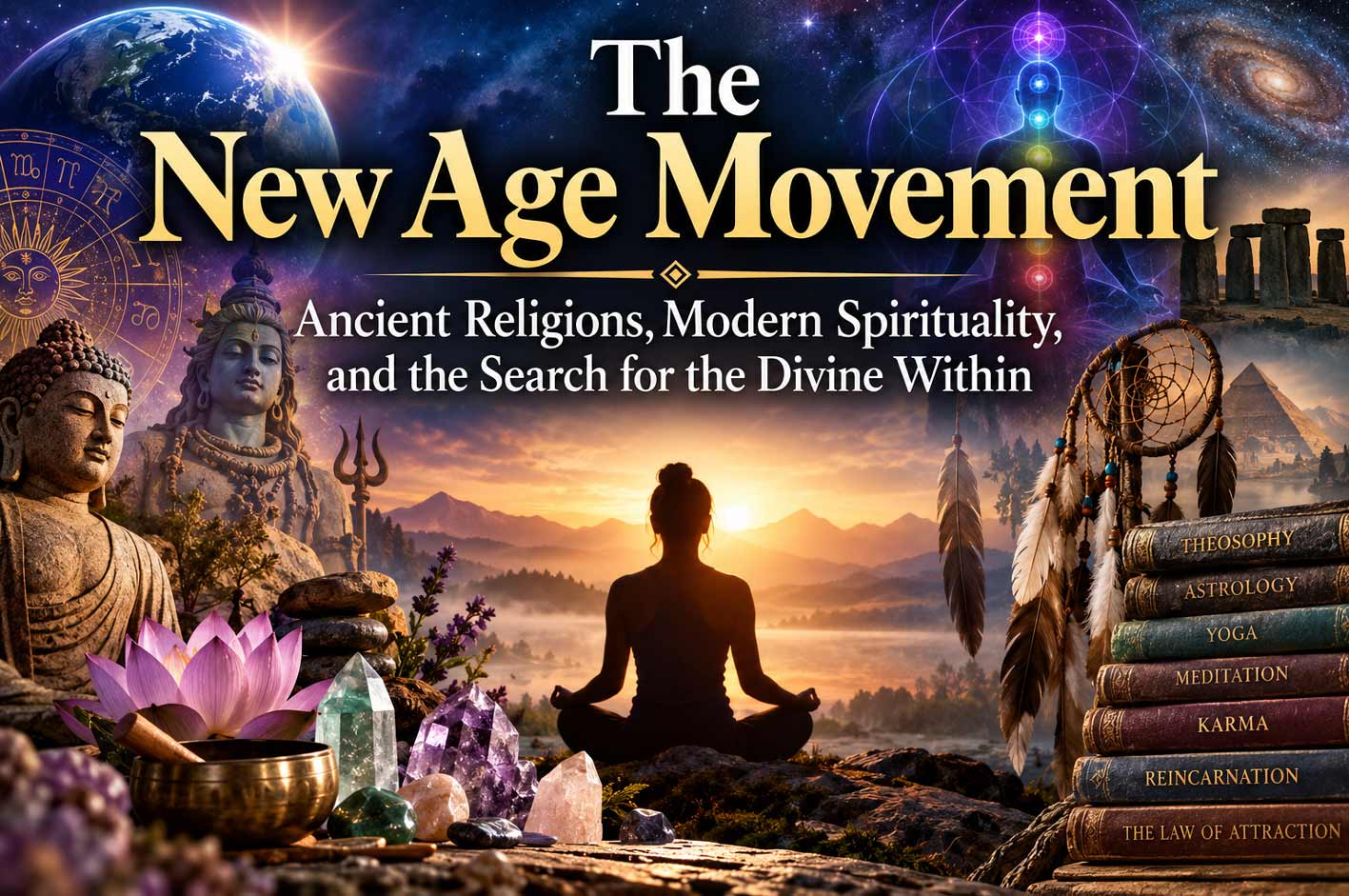
The New Age movement is difficult to define for the simple reason that nobody is really in charge of it. There is no New Age pope, denomination, creed, or headquarters. People who hold recognizably New Age beliefs may not even call themselves New Agers, and many of the ideas have migrated so thoroughly into popular culture that people use New Age language without knowing where it came from.
Walk through the spirituality section of a bookstore, however, and the family resemblance becomes easier to see. Astrology, reincarnation, chakras, crystals, meditation, spirit guides, psychic abilities, energy healing, karma, past lives, channeling, higher consciousness, manifestation, and the idea that all religions ultimately point toward the same spiritual reality frequently occupy neighboring shelves. Not every New Age believer accepts all of them, and some ideas come from traditions that long predate anything called the New Age movement. What holds the movement together isn’t a single doctrine so much as a way of looking at reality: the universe is fundamentally spiritual, humanity possesses an unrealized divine or higher nature, and spiritual transformation comes through awakening to realities that conventional Western religion and materialistic science have failed to recognize.
The movement became highly visible in the 1960s through the 1980s, but its roots reach much farther back. To understand New Age spirituality, we have to travel through Western occultism, Spiritualism, Theosophy, Hinduism, Buddhism, astrology, alternative healing, psychology, and eventually the counterculture. It is less a new religion than an enormous spiritual mixing bowl.
Before the New Age
Western culture had long contained mystical, esoteric, and occult traditions alongside institutional Christianity. Renaissance thinkers experimented with Hermeticism, astrology, alchemy, and forms of Christian mysticism. Rosicrucianism and later Freemasonry developed elaborate symbolic systems, while various occult movements claimed access to hidden spiritual knowledge unavailable through ordinary religious institutions.
The nineteenth century created especially fertile ground for new spiritual movements. Traditional Christianity remained culturally powerful, but industrialization, scientific discoveries, biblical criticism, evolutionary theory, and increasing contact with non-Western religions were changing the intellectual environment. Some people rejected religion altogether. Others began searching for a spirituality that could absorb new ideas without surrendering belief in an unseen world.
Spiritualism became one important part of that environment. Beginning prominently with the Fox sisters in New York in 1848, Spiritualists claimed that living people could communicate with the dead through mediums, séances, automatic writing, rappings, and other phenomena. Spiritualism became enormously popular in both America and Europe and helped normalize the idea that individuals could obtain spiritual knowledge through direct experiences outside churches and traditional revelation.
New Thought developed during roughly the same period and emphasized the relationship between mind, belief, health, and circumstances. Phineas Quimby, Emma Curtis Hopkins, and later movements such as Unity taught in various ways that thought and spiritual understanding could affect physical experience. Some of that vocabulary eventually fed directly into New Age ideas about positive thinking, healing, abundance, and manifestation.
But the single most important bridge between nineteenth-century occultism and later New Age spirituality was probably Theosophy.
Helena Blavatsky and Theosophy
The Theosophical Society was founded in New York in 1875 by Helena Petrovna Blavatsky, Henry Steel Olcott, William Quan Judge, and others. Blavatsky quickly became its dominant intellectual personality. Born in the Russian Empire, she claimed extensive travels and encounters with spiritually advanced teachers whom Theosophists often called Masters or Mahatmas.
Blavatsky argued that the world’s religions contained fragments of a much older universal wisdom tradition. Christianity, Hinduism, Buddhism, ancient Egyptian religion, Western occultism, and other traditions could therefore be studied as different expressions of deeper spiritual truths. Theosophy wasn’t satisfied with asking which religion was correct. It attempted to get behind all religions to the supposedly ancient wisdom from which they had developed.
Her major works, particularly Isis Unveiled and The Secret Doctrine, combined material from religion, mythology, occultism, Eastern philosophy, speculative history, and esoteric interpretation. The resulting system was complicated, and sometimes spectacularly so. Humanity progressed through enormous cosmic cycles, spiritual evolution extended far beyond Darwinian biological evolution, and hidden Masters supposedly guided human development from behind the scenes.
Theosophy gave later New Age spirituality several ideas that would become almost foundational: religions share an underlying spiritual truth, humanity is evolving toward higher consciousness, advanced spiritual beings guide that development, reincarnation and karma explain human existence, and ancient Eastern religions preserve wisdom neglected by the modern West.
Blavatsky didn’t invent most of those ideas. Her importance was in assembling them into a Western esoteric system and helping create an audience ready to receive them.
The Eastern Connection
The New Age movement owes an enormous debt to Hindu and Buddhist traditions, although the versions that entered Western popular spirituality were often simplified, reinterpreted, or detached from their original religious settings.
From Hinduism came concepts such as karma, reincarnation, yoga, chakras, meditation, and the possibility of discovering a deeper spiritual identity beneath ordinary consciousness. Hindu traditions themselves are enormously diverse, so saying “Hinduism teaches” any single New Age proposition can quickly become misleading. Nevertheless, Western spiritual seekers found concepts in Vedanta and other Hindu traditions that seemed to support the idea that the individual self participates in or is ultimately connected with a universal divine reality.
Teachers from India helped bring these ideas directly to Western audiences. Swami Vivekananda’s appearance at the World’s Parliament of Religions in Chicago in 1893 was particularly important. Later teachers and organizations introduced Americans and Europeans to various forms of Vedanta, yoga, meditation, and devotional spirituality.
Buddhist ideas entered the Western spiritual marketplace as well. Meditation, mindfulness, enlightenment, detachment from ego, and altered states of consciousness became attractive to people looking for spirituality without traditional Western theism. As with Hinduism, Western adaptations frequently removed practices from the larger religious systems in which they originally functioned.
The result was sometimes genuine cross-cultural learning and sometimes spiritual cherry-picking. A person could borrow reincarnation from Hinduism, meditation from Buddhism, angels from Christianity, astrology from ancient pagan traditions, Native American imagery, and a little modern psychology and feel no obligation to explain whether these systems actually agreed with one another.
That freedom to combine traditions became one of the defining characteristics of New Age spirituality.
Alice Bailey and the Coming New Age
Another major figure in the transition from Theosophy to modern New Age thought was Alice Bailey. Born in England in 1880, Bailey became involved with the Theosophical Society before eventually developing her own teachings. She claimed to receive telepathic communications from a spiritual teacher known as Djwal Khul, often called “the Tibetan.”
Bailey wrote extensively about spiritual evolution, esoteric psychology, meditation, cosmic hierarchy, and humanity’s movement into a new spiritual era. Her writings helped popularize expectations of an approaching transformation in human consciousness and contributed to the vocabulary that would later surround the Age of Aquarius.
Astrologically, an “age” refers to a vast period associated with the precession of the equinoxes. New Age writers frequently interpreted the movement from the Age of Pisces into Aquarius as more than an astronomical or astrological change. Aquarius became a symbol of humanity moving beyond old religious institutions, conflict, dogmatism, and materialism into an era of spiritual awakening, unity, peace, and expanded consciousness.
Precisely when the Age of Aquarius begins depends on whom you ask, which is convenient when an age lasts roughly two thousand years. But the expectation of a coming transformation became enormously influential.
The “New Age” was therefore originally more than a marketing label. It expressed the expectation that humanity itself was entering a new stage of spiritual evolution.
Astrology
Astrology became one of the most recognizable elements of New Age culture, although it obviously predates the movement by thousands of years. Ancient Mesopotamians, Greeks, Romans, Persians, Indians, and others developed astrological systems connecting celestial movements with earthly events.
Modern New Age astrology increasingly focused on individual personality and spiritual development. A person’s birth chart could supposedly reveal character, relationships, challenges, opportunities, and spiritual lessons. Sun signs became the simplified popular version, producing the familiar newspaper horoscope in which one-twelfth of humanity apparently needed to avoid major financial decisions on Tuesday.
More sophisticated practitioners work with planets, houses, aspects, rising signs, lunar positions, and complete natal charts. Some connect astrology with karma and reincarnation, interpreting a person’s birth circumstances as part of a larger spiritual journey.
Christianity historically rejected astrology as a means of spiritual guidance because biblical religion directs people toward God rather than celestial objects or divinatory systems for knowledge of their destiny. The disagreement isn’t about whether stars exist or whether the heavens display God’s glory. It is about whether the positions of those objects provide a hidden system for interpreting human lives.
Karma and Reincarnation
Reincarnation became one of the most widespread Eastern ideas adopted by Western New Age spirituality. Human beings are understood to live multiple earthly lives, gradually learning lessons and developing spiritually.
Karma provides the moral or spiritual mechanism connecting those lives. Actions have consequences that may extend beyond the present lifetime, so circumstances encountered now can sometimes be interpreted as results of previous existence.
But New Age versions of karma frequently differ substantially from Hindu, Buddhist, and Jain understandings. In Western popular spirituality, karma can become little more than cosmic payback: do something bad and eventually the universe sends the bill. Traditional Asian treatments are generally considerably more complicated.
Reincarnation also changes the basic shape of salvation. Christianity presents human life as moving toward death, resurrection, judgment, and eternal destiny. Reincarnation presents existence as a repeated cycle in which consciousness or the soul returns through multiple lives until some form of liberation, enlightenment, or spiritual advancement occurs.
Those aren’t two different descriptions of the same journey. They are different journeys.
The Divine Within
Perhaps the most characteristic New Age idea is that humanity’s fundamental spiritual problem is ignorance rather than sin.
People don’t primarily need forgiveness from a holy God. They need awakening. Beneath the ego, social conditioning, fear, and ordinary consciousness lies a deeper spiritual identity connected with divine or universal reality.
Exactly what that means varies considerably. Some New Age thinkers are pantheistic, identifying God with everything that exists. Others are panentheistic, seeing the universe as existing within a larger divine reality. Some speak less personally of universal consciousness, cosmic intelligence, Source, Spirit, or simply “the Universe.”
The vocabulary changes, but the direction is similar. Instead of God being fundamentally distinct from creation, divinity is discovered within or through creation and frequently within the self.
That produces one of the sharpest contrasts with Christianity. Christianity certainly teaches that believers are indwelt by the Holy Spirit and transformed into the image of Christ, but it never concludes that human beings discover they were God all along. Creator and creation remain distinct.
The Christian gospel says reconciliation is needed between God and humanity. New Age spirituality frequently says the perceived separation itself is the illusion.
Higher Consciousness
If humanity’s problem is spiritual ignorance, then expanding consciousness becomes a form of salvation.
Meditation, breathwork, visualization, yoga, psychedelic experiences, chanting, sensory deprivation, hypnosis, energy practices, and other techniques have all appeared somewhere within the broad New Age environment. The purpose varies, but practitioners often seek to move beyond ordinary awareness and experience deeper levels of reality.
The human mind is consequently treated as possessing capacities that conventional Western culture has ignored or suppressed. Intuition, telepathy, clairvoyance, precognition, astral projection, remote viewing, and other paranormal abilities may be interpreted as undeveloped aspects of consciousness.
Not every New Age practitioner believes in all of these things. That qualification is important because the movement has no central creed. Someone practicing mindfulness and believing vaguely in universal spiritual energy isn’t necessarily expecting to leave the body tonight and inspect Jupiter.
But the expectation that consciousness can expand beyond its ordinary limits runs through much of New Age spirituality.
Spirit Guides, Ascended Masters, and Channeling
The Spiritualist and Theosophical heritage becomes especially obvious in New Age beliefs about nonphysical intelligences.
Some practitioners believe individuals have spirit guides who provide protection, wisdom, or direction. Others speak of angels, higher selves, extraterrestrial beings, or Ascended Masters, spiritually advanced individuals who have transcended ordinary human existence and now assist humanity’s development.
Channeling involves allowing one of these beings or intelligences to communicate through a human intermediary. The channeler may enter an altered state, speak messages attributed to another entity, or produce written material believed to come from an external spiritual source.
One of the best-known modern examples was J. Z. Knight, who claimed beginning in the 1970s to channel an ancient warrior called Ramtha. Other channelers produced books and teachings attributed to spiritual entities, extraterrestrials, collective consciousnesses, or enlightened beings.
The resemblance to nineteenth-century Spiritualism isn’t accidental. The terminology changed, but the basic claim remained recognizable: human beings can receive information from intelligent entities beyond ordinary physical experience.
From a Christian perspective, the question isn’t merely whether such experiences feel real. Scripture itself doesn’t assume every spiritual experience is imaginary. It tells believers to test the spirits, which is a considerably more cautious approach than assuming anything encountered during an altered state of consciousness must be benevolent because it has soothing things to say about universal love.
Crystals, Energy, and Healing
Crystals became almost synonymous with New Age spirituality in popular culture. Different stones are believed by some practitioners to possess or interact with particular forms of energy and may be used for healing, emotional balance, meditation, protection, or spiritual development.
These beliefs often connect with a broader understanding of invisible energy flowing through or around the human body. Concepts borrowed or adapted from Asian traditions, such as chakras, prana, and qi, are sometimes combined with Western esoteric ideas about auras and subtle bodies.
Practices such as Reiki, energy healing, chakra balancing, therapeutic touch, and crystal healing developed or became popular within this larger alternative-spirituality environment. They shouldn’t all be treated as identical, and their practitioners may explain them very differently.
The language can also become confusing because energy has a precise meaning in physics and a much looser meaning in alternative spirituality. Saying that a crystal possesses physical energy is trivial; everything physical does. Saying that a particular crystal directs invisible spiritual energy capable of healing disease is a very different claim requiring different evidence.
Using the same word doesn’t make the two concepts scientifically equivalent.
Holistic Health
New Age spirituality developed alongside growing interest in holistic health, the idea that physical health should be understood in connection with mental, emotional, environmental, and spiritual well-being.
There is nothing inherently New Age about recognizing that stress, relationships, sleep, nutrition, mental health, and physical health affect one another. Modern medicine itself recognizes many of these relationships. Problems arise when legitimate holistic concerns become attached to unsupported claims about invisible energies, miracle cures, or treatments offered as substitutes for effective medical care.
The New Age marketplace has included everything from sensible lifestyle practices to treatments supported by little more than testimonials and spiritual vocabulary. That range makes sweeping judgments difficult.
Christians don’t need to choose between believing God created the whole person and believing medicine works. Prayer and doctors have never been natural enemies except when someone insists on making them so.
Manifestation and the Law of Attraction
One of the most successful New Age ideas to migrate into mainstream culture is manifestation.
The basic concept is that thoughts, beliefs, intentions, emotions, or spiritual vibrations influence what people attract into their lives. Positive thoughts supposedly attract positive circumstances, while negative thinking can attract unwanted experiences.
The modern Law of Attraction draws heavily from New Thought traditions and became enormously popular through books, seminars, motivational speakers, and especially The Secret in the early twenty-first century.
There is an obvious grain of truth that helps make the idea persuasive. Beliefs affect behavior. Optimistic people may persevere longer, notice opportunities, interact differently with others, and make decisions that improve their circumstances. Constant pessimism can certainly become self-defeating.
But that psychological observation is very different from claiming that thoughts send frequencies into the universe that magnetically attract houses, relationships, parking spaces, or financial abundance.
The distinction matters particularly when suffering enters the picture. If people create reality through their thoughts, poverty, illness, abuse, and tragedy can quietly become evidence that victims manifested the wrong circumstances. A philosophy intended to empower people can become remarkably cruel when applied consistently.
Past-Life Regression
Belief in reincarnation naturally produced interest in discovering previous lives. Past-life regression generally uses hypnosis or guided imagery to help individuals recover experiences interpreted as memories from earlier incarnations.
People have reported remarkably detailed stories involving historical settings, relationships, deaths, and identities. Advocates sometimes present apparently accurate details as evidence of reincarnation.
Critics point to the extraordinary suggestibility of human memory. Hypnosis doesn’t function like opening a perfectly preserved video archive in the brain. People can construct false memories, combine forgotten information with imagination, respond to suggestions, and become increasingly confident in events that never occurred.
That doesn’t prove every unusual memory report has an obvious explanation. It does mean that vividness and sincerity aren’t enough to establish that someone lived in medieval France.
Memory is evidence that requires investigation, not a time machine.
Native American and Indigenous Spirituality
New Age spirituality has also borrowed extensively from Native American and other Indigenous religious traditions. Sweat lodges, vision quests, shamanic journeys, animal guides, medicine wheels, drumming, and ideas about sacred relationships with nature have all appeared in New Age settings.
This borrowing has become controversial because practices belonging to particular peoples and traditions are sometimes detached from their original communities and repackaged for Western consumers. A ceremony with a specific cultural and religious meaning can become a weekend workshop taught by someone with little connection to the people from whom it supposedly came.
The term shamanism itself has been expanded far beyond its original cultural context and is now used broadly for practices involving altered consciousness, spirit journeys, healing, and interaction with nonphysical beings.
The attraction is understandable. Modern industrial society can leave people feeling disconnected from nature, community, ritual, and the sacred. But appreciating another culture’s spiritual tradition and manufacturing a generic “Native spirituality” from selected pieces of many cultures aren’t the same thing.
The New Age tendency to see all spiritual traditions as expressions of one underlying truth makes that distinction especially easy to overlook.
Wicca, Paganism, and the Occult
New Age spirituality overlaps with modern Paganism, Wicca, ceremonial magic, astrology, Tarot, divination, and various occult traditions, but they shouldn’t simply be collapsed into one religion.
Wicca, for example, developed as a modern Pagan religious movement with its own history, rituals, ethical traditions, and understandings of deity. Many Wiccans wouldn’t describe themselves as New Age at all.
Tarot likewise began historically as playing cards before becoming associated with divination and esoteric interpretation. Modern practitioners may use Tarot to predict future events, explore psychological patterns, stimulate intuition, or provide symbolic frameworks for personal reflection.
New Age bookstores brought many of these traditions into the same commercial environment, which helped blur distinctions. Someone interested in meditation might encounter Tarot cards, crystals, astrology charts, books on Buddhism, angel guides, Wiccan supplies, and aromatherapy without being expected to choose one coherent theological system.
That marketplace itself helped shape modern spirituality. Religion increasingly became something individuals assembled rather than something they inherited.
Psychology Joins the Movement
Twentieth-century psychology contributed another major stream to New Age thinking.
Carl Jung was especially influential because of his interest in archetypes, dreams, mythology, synchronicity, religion, alchemy, and the collective unconscious. Jung wasn’t simply a New Age teacher, and reducing his complex psychological theories to New Age spirituality would be unfair. Nevertheless, his work provided concepts that later spiritual writers eagerly adopted.
The human potential movement of the 1960s and 1970s further blurred the boundaries between psychology and spirituality. Organizations and retreat centers experimented with encounter groups, meditation, altered consciousness, bodywork, Eastern philosophy, and methods intended to unlock unrealized human capacities.
California became particularly associated with this mixture, especially places such as the Esalen Institute. The broader cultural message was increasingly that human beings possessed hidden potential suppressed by conventional society, rigid religion, and ordinary patterns of thought.
Psychological growth and spiritual awakening began speaking the same language.
The Counterculture and the New Age Explosion
The social upheavals of the 1960s created ideal conditions for these previously separate streams to converge.
Many young Americans and Europeans distrusted traditional institutions, including churches. Eastern religions became increasingly visible. Psychedelic drugs introduced millions of people to unusual states of consciousness. The environmental movement encouraged a more holistic understanding of humanity and nature. Opposition to war produced dreams of global unity, while popular music carried Eastern and mystical themes into ordinary homes.
The Beatles’ interest in Indian spirituality, particularly their association with Maharishi Mahesh Yogi and Transcendental Meditation, helped make Eastern religious practices culturally fashionable. George Harrison’s embrace of Hindu spirituality went considerably deeper and introduced millions of Western listeners to explicitly devotional Indian ideas.
By the 1970s and 1980s, what had once belonged to occult societies and small esoteric circles had become part of popular culture. Bookstores developed New Age sections. Shirley MacLaine wrote about reincarnation and spiritual experiences. Channelers attracted audiences. Crystals, meditation, astrology, holistic healing, and psychic development became recognizable features of the cultural landscape.
The movement didn’t need a headquarters because the culture itself increasingly became the distribution system.
UFOs and Extraterrestrials
The New Age movement also developed a substantial extraterrestrial wing.
Some people came to believe that advanced beings from other planets were assisting humanity’s spiritual evolution. UFO encounters could be interpreted not simply as technological contact but as spiritual experiences. Extraterrestrials became cosmic teachers warning humanity about nuclear weapons, environmental destruction, materialism, or spiritual immaturity.
This is the environment from which movements such as Raëlism and, in a very different way, Heaven’s Gate could emerge. Both incorporated extraterrestrials into religious systems, although their beliefs and conclusions differed dramatically.
The connection between UFOs and New Age spirituality isn’t difficult to understand. Once spiritual evolution, Ascended Masters, channeling, cosmic consciousness, and hidden higher beings are accepted, moving some of those beings to another planet isn’t a particularly large conceptual leap.
Sometimes angels became extraterrestrials. Sometimes extraterrestrials functioned very much like angels.
A Course in Miracles
One of the more explicitly Christian-sounding expressions of New Age spirituality emerged through A Course in Miracles, first published in the 1970s.
Helen Schucman, a psychologist, claimed that an inner voice she identified as Jesus dictated the material to her. The resulting work uses Christian vocabulary extensively, including God, Christ, forgiveness, salvation, miracles, and the Holy Spirit.
But those terms are given meanings substantially different from historic Christianity. The physical world is treated as connected with illusion and separation, while salvation involves a transformation of perception and recognition of spiritual unity.
This makes A Course in Miracles an especially useful example of why theological vocabulary alone tells us very little. Two people can talk for an hour about Jesus, salvation, miracles, and God while meaning completely different things by every word.
Christian apologetics therefore has to listen past vocabulary to definitions.
Are All Religions Really One?
Religious pluralism lies close to the heart of much New Age spirituality. Different religions are often understood as culturally conditioned paths toward the same ultimate spiritual reality.
That idea is attractive because it appears tolerant and inclusive. Instead of Christians, Hindus, Buddhists, Muslims, Jews, and others fighting over who is right, everyone can be understood as approaching the same mountain from different directions.
The difficulty is that the religions themselves make contradictory claims.
Christianity teaches a personal Creator distinct from creation. Some Hindu philosophies understand ultimate reality very differently. Buddhism doesn’t require the Christian Creator at all. Islam rejects the Christian doctrine of the Trinity and Incarnation. Christianity says Jesus was crucified and raised from the dead; Islam traditionally denies the crucifixion as Christianity understands it.
Saying all religions teach the same thing works only by ignoring a considerable amount of what the religions actually teach.
Respecting another religion doesn’t require pretending disagreement doesn’t exist. In fact, taking another person’s beliefs seriously enough to acknowledge the disagreement may be more respectful than rewriting everyone’s religion until they all agree with ours.
Jesus in New Age Spirituality
Jesus appears frequently in New Age thought, but usually not as the unique incarnate Son of God proclaimed by historic Christianity. He may be described as an enlightened master, spiritual teacher, avatar, example of Christ consciousness, member of a hierarchy of Ascended Masters, or human being who fully realized the divine potential available to everyone.
The distinction between Jesus and the Christ becomes especially important in some systems. Jesus was the historical individual; Christ represents a universal divine consciousness that Jesus embodied exceptionally well but that others can potentially experience.
This preserves admiration for Jesus while rejecting the Christian claim that He is uniquely God incarnate.
It also changes the gospel completely. Jesus no longer comes primarily to accomplish something humanity cannot accomplish for itself. He comes to demonstrate what humanity can discover within itself. The difference between those two ideas is enormous.
Sin or Ignorance?
Christianity and New Age spirituality diagnose the human condition differently, and almost everything else follows from that disagreement.
Christianity says human beings are created in God’s image but alienated from Him by sin. We don’t merely need better information or expanded consciousness. We need reconciliation, forgiveness, transformation, and ultimately resurrection.
New Age spirituality generally approaches the problem as ignorance, imbalance, fear, ego, negative consciousness, forgotten divinity, blocked energy, or failure to recognize our connection with the larger spiritual whole. Different teachers use different language, but the solution usually involves awakening rather than atonement.
That makes the cross difficult to fit into a New Age worldview. If humanity’s fundamental problem is ignorance of its divine nature, a Savior bearing sin becomes unnecessary. Jesus becomes much easier to understand as a teacher showing us how to awaken.
The resurrection undergoes a similar transformation. Christianity proclaims something God did in history to Jesus’ dead body. New Age interpretations are more likely to treat resurrection symbolically as spiritual awakening, transformation, or demonstration of higher consciousness.
The two systems can use the same words while telling very different stories.
Why the New Age Movement Became So Influential
New Age spirituality succeeded partly because it offered modern Westerners something many wanted: spirituality without institutional religion.
People could meditate without joining a church, believe in an afterlife without accepting a creed, admire Jesus without submitting to Christian doctrine, borrow from Buddhism without becoming Buddhist, practice yoga without becoming Hindu, and believe in divine reality without necessarily calling it God.
It was highly individualistic, which made it particularly compatible with modern Western culture. Instead of asking, “Which religion is true?” the question increasingly became, “Which spiritual practices work for me?”
That shift has outlived the New Age label itself.
Someone today may talk about manifestation, vibrations, energy, the universe sending signs, past lives, spirit guides, karma, astrology, chakras, crystals, and higher consciousness while insisting they aren’t religious at all. In one sense they’re right: they may belong to no religious institution.
Historically, however, those ideas didn’t simply appear out of nowhere. They belong to a long spiritual genealogy.
From New Age to “Spiritual but Not Religious”
The phrase New Age isn’t nearly as fashionable as it once was. The movement didn’t disappear; much of it simply became mainstream.
Yoga studios, meditation apps, astrology websites, manifestation videos, energy healing, mindfulness retreats, crystal shops, psychedelic spirituality, wellness influencers, and social-media discussions of vibrations and the universe carry forward ideas that would once have been immediately identified with New Age culture.
The modern phrase “spiritual but not religious” captures much of this transition. People increasingly construct personal spiritual systems without joining formal religious organizations. One person might believe in God, reincarnation, astrology, guardian angels, karma, manifestation, and Jesus while seeing no contradiction because the beliefs weren’t acquired as parts of complete theological systems.
That makes contemporary New Age spirituality harder to identify but probably more culturally influential.
The New Age movement didn’t conquer Western religion by creating a giant denomination. It succeeded in almost the opposite way: many of its ideas escaped the movement entirely.
Christianity and the New Age
Christians sometimes responded to the New Age movement by treating everything remotely unusual as demonic, which wasn’t particularly helpful. Meditation isn’t one single practice. Stretching exercises don’t secretly convert someone to Hinduism. Interest in nutrition isn’t occultism. Recognizing that mental and physical health interact isn’t New Age theology.
At the same time, Christians shouldn’t miss genuine theological conflicts simply because New Age spirituality uses positive language about love, peace, healing, spiritual growth, and Jesus. The central questions remain substantial. Is God the Creator or an impersonal universal consciousness? Are human beings creatures made in God’s image or expressions of divinity awakening to themselves? Is our deepest problem sin or ignorance? Do we live once or repeatedly through reincarnation? Is Jesus uniquely God incarnate or one enlightened teacher among many? Is salvation reconciliation with God through Christ or discovery of the divine within?
The New Age movement is fascinating precisely because it brings so many religious ideas together. Theosophy supplied the framework of ancient hidden wisdom and spiritual evolution. Hindu and Buddhist traditions supplied reincarnation, karma, meditation, yoga, and concepts of enlightenment. Spiritualism supplied communication with unseen beings. Western occultism supplied astrology, esotericism, and magical traditions. New Thought contributed the power of mind and positive thinking. Psychology contributed self-actualization and expanded consciousness. Indigenous traditions were selectively incorporated, and modern science supplied vocabulary involving energy, vibration, dimensions, evolution, and eventually extraterrestrial life.
The result isn’t one single religion, but a spiritual ecosystem.
And perhaps the most important thing Christians can understand about the New Age movement is that its deepest promise isn’t really crystals, astrology, reincarnation, or UFOs. Those are branches. The deeper promise is that the truth we need is already hidden somewhere within us, waiting to be discovered.
Christianity begins with a very different claim: the truth we most desperately need came to us.