

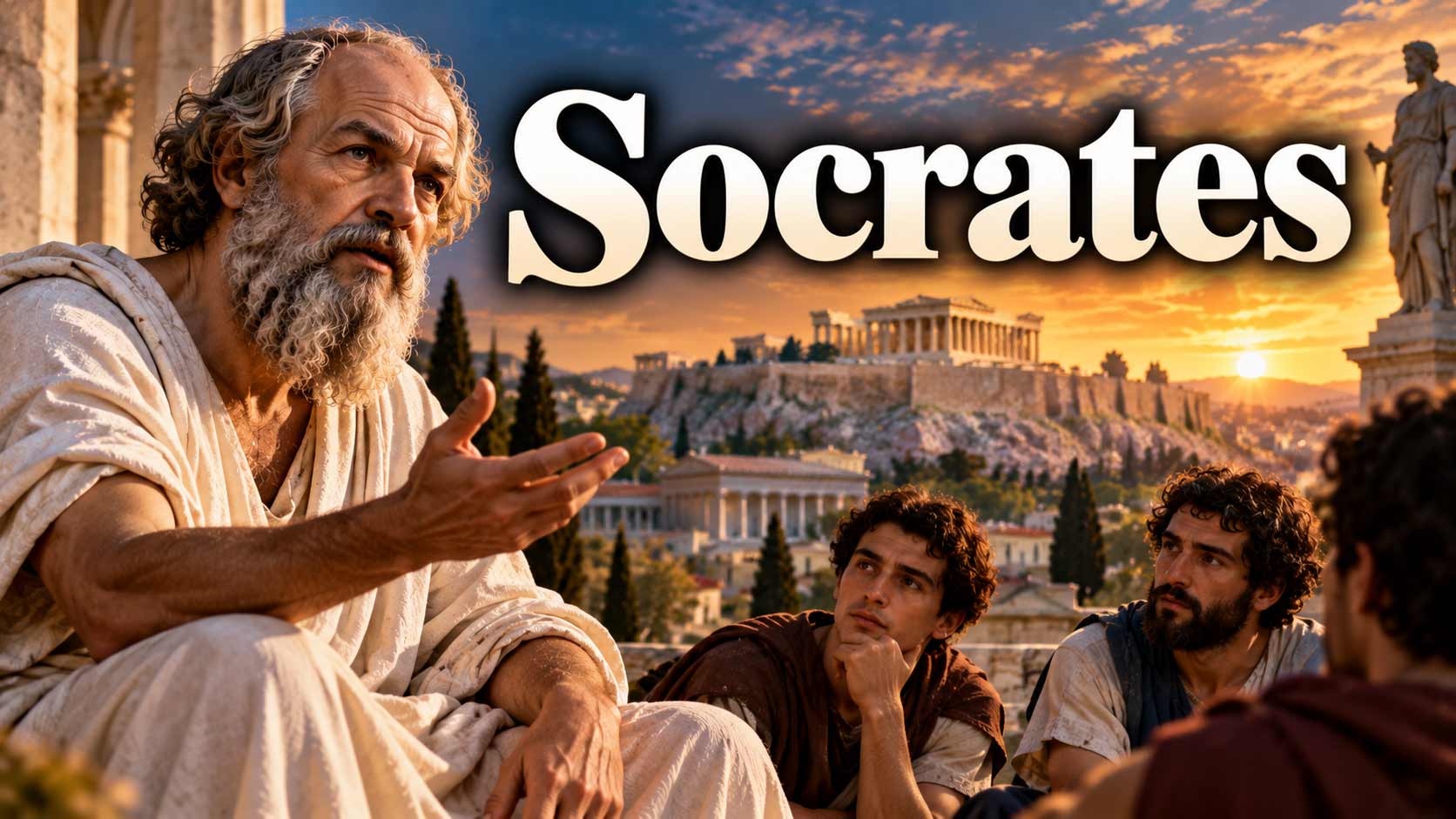
Socrates is one of the strangest major figures in intellectual history. He wrote no books, founded no school in the ordinary sense, charged no tuition, left behind no systematic philosophy, and spent much of his time wandering around Athens asking people questions until they discovered they didn’t know nearly as much as they thought they did. The city eventually responded by putting him to death.
Yet Western philosophy is almost impossible to imagine without him. Plato made him the central figure in many of his dialogues. Aristotle treated him as an important turning point in Greek thought. Stoics admired him, skeptics claimed him, Christian thinkers argued with him and sometimes praised him, and philosophers have been trying to figure out exactly what he believed for more than two thousand years.
Socrates changed philosophy partly because he changed the question. Earlier Greek thinkers had often concentrated on the nature of the cosmos: What is everything made of? How did the universe begin? What explains change? Socrates turned philosophical attention toward the human person. What is justice? What is courage? What is virtue? What makes a life good?
And perhaps most uncomfortably: How do you know?
Athens in the Fifth Century BC
Socrates was born in Athens around 470 BC, during one of the most remarkable periods in Greek history. Athens was becoming the cultural and political center of the Greek world, experimenting with democracy while producing achievements in architecture, drama, history, art, and philosophy that would influence Western civilization for millennia.
It was also a city at war surprisingly often. Athens fought Persia, built an empire of its own, and eventually entered the disastrous Peloponnesian War against Sparta and its allies. Socrates lived through Athens’ rise, confidence, military catastrophe, political instability, and eventual defeat.
His father, Sophroniscus, is traditionally described as a stonemason or sculptor, while his mother, Phaenarete, was a midwife. Socrates himself served as an Athenian soldier and appears to have performed courageously in several military campaigns. Plato’s dialogues describe him enduring cold, hardship, and danger with unusual self-control.
Physically, Socrates was hardly the Greek ideal. Ancient descriptions portray him as short or stocky, with a broad nose, bulging eyes, and an appearance sometimes compared with the comic figure Silenus. His admirers weren’t following him because he looked like Apollo. His attraction was intellectual and personal. Socrates had an extraordinary ability to make ordinary conversations become questions about how a person should live.
The Problem of Knowing Socrates
Writing about Socrates presents an immediate problem: Socrates didn’t write anything.
Almost everything we know about him comes through other people, and those people don’t always give us the same Socrates. The most important source is his student Plato, whose dialogues feature Socrates as the principal speaker in many cases. But Plato was also a philosopher of enormous originality, so scholars have spent centuries trying to determine where the historical Socrates ends and Plato begins.
Another student, Xenophon, portrays Socrates as a practical moral teacher concerned with virtue, discipline, friendship, household management, and proper conduct. The comic playwright Aristophanes gives us something entirely different. In his play The Clouds, performed while Socrates was still alive, Socrates appears as an absurd intellectual running a “Thinkery,” speculating about the heavens and teaching clever arguments.
Aristophanes was writing comedy, not biography, but the caricature tells us something important. Socrates was already famous enough in Athens to be recognizable from the stage. Plato, Xenophon, and Aristophanes therefore give us overlapping but different portraits. Historians call the challenge of reconstructing the actual man the Socratic problem.
The irony is appropriate. Even our knowledge of the man famous for asking what we really know begins with uncertainty about what we really know.
The Oracle at Delphi
One of the most famous stories about Socrates comes from Plato’s Apology, which presents Socrates’ defense at his trial. Socrates’ friend Chaerephon supposedly asked the oracle at Delphi whether anyone was wiser than Socrates. The oracle answered that no one was wiser.
Socrates found this puzzling because he didn’t consider himself wise. So he began questioning people who possessed reputations for wisdom: politicians, poets, craftsmen, and others. Again and again he discovered that people who believed themselves wise often couldn’t adequately explain what they claimed to know.
Socrates eventually concluded that the oracle’s meaning was something like this: his peculiar wisdom consisted in recognizing the limits of his knowledge. This is the background to the famous saying commonly summarized as “I know that I know nothing.” Socrates doesn’t quite say it in that familiar form in Plato, but the phrase captures something important about his attitude. He knew enough to know that he wasn’t entitled to pretend certainty where he didn’t possess it.
That wasn’t skepticism for its own sake. Socrates wasn’t saying that nothing can be known. He was trying to clear away false confidence so that genuine inquiry could begin.
The Socratic Method
The approach associated with Socrates is usually called the Socratic method. It often begins innocently enough. Someone claims to know what courage is, or justice, or piety. Socrates asks for a definition. The person gives one. Socrates asks whether the definition applies in another situation. A contradiction appears. The definition is modified, and Socrates asks another question. Eventually the confident expert is considerably less confident.
Plato’s dialogue Euthyphro provides a classic example. Socrates encounters Euthyphro, who is confident that he understands piety well enough to prosecute his own father. Socrates asks him to explain what piety actually is. Euthyphro offers one answer after another, and Socrates keeps showing that the definitions don’t quite work.
The conversation produces one of philosophy’s enduring questions: Is something good because the gods command it, or do the gods command it because it is good?
The Euthyphro dilemma, as it came to be called, continues to appear in discussions of God and morality. Christian philosophers have offered several responses, including the argument that goodness isn’t an arbitrary rule existing above God or something God simply invents; rather, goodness is grounded in God’s own nature.
Socrates had a remarkable talent for starting conversations in ancient Athens that people are still arguing about on the internet 2,400 years later.
Definitions Matter
Socrates’ questions weren’t verbal games. He believed that unclear thinking about moral concepts produced unclear living.
Suppose someone says courage means fearlessness. That sounds reasonable until Socrates asks whether a person who recklessly runs into danger because he doesn’t understand the danger is courageous. Perhaps courage requires knowledge. But what kind of knowledge? And does knowledge alone make someone courageous?
The same process can be applied to justice, friendship, goodness, piety, and virtue. Socrates was searching for what these things actually are rather than merely collecting examples. A courageous soldier is an example of courage, but pointing to the soldier doesn’t tell us what makes courage courage.
That search for definitions became enormously important for philosophy. Before we can argue intelligently about whether something is just, we need some idea what justice means. It sounds obvious until five people try to define it.
Virtue and Knowledge
One of the most distinctive ideas associated with Socrates is the close relationship between virtue and knowledge. Socrates appears to have believed that people do wrong fundamentally because they don’t truly understand the good. If someone genuinely knows what is good for the soul, he will pursue it. Evil therefore involves ignorance.
This leads to the Socratic claim that no one knowingly does wrong. People certainly perform actions they know society condemns, but Socrates’ point runs deeper. The wrongdoer still believes, at the moment of action, that some perceived benefit makes the action worth choosing.
A thief wants the money. A tyrant wants power. A coward wants safety. Each pursues what appears to him as a good, even when his understanding of the good is badly distorted. This makes moral education extremely important. If virtue depends upon knowledge, then becoming good requires learning to understand what is genuinely good rather than simply following desires.
Christianity agrees that ignorance can contribute to sin, but it gives a considerably darker diagnosis of the human condition. People don’t merely misunderstand the good. They can recognize something as wrong and choose it anyway. Paul describes that internal conflict with uncomfortable familiarity in Romans 7.
Socrates believed education could transform the soul because truth properly understood changes behavior. Christianity says we need truth, but we also need transformation of the will.
Care for the Soul
Socrates repeatedly emphasized what might be called care of the soul. Athenians devoted enormous energy to wealth, reputation, political power, physical appearance, and social status. Socrates asked why they spent so little effort developing the part of themselves that determined whether they were actually good.
For Socrates, the health of the soul mattered more than external success. Wealth couldn’t make a bad person good, while virtue could guide the proper use of wealth and everything else. This helps explain why Socrates could irritate powerful people while apparently remaining relatively indifferent to his own poverty. He judged success by a different standard.
Plato portrays him as believing that committing injustice is worse than suffering it. Being wronged can damage your body, possessions, or reputation. Doing wrong damages your soul. That is a remarkably demanding moral principle, and it is one reason later Christian thinkers sometimes found Socrates strangely familiar.
Socrates and Religion
Socrates is sometimes presented as a secular rationalist who challenged Greek religion and was executed for atheism. The reality is more complicated.
He clearly questioned conventional assumptions about the gods, particularly stories portraying them behaving immorally. But Socrates also spoke seriously about divine matters, prayer, religious obligations, and his sense of a divine mission.
Most famously, he described something he called his daimonion, often translated as a divine sign or inner voice. Socrates said this sign had accompanied him since childhood and warned him against certain actions. It didn’t normally tell him what to do. It restrained him from doing particular things.
Exactly what Socrates meant remains debated. It could be interpreted as conscience, intuition, religious experience, or something more explicitly supernatural. Socrates himself appears to have understood it religiously.
This makes the later accusation that he simply didn’t believe in divine things rather awkward. Socrates’ problem wasn’t that he had no religion. It was that his religious ideas didn’t always fit comfortably inside the expectations of Athens.
Socrates and the Sophists
Socrates is often associated with the Sophists, but he and Plato worked hard to distinguish him from them. The Sophists were traveling teachers who offered instruction in rhetoric, argument, politics, and other skills useful for public life. In democratic Athens, the ability to persuade an assembly or jury could be enormously valuable, and successful Sophists could charge substantial fees.
Socrates didn’t charge students for instruction and denied that he possessed a body of wisdom he could simply transfer to them. The deeper difference concerned the purpose of argument. A skilled rhetorician might ask, “How can I persuade the audience?” Socrates wanted to know, “Is what I’m saying true?” Those aren’t always the same question.
This distinction helps explain Plato’s hostility toward rhetoric divorced from truth. A society in which persuasion matters more than reality can be manipulated by whoever learns to speak most effectively.
The problem hasn’t exactly disappeared.
Alcibiades and the Politics of Athens
Socrates’ relationships with several controversial figures created political problems for him.
One was Alcibiades, an extraordinarily talented and notoriously unreliable Athenian politician and military commander. Alcibiades shifted loyalties during the Peloponnesian War, defecting from Athens and becoming associated at different times with Sparta and Persia before eventually returning to Athens.
Another Socratic associate was Critias, who became one of the leaders of the Thirty Tyrants, the brutal oligarchic regime imposed after Athens’ defeat by Sparta in 404 BC.
Socrates wasn’t responsible for the actions of these men, and he himself demonstrated independence from political authorities. But Athenians living through military defeat, oligarchic terror, and political restoration had reasons to look suspiciously at a teacher associated with some of the city’s most notorious figures.
Ideas don’t exist outside history. Socrates’ trial occurred in a city carrying fresh political wounds.
The Trial of Socrates
In 399 BC, Socrates was brought to trial. The formal accusations were that he failed to recognize the gods recognized by the city, introduced new divine beings, and corrupted the youth. His accusers included Meletus, Anytus, and Lycon. Plato’s Apology presents Socrates responding to the charges before a large Athenian jury.
If Plato’s portrayal is anywhere close to the actual defense, Socrates didn’t exactly throw himself on the mercy of the court. He questioned his accusers, challenged their logic, defended his philosophical mission, and compared himself to a gadfly sent to stir a large but sluggish horse. Athens was the horse. Socrates was the irritating insect keeping it awake.
Most defendants probably avoided explaining to jurors that the city needed them because everyone else was intellectually sleepy. But Socrates apparently wasn’t interested in saving himself by pretending his life’s work had been a mistake.
“The Unexamined Life”
The most famous line associated with the trial is Socrates’ declaration that “the unexamined life is not worth living.”
The statement summarizes his entire approach to philosophy. Human beings shouldn’t merely drift through life absorbing the assumptions of family, culture, politics, religion, and ambition without asking whether those assumptions are true.
What is the good life? Why do I believe what I believe? What makes something just? What should I value? Am I pursuing things that actually make a person good? For Socrates, these weren’t academic questions reserved for professional philosophers. They were questions about whether a human being was living properly.
That helps explain why Socrates became so important. Philosophy before him often looked upward toward the stars or downward toward the elements. Socrates looked at the person standing in front of him and asked what kind of human being he was becoming.
Condemned to Death
The jury found Socrates guilty. Under Athenian procedure, the prosecution proposed a penalty, and the defendant could propose an alternative. The prosecution demanded death.
Socrates could have suggested a serious punishment that might have persuaded enough jurors to spare him. Instead, Plato has him initially suggest that he deserves free meals in the Prytaneum, an honor normally given to distinguished citizens and Olympic victors.
This was not an especially promising sentencing strategy. He eventually accepted the possibility of a fine, supported by friends including Plato. The jury nevertheless sentenced him to death. Execution in Athens was carried out by drinking hemlock, a poisonous plant whose effects eventually produce paralysis and death.
Why Didn’t Socrates Escape?
Socrates had another opportunity to save himself. Plato’s Crito describes his friend Crito visiting him in prison with a plan for escape. Friends were prepared to help Socrates leave Athens. Socrates refused.
His reasoning is one of the earliest important discussions of political obligation. Socrates argued that he had lived under the laws of Athens throughout his life, benefited from them, raised his family under them, and never chosen exile. He couldn’t simply accept the city’s legal system when it benefited him and reject it when it produced a result he disliked. More fundamentally, escaping would require him to answer injustice with injustice.
Whether Socrates was correct is another question. Christians aren’t obligated to obey every unjust command merely because government issued it; the apostles themselves said, “We must obey God rather than men.” But Socrates’ refusal demonstrates how seriously he took his principle that doing wrong is worse than suffering wrong.
His philosophy wasn’t merely something he discussed in the marketplace. Eventually he had to die by it.
The Death of Socrates
Plato describes Socrates’ final hours in the Phaedo.
Friends gathered around him in prison while Socrates discussed the soul, death, and immortality. Eventually the executioner brought the cup containing hemlock. Socrates drank it.
As the poison took effect, his legs became heavy and numb. The paralysis moved upward through his body until he died.
His final recorded words concerned a debt of a rooster to Asclepius, the Greek god associated with healing. Scholars have debated the meaning ever since. One interpretation is that Socrates regarded death as a kind of healing or release of the soul from the body, though certainty is impossible.
The philosopher who spent his life asking people whether they really knew what they claimed to know left us one final statement we’re still trying to interpret.
Socrates and the Immortal Soul
The immortality of the soul appears prominently in Plato’s portrayal of Socrates, especially in the Phaedo. But this is one of the places where the Socratic problem becomes particularly important.
Plato developed an extensive philosophy of the soul, eternal realities, knowledge, and the Forms. Determining how much of that system belonged to Socrates himself isn’t easy.
Still, Socrates clearly regarded the condition of the soul as more important than the body. Death therefore didn’t terrify him in the way one might expect. If death meant either unconsciousness or continued existence elsewhere, Socrates argued in the Apology, it wasn’t something a good person needed to fear irrationally.
There is an interesting point of contact with Christianity here, but also an important difference. Greek philosophical traditions often moved toward the idea of the soul escaping or surviving the body. Christianity’s ultimate hope isn’t simply an immortal soul leaving the body behind. It is resurrection. The Christian hope is not that we finally get rid of embodiment but that God redeems the whole person.
Socrates and Christianity
Socrates died almost four centuries before Jesus was crucified, so any attempt to turn him into a secret Christian would be historically ridiculous. Nevertheless, early Christians sometimes found him unusually interesting.
Justin Martyr, writing in the second century, regarded Socrates as someone who had lived according to reason and challenged false beliefs about the gods. Justin believed the divine Logos had been active before the incarnation, which allowed him to see genuine glimpses of truth among pre-Christian philosophers.
There are obvious reasons Christians could admire Socrates. He valued truth above popularity. He challenged immoral portrayals of the gods. He emphasized virtue over wealth. He cared about the soul. He accepted death rather than abandon what he believed was his divine calling.
There are also enormous differences. Socrates didn’t know the God of Israel as revealed in Scripture, didn’t proclaim Christ, didn’t understand sin and redemption in Christian terms, and didn’t possess the Christian hope of bodily resurrection.
Christians therefore don’t need to baptize Socrates intellectually in order to appreciate him. Paul himself demonstrates the better approach in Acts 17. Greek thought can contain genuine insight while still needing correction and completion in light of God’s revelation.
The Socratic Method and Christian Apologetics
Socrates has something particularly useful to teach Christian apologists: questions can expose assumptions more effectively than speeches. Suppose someone says, “There is no absolute truth.” A Socratic response might ask, “Is that statement absolutely true?”
If someone says morality is entirely subjective, the useful question may be what exactly follows when one society approves slavery and another condemns it. If morality is only preference, in what sense can we say the slaveholding society was actually wrong rather than merely different?
Questions force a person to examine the foundations underneath the conclusion.
Jesus Himself frequently used questions, though His method and authority were obviously different from Socrates’. “Who do you say that I am?” “Which of these three was a neighbor?” “What does it profit a man to gain the whole world and lose his soul?”
A good question can do something an argument sometimes can’t. It makes the other person participate in discovering the problem.
The Legacy of Socrates
Socrates’ immediate legacy came through his students, above all Plato.
Plato founded the Academy and developed one of the most influential philosophical systems in history. Plato’s student Aristotle then constructed another. Through them, questions that Socrates raised about virtue, knowledge, reason, politics, the soul, and the good life became foundational to Western philosophy.
Other Socratic traditions developed as well. Antisthenes influenced the tradition that became Cynicism. Aristippus became associated with the Cyrenaic school. Later Stoics regarded Socrates as an example of wisdom and moral independence.
His influence therefore isn’t one particular doctrine that everyone accepted. It is a way of approaching the intellectual life.
Define your terms. Examine your assumptions. Follow the argument even when it becomes uncomfortable. Don’t confuse reputation with wisdom. Don’t assume that because everyone says something, anyone has actually thought it through.
And don’t imagine that discovering someone else’s ignorance proves your own wisdom.
Why Socrates Still Matters
Socrates never wrote the great philosophical book that made him famous. Other people had to write books about him.
That may actually fit the man better.
His philosophy happened in conversation. It occurred when someone said something ordinary and Socrates asked what he meant. Then he asked another question. Then another. Before long, the conversation had moved from an ordinary claim about courage or justice into an examination of how a human being ought to live.
Socrates understood something that remains easy to forget in an age when information is almost unlimited. Possessing information isn’t the same thing as possessing wisdom. Intelligence isn’t the same thing as goodness. Winning an argument isn’t the same thing as discovering truth.
His famous declaration about the examined life shouldn’t be mistaken for a command to spend our lives endlessly staring inward. Socrates examined life because he believed there really was a better and worse way to live, and that discovering the difference was worth the trouble.
Christians will disagree with some of his answers and go considerably farther than Socrates could go. But his basic challenge remains valuable: don’t merely inherit your beliefs, repeat them, defend them, or assume you understand them.
Ask why they’re true. Socrates spent his life asking that question. Athens eventually made him drink hemlock rather than stop.