

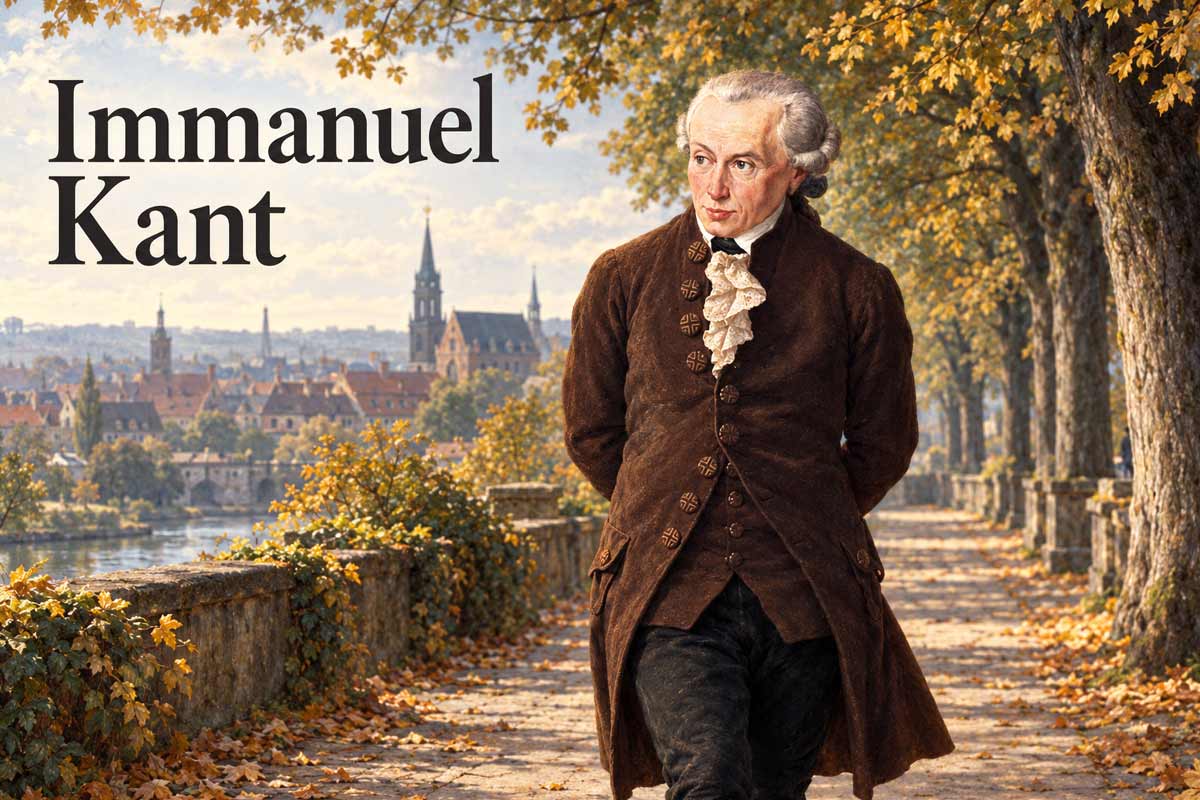
If David Hume made you wonder whether we know as much as we think we do, Immanuel Kant wanted to explain how knowledge is possible in the first place. He agreed that experience matters, but he didn’t think the mind simply receives sensations and waits for habits to develop. The mind contributes a structure that makes coherent experience possible. That claim became the center of a philosophy that reshaped discussions of knowledge, morality, and religion. Kant’s answer to skepticism preserved a substantial role for reason, while also placing limits on what reason could claim to know about God.
Kant is one of those philosophers whose name appears everywhere and whose books can make even a patient reader feel underqualified. Part of the difficulty is that he develops a specialized vocabulary to explain distinctions that ordinary language doesn’t always preserve. We don’t have to master that entire vocabulary to understand the questions that drove him. He wanted to know what we can know, what we ought to do, and what we can reasonably hope for. Those questions belong together in his philosophy, because the limits of knowledge don’t exhaust the responsibilities and hopes of human life.
A Life in Königsberg
Kant was born in 1724 in Königsberg, then part of East Prussia, and died there in 1804. The city is now called Kaliningrad and is part of Russia. He studied and later taught at the University of Königsberg, developing a career that included interests in science as well as philosophy. His family and early schooling were shaped by Pietism, a movement within Lutheran Christianity that emphasized personal devotion and religious seriousness. His mature religious philosophy departed significantly from traditional Christian teaching, but it developed against a background in which faith and moral responsibility were familiar concerns.
His major works include the Critique of Pure Reason, first published in 1781 and substantially revised in 1787, the Groundwork of the Metaphysics of Morals, and the Critique of Practical Reason. The Critique of Judgment extends his inquiry into beauty and the apparent purposiveness of nature. The word critique here means a disciplined examination of a faculty’s powers and limits. Kant wasn’t simply criticizing reason for failing to do its job. He wanted to establish what its job actually was, so that it could be used legitimately rather than sent on missions it couldn’t complete.
What Hume Woke Him Up To
Kant credited Hume with awakening him from his philosophical complacency. Hume had questioned how experience could justify the claim that an effect necessarily follows its cause. Repeated observations show what has happened, but they don’t by themselves demonstrate that the connection must hold. Kant took that challenge seriously while rejecting the idea that habit supplies the whole explanation of our causal understanding. He asked whether the concept of cause might instead belong to the conditions that make objective experience possible.
This changes the direction of the inquiry. Rather than assuming that the mind must passively conform to objects exactly as they exist independently of us, Kant examines how objects of experience conform to the way human cognition works. He compares this change in approach to the shift associated with Copernicus. The comparison doesn’t mean that Kant discovered a new astronomical theory. It describes his attempt to explain knowledge by investigating the contribution of the knowing subject, rather than concentrating entirely on the objects known.
The Mind Does More Than Receive
For Kant, sensation supplies material that human cognition organizes. Space and time are forms through which we encounter that material, rather than properties we simply discover in things considered entirely apart from our way of experiencing them. The understanding also employs basic concepts, which he calls categories, to make judgments about objects and events. Causation is one of those concepts. These contributions aren’t optional habits that one person might adopt while another chooses a completely different system.
An experience of events occurring in an objective order requires more than a succession of private sensations. Kant argues that the understanding must connect appearances according to rules if we are to recognize them as events in a common world. His claim about causation therefore concerns the structure of possible experience. It doesn’t tell us, without observation, which medicine cures a particular illness or what caused a particular accident. Experience remains necessary to discover specific causes, even though the causal framework isn’t merely learned by collecting instances.
Kant also distinguishes knowledge that depends on experience from knowledge that can be justified independently of particular experiences. He calls the latter a priori. His controversial claim is that some a priori judgments add to our knowledge rather than simply unpacking what a concept already contains. These are synthetic a priori judgments, and he treats mathematics and fundamental principles of natural science as important examples. The terminology is demanding, but the underlying question is understandable: how can we have necessary knowledge that is informative about the objects we experience?
Appearances and Things in Themselves
Kant distinguishes things as they appear to us under the conditions of human experience from things considered as they are in themselves. We can know objects within experience, but we can’t simply step outside the conditions of knowing and describe reality from a viewpoint unrestricted by them. This is a central feature of his transcendental idealism. Transcendental, in this context, concerns the conditions of possible experience and knowledge. It doesn’t mean mystical insight into a hidden spiritual world.
Calling experienced objects appearances doesn’t mean they are imaginary or that everybody invents a private reality. Kant is defending the possibility of objective knowledge within the world we experience. The restriction concerns claims about things independently of the forms and concepts through which we know them. Philosophers have disagreed over the best interpretation of this distinction and whether Kant successfully establishes it. We can at least avoid the misleading summary that he teaches that nothing is real or that all opinions are equally true.
That restriction also changes the status of traditional metaphysical arguments. Reason naturally asks about the soul, the world as a complete whole, and God. Kant thinks difficulties arise when it tries to answer those questions as though their objects could be known in the same way as objects of possible experience. He examines cases in which reason appears able to argue for opposing conclusions when it goes beyond those limits. His purpose is to discipline its claims, while preserving the knowledge available within its proper field.
Duty and the Good Will
Kant’s moral philosophy begins with the good will. Intelligence, courage, and other abilities may serve harmful purposes, so possessing them doesn’t make a person morally good. A good will is committed to acting according to moral duty. Kant therefore distinguishes doing something that happens to accord with duty from doing it because it is our duty. The outward action may look the same while the reason for performing it differs considerably.
A merchant might deal honestly because cheating customers would hurt business. That conduct is preferable to fraud, but Kant asks whether honesty remains dependable when dishonesty becomes profitable. An action done from respect for the moral law has a kind of moral worth that mere advantage doesn’t provide. This doesn’t mean that enjoying a good deed automatically spoils it, or that a decent person must dislike helping others. It means that the authority of duty shouldn’t depend on whether obeying it suits our feelings or interests at the moment.
This places Kant at a considerable distance from Hume’s account of sentiment in morality. Kant thinks rational beings can recognize an obligation that binds them independently of whatever they happen to desire. A moral requirement isn’t just useful advice about getting something we want. It can require us to change what we do even when we would rather do something else. His concern is to explain that unconditional authority without reducing morality to reward, punishment, or social approval.
The Categorical Imperative
Kant distinguishes hypothetical imperatives from the categorical imperative. A hypothetical imperative tells us what to do if we want a particular result: if you want to learn an instrument, you need to practice. The categorical imperative binds us without depending on such a chosen goal. One formulation directs us to act only on a principle that we can also will as a universal law. Kant calls the principle on which we act a maxim, so the test concerns the rule embodied in our action and the circumstances under which we adopt it.
His example of a false promise illustrates the point. Suppose I borrow money while promising to repay it, even though I have no intention of doing so. I’m depending on other people’s trust in promises while making an exception for myself. If the practice of making promises without intending to keep them became the general rule in those circumstances, the trust my deception requires would collapse. Kant’s objection is therefore deeper than the possibility that I might be caught. My action depends on a practice that the principle behind my action would undermine.
Another formulation requires us to treat humanity, in ourselves and others, as an end and never merely as a means. People have a dignity that prohibits treating them simply as tools for our purposes. This doesn’t forbid all relationships in which people help one another accomplish goals. Paying someone to repair a roof can respect that person’s agency and legitimate interests. Deceiving or coercing someone to obtain what we want disregards the person in a way that ordinary cooperation need not.
Kant connects morality with autonomy, the rational will’s authority to legislate the moral law for itself. That expression can sound as though each person gets to invent a convenient morality, but that isn’t his meaning. The law must be valid for rational beings generally, rather than tailored to an individual’s preferences. Freedom involves the capacity to act according to that law, instead of simply being pushed around by appetite or external pressure. His account of autonomy therefore demands considerably more self-discipline than the modern slogan that we should each do whatever feels right.
God and the Limits of Proof
Kant criticizes the traditional theoretical proofs of God’s existence. Against the ontological argument, he maintains that existence isn’t a property that can simply be added to the concept of a perfect being in order to establish that such a being exists. A complete description of something doesn’t by itself supply an instance of it. He also challenges the cosmological argument and the attempt to infer a fully divine creator from the world’s apparent design. An argument suggesting order or intelligence, in his view, doesn’t establish everything traditionally claimed about God.
We should distinguish that criticism from a demonstration that God doesn’t exist. Kant thinks theoretical reason is unable to establish the relevant knowledge, and he also rejects its claim to settle the question negatively. He looks instead to practical reason, which concerns our moral agency and obligations. Moral faith occupies a different position from knowledge established by theoretical demonstration. His approach is therefore more complicated than either a standard defense of natural theology or a straightforward rejection of religion.
In his account of the highest good, virtue is joined with happiness proportionate to moral worth. Our duty directs us toward that ideal, even though the ordinary course of the world doesn’t ensure that good people will be happy. Kant argues that practical reason has grounds to postulate God as the condition of its realization. He also postulates immortality in connection with the moral progress required toward complete conformity with the moral law. These claims aren’t presented as discoveries of supernatural objects through scientific observation, and they don’t make belief in God the prior foundation of all moral obligation.
The resulting argument needs careful evaluation. A requirement or hope within moral life doesn’t obviously establish that the conditions necessary for its fulfillment exist. Kant’s defense is more developed than saying that a just universe would be nice, so there must be one. It concerns what practical reason is entitled to assume in connection with an end that the moral law requires us to pursue. Even so, readers can question whether his moral reasoning supplies a sufficient basis for the faith he places upon it.
Religion and the Christian Question
In Religion within the Boundaries of Mere Reason, Kant examines religion through its relationship to moral life. His account of radical evil recognizes a deep disorder in human motivation, especially the tendency to subordinate moral duty to self-interest. The problem can persist beneath conduct that looks respectable. Someone may obey the rules whenever it is convenient while reserving the right to ignore them when personal advantage demands it. Kant calls for a transformation of the fundamental disposition, rather than satisfaction with a collection of outwardly acceptable acts.
Christian readers can recognize something of that concern without identifying it with the whole Christian account of sin and salvation. Kant interprets Christian themes through the requirements of rational moral religion, and the significance he gives them often differs from their significance in historic Christian teaching. Christianity makes claims about God’s action in history, including the incarnation, the cross, and the resurrection. Those claims can’t be replaced by their usefulness in encouraging good behavior without substantially changing the faith. Christians have therefore questioned whether Kant’s philosophical framework allows revelation to speak with its own authority.
His warning against substituting religious observance for a changed moral life is nevertheless worth taking seriously. Correct words and dutiful participation don’t automatically establish that our motives have been transformed. At the same time, the Christian gospel concerns more than our determination to become morally better. It involves grace, forgiveness, and reconciliation with God through Christ. We can appreciate Kant’s seriousness about moral responsibility while asking whether his treatment of religion adequately accounts for the God to whom Christians pray and the salvation they confess.
Reading Kant Today
Immanuel Kant belongs in Modern Philosophy, with substantial connections to Epistemology, Ethics, and Philosophy of Religion. The Groundwork of the Metaphysics of Morals is a useful introduction to his account of duty and the categorical imperative. The Prolegomena to Any Future Metaphysics offers a more compact route into the questions behind the Critique of Pure Reason, although compact doesn’t mean effortless. Reading Hume first helps explain why Kant considered his inquiry necessary. His influence also makes him important for understanding many of the philosophical and theological developments that follow him.
Kant asks us to distinguish knowledge from speculation and moral obligation from preference. Christians have reasons to value those distinctions, even when they reject the limits he places on religious knowledge or his account of moral faith. Respecting people as persons and refusing to make convenient exceptions for ourselves are concerns that should survive disagreement with his larger system. His philosophy also leaves us with a question about the proper authority of reason in matters of faith. We need to examine whether reason is identifying the conditions of responsible belief or imposing restrictions that exclude what God may actually have revealed.