

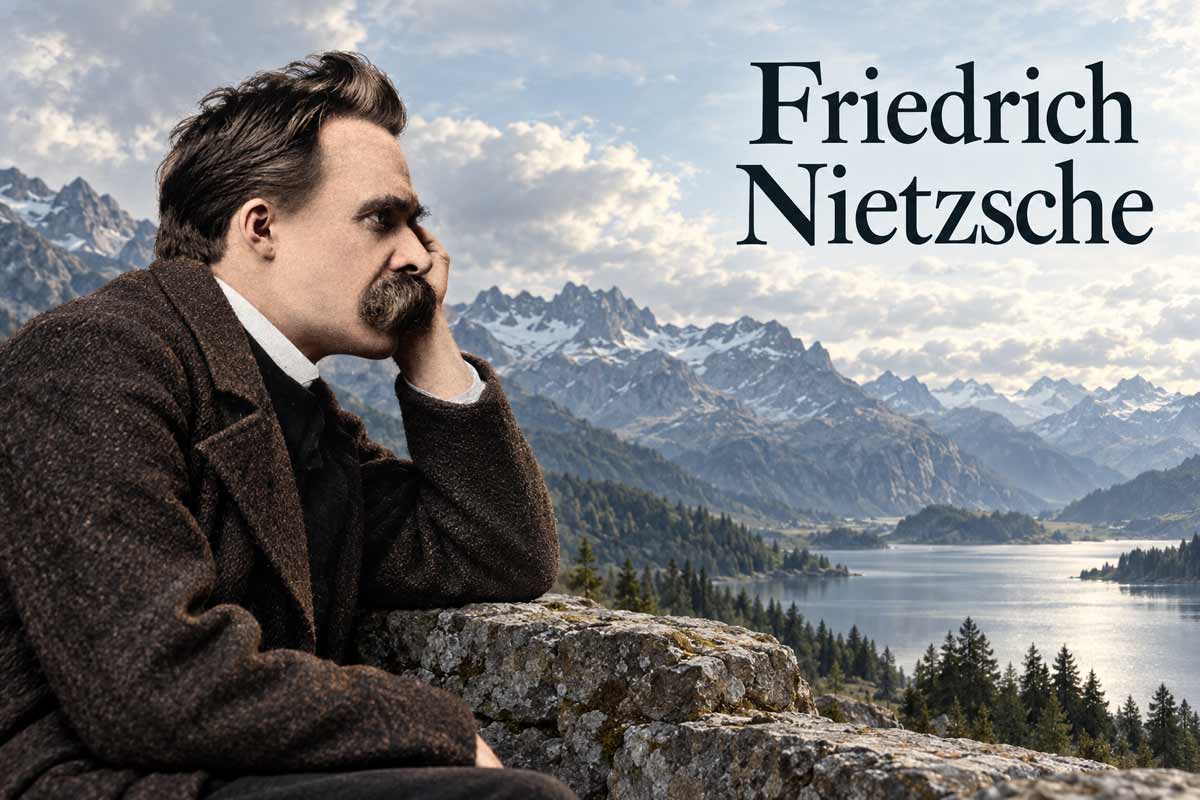
Friedrich Nietzsche is probably better known for three words than for anything else he wrote: “God is dead.” Christians sometimes hear that statement as an atheist’s victory announcement, while admirers sometimes repeat it as though Nietzsche had finally settled the question of God’s existence. Neither response gives us much understanding of the man. Nietzsche was describing what he believed had happened to European civilization when its Christian beliefs lost their authority. He thought people were discarding the foundation of their moral world without understanding how much of the building rested on it.
That concern makes Nietzsche an unusually important critic of Christianity. He didn’t merely dispute miracles or complain about corrupt clergy. He questioned whether Christian ideas about humility, compassion, equality, and self-denial were good for human beings in the first place. His writings force us to consider both the truth of our beliefs and the kind of people those beliefs produce. Christians don’t need to agree with him to recognize that those are serious questions.
From a Pastor’s Son to a Critic of Christianity
Friedrich Nietzsche was born in 1844 in Röcken, in what is now Germany, into a family with strong Lutheran connections. His father was a pastor, and Christianity shaped his childhood, although he eventually abandoned the faith. His academic specialty was classical philology, the study of ancient languages and texts, rather than theology or modern philosophy. In 1869, at just twenty-four, he became a professor at the University of Basel. His familiarity with Greek literature helped supply the alternatives to Christian culture that appear throughout his later work.
Poor health forced Nietzsche to leave his university position in 1879. He spent the following years traveling and writing, producing books such as The Gay Science, Thus Spoke Zarathustra, Beyond Good and Evil, and On the Genealogy of Morals. A mental collapse in 1889 ended his productive career, and he died in 1900 after years of incapacity. The cause of that collapse remains disputed, so confident diagnoses offered long after his death deserve caution. His philosophy also deserves to be assessed by its arguments rather than dismissed through speculation about his illness.
Nietzsche belongs to modern philosophy, although his influence extends deeply into contemporary thought. His style differs considerably from the orderly arguments readers might expect from Locke or Kant. He writes in short observations, psychological portraits, polemics, and, in Zarathustra, an elaborate philosophical story. That gives his work considerable force, but it also makes isolated quotations dangerous. A sentence taken from Nietzsche can become a slogan before anyone has bothered to ask what he was attacking or proposing.
What “God Is Dead” Means
In The Gay Science, Nietzsche tells the story of a madman who enters a marketplace looking for God. The people around him already don’t believe in God, so they find the search amusing. The madman’s response is that they have killed God without understanding the consequences. His imagery describes a world that has lost its horizon and direction. The unbelievers think they have simply dropped an unnecessary belief, while the madman sees a civilization losing its organizing center.
Nietzsche wasn’t suggesting that an eternal divine being had literally ceased to exist. He was speaking about the collapse of belief in the Christian God and the authority that belief had exercised over European life. Nor does the story amount to a philosophical demonstration that God doesn’t exist. A society’s loss of confidence in a belief tells us something about that society; it doesn’t, by itself, establish whether the belief is true. Nietzsche’s attention falls especially on what follows when people continue living by Christian moral assumptions after abandoning the worldview that supported them.
He thought many secular Europeans wanted the benefits of Christian morality without its theological commitments. They still appealed to compassion, equal worth, and moral obligations, while assuming that Christianity itself could be quietly removed. Nietzsche wasn’t inclined to let them make that transition so comfortably. He asked why those inherited values should remain authoritative once their religious foundation had been rejected. Secular philosophers have offered answers to that question, but Nietzsche insisted that an answer was needed rather than simply assumed.
Nihilism and the Loss of Meaning
The danger Nietzsche saw was nihilism, a condition in which the highest inherited values lose their credibility and life seems to have no binding purpose. That doesn’t necessarily mean someone spends the day announcing that nothing matters. It can appear as exhaustion, cynicism, or the conviction that all moral claims are disguises for personal preference. People may keep working, shopping, and amusing themselves while losing any convincing account of why their lives should amount to more than that. Nietzsche feared the spiritual emptiness underneath an apparently functioning civilization.
It’s therefore misleading to describe him as someone who simply celebrated meaninglessness. He welcomed the freedom he associated with the decline of Christian belief, but he also understood the dangers of that decline. His ambition was to overcome nihilism through new forms of valuation and a fuller affirmation of life. The difficult question was how those new values could command allegiance without the authority he had rejected. Announcing that people must create meaning is easier than explaining why one person’s creation should deserve anyone else’s respect.
Master Morality and Slave Morality
Nietzsche approached morality by asking how moral judgments developed and what human needs they served. In On the Genealogy of Morals, he describes an aristocratic pattern of valuation in which powerful people call their own qualities good. Strength, confidence, nobility, and excellence receive approval, while commonness and weakness are considered bad. The distinction initially concerns rank and character rather than the opposition between righteousness and wickedness familiar to Christians. Nietzsche calls this general pattern master morality, although he recognizes that actual cultures and individuals can contain mixed moral tendencies.
Slave morality, in his account, develops among people unable to express their power directly. They reverse the valuations of their rulers, treating the powerful as evil and presenting their own humility, patience, and weakness as goodness. Nietzsche uses the French term ressentiment for the sustained resentment that drives this reversal. The person who cannot defeat an enemy outwardly defeats him morally by condemning everything he represents. Nietzsche traces a decisive development of this process through ancient Jewish religion and Christianity, a reconstruction Christians have substantial reasons to dispute.
This theory challenges the claim that moral language always expresses disinterested concern for what is right. Sometimes a person really does call another person’s success sinful because he envies it, or praises restraint because he lacks the courage to act. Religious communities aren’t immune to that kind of self-deception. Nietzsche’s psychological suspicion can expose real hypocrisy, especially when resentment dresses itself in respectable moral language. But identifying a corrupt motive in some moral judgments doesn’t establish that every judgment of the same kind has that motive or lacks truth.
Why He Opposed Christian Morality
Nietzsche’s objection to Christianity reaches beyond misconduct by Christians. He believed its elevation of humility, pity, and self-denial discouraged the development of exceptional human beings. By giving weakness moral prestige and promising another world, Christianity could teach people to turn against the strength, desires, and ambitions of this one. He associated the ascetic ideal with efforts to give suffering meaning through guilt and renunciation. In his account, that solution preserved people while also deepening their hostility toward life.
Christians should recognize the real abuses that make parts of this criticism persuasive. Teaching people to despise their bodies, remain passive under mistreatment, or feel guilty for every legitimate pleasure can produce serious harm. A faith centered on fear and manipulation gives Nietzsche plenty to work with. Yet Christianity’s central claims include the goodness of creation, God’s entrance into embodied human life, and the resurrection of the body. Those beliefs give Christians grounds to challenge religious contempt for life rather than accept it as the inevitable meaning of their faith.
The disagreement becomes especially sharp over compassion. Nietzsche worries that pity can preserve weakness, spread suffering, and obstruct the development of stronger people. Christianity treats the vulnerable as people whose worth doesn’t depend on strength, achievement, or usefulness. That doesn’t require denying differences in talent or excusing every destructive behavior. It does mean that the sick, disabled, and unsuccessful don’t lose their claim to love because they fail to advance somebody else’s vision of greatness.
Christian humility also needn’t mean being incapable of action. Jesus’ willingness to serve and suffer is presented as a deliberate exercise of love, not merely the consolation of someone unable to do anything else. Forgiveness can require the strength to abandon revenge when revenge is available. Nietzsche’s suspicion should make Christians examine whether their apparent virtue hides fear or bitterness, but it doesn’t settle the meaning of sacrificial love. The deeper disagreement concerns whether strength finds its highest expression in self-exaltation or can also find it in service.
The Will to Power
One of Nietzsche’s most famous ideas is the will to power. He describes living beings in terms of striving, expansion, interpretation, and the overcoming of resistance, rather than treating survival or pleasure as sufficient explanations of life. In human life, that striving can appear in artistic achievement, intellectual discipline, self-mastery, and the shaping of one’s character. It isn’t adequately explained as the desire to hold political office or boss other people around. Nietzsche’s language about power reaches into how people organize their own drives and give form to their experience.
At the same time, turning the will to power into a harmless slogan about personal growth leaves out much of what Nietzsche wrote. In Beyond Good and Evil, he connects life with appropriation and exploitation and defends a severely hierarchical vision of cultural achievement. His admiration for higher types goes along with a willingness to speak of many others as instruments of their development. Readers disagree about the scope of his claims, but the harshness isn’t merely a later misunderstanding. A fair account needs to acknowledge both the depth of his thinking about self-overcoming and the human cost of some of his judgments.
There’s another caution concerning The Will to Power, the book published under that title after his death. It was assembled from his notebooks and isn’t a completed book Nietzsche approved for publication. His published writings should therefore carry more authority than an arrangement of unfinished materials presented as though it were his final system. The notebooks remain important for understanding his intellectual development, but they require careful handling. A philosopher’s abandoned experiments don’t automatically become his settled position because an editor puts them between covers.
The Overman and the Last Man
In Thus Spoke Zarathustra, Nietzsche introduces the Übermensch, commonly translated as the overman or superman. The term describes an ideal of human self-overcoming beyond inherited habits and exhausted values. Nietzsche’s dramatic figure points toward someone able to affirm earthly life and give it a higher form without relying on the Christian world beyond. The familiar translation “superman” can make the idea sound more straightforward than it is. A cape wouldn’t do much to resolve Nietzsche’s problem of meaning.
The contrast is the last man, who wants comfort, safety, and modest satisfactions without the risk of greatness. This figure has little appetite for demanding questions or costly achievement. Nietzsche fears a culture that gradually trades ambition and excellence for the least troublesome existence available. His challenge can resonate with anyone who worries about drifting through life on entertainment and convenience. But Christians can appreciate the warning against complacency without accepting his tendency to measure human worth through exceptional achievement.
Nietzsche’s ideal isn’t a simple instruction to follow every impulse or declare every preference sacred. Self-overcoming requires discipline, struggle, and the transformation of one’s existing character. Still, his proposal raises a question it cannot avoid: on what grounds should the new values of an exceptional individual be judged higher? If cruelty expresses someone’s strength, strength alone doesn’t tell us why that cruelty should be condemned. Christianity brings a different standard to that discussion, locating greatness within accountability to God and love of one’s neighbor.
Eternal Recurrence and the Affirmation of Life
Nietzsche presents another challenge through eternal recurrence. In The Gay Science, he asks readers to imagine being told that their lives will repeat endlessly, with every joy, sorrow, mistake, and ordinary detail returning in the same order. Would that prospect be unbearable, or could they welcome it? As a thought experiment, it tests the depth of a person’s affirmation of life. The challenge goes far beyond enjoying the pleasant portions while wishing the rest had never happened.
Nietzsche’s notebooks also consider recurrence as a possible account of the world, and readers dispute how literally his various discussions should be understood. We don’t need to settle that debate to understand the force of the challenge. His ideal involves overcoming resentment toward existence and affirming life even with its suffering. Christianity also calls people to live faithfully within a painful world, but its hope concerns redemption and resurrection rather than the endless return of every event. Christians can affirm God’s goodness without declaring that every evil ought to happen again.
Perspective, Truth, and His Troubled Legacy
Nietzsche also questions the possibility of knowledge detached from every human perspective. Our desires, language, history, and position influence what we notice and how we interpret it. His perspectivism doesn’t have to mean that every opinion is equally good or that careful inquiry is pointless. In On the Genealogy of Morals, he suggests that bringing more perspectives to bear can make understanding fuller. He challenges claims to a view from nowhere while continuing to distinguish penetrating interpretations from shallow and dishonest ones.
His influence reaches into existentialism, psychology, literary criticism, and later debates over culture and truth. His reputation has also been complicated by the Nazi appropriation of his work after his death. Nietzsche opposed the antisemitic movements and aggressive German nationalism of his own day, and treating him as a Nazi ignores both those objections and the chronology. His sister’s promotion of his legacy helped shape its politically distorted reception. Nevertheless, rejecting that distortion doesn’t require sanitizing his contempt for equality or the troubling implications of his aristocratic ideals.
Why Christians Should Read Nietzsche
Nietzsche is valuable to Christian readers partly because he refuses to let either believers or unbelievers get by with easy answers. He asks Christians whether humility conceals resentment and whether promises about eternity excuse a failure to live well now. He asks secular readers why they retain moral obligations inherited from a religion they no longer believe. Those questions can expose inconsistencies without establishing that all Christian morality is corrupt or that secular people cannot behave morally. Evaluating his challenge requires distinguishing the source, justification, and actual practice of a moral belief.
The Christian response is strongest when it addresses those questions honestly and embodies an answer in practice. Compassion should restore people rather than provide a stage for the benefactor’s importance, and humility should coexist with courage rather than disguise timidity. At the same time, human dignity cannot depend on being healthy, powerful, or culturally impressive. Christianity’s claim is that people matter because they bear God’s image, and that love can express a greatness domination cannot supply. Nietzsche makes the dispute unavoidable: whether the highest human life is one that rises above the vulnerable or one strong enough to love them.