

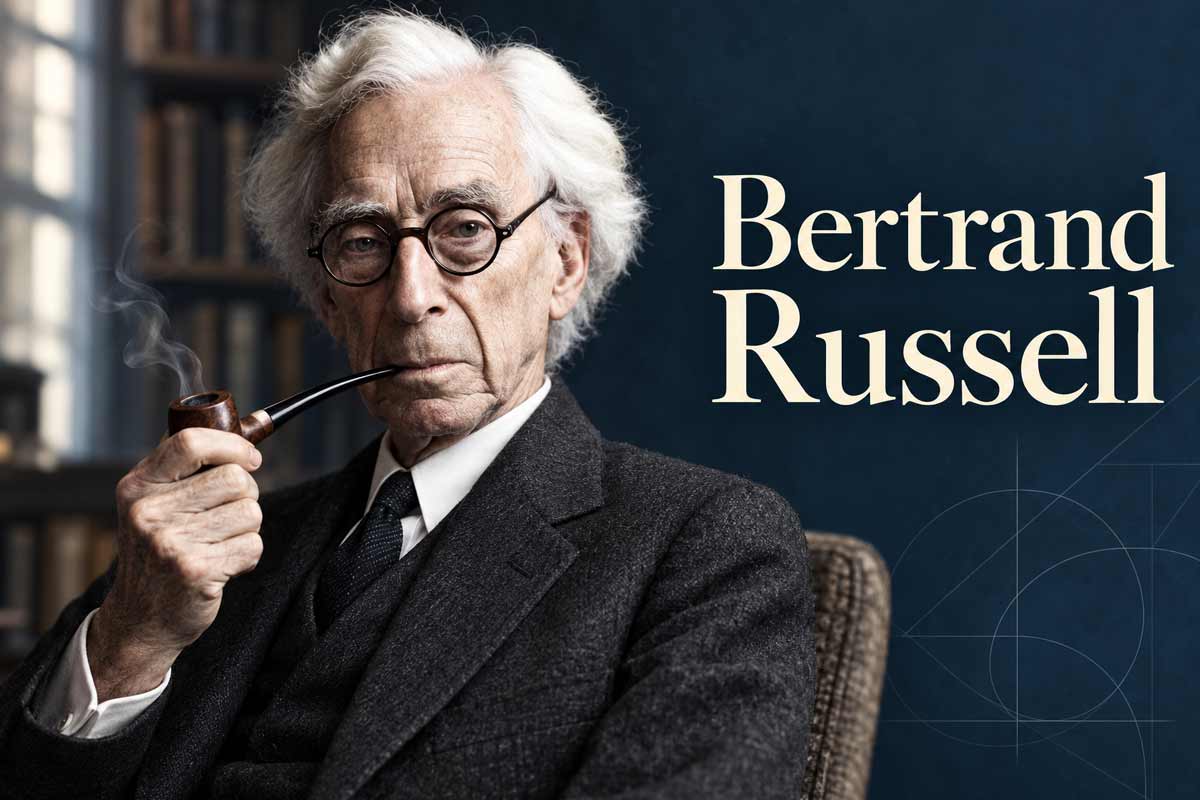
Bertrand Russell is often introduced to Christians as the man who wrote Why I Am Not a Christian. That certainly belongs in the story, but it leaves out much of the reason anyone paid attention to him. Russell helped transform philosophy’s approach to logic, language, mathematics, and knowledge. He also became a public advocate for freedom of thought and an outspoken critic of war. Understanding his objections to Christianity requires meeting the philosopher behind them rather than treating him as a collection of skeptical quotations.
Russell’s work offers both a challenge and an invitation. The challenge is his conviction that religious beliefs often survive through fear, habit, and institutional power rather than adequate evidence. The invitation is to examine what we mean, how our arguments work, and whether our confidence exceeds our reasons. Christians can benefit from that discipline without accepting every conclusion Russell drew from it. Clear thinking doesn’t belong to either side of the argument by default.
A Long Life Across a Changing World
Bertrand Russell was born in Britain in 1872 into a prominent aristocratic family. Orphaned as a young child, he grew up largely under his grandmother’s care before studying at Trinity College, Cambridge. Mathematics and philosophy became central interests, and he developed into an influential thinker in both fields. His early academic work helped establish the approach now known as analytic philosophy. That tradition emphasizes careful arguments, logical structure, and the clarification of concepts and language.
His career extended far beyond the university. He lost his Trinity lectureship during the First World War because of his antiwar activities, and his writings led to imprisonment in 1918. He later became an international public intellectual whose books addressed subjects ranging from knowledge to education and politics. The Nobel Prize in Literature followed in 1950, recognizing the importance of his writing rather than awarding him a prize for mathematics. He died in 1970, having lived through nearly a century of extraordinary intellectual and political change.
Russell therefore stands near the transition from nineteenth-century philosophical debates to contemporary philosophy. His life overlapped with the end of Victorian Britain, two world wars, and the nuclear age. Those changes help explain why his concerns expanded from the foundations of mathematics to the survival of civilization. His views also developed over time, sometimes substantially. Readers shouldn’t assume that a sentence from one stage of his career represents an unchanged system he maintained for seventy years.
What Logic Can Reveal
Russell believed that ordinary language can hide the structure of what we’re saying. A sentence may sound straightforward while carrying assumptions its speaker hasn’t noticed. Logical analysis attempts to make those assumptions visible so we can evaluate the claim more accurately. That approach doesn’t mean replacing every conversation with mathematical symbols. It means recognizing that familiar grammar can make a confused idea seem clearer than it is.
His theory of descriptions provides a useful example. Consider the statement, “The present king of France is bald,” written when France has no king. Its grammatical form makes it look like an ordinary claim about someone’s hair. Russell analyzes it as asserting that there is a king of France, that there is only one, and that this person is bald. Since the existence claim fails, the whole assertion is false without requiring a mysterious nonexistent king to serve as its subject.
This may sound like a great deal of work to establish the hairstyle of someone who isn’t there. The point, however, concerns how language can mislead us about what exists. We can construct a description and then unconsciously treat it as though it must identify a real object. Russell’s analysis separates the description from the claim that anything satisfies it. That discipline matters in philosophy, and it can also help whenever an argument hides an assumption inside a phrase everyone has accepted without examination.
Mathematics and Russell’s Paradox
Russell’s work with Alfred North Whitehead produced Principia Mathematica, published in three volumes between 1910 and 1913. Their project sought to develop mathematics through carefully stated logical principles, definitions, and formal deductions. The ambition was to clarify why mathematical claims follow and what their foundations require. This was far more demanding than showing that ordinary calculations usually come out correctly. Russell wanted to understand the structure that made those calculations possible.
One difficulty was the contradiction now called Russell’s paradox. Imagine the set of all sets that aren’t members of themselves, and ask whether that set is a member of itself. If it is, then it fails the condition for belonging; if it isn’t, then it satisfies the condition and must belong. Either answer reverses itself. The problem shows that an apparently reasonable way of collecting things into sets can produce a contradiction when applied without restrictions.
Russell responded by developing restrictions on the kinds of expressions and collections that could legitimately be formed. His theory of types organizes them into levels intended to prevent certain forms of self-reference. The larger project remained subject to debate about its assumptions and what could be derived from them. It would be misleading to say that Russell permanently settled the foundations of mathematics. His importance includes exposing problems that earlier confidence had overlooked and helping create more precise ways to investigate them.
Appearance and Reality
In The Problems of Philosophy, published in 1912, Russell introduces questions about knowledge through an ordinary table. It seems solid, brown, and roughly rectangular, yet its appearance changes with the lighting and the observer’s position. What we immediately experience isn’t simply identical with everything we believe about the physical object. This distinction between appearance and reality doesn’t require us to stop using tables. It asks what justifies our belief that there is a continuing object behind changing experiences.
Russell distinguishes knowledge by acquaintance from knowledge by description. Acquaintance concerns what is directly present to experience, while description allows us to know about things we haven’t encountered in that direct way. The distinction helps explain how people can speak meaningfully about distant objects, historical persons, and other people’s experiences. It also forces us to examine the steps between what we experience and what we infer. Russell’s thinking about these issues changed, but the demand to identify those steps remained important.
He also examines induction, the process of drawing expectations about unobserved cases from observed ones. The sun has risen repeatedly, but what makes past regularity a sufficient basis for confidence about the future? Simply pointing to the past success of induction already relies on the sort of reasoning being questioned. Russell doesn’t respond by advising everyone to abandon practical expectations. He distinguishes their usefulness from the harder philosophical question of how they can be justified.
For a period, Russell’s approach was associated with logical atomism, the attempt to analyze complex statements and facts into more elementary components. The “atoms” here concern logical analysis, rather than tiny physical particles. Ludwig Wittgenstein influenced this phase of his thinking, although their relationship also involved significant disagreement. Russell hoped that careful analysis could bring philosophy closer to the precision found in science and mathematics. That hope shouldn’t be confused with a promise that every human question could be solved as easily as a calculation.
Was Russell an Atheist or an Agnostic
Russell is described as both an atheist and an agnostic, and the labels need some explanation. Agnosticism concerns whether someone claims to know that God exists or doesn’t exist; atheism can describe the absence of belief in God. Those positions can overlap when someone doesn’t believe but also doesn’t claim to possess an absolute proof of nonexistence. Russell’s public position was firmly opposed to Christian belief, even when he described his position in terms of uncertainty. Calling him an agnostic shouldn’t suggest that he regarded Christianity and unbelief as equally convincing alternatives.
His objections developed from his judgment that the arguments offered for religious belief were insufficient. He also believed that emotional need and social conditioning explained much of religion’s appeal. That second claim must be handled carefully because explaining why people find a belief attractive doesn’t determine whether it’s true. A person may believe something partly because it is comforting and still have good reasons for believing it. The same examination of motive can be applied to unbelief without settling its truth either.
Why I Am Not a Christian
Russell delivered the lecture Why I Am Not a Christian in 1927. He explained his rejection of belief in God and immortality and challenged the claim that Jesus was the wisest and best of men. The lecture later became widely known through a collection published under the same title. It remains influential because it brings philosophical objections together with criticism of religious institutions and moral teaching. Readers should nevertheless remember that a public lecture isn’t a complete treatment of every argument it addresses.
His treatment of the first-cause argument is a familiar example. Russell asks why God doesn’t require a cause if everything else requires one, and why the universe couldn’t simply exist without a cause. That objection identifies a real problem in an argument whose premise says that absolutely everything must have a cause. However, important versions of cosmological reasoning concern things that begin to exist, depend on something else, or require an explanation because their existence isn’t necessary. Russell’s objection doesn’t automatically dispose of those more carefully stated arguments, which require examination on their own terms.
This distinction doesn’t make the Christian case effortless. A defender still needs to establish that the relevant premise is sound, that the proposed explanation follows, and that it has the characteristics attributed to God. Moving from an unexplained universe to the Christian understanding of God involves further reasoning. But a skeptic likewise needs to engage the argument actually being offered. Asking who made God is decisive against some careless presentations without becoming a universal answer to every argument for a necessary source of existence.
Russell also questions arguments that move from natural order or moral judgment to God. The existence of suffering and apparent waste makes a simple appeal to perfect design difficult, while moral arguments raise questions about the relationship between goodness and divine command. If something is good merely because God commands it, goodness can appear arbitrary; if God commands it because it is independently good, God may seem unnecessary to its foundation. Christians have responded by grounding goodness in God’s character rather than treating it as either an arbitrary decision or an external rule imposed on him. That response deserves examination, just as Russell’s challenge does, instead of being treated as though the debate ended with its first formulation.
His Moral Criticism of Christianity
Russell’s criticism of Jesus centers especially on teachings about punishment and hell. He regarded eternal punishment as incompatible with the highest moral goodness, and he also questioned Gospel passages that he interpreted as mistaken expectations about the timing of Christ’s return. These objections go beyond asking whether religious statements can be proved. They ask whether the picture of God and Jesus being presented is morally worthy of belief. Christians shouldn’t answer that question by assuming that a critic’s disbelief makes his concern irrelevant.
Answering Russell requires serious interpretation of the texts and an honest account of divine judgment. Christians themselves disagree about the nature and duration of final punishment and about the meaning of several passages concerning Christ’s return. Those differences don’t establish that every interpretation is equally sound, but they do mean that Russell’s criticism of one interpretation cannot simply be applied to all of them. At the same time, changing an interpretation merely because it is uncomfortable wouldn’t be a satisfactory response. The task is to explain what the texts mean and why that interpretation deserves confidence.
Russell also points to religious persecution, suppression of inquiry, and the use of fear to enforce obedience. Those abuses are part of history, and defending Christianity doesn’t require defending everything done in its name. Yet his indictment can become too sweeping when religion is treated chiefly as a source of cruelty and intellectual obstruction. Religious institutions have also supported learning, care for the vulnerable, and moral criticism of powerful interests. Historical judgment requires examining both, while keeping the conduct of believers distinct from the truth of Christianity’s central claims.
Ethics Without Religious Belief
Russell’s rejection of Christianity didn’t lead him to conclude that suffering was irrelevant or that selfishness should rule human conduct. In What I Believe, he describes the good life as inspired by love and guided by knowledge. Love supplies concern for people’s well-being, while knowledge helps us understand what will actually benefit them. Benevolent intentions without sound judgment can do harm, and technical knowledge without concern for others can become dangerous. His moral outlook therefore requires both human sympathy and careful investigation of consequences.
His thinking about the foundations of ethics developed over time, and it shouldn’t be reduced to one slogan. In What I Believe, he connects ethical judgments with desires rather than treating them as discoveries of facts in the same way as scientific claims. That approach raises a problem when people’s desires conflict profoundly. Explaining why we want a less cruel world isn’t necessarily the same as explaining why someone who wants domination ought to accept our judgment. Russell’s ethical seriousness is clear, but seriousness of conviction doesn’t by itself resolve the question of moral authority.
Christians can recognize the value of love informed by knowledge while proposing a different account of its foundation. Human beings have worth because they bear God’s image, and moral obligations answer to more than personal preference or social agreement. That claim itself requires defense; invoking God doesn’t excuse careless reasoning or harmful conduct. The disagreement concerns what ultimately makes love and justice binding. It shouldn’t become the false claim that unbelievers are incapable of either.
Politics and the Nuclear Age
Russell’s public commitments grew from concern about oppression, irrational hostility, and the damage caused by war. His opposition to the First World War didn’t develop into an unchanging refusal to resist every aggressor. He supported the war against Hitler and strongly criticized Bolshevik authoritarianism despite his sympathy for social reform. His judgments weren’t infallible, and his political positions sometimes changed sharply. They show a continuing attempt to balance individual liberty, human welfare, and the dangers presented by powerful states.
Nuclear weapons made those dangers especially urgent. The Russell–Einstein Manifesto of 1955 called attention to the possibility that conflict could destroy humanity rather than merely defeat one side. It helped lead to the Pugwash movement, bringing scientists into discussion of war and international security. Russell also became a prominent advocate of nuclear disarmament. Whatever readers think of particular policies he favored, his larger concern was that scientific power had advanced beyond the political wisdom needed to manage it safely.
What Christians Can Learn From Russell
Russell deserves more than automatic agreement from skeptics or automatic dismissal from Christians. His work teaches readers to define their terms, uncover hidden assumptions, and distinguish a convincing sentence from a sound argument. His criticism of religion presses believers to examine whether they are defending truth or simply protecting familiar institutions. His own arguments must face the same scrutiny, especially when a broad claim outruns the evidence or a simplified version of an opponent’s position carries the discussion. An influential philosopher’s confidence isn’t a substitute for that examination.
The Christian response is strongest when it combines intellectual care with the moral seriousness Russell valued. We should be willing to acknowledge abuses, explain difficult teachings, and refuse to make emotional pressure do the work of evidence. We can also question whether his account of reality adequately grounds the dignity and obligations his public life so strongly affirmed. Russell wanted people to live courageously without religious assurances; Christianity claims that courage and reason can coexist with trust in God. The disagreement deserves clear thought from both sides, and a faith that asks to be believed should be willing to be understood.