

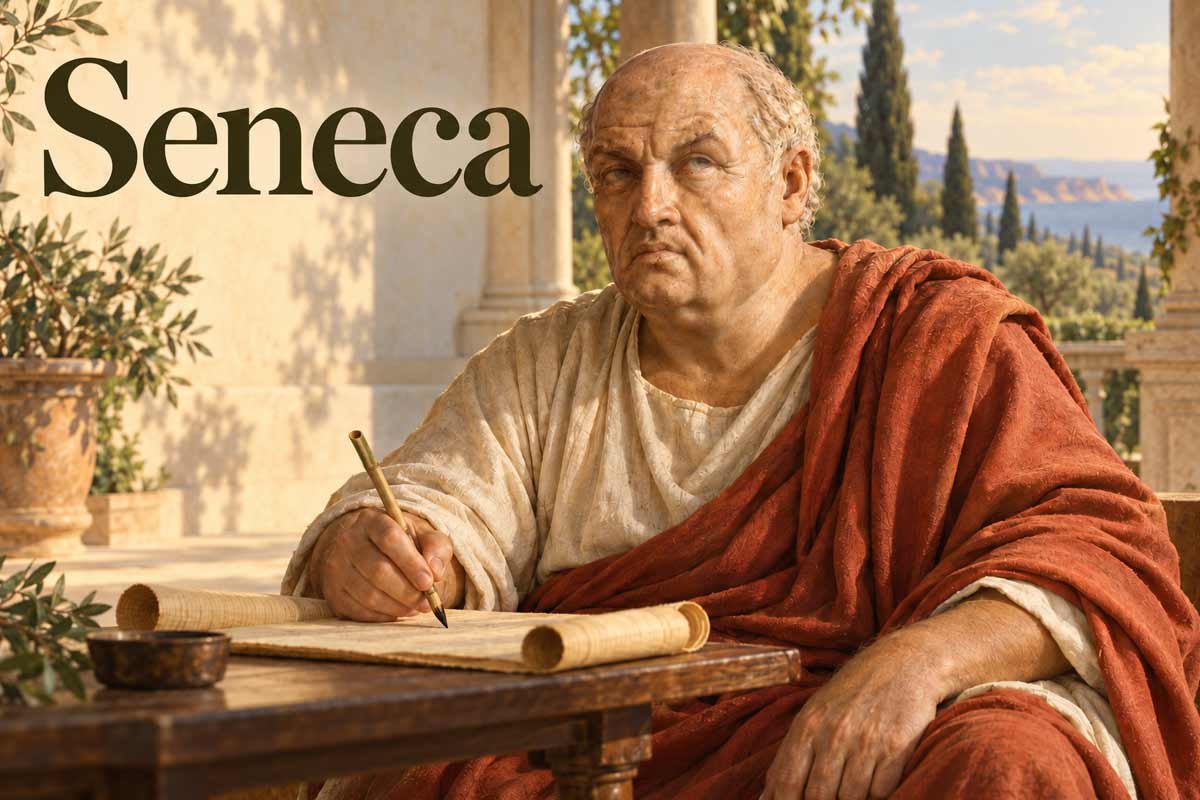
Seneca could explain why money shouldn’t control your life while possessing a great deal of it. He could describe the virtues of a merciful ruler while advising Nero, whose eventual approach to disagreement involved removing the person who disagreed. That tension makes him an interesting philosopher to read, although it doesn’t make him an easy one to defend. His writings contain some of antiquity’s most practical observations about anger, ambition, suffering, and the way we spend our days. His career also reminds us that understanding a moral principle and living by it are two different accomplishments.
Seneca belongs to the Roman tradition of Stoicism, alongside Epictetus and Marcus Aurelius, although their circumstances were quite different. Epictetus experienced slavery, Marcus Aurelius governed an empire, and Seneca served near the center of imperial power. All three believed that character mattered more than whatever circumstances happened to surround a person. Seneca gives that conviction a personal, conversational presentation, often sounding like an older friend who has noticed that our excuses aren’t improving with age. His place in Ancient Philosophy rests largely on his ability to bring demanding philosophical ideas into the decisions people actually make.
A Philosopher at the Imperial Court
Lucius Annaeus Seneca was born around 4 BC in Corduba, in what is now Spain, and educated in Rome. He’s usually called Seneca the Younger to distinguish him from his father, a writer associated with Roman rhetoric. Philosophy became an important part of his education, but his public life also involved the pressures and opportunities of Roman politics. In AD 41, under the emperor Claudius, he was exiled to Corsica following an accusation of adultery. The accusation’s truth remains uncertain, and the episode illustrates how quickly a prominent Roman could become vulnerable to court intrigue.
Seneca returned in AD 49 through the influence of Agrippina, who arranged for him to tutor her son Nero. When Nero became emperor in AD 54, Seneca and the military official Burrus became important advisers. Seneca’s treatise On Clemency encouraged the young ruler to exercise restraint, presenting mercy as a strength appropriate to someone with enormous power. Advising an emperor meant trying to shape the character of someone who possessed very few effective restraints outside himself. A teacher could recommend self-control, but he couldn’t assign the emperor detention for refusing to practice it.
The relationship eventually revealed its darker side. After Nero had Agrippina killed in AD 59, the historian Tacitus attributes to Seneca the message sent to the Senate defending Nero’s version of events. Tacitus wasn’t an eyewitness to everything he describes, and ancient accounts require careful reading, but this is a serious charge against the philosopher’s public conduct. Seneca later withdrew increasingly from court, yet withdrawal didn’t guarantee safety. In AD 65, after being implicated in a conspiracy against Nero, he was ordered to take his own life; his actual involvement in the plot remains disputed.
What Stoicism Meant to Seneca
Stoicism began in the Greek world centuries before Seneca, and he adapted its teaching for a Roman readership. Its central moral claim was that virtue is the true good: wisdom, justice, courage, and self-control make a life good in a way that possessions and public recognition cannot. Wealth, health, and influence may be preferable to their opposites, but having them doesn’t make someone morally better. A dishonest person with excellent health and impressive connections is still dishonest. Seneca wanted people to stop confusing an advantageous situation with a well-ordered soul.
For the Stoics, living according to nature meant living in accordance with reason and our responsibilities as human beings. It didn’t mean doing whatever impulse felt natural at the moment. Human beings can reflect on their judgments, recognize obligations, and cooperate with others, so a properly human life should express those capacities. Seneca’s view places considerable responsibility on the person making a decision, even when circumstances are unpleasant. You may not choose the insult, the illness, or the political environment, but you still have to consider what sort of response is worthy of you.
That teaching shouldn’t be reduced to pretending that pain isn’t painful or that people don’t need friends. In his ninth letter to Lucilius, Seneca explains that the wise person experiences troubles but overcomes them, and that self-sufficiency doesn’t eliminate the desire for friendship. The point is to prevent another person’s approval, or the possibility of losing something valuable, from becoming the ruler of your character. His ideal is demanding, and ordinary people don’t attain it simply by reading a few quotations. Seneca often presents himself as someone working toward wisdom, rather than someone who has already completed the assignment.
Anger and the Stories We Tell Ourselves
In On Anger, Seneca treats anger as a destructive force that promises control while making a person less capable of exercising it. The angry person often believes he’s defending justice, but his judgment becomes organized around retaliation. An offense begins to occupy more space in his mind than its actual importance warrants. He may punish someone more severely than the wrongdoing deserves, or discover too late that he misunderstood what happened. Seneca isn’t impressed by the argument that a burst of rage is useful because it supplies energy; reason should direct correction without surrendering authority to fury.
He also distinguishes an involuntary first reaction from the judgment that develops into anger. A person may startle, flush, or feel a sudden internal disturbance before consciously deciding anything. The crucial question is what happens when the mind accepts the impression that an injury demands revenge. That distinction leaves room for a pause in which we can examine the facts and reconsider the meaning we’ve assigned to them. Someone who didn’t return your greeting may be distracted rather than contemptuous, and a disagreement doesn’t automatically amount to an attack on your dignity.
Seneca recommends delay, restraint, and habits that make angry reactions less likely to gain momentum. He also describes examining his conduct at the end of the day, considering where he failed and what should change. Christians can recognize much of this practical wisdom in James 1:19–20, which connects slow speech and slow anger with the warning that human anger doesn’t produce God’s righteousness. There are differences, since Scripture allows for anger without sin and portrays God’s judgment in ways Stoicism doesn’t. Still, being able to produce a theological defense of righteous anger is no guarantee that the anger we’re currently enjoying qualifies.
The Time We Keep Giving Away
On the Shortness of Life challenges the assumption that our main problem is an inadequate supply of years. Seneca argues that we waste much of the time we receive through distraction, ambition, and commitments we never seriously examine. People carefully defend their property while allowing others to claim enormous portions of their lives. They imagine they’ll begin living properly when business slows down, their position improves, or the next obligation ends. Meanwhile, the habits that postpone a meaningful life become the habits by which they live it.
His argument goes deeper than advice about getting more tasks accomplished. A person can be busy from morning until night and still avoid deciding what deserves that much attention. Seneca thinks philosophical reflection helps us recognize which desires are leading us somewhere worthwhile and which merely keep us occupied. Rest and study can serve a serious purpose, while socially impressive activity can amount to wasted life. He wants readers to question the value of their pursuits, rather than become more efficient at pursuing whatever happens to be in front of them.
There’s a useful connection here with Psalm 90:12, where numbering our days is associated with gaining a heart of wisdom. Awareness of mortality should affect what we value before mortality becomes an immediate crisis. However, Seneca’s criticism of busyness needs to be applied with some fairness. Someone working long hours to support a family doesn’t possess the same freedom as a wealthy Roman who can retreat to an estate and read philosophy. His insight about wasted attention remains valuable, but we shouldn’t use it to suggest that every exhausted person has simply made poor choices.
Wealth and the Problem of Consistency
Seneca’s wealth created an obvious difficulty for a man who wrote so much about freedom from material dependence. In On the Happy Life, he argues that a philosopher may possess riches without making riches the foundation of happiness. Poverty isn’t automatically virtuous, just as prosperity isn’t automatically corrupt. The moral issue concerns how wealth is obtained, how it’s used, and whether losing it would destroy the person’s ability to live well. There is a legitimate distinction between owning something and being governed by the need to keep it.
The distinction also creates a convenient place to hide. It’s easy for a wealthy person to announce that he isn’t attached to money while arranging his life around protecting it. Seneca’s relationship with Nero makes the question especially uncomfortable because imperial favor contributed to his position and prosperity. His arguments about wealth deserve examination on their merits, but they don’t settle every question about his own conduct. A sound principle can be used sincerely, defensively, or both, and readers don’t have to choose between dismissing all his teaching and excusing everything he did.
In his eighteenth letter, Seneca recommends occasionally practicing a simpler way of life, using plain food and modest conditions to test the fear of poverty. The purpose is to discover that the condition we dread may be less terrible than imagination makes it. It’s a practical exercise in loosening the grip of comfort, although temporarily choosing simplicity is different from having deprivation imposed on you. Christians have their own reasons to practice generosity and resist dependence on possessions, including Jesus’ warning about serving God and wealth. That warning becomes more useful when we apply it to our own attachments rather than reserve it for people richer than we are.
Human Dignity in a Society of Slaves
Seneca’s forty-seventh letter offers a striking criticism of the way Roman masters treated enslaved people. He insists on their humanity, rejects contempt based on social position, and approves of treating them as companions who can share conversation and a meal. A person’s legal status doesn’t tell us whether he possesses courage, intelligence, or moral character. Fortune can also reverse the positions of master and slave, making pride in status particularly foolish. Seneca challenges the habit of looking at someone primarily through the category that makes mistreating him socially acceptable.
We should appreciate that challenge without turning Seneca into a modern abolitionist. He addresses conduct within slavery rather than demanding the institution’s elimination. His moral criticism reaches beyond common Roman assumptions, but it doesn’t reach all the conclusions readers today might expect. Christianity also developed within a world where slavery was deeply established, and Christian history includes both resistance to the institution and shameful efforts to defend it. Recognizing shared humanity is an important moral beginning; the harder test is what people are prepared to change because they recognize it.
Providence and the Christian Comparison
Seneca’s philosophy wasn’t a purely secular program for managing stress. Stoicism understood the universe as ordered by divine reason, with providence and nature closely connected. Seneca could speak about God, the gods, and a divine presence within human beings, although those expressions don’t amount to a confession of Christian faith. In his forty-first letter, he describes a holy spirit within us that observes our conduct and supports the pursuit of goodness. The language may sound familiar to Christians, but it belongs to his Stoic understanding of divinity and human reason, not the New Testament teaching about the Holy Spirit.
In On Providence, he addresses a question believers still ask: why do good people suffer if the world is governed by divine care? His answer treats adversity as a means by which strong character is trained. A good person may encounter hardship without having his real good, his virtue, taken away. Seneca compares divine discipline to demanding training rather than indulgent protection. The argument offers a serious answer to the assumption that providence should guarantee comfortable circumstances, though it doesn’t remove every difficulty raised by suffering.
Christianity can agree that hardship sometimes develops endurance while challenging an account that makes moral character the whole measure of what has been harmed. Disease, bereavement, and violence damage real human goods, even when sufferers respond courageously. Biblical lament allows people to acknowledge those losses, and the resurrection promises more than an improved attitude toward them. God doesn’t merely instruct people to become inwardly invulnerable; Christian hope includes the restoration of embodied life and the defeat of death. A believer can learn from Seneca’s discipline without treating grief as a philosophical failure.
Seneca also lived during the apostle Paul’s lifetime, which helped encourage later speculation about a connection between them. His brother Gallio appears in Acts 18 as the Roman official who declined to adjudicate the charges brought against Paul in Corinth. That historical connection doesn’t establish that Seneca met Paul or received Christian instruction from him. Letters later circulated as correspondence between the two men, but they aren’t regarded as authentic. Similar moral observations don’t require a secret conversion, and resemblance in vocabulary doesn’t establish agreement about God, salvation, or the identity of Jesus.
Facing Death Without Making It an Ideal
Seneca frequently encourages readers to confront mortality instead of allowing fear of death to control their choices. Someone who believes survival must be preserved at any moral cost becomes vulnerable to whoever can threaten it. For Seneca, philosophy should prepare a person to live honorably and to face life’s end with composure. That concern runs through his letters and essays, where reflection on death is intended to clarify the responsibilities of the present. His own forced death under Nero made this teaching particularly important to later readers.
The Stoic position also allowed a person to choose death under certain circumstances, including conditions believed to make honorable life impossible. That’s a significant point of disagreement with Christian ethics, which understands life as a gift entrusted to us and doesn’t make personal autonomy its final standard. Seneca’s death needs to be read in the context of an imperial order, rather than reduced to a simple story of unrestricted choice. Tacitus portrays a difficult, prolonged death and describes Seneca trying to console the people around him. The account helped shape an enduring image of philosophical courage, but Christians needn’t endorse every Stoic conclusion to recognize the cruelty of Nero’s demand.
Reading Seneca with Both Eyes Open
Seneca’s surviving works include letters, moral essays, investigations of natural phenomena, and tragedies that portray the devastation caused by destructive passions. For readers beginning with his philosophy, On the Shortness of Life, On Anger, and the Moral Letters to Lucilius provide a useful entrance. The letters move between everyday circumstances and larger moral questions, which makes them approachable without making their teaching shallow. They ask whether the life we’re defending is actually the life we ought to be living. Seneca is especially good at noticing how respectable explanations can protect habits we’d rather not examine.
His career also prevents us from treating wisdom as a collection of quotations detached from conduct. He understood the danger of ambition and the importance of mercy, yet his proximity to Nero placed him inside a system that violated the principles he taught. That failure doesn’t make every observation false, but it makes self-examination part of reading him honestly. Christians should be particularly cautious about congratulating themselves for recognizing the difference, since we’ve also found ways to justify comfortable relationships with compromised power. Seneca leaves us with useful counsel and an uncomfortable question about how much of the wisdom we admire is visible in the life we live.