

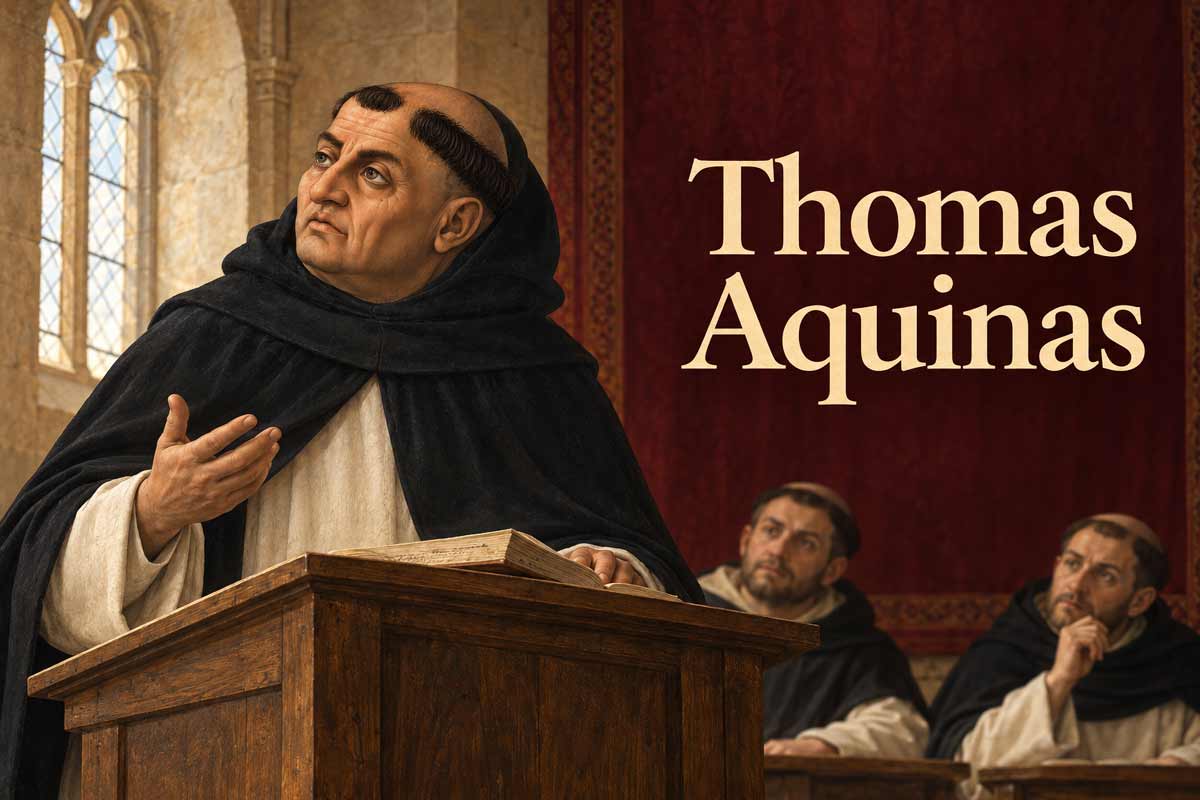
Thomas Aquinas is sometimes introduced as the man who proved God’s existence five different ways. That makes him sound like an unusually persistent salesman, and it leaves out most of what he was doing. He wanted to understand how everything fits together under God: the physical world, human nature, moral responsibility, revelation, and salvation through Christ. His arguments about God’s existence belong within that larger undertaking. Whether we agree with every part of his system or not, he forces us to think carefully about what we’re claiming when we say that Christianity is true.
Aquinas belongs to medieval philosophy, but his questions haven’t stayed in the Middle Ages. Christians still debate how much reason can tell us about God, what makes an action morally wrong, and whether philosophical language helps explain Scripture or starts controlling it. He’s especially influential in Roman Catholic theology, although his arguments also appear in Protestant apologetics and discussions with unbelievers. Reading him doesn’t require becoming a Catholic or treating Aristotle as an honorary apostle. It requires enough patience to understand his reasoning before deciding where it succeeds and where it doesn’t.
A Friar With an Unwelcome Career Plan
Thomas was born around 1225 near Aquino in what is now Italy, into a family with connections and expectations. He received an early education at the Benedictine monastery of Monte Cassino and later studied in Naples. His decision to join the Dominicans brought him into an order devoted to preaching and learning, with a way of life that depended on poverty rather than an established family’s prestige. His relatives opposed the decision and detained him while trying to change his mind. The future defender of reasonable argument apparently didn’t find his family’s arguments particularly persuasive.
He eventually continued his studies under Albert the Great and became a teacher whose career took him through Paris and several centers of learning in Italy. This was a period when more of Aristotle’s writings, together with important Muslim and Jewish philosophical discussions, were entering the Latin intellectual world. Aquinas drew on that material, as well as Scripture, Augustine, and other Christian authorities. He didn’t simply adopt whatever Aristotle said, and he disagreed with conclusions reached by some interpreters of Aristotle. His project was to use what he considered sound philosophy without surrendering Christian teaching to it.
What Reason Can Know and What God Must Reveal
Aquinas believed that truth discovered through sound reasoning cannot contradict truth genuinely revealed by God, because the same God is responsible for both. That doesn’t make every philosophical argument sound or every interpretation of Scripture correct. It means that a real contradiction tells us that something has gone wrong in our reasoning or interpretation. He thought human reason could establish certain truths about God, including God’s existence, while doctrines such as the Trinity and the Incarnation require revelation. Reason can help clarify those doctrines and answer objections, but it can’t independently discover the gospel by studying the furniture.
He also argued that revelation is needed even for truths that reason can reach. Most people don’t have the time, training, or opportunity to follow a lengthy philosophical demonstration, and even capable thinkers make mistakes. God hasn’t reserved knowledge of Himself for people who can finish a graduate seminar. Aquinas therefore treated faith as trust in God’s truthfulness rather than a substitute for thinking. His familiar conviction that grace perfects nature means that God’s work brings human beings toward their intended fulfillment; it doesn’t mean fallen people can educate themselves into salvation.
Why He Begins With Objections
The Summa Theologiae, his best-known work, organizes theology through questions and individual articles. An article typically begins with objections to the position Aquinas will defend, then presents a contrary authority, gives his answer, and responds to the objections. A reader who stops after the first paragraph may attribute to Aquinas something he spends the rest of the article rejecting. The format reflects medieval scholastic teaching, where careful distinctions and serious objections were part of learning. It can feel unfamiliar, but the habit of stating an opponent’s argument before answering it would improve plenty of modern discussions.
The Summa covers far more than philosophical proofs, including creation, human action, virtue, law, grace, Christ, and the sacraments. Aquinas also wrote biblical commentaries, commentaries on Aristotle, disputed questions, and the Summa contra Gentiles, which develops a sustained defense of Christian truth. His Five Ways appear in a brief article near the beginning of the Summa Theologiae. They introduce conclusions that the surrounding work attempts to develop more fully. We shouldn’t expect those few paragraphs to carry every argument for every Christian doctrine, and Aquinas didn’t expect them to do that either.
The Five Ways to God’s Existence
The first way begins with change, which Aquinas calls motion. He means more than an object traveling across a room: something becomes actual that was previously only possible, as wood that could become hot is heated. He argues that this transition requires something already actual, and that a series of changers whose activity depends on others needs a source that doesn’t itself require being activated. His example of a hand moving a staff concerns dependence in the activity taking place. The question isn’t simply which event happened longest ago, but what makes the changing world possible at all.
The second way concerns efficient causes, meaning causes that bring about effects. Aquinas argues that something cannot be the cause of its own existence, because it would have to exist already in order to produce itself. An ordered series of causes that depends on a first source cannot explain its effects if that source is removed. He concludes that there must be a first cause that doesn’t derive its causal power from another. We can debate the argument’s premises and its treatment of causal dependence, but answering it requires more than asking who caused God: his proposed explanation is precisely a cause that isn’t itself caused.
The third way starts with things that come into existence and pass away. Aquinas calls them possible to be and not to be, and argues toward a necessary being whose necessity doesn’t come from something else. This argument raises difficult questions about how the existence and nonexistence of individual things relate to the world as a whole. It shouldn’t be reduced to the observation that everything eventually wears out. Its larger concern is whether a world of things whose existence is not necessary can provide a sufficient explanation for existence without something that exists necessarily.
The fourth way starts with degrees of qualities such as goodness and truth, and argues toward a source of those perfections. This is one of the less immediately accessible arguments because it relies on assumptions about being and goodness that Aquinas develops elsewhere. He’s not merely saying that some people are nicer than others, so there must be someone who wins the niceness competition. Critics question whether comparisons require the kind of maximum and cause he proposes. Defenders respond that the argument concerns the way limited beings possess perfections that aren’t independently grounded in themselves.
The fifth way looks at the regular direction of natural things toward particular outcomes, even when those things have no knowledge of what they’re doing. Aquinas reasons that this ordered activity ultimately requires intelligence. His concern is the intelligibility and directedness of nature, rather than an isolated biological feature that science hasn’t explained yet. Discovering how a natural process operates therefore doesn’t automatically answer the philosophical question he’s raising. The argument still requires scrutiny, including whether its account of natural purpose is convincing, but it deserves a better hearing than being dismissed as an appeal to gaps in scientific knowledge.
These arguments don’t all have the same structure, and accepting one doesn’t settle every question about God. Aquinas follows them with discussions of divine attributes and depends on revelation for specifically Christian mysteries. He also believed that the world’s beginning in time is known through faith rather than demonstrable by philosophy alone. That distinction surprises readers who assume his entire case requires proving that the universe had a first moment. For him, even a world without a temporal beginning would still require God as the source of its existence.
God Is More Than the Largest Being
Aquinas describes God as the source of being, not simply the most powerful member of a universe containing many members. Created things have an existence they receive; God doesn’t receive existence from somewhere else. His doctrine of divine simplicity means that God isn’t assembled from parts or composed of separate features that could come apart. God’s goodness, wisdom, and power aren’t detachable possessions added to a more basic divine substance. Christians have debated how best to formulate these ideas, but Aquinas uses them to explain why God cannot depend on something more fundamental than Himself.
That also shapes how he thinks about language. When we call God good, Aquinas doesn’t think divine goodness is identical in manner to a human being’s goodness, nor does he think the word becomes meaningless. He describes such language as analogical: there is a real relationship between the goodness of creatures and its source in God, without reducing God to a creature. The approach tries to preserve both meaningful knowledge and humility about its limits. We can speak truthfully about God without pretending that our language contains everything He is, a distinction worth remembering whenever theology starts sounding overconfident.
Human Beings Have Bodies for a Reason
Aquinas borrowed Aristotle’s language of matter and form to explain human nature. The soul is the form of the body, meaning the principle that makes a living human body the kind of living thing it is. He isn’t imagining a complete person who temporarily occupies a disposable physical container. The human being is a unity of body and soul, with bodily life belonging to what we are. Although he argued that the rational soul survives bodily death, separation from the body isn’t the complete condition of human life. Bodily resurrection therefore restores something essential rather than adding an optional accessory to eternal existence.
His treatment of the emotions also resists the idea that holiness means becoming less human. Love, fear, sorrow, and anger aren’t automatically sinful simply because we experience them. Their moral character depends on their relationship to reason, their objects, and the way we consent to or act on them. Courage doesn’t require never feeling afraid, and compassion doesn’t become suspect because another person’s suffering affects us. Aquinas wants the person’s desires and actions properly ordered toward what is good, which gives moral formation a more substantial goal than maintaining a calm expression.
Virtue and the Moral Order
For Aquinas, virtue is a settled capacity to act well, not merely an occasional good decision. Prudence concerns judging rightly about what to do, justice concerns giving others what is due, fortitude concerns facing difficulty, and temperance concerns governing desires. These virtues work together because moral life involves both recognizing the good and becoming capable of choosing it consistently. He also distinguishes the theological virtues of faith, hope, and charity, which direct us toward God through His grace. Human character matters, but our ultimate fulfillment isn’t something we can manufacture through disciplined habits alone.
His account of natural law begins with the principle that good should be pursued and evil avoided. From there, reason considers the goods appropriate to human beings, including preserving life, raising children, seeking truth, and living with others. Natural law isn’t simply whatever happens in nature, and it doesn’t mean that any strong desire carries moral authority. It concerns how rational creatures participate in God’s ordering of creation by recognizing and pursuing genuine human goods. Aquinas understood that bad habits and corrupt customs can distort moral judgment, so agreement with conscience requires attention to how conscience has been formed.
He also distinguished moral obligation from what civil government should punish. Human law should serve the common good, and he argued that it shouldn’t attempt to prohibit every vice. Laws imposed on ordinary people must take their actual condition into account, or an effort to force perfection can produce greater harm. He also recognized that unjust laws can fail to bind the conscience, although questions about scandal and public disorder complicate how resistance should occur. These distinctions remain useful when Christians debate legislation, because identifying something as sinful doesn’t by itself determine the wisest legal response.
Grace and Salvation Through Christ
Aquinas’s confidence in reason shouldn’t obscure his conviction that human beings need divine grace. Sin wounds human nature, and even an unfallen human being couldn’t attain the direct vision of God through natural powers alone. The fulfillment he calls the beatific vision is the knowledge of God granted by God, rather than the final accomplishment of an unusually successful philosopher. Aquinas places Christ and God’s saving action at the center of the journey toward that fulfillment. A summary that turns him into a teacher of salvation through intelligence has missed the theological purpose of his work.
That doesn’t erase disagreements between his theology and Protestant accounts of salvation. His teaching on justification includes the forgiveness of sins and God’s inward renewal of the person, with grace understood as a divine gift that makes possible a transformed life. Protestant traditions differ among themselves, but many distinguish more sharply between justification as acceptance before God and sanctification as subsequent growth. Aquinas’s account also connects grace closely with the sacraments. We should examine those differences through Scripture rather than assuming either that his system matches our own or that his emphasis on virtue means he believed people could earn salvation without God.
Catholic Teaching and Conclusions We Should Challenge
The Catholic setting of Aquinas’s work is particularly clear in his account of the Eucharist. He defended transubstantiation, the teaching that the substance of bread and wine becomes Christ’s body and blood while their outward appearances remain. Substance here means what something is at its underlying level, not a hidden chemical ingredient that a laboratory could isolate. Aquinas used philosophical distinctions to explain a doctrine he accepted through faith; he wasn’t claiming that Aristotle discovered communion. Christians who reject that account still need to describe it accurately before explaining why they think Scripture leads elsewhere.
There are also conclusions we shouldn’t soften because we admire his intellect. Aquinas defended the execution of persistent heretics by secular authorities after the Church’s efforts at correction, treating religious corruption as a grave threat to the community. His medieval setting helps explain the argument, but it doesn’t make it right. The authority to exclude someone from a church doesn’t establish authority to put that person to death, and the New Testament’s instructions about correction and discipline don’t justify that transition. Appreciating his reasoning in one area doesn’t require surrendering our judgment in another.
An Unfinished Work and a Lasting Influence
Aquinas stopped writing late in 1273, leaving the Summa Theologiae unfinished. Accounts from his circle connect that decision with an extraordinary religious experience and describe him as regarding what he’d written as straw beside what had been shown to him. We should present that as a reported event rather than pretend we can reconstruct the experience. In 1274 he became ill while traveling to the Council of Lyon and died at the abbey of Fossanova on March 7. He was canonized in 1323, and his writings became a major source for later Catholic theology and the philosophical tradition known as Thomism.
The best reason to read Aquinas isn’t to acquire five arguments to recite whenever someone mentions atheism. It’s to learn how carefully questions about God, human nature, and moral responsibility need to be considered. His work gives us arguments worth testing, distinctions worth understanding, and conclusions that require serious biblical evaluation. We can learn from a Christian thinker without accepting every doctrine he defended, just as we can challenge his errors without dismissing everything he contributed. For Aquinas, knowing truth was directed toward knowing God; the enduring question is whether our own study leads us toward that same purpose.