

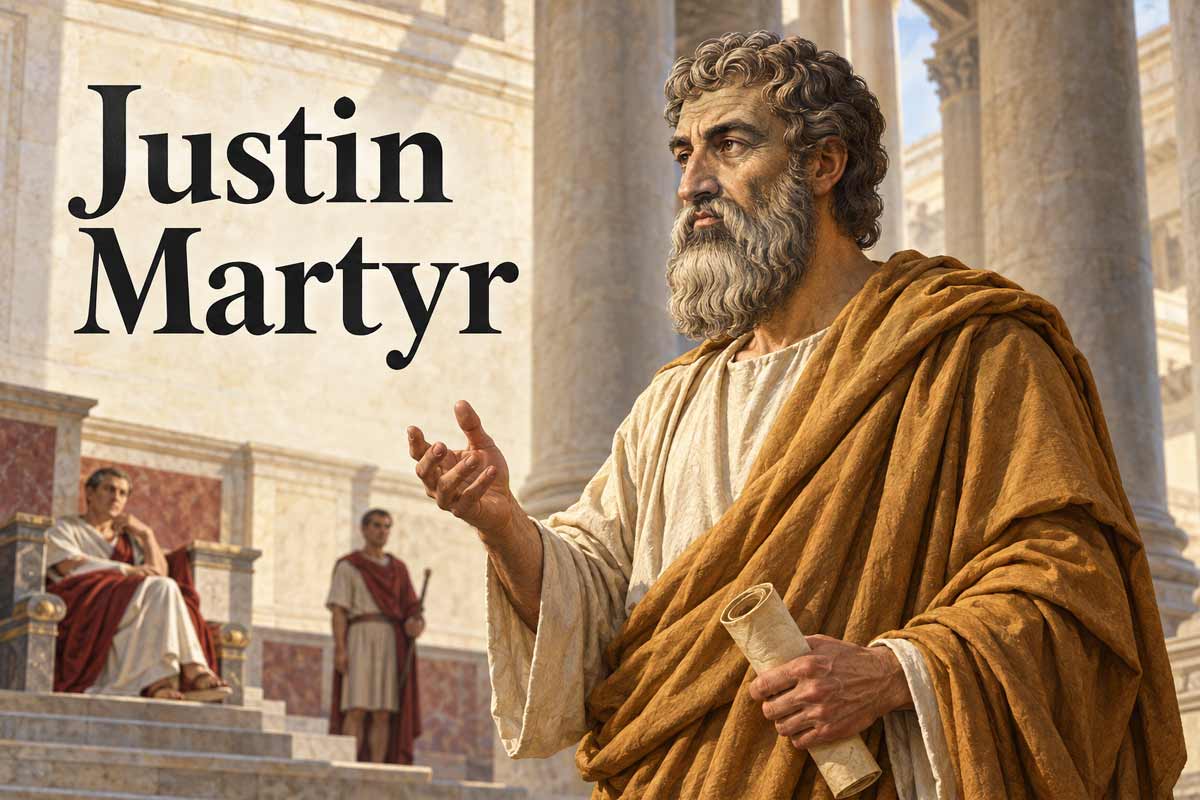
Justin Martyr spent years looking for a philosophy that could tell him the truth about God. When he became a Christian, he didn’t conclude that thinking had been a terrible mistake and that he should give it up. He believed he’d finally found what he’d been looking for, and he continued wearing the philosopher’s cloak while teaching others about Jesus. That combination made him an unusual figure in the second-century church. He could discuss Plato with educated pagans, argue from the Hebrew prophets with Jewish opponents, and explain to Roman officials why Christians deserved a fair hearing instead of an execution.
The word “apologist” can confuse people who haven’t encountered it before. Justin wasn’t apologizing for being a Christian, although the authorities would’ve preferred that he did. An apology in this setting was a reasoned defense, and his surviving writings show him defending Christianity against charges of atheism, moral corruption, and disloyalty to the empire. He also tried to explain why a crucified Jewish teacher should be worshiped and why Christian faith made sense of truths the philosophers had only partially understood. Eventually, the man who argued that Christians shouldn’t be killed simply for being Christians was killed for being a Christian.
A Philosopher Looking for God
Justin was born around the beginning of the second century at Flavia Neapolis, in the region of Samaria, near ancient Shechem and present-day Nablus. His family appears to have been pagan, and he received an education that brought him into contact with Greek philosophy. We don’t know his exact birth date, and much of what we know about his intellectual development comes from the opening of his Dialogue with Trypho. That account is arranged to make a theological point, so it shouldn’t be treated as an unedited diary. It does, however, show the kinds of questions that drove him and the philosophical world in which he learned to ask them.
In Justin’s account, he first studied with a Stoic who had little to offer about God and didn’t consider the subject especially necessary. He moved on to a teacher associated with Aristotle’s tradition, but became disillusioned when the man began discussing payment. A Pythagorean insisted that Justin needed training in music, astronomy, and geometry before proceeding, which sent him looking elsewhere. Finally, he found a Platonist whose teaching seemed to promise knowledge of realities beyond the material world. Justin was searching for God, and he believed he was getting close, although his account also suggests that he wasn’t the easiest prospective student to enroll.
The turning point came, he says, through a conversation with an older man near the sea. The man challenged his assumptions about the soul and his confidence that philosophical contemplation could bring him to a knowledge of God. He directed Justin toward the prophets, who spoke through God’s revelation, and toward the Christ they proclaimed. Justin describes his response as a love for the prophets and for those who followed Christ. In his Second Apology, he also explains that the courage of Christians facing death helped undermine the accusations he’d heard against them. People supposedly devoted to pleasure and wickedness weren’t behaving as he would’ve expected when preserving their lives required only denying their faith.
Christianity Before It Had Imperial Protection
Justin eventually taught in Rome, where people could come to him to discuss Christian belief. He wasn’t a bishop overseeing a famous cathedral, and Christianity hadn’t become a favored religion with the emperor’s backing. Christians were a vulnerable minority whose refusal to sacrifice to the gods could be interpreted as contempt for the religious order that supported Roman public life. Persecution wasn’t equally intense in every place or every year, but a local accusation could have deadly consequences. Justin’s apologetics developed in that setting, where getting the authorities to distinguish a religious label from a criminal act was an urgent concern.
His First Apology, usually dated to the middle of the second century, addresses Emperor Antoninus Pius, members of the imperial family, the Senate, and the Roman people. Justin appeals to the rulers’ reputation for philosophy and justice, then asks them to act accordingly. If Christians commit crimes, he argues, investigate and punish the crimes. If they haven’t committed crimes, calling them Christians doesn’t supply the missing evidence. He isn’t asking for a religious exemption from ordinary moral responsibility, and he doesn’t claim that everyone using the Christian name is innocent. He wants actual conduct examined instead of allowing popular hostility to serve as a verdict.
The shorter Second Apology brings the argument down to the level of individual lives. Justin tells of a woman whose conversion led her to reject the immoral life she’d previously shared with her husband. After their separation, the husband used her Christian identity against her and then pursued the teacher associated with her conversion. The resulting proceedings, as Justin recounts them, condemned people for confessing Christ rather than for demonstrated wrongdoing. We don’t possess every side of the case, but Justin’s purpose is clear. A law that lets personal resentment turn someone’s faith into a capital charge has given an accuser a very convenient weapon.
Why Christians Were Called Atheists
The accusation of atheism sounds strange to modern readers because Christians believe in God. In Justin’s setting, however, refusing the recognized gods could make someone an atheist in the eyes of the surrounding society. Christians wouldn’t worship the gods represented in temples or offer the sacrifices expected of loyal participants in Roman religious life. Justin answers that Christians do worship the Creator, His Son Jesus Christ, and the prophetic Spirit. He then questions whether the gods of pagan mythology deserve worship at all, given the immoral behavior attributed to them. His defense challenges both the accusation and the standards by which the accusation was being made.
Justin also insists that Christian hope doesn’t make believers enemies of public order. They pay taxes, seek to live honestly, and recognize that God sees conduct a magistrate may never discover. Their expectation of God’s kingdom doesn’t mean they’re organizing a military revolt against Rome. At the same time, civic obedience has a limit when the state demands worship that belongs to God. Justin’s argument therefore leaves room for loyal citizenship without allowing the emperor to become the judge of every religious obligation. That distinction would become painfully concrete when a Roman official demanded that he sacrifice to the gods.
The Word Behind the Truth Philosophers Found
Justin’s most distinctive contribution is his explanation of the relationship between Christ and the truth found outside the church. He uses the Greek term Logos, which can mean word or reason, and identifies the Logos with the divine Word who became flesh in Jesus Christ. The language gave him a point of contact with Greek philosophy, but the person at the center of his argument was the Christian Savior. Justin believed that human beings could recognize portions of truth because the Word’s activity wasn’t confined to the years of Jesus’ earthly ministry. Christ’s incarnation brought into history the One through whom those glimpses of truth had been possible in the first place.
He develops this through the idea often called the “seed of the Word.” Philosophers and other writers could perceive something true without possessing a complete or consistent understanding of it. In the First Apology, he even describes people such as Socrates and Heraclitus as Christians in the sense that they lived in accordance with the Logos before Christ’s incarnation. That’s stronger language than many Christians today would use, and it deserves to be read carefully. Justin wasn’t saying that every religion saves or that Greek philosophy and the gospel are interchangeable. He believed that whatever truth a philosopher possessed came from the same Word who was fully revealed in Christ.
This gave Justin a way to engage educated outsiders without pretending that they were wrong about everything. A Christian doesn’t have to deny a true statement because it came from someone who isn’t a Christian. The harder task is distinguishing the truth a thinker has recognized from the errors that accompany it. Justin was quite willing to criticize philosophical contradictions and the moral failures of pagan religion while acknowledging real insight. His approach encourages Christians to listen carefully, explain their disagreements, and resist the temptation to treat every conversation as a contest in which conceding anything means losing everything.
Jesus and the Hebrew Scriptures
Justin’s apologetics also depends heavily on the Hebrew prophets. He argues that Jesus’ birth, suffering, resurrection, and the spread of His message among the nations belong to a story God had already begun telling. This helps explain why he doesn’t rest his defense entirely on reports of miracles. He knew that an opponent could dismiss an extraordinary deed as magic, so he sought to show that Jesus fit the prior witness of Scripture. His case combines predictions with patterns he believes point toward Christ, such as the Passover and the bronze serpent. Readers need to distinguish those kinds of interpretation, since a direct prediction and a symbolic connection aren’t the same kind of argument.
The Dialogue with Trypho develops this biblical defense at length. Trypho is presented as a Jewish interlocutor who challenges Christian claims about the Messiah, the law, and Jesus’ divine identity. The work may preserve memories of actual conversations, but its finished form is Justin’s literary presentation, and we shouldn’t assume that every exchange happened exactly as written. Trypho raises a serious difficulty when he questions how the Messiah could have suffered the shame of crucifixion. Justin answers by distinguishing the Messiah’s suffering first coming from His future coming in glory, and by reading passages such as Isaiah’s suffering servant in relation to Jesus. The debate concerns the meaning of shared Scriptures rather than whether those Scriptures matter.
Justin’s language about Jews can be harsh, and some of his claims about their collective responsibility and spiritual blindness should trouble Christian readers. His conviction that Christ fulfills Israel’s Scriptures sometimes becomes an argument that speaks about Jewish people too broadly and dismissively. We can recognize the conflicts surrounding the early church without treating every expression of hostility as an example to follow. Defending Jesus as Messiah doesn’t require contempt for Jews, and a Christian reading of the Old Testament shouldn’t erase its original historical setting. Justin is valuable here as both an early witness to Christian interpretation and a reminder that theological conviction doesn’t automatically keep polemics fair.
There is also a revealing qualification in chapter 47 of the Dialogue. Justin accepts fellowship with Jewish believers in Jesus who continue observing Mosaic practices, provided they don’t require Gentile Christians to adopt those practices as conditions of salvation. He acknowledges that other Christians are less willing to receive them, and he disagrees with those Christians. His position doesn’t remove the more troubling features of his argument, but it shows that he could distinguish a believer’s inherited observance from an attempt to impose it on everyone else. The question of who must keep which customs was still alive in the second century. Justin’s answer allowed more room for different practices than some of his contemporaries preferred.
The Divine Christ and the Developing Language of Doctrine
Justin presents Jesus as the preexistent Son and Word of God, who truly became human and is worthy of worship. The idea that Christians waited until the fourth century to regard Jesus as divine doesn’t fit his writings. Yet Justin’s explanations don’t simply reproduce the language later used at Nicaea. He speaks of the Son in relation to the Father’s will and uses language of order and rank that later Christian theology would need to clarify. We shouldn’t quietly rewrite him into a modern statement of faith, nor should we assume that every distinction he makes amounts to a fully developed later heresy. He is an early Christian thinker trying to explain the divine Christ while maintaining belief in one God.
His use of philosophy also requires judgment rather than automatic approval. At times, Justin claims that Greek thinkers borrowed important ideas from Moses and the prophets, but resemblance alone doesn’t establish that one writer read another. His arguments about pagan myths imitating biblical truths through demonic activity can also move beyond what historical evidence allows us to demonstrate. In chapter 31 of the First Apology, his account of the Greek translation of Scripture even places Herod in the time of the earlier Ptolemaic translation tradition. These weaknesses don’t make everything he wrote worthless. They do remind us that an apologist can reach a sound conclusion through some arguments that need correction, and that defending Christianity doesn’t require defending every argument ever made for it.
A Sunday Service in the Second Century
One of Justin’s most useful contributions is his description of Christian worship in chapters 65 through 67 of the First Apology. Christians gather on Sunday, hear readings from the prophets and the memoirs of the apostles, and receive instruction encouraging them to live accordingly. They pray together, share the bread and cup, and give voluntarily to support people in need. Deacons distribute Communion and take portions to those who are absent. Justin connects Sunday worship with creation and with Jesus’ resurrection. Whatever differences exist between his account and a particular church’s service today, he is describing a recognizable Christian gathering long before Constantine.
The collection is especially revealing because Justin explains what the money supports. He mentions widows, orphans, people suffering through illness or other hardship, prisoners, and travelers needing help. Worship and practical care belong together in his description of the church. He’s trying to answer outsiders who suspect Christians of dangerous secret behavior, and part of his response is to explain the ordinary work of feeding and helping people. Christians could argue that their beliefs improved conduct because there was conduct available for inspection. An apologetic that praises Christian love becomes much less persuasive when nobody can locate the people receiving it.
Justin also gives baptism and Communion a theological weight that some modern readers may find unfamiliar. In chapter 61, he describes converts being instructed, believing the teaching, committing themselves to a changed life, and praying and fasting before baptism in the name of the Father, Son, and Holy Spirit. He connects that washing with regeneration and the forgiveness of sins. In chapter 66, he insists that the Eucharist is received as more than ordinary food and identifies it with the flesh and blood of the incarnate Jesus. These statements shouldn’t be diluted into language he didn’t use, but they also don’t settle every later dispute about how the sacraments work. Justin’s account is an early witness that Christians from different traditions need to read honestly, including where it challenges their assumptions.
Resurrection and the Gifts of the Spirit
Justin expected the resurrection of the body, and he resisted the idea that Christian hope could be reduced to souls escaping to heaven. He also believed that the righteous would reign with Christ in a restored Jerusalem for a thousand years, drawing on the prophets and on the Revelation he attributes to John. In chapters 80 and 81 of the Dialogue, he explains that expectation while acknowledging that other sincere Christians disagree about the millennium. That distinction deserves attention from anyone who thinks disagreement about an end-times timetable automatically puts someone outside the faith. Justin held his view firmly and still recognized believers who didn’t share it. His position is an early form of premillennial expectation, without all the features of later dispensational systems.
His writings also speak of prophetic gifts continuing among Christians and of demons being overcome in Jesus’ name. Chapter 82 of the Dialogue explicitly places prophetic gifts in Justin’s own time, while chapter 85 appeals to deliverance as evidence of Christ’s authority. Those passages show that at least this prominent second-century apologist didn’t describe the church as having left all such activity behind with the apostles. They aren’t independent verification of every reported event, and they don’t establish that every modern claim to a gift is trustworthy. Justin himself recognizes false teachers and the need to distinguish truth from error. We can take his testimony seriously without asking it to answer more questions than it actually addresses.
Why He Is Called Martyr
Around AD 165, during the reign of Marcus Aurelius, Justin and six other Christians were brought before the Roman prefect Junius Rusticus. The surviving account of their trial records questions about their beliefs, where they met, and whether they would obey the demand to sacrifice. Justin confessed his Christian faith and explained that he taught those who came to him. The others also acknowledged that they were Christians, including a woman named Charito and a man, Euelpistus, who identified himself as an imperial servant. Their varied backgrounds show that the proceeding involved more than one philosopher defending his intellectual position. Ordinary believers were being asked to make the same choice.
When Rusticus threatened punishment, Justin maintained that faithfulness to Christ offered hope beyond the court’s judgment. He and his companions refused to sacrifice, and the account records their sentence to scourging and beheading. Justin had earlier expected hostility from the Cynic philosopher Crescens, but we shouldn’t turn that expectation into certainty about exactly who caused his arrest. Nor should we assume that Marcus Aurelius personally conducted or ordered this particular trial. What we can say is that a Roman court condemned Justin and his companions for refusing the religious obedience demanded of them. The name “Martyr” preserves the end of a life that had already been devoted to bearing witness.
Justin’s willingness to die didn’t prove every historical claim or interpretation he made. People can be sincere and mistaken, and a Christian defense shouldn’t rely on courage as a substitute for evidence. His life does, however, connect the arguments he wrote with the convictions he actually held. He wanted rulers to examine Christian conduct, wanted philosophers to follow truth wherever it led, and wanted readers of Scripture to consider the claims of Jesus. When his own confession became dangerous, he didn’t invent a private exception to those convictions. The philosopher who had spent years asking how to know God believed he’d found his answer in Christ, and he kept that answer when the court demanded another one.