

Few Christian writers have reached as many different kinds of readers as C. S. Lewis. Some encounter him through a defense of the faith, others through letters supposedly written by a demon, and still others through a wardrobe that turns out to have considerably more storage space than advertised. His books can introduce children to courage and sacrifice while giving adults something serious to consider about morality, suffering, and the claims of Jesus. That range helps explain his enduring importance in Christian apologetics. Lewis understood that people bring their imaginations and desires into a discussion along with their arguments, and he knew how to address all of them.
Clive Staples Lewis was born in Belfast in 1898 and died in England in 1963. Known to his friends as Jack, he became a distinguished scholar of literature, teaching at Oxford before taking a professorship in medieval and Renaissance literature at Cambridge in 1954. His professional expertise was literary scholarship, and he wrote about Christianity as a layman rather than an ordained minister. That distinction matters when we read him. His ability to explain a difficult idea could be remarkable, but his popularity doesn’t make every theological opinion he held authoritative. We can appreciate his gifts while examining his conclusions, just as we should with any other Christian writer.
From Atheism to Christian Faith
Lewis’s childhood included a devastating loss when his mother died of cancer in 1908. He later abandoned the Christian faith of his upbringing and became an atheist, although his love of stories and his sensitivity to beauty remained strong. Military service during the First World War brought him into the fighting in France, where he was wounded in 1918. His eventual return to faith therefore wasn’t the sheltered optimism of someone who had never encountered suffering. He had experienced bereavement and war well before becoming a Christian apologist. Those experiences don’t settle the truth of his beliefs, but they help us understand why pain and longing occupy such important places in his writing.
His conversion developed gradually through reading, reflection, and conversations with friends. George MacDonald’s imaginative writing helped awaken a sense of holiness, while friendships with people such as J. R. R. Tolkien challenged his assumptions about Christianity. Lewis traditionally dated his acceptance of belief in God to 1929, with his embrace of Christianity following in 1931. An important conversation with Tolkien and Hugo Dyson helped him reconsider the relationship between the gospel and the stories that had moved him for years. He came to see the Christian account of Christ’s death and resurrection as something that could satisfy the imagination while also making a claim about actual events. Believing that God exists and believing that God has acted in Jesus became distinct stages in his journey.
Lewis sometimes described Christianity as a true myth, which can sound confusing if we use myth to mean a false story. He was using the word to describe a story with deep imaginative significance, and the crucial addition was that the gospel concerned something that really happened. The distinction is essential to understanding his apologetics. A beautiful account of sacrifice might move us without being historically true, but Christianity claims that the Son of God actually entered human history, died, and rose again. Lewis’s attraction to the story didn’t remove the need to consider that claim. It helped him recognize that historical truth and imaginative meaning could belong together.
What He Meant by Mere Christianity
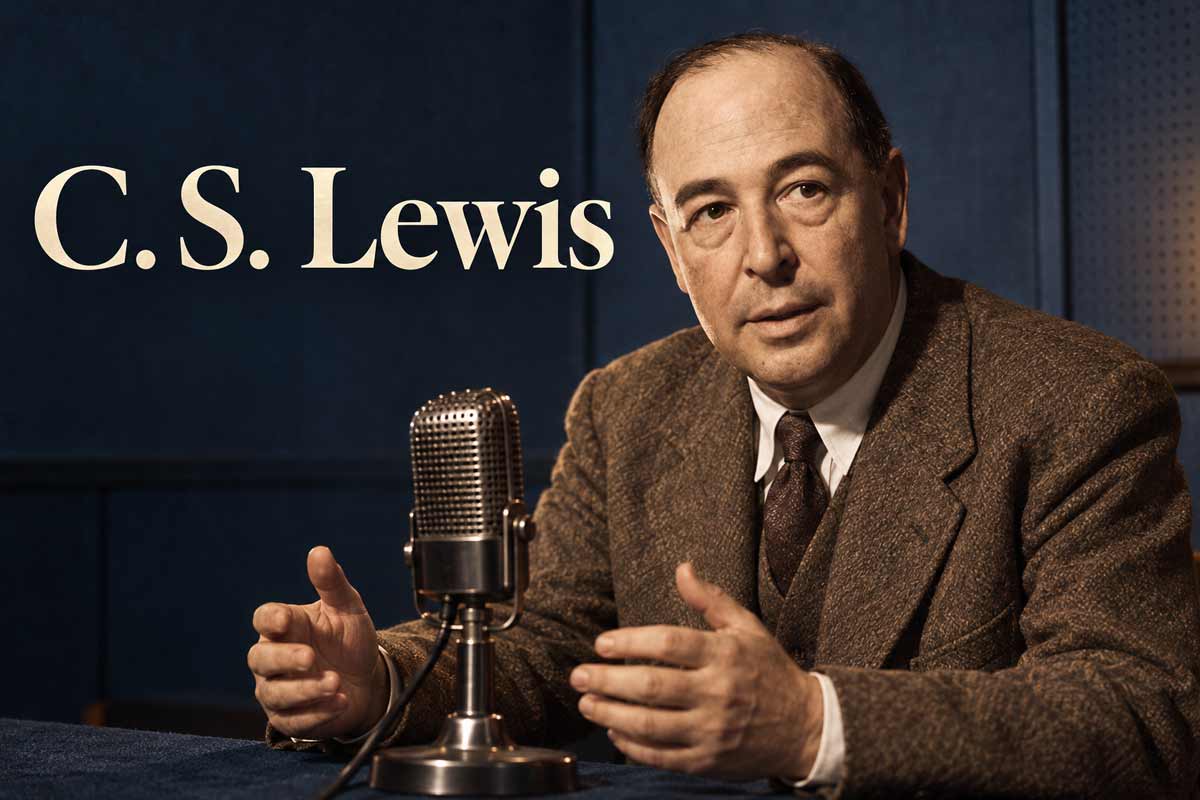
During the Second World War, Lewis gave BBC radio talks explaining Christian belief to a broad audience. The talks eventually became the basis of Mere Christianity, published in 1952. His approach began with experiences listeners could recognize and moved toward the Christian account of God, human failure, and redemption. You didn’t need a theological education to follow the discussion, although the subjects themselves were substantial. Lewis could translate an abstract question into an ordinary situation without assuming that ordinary people were incapable of serious thought. That remains one of the most useful lessons his work offers anyone who teaches or defends the faith.
The word “mere” can suggest something small or watered down, but that wasn’t Lewis’s intention. In the book’s preface, he compared the shared Christian faith to a hallway leading into different rooms, with the rooms representing particular Christian communions. The hallway helped people reach a place where they could consider entering a room; it wasn’t supposed to become their permanent residence. Lewis himself belonged to the Church of England, and he wasn’t proposing a new denomination with all the difficult doctrines removed. His project concentrated on central Christian convictions while leaving many disagreements for other discussions. That approach can encourage cooperation without requiring us to pretend that differences over baptism, church authority, or the Lord’s Supper are unimportant.
Morality and the Meaning of the Universe
One of Lewis’s best-known arguments begins with the way people appeal to standards of right and wrong. When someone breaks a promise or treats us unfairly, that hurts us. But in saying we’re hurt, we ordinarily mean more than that we dislike what happened. We believe the person ought to have acted differently, even if the wrongdoing was convenient or popular. Lewis distinguished this sense of obligation from a passing desire or instinct. Competing impulses can pull us toward safety and toward helping someone in danger, yet we also judge which impulse we should follow. For Lewis, that judgment suggested a moral standard with an authority our preferences couldn’t supply.
He also asked what we mean when we call one society’s conduct morally better than another’s. If improvement means anything beyond a change in fashion, some standard must make the comparison possible. Lewis argued that this feature of our experience points beyond human approval toward a moral source. The argument doesn’t depend on claiming that every culture has identical customs or that unbelievers can’t behave honorably. An atheist may be more conscientious than a Christian, and Christians can fail badly. The question concerns what makes a moral obligation binding, including when keeping it costs us something.
We should give that argument its proper scope. Recognizing objective moral obligations doesn’t immediately establish the Trinity, the Resurrection, or the inspiration of Scripture. Critics also offer accounts of morality based on reason, human flourishing, social relationships, or other foundations, and a responsible defense of the faith must engage those accounts. Lewis provided an accessible opening to that discussion rather than a substitute for every discussion that follows. His argument is especially helpful in exposing the difficulty of treating morality as mere personal preference while continuing to condemn injustice as something everyone ought to oppose. It invites us to ask whether our moral judgments fit comfortably within the account of reality we claim to believe.
Reason and the Possibility of Miracles
In Miracles, first published in 1947, Lewis examined the relationship between naturalism and rational thought. The issue was whether a view that explains everything entirely through natural processes can adequately account for reasoning that genuinely follows evidence and logical connections. A belief can have a causal history while also being held for good reasons, and explaining the first isn’t automatically an explanation of the second. Lewis wanted readers to consider whether their worldview could make room for the authority of reason itself. That is a more demanding question than whether the brain is involved in thinking. Christians don’t need to deny the brain’s activity to ask what makes an inference rationally justified.
This part of his work also illustrates why even an effective apologist needs correction. In 1948, the philosopher Elizabeth Anscombe, herself a Christian, criticized his treatment of naturalism at the Oxford Socratic Club. Lewis later revised the relevant chapter for the 1960 edition of Miracles. The familiar story that this encounter destroyed his confidence and ended his apologetic work doesn’t fit his continued writing and activity. We don’t have to turn the exchange into a contest with an infallible winner. A serious objection helped produce a more careful argument, and that is something Christians should welcome rather than conceal.
Jesus and the Famous Trilemma
Lewis’s discussion of Jesus is often summarized as the choice between Lord, liar, or lunatic. His target was the comfortable suggestion that Jesus could be accepted simply as a great moral teacher while his extraordinary claims were dismissed. If someone genuinely claims the authority that belongs to God, the truth or falsity of that claim has consequences for our assessment of the person. Lewis drew particular attention to Jesus’s authority to forgive sins, including offenses committed against other people. That authority makes sense within the Christian understanding of who Jesus is. It becomes much harder to explain if we reduce him to another instructor offering useful advice.
The historical qualification is important, however. A critic may question whether the Gospels accurately preserve Jesus’s claims, or propose that the claims developed through later interpretation. Calling that person to choose among three alternatives doesn’t answer the objection until the historical question has been addressed. Lewis’s argument therefore works most directly when the relevant portrait of Jesus is accepted. It challenges a selective reading of that portrait, but it shouldn’t be presented as a complete proof of Christianity requiring no examination of the evidence. Apologetics becomes weaker when we ask a memorable argument to do work it was never equipped to do.
Longing for More
Another recurring theme in Lewis’s writing is an intense longing that ordinary pleasures awaken without finally satisfying. He used the word “joy” for this experience, distinguishing it from simple happiness or enjoyment. A landscape, a story, or a piece of music could evoke a desire that seemed to reach beyond the thing that occasioned it. Lewis eventually understood that longing as a clue to the purpose for which human beings were made. His autobiography, Surprised by Joy, recounts his early life and conversion; its title refers to this experience rather than to his later marriage to Joy Davidman. Keeping those meanings separate helps us follow what he was saying.
His argument from desire compared this longing with natural appetites that have real objects, such as hunger and food. He suggested that a desire no earthly experience can fully satisfy may point toward fulfillment beyond the present world. The argument doesn’t mean that every wish must come true or that dissatisfaction proves whatever religious belief we prefer. Its force depends on whether the longing Lewis described is best understood as a natural orientation toward something real or explained in another way. For readers who recognize the experience, his account can open a serious conversation about the limits of earthly fulfillment. It can also help Christians enjoy good things without expecting a career, a relationship, or a vacation to carry the weight of eternity.
Suffering and the Reality of Grief
The Problem of Pain, published in 1940, addresses the difficulty of reconciling suffering with a good and powerful God. Lewis discussed human freedom, the consequences of evil, and the conditions of life in a world with a stable natural order. He also challenged the assumption that divine goodness would necessarily mean keeping us comfortable. God’s concern for our character and our relationship with him may involve something more demanding than the removal of every unpleasant experience. That argument deserves consideration, but it doesn’t give us privileged knowledge of why a particular child becomes ill or why a particular family suffers. There is a considerable difference between discussing the possibility of a purpose and announcing God’s explanation for somebody else’s tragedy.
Lewis’s own bereavement brought the subject into painfully personal focus. He married Joy Davidman in a civil ceremony in 1956 and in a Christian ceremony in 1957, after she had been diagnosed with cancer. She died in 1960, and his reflections on the loss appeared in A Grief Observed in 1961, initially under a pseudonym. This book records distress, questions, and the frightening feeling that God is absent when most urgently needed. Lewis examined his own assumptions about God while struggling with the loss of a real person he loved. The result shouldn’t be flattened into a tidy illustration that his earlier arguments made grieving easy.
Reading the two books together helps us distinguish an intellectual answer from the experience of living through suffering. Lewis’s grief didn’t establish that his earlier reasoning was worthless, and his earlier reasoning didn’t cancel the reality of grief. Christians can believe in the resurrection while feeling the terrible absence of someone who has died. We can confess God’s goodness while praying with the anguish expressed in the Psalms. For anyone involved in apologetics or ministry, that distinction has practical consequences. A thoughtful explanation may be useful, but a grieving person may first need patience, presence, and someone willing to listen.
Imagination in the Service of Faith
Lewis’s fiction extends his work into territory that a formal argument often can’t reach. The Screwtape Letters, published in 1942, presents advice from the senior demon Screwtape to his nephew Wormwood about undermining a human being’s spiritual life. Since the advice comes from the enemy’s perspective, readers have to reverse its moral direction. The format exposes the ordinary habits through which people excuse themselves, neglect prayer, nurse resentment, and become impressed with their own spirituality. Its usefulness lies partly in the uncomfortable recognition that temptation doesn’t always arrive looking spectacularly evil. A person can drift away from faith while remaining thoroughly satisfied with his own good intentions.
The seven books of The Chronicles of Narnia, published between 1950 and 1956, give Christian themes imaginative form through another world and its inhabitants. Aslan’s role brings sacrifice, judgment, mercy, and resurrection into the experience of the story. Lewis explained this project as a supposal: imagining how Christ might act in a world such as Narnia. That approach differs from assigning every character and object a single counterpart in a rigid allegorical code. Readers should allow the stories to work as stories while recognizing their Christian meaning. A talking lion isn’t historical evidence for the resurrection, but a well-told story can help someone understand why redemption matters.
There is a useful connection here with Lewis’s own journey to faith. His imagination had been engaged by beauty and sacrificial stories before he accepted Christianity’s claims. In his fiction, he offered other readers an opportunity to encounter recognizable spiritual realities through an unfamiliar setting. The approach can make pride look ugly again when we’re accustomed to calling it confidence, or make courage attractive when fear has become our normal way of living. It doesn’t remove the need for sound doctrine and historical inquiry. It gives those discussions a richer human setting by helping people see what the ideas mean in a life.
Education and Moral Formation
In The Abolition of Man, published in 1943, Lewis considered what happens when education teaches people to regard moral judgments as expressions of feeling without objective authority. His concern extended beyond whether students could repeat the right answers on an examination. Education also shapes what they love, admire, and learn to resist. If moral convictions are reduced to conditioning, those with the power to condition others can determine the values the next generation receives. Lewis warned that a promised increase in humanity’s control over itself could become the control of many people by a smaller group. The practical question is who directs that power and by what standard their decisions can be judged.
He used the term “Tao” for the broad tradition of objective moral value, drawing examples from different cultures and religious traditions. He wasn’t announcing a conversion to Taoism or claiming that every religion teaches the same theology. The point was that moral reasoning depends on standards it can’t simply discard while continuing to make authoritative judgments. We can debate his account of that tradition and the particulars of his argument, but the underlying concern remains recognizable. Teaching children to question manipulation is valuable; teaching them that all honor, loyalty, and justice are merely manipulation creates a different problem. Lewis wanted education to form people capable of wise judgment, including the moral judgment needed to use knowledge responsibly.
Reading Lewis with Appreciation and Discernment
Lewis’s strengths don’t require us to adopt every element of his theology or every assumption reflected in his books. His Anglican background, his approach to disputed doctrines, and his views on some social questions won’t align with every Christian reader’s convictions. His common-ground project also leaves matters unresolved that a local church eventually has to address. We should test his teaching by Scripture and consider an argument’s actual premises instead of accepting it because we like its author. A writer who helped us understand one difficult subject may still be mistaken about another. Appreciation becomes more useful when it allows careful disagreement rather than demanding loyalty to everything the person wrote.
For someone beginning with Lewis, Mere Christianity provides a good introduction to his explanation of Christian belief and conduct. The Screwtape Letters turns attention toward motives and habits, while The Problem of Pain and A Grief Observed approach suffering from different angles. Readers interested in the relationship between imagination and faith can turn to Narnia, and those concerned with education and moral judgment can consider The Abolition of Man. These books reward reading beyond the isolated quotations that circulate online. An illustration makes better sense within the discussion it was written to serve, and an author deserves to be judged by what he actually said.
Lewis’s lasting contribution is his ability to make Christian belief intellectually serious and personally recognizable. He helped readers consider whether their moral judgments, rational thought, and deepest longings fit the world they thought they inhabited. He also brought those questions into contact with the claims of Christ and the demands of Christian living. His writing can challenge an unbeliever’s assumptions, but it can just as readily expose a believer’s pride or complacency. That is a healthy direction for apologetics to take. Defending the faith should deepen our willingness to live it, including the willingness to accept correction, care for hurting people, and acknowledge our dependence on the God we are discussing.