

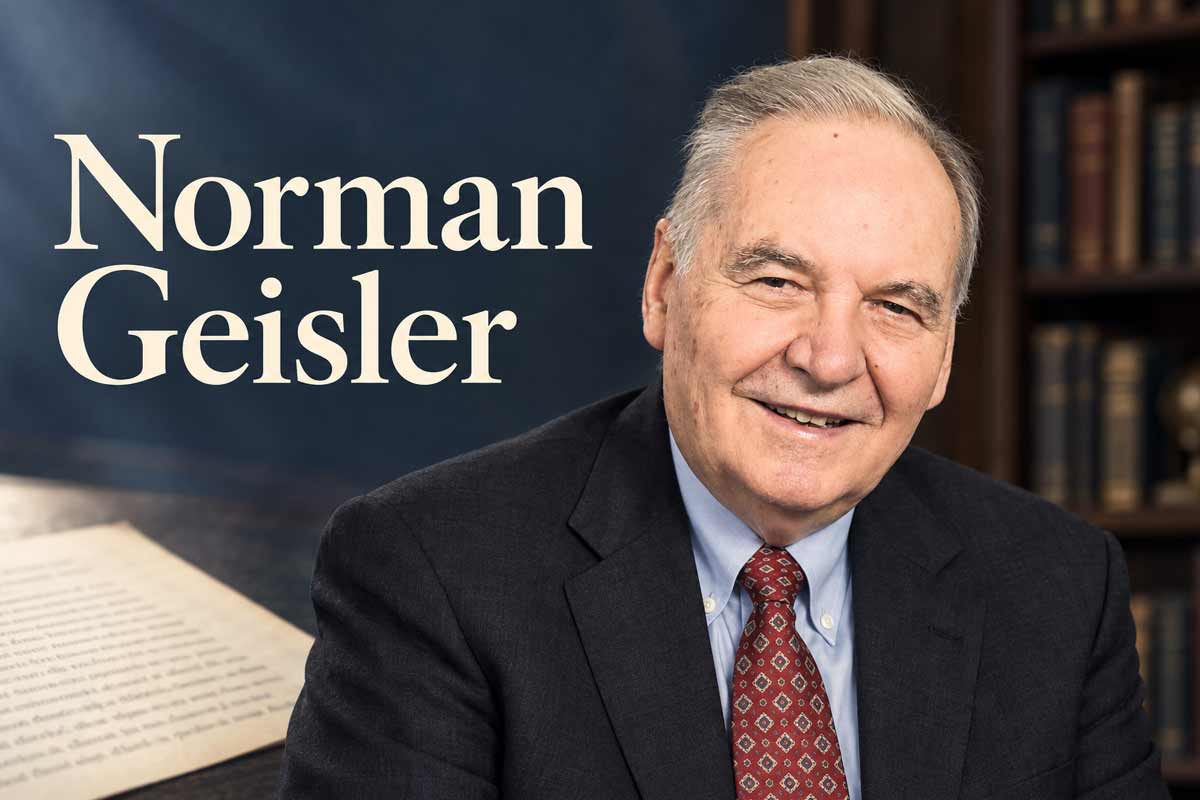
A Christian can learn an answer to a question about the resurrection and still be unprepared for the next question: why believe a resurrection is possible in the first place? A skeptic might accept that the New Testament contains useful historical information while rejecting the claim that it speaks with divine authority. Norman Geisler spent much of his life working through the connections between those questions. He wanted Christians to understand how the case for their faith fits together, including the philosophical assumptions underneath their arguments. For him, an answer was stronger when you could explain the reasoning that brought you to it.
Geisler became one of the most influential American evangelical defenders of Christianity in the late twentieth century. His work extended from arguments for God’s existence to biblical interpretation, ethics, and the training of future apologists. Readers who know Frank Turek’s presentations will recognize some of the approach, since the two coauthored I Don’t Have Enough Faith to Be an Atheist. But Geisler’s own interests reached well beyond a popular presentation of evidence. He was a philosopher and theologian who believed that defending Christianity required careful thinking about truth, God, history, and the meaning of Scripture.
A Young Evangelist Who Needed Answers
Norman Leo Geisler was born on July 21, 1932. In his account of his early life, his parents had become disillusioned with religion, and Christianity wasn’t an established conviction in his home. A local church nevertheless kept bringing him to its programs over a period of years. He eventually committed his life to Christ while still in high school and quickly became involved in evangelism. The patience of that congregation helped shape the ministry of a man who would later spend decades preparing other Christians to explain their faith.
His enthusiasm soon encountered questions he couldn’t answer. Geisler recalled an early encounter in Detroit with a man who used a saying of Jesus, removed from its context, to argue that he shouldn’t be witnessing at all. The young Christian knew he believed the gospel but lacked the knowledge to deal with the objection. He decided to pursue answers, and his education eventually included a philosophy degree from Wheaton College in 1958, a theology master’s from Wheaton in 1960, and a philosophy doctorate from Loyola University Chicago in 1970. His later academic work grew from a practical concern: he wanted to speak about Christ without being helpless when someone challenged what he said.
Over the following decades, Geisler taught at institutions including Trinity Evangelical Divinity School and Dallas Theological Seminary. His classrooms brought philosophy into contact with the questions pastors would face in their churches. A minister might be able to explain a passage and still struggle when a college student asked whether religious truth could be known at all. Geisler saw preparation for those conversations as part of Christian education. He wanted the church’s teachers to understand both the beliefs they held and the objections people would raise against them.
Why He Started with Truth
Geisler’s apologetics began with the conviction that people can know truths about the real world. He didn’t mean that we know everything, never make mistakes, or possess a complete explanation of every subject. He meant that our limitations don’t make all knowledge impossible. The claim that nobody can know anything already presents itself as something its speaker knows. Likewise, someone who insists that no statement is objectively true usually expects us to treat that very statement as objectively true. Geisler pressed these problems because a discussion about Christianity goes nowhere if every inconvenient claim can be dismissed as merely somebody’s personal truth.
He also emphasized the law of noncontradiction: a claim and its denial cannot both be true in the same sense at the same time. That qualification is essential, since an apparent contradiction can disappear when we clarify what somebody means. A person can be physically tired and emotionally energized without violating logic. But Jesus cannot both have risen bodily from the dead and never have risen bodily from the dead, if both claims concern the same event. Respect for another person’s convictions doesn’t require us to pretend that contradictory descriptions of reality are equally accurate.
This approach gave Geisler a way to address religious pluralism without beginning by assuming every other religion was wholly mistaken about everything. Different traditions can recognize moral truths, offer thoughtful observations, and agree on particular beliefs. Their agreements don’t settle their disagreements about God, salvation, or Jesus. Christians should identify those differences carefully instead of treating a religious label as a substitute for understanding what someone actually believes. A defense of Christian truth becomes less credible when it depends on a false description of somebody else’s faith.
An Evangelical Who Learned from Aquinas
Thomas Aquinas had a major influence on Geisler’s philosophy. Geisler remained an evangelical Protestant, but he found important resources in the medieval thinker’s account of existence, causation, and our knowledge of God. His book Thomas Aquinas: An Evangelical Appraisal reflected that willingness to learn across a significant theological divide. Appreciating Aquinas’s reasoning didn’t require accepting all of Roman Catholic theology. It required examining an argument on its merits rather than deciding whether it was usable by checking the author’s denominational address.
One of Geisler’s favorite arguments concerned the dependence of created things on a source of existence. Discussions about cosmology often ask what caused the universe to begin. His preferred philosophical argument also asked why dependent things exist at all, including right now. Such things don’t contain within themselves the complete explanation of their existence. Geisler reasoned that their dependence ultimately points to a necessary being whose existence isn’t received from anything else. He called this a vertical cosmological argument because it concerns dependence rather than simply tracing a sequence backward through time.
That distinction helps clarify the familiar objection about who created God. The argument doesn’t begin by claiming that absolutely everything must have a creator and then quietly giving God an exemption. It distinguishes dependent existence from the independent source on which dependent things rely. Critics can challenge whether the reasoning establishes such a source or whether its conclusions justify the Christian understanding of God. Those are substantive objections that deserve answers. But describing the argument accurately comes before deciding whether it succeeds.
Geisler’s understanding of God also included the classical doctrines of God’s eternality, immutability, and simplicity. In ordinary language, God doesn’t owe his existence to another being, doesn’t become a different kind of being over time, and isn’t assembled from more basic components. Divine simplicity can sound as though it means God is easy to understand, which would come as news to most theology students. The doctrine actually concerns God’s indivisible being. Geisler believed these ideas protected the distinction between the Creator and creation, preventing us from imagining God as merely a much larger and more powerful version of ourselves.
From Belief in God to Belief in Christ
Geisler was a leading representative of classical apologetics. Its general approach first argues for the existence of God and then examines the evidence for Christianity in particular. Establishing that a Creator exists doesn’t by itself establish the Trinity, the incarnation, or the resurrection of Jesus. Those claims require further argument. The order mattered to Geisler because someone who has ruled out God’s existence will interpret every report of a miracle through that prior commitment. A philosophical defense of theism helps make a historical investigation of miracles possible without dismissing them before examining the evidence.
His well-known twelve-point framework laid out the movement from knowable truth to God, from God to the possibility of miracles, and from the New Testament accounts to Jesus’ identity and authority. The argument then used Jesus’ teaching about Scripture to support belief in the Bible as God’s Word. At the historical stage, the New Testament could be examined as a collection of ancient documents before its inspiration had been established. Geisler was trying to avoid beginning with the very conclusion a skeptical reader was being asked to accept. The case depended on the reasoning connecting its stages, rather than on repeating that Christians believe the Bible.
That sequence also exposes the work an apologist must do. Showing that miracles are possible doesn’t establish that a particular miracle occurred. Showing that a document preserves reliable information doesn’t automatically establish that every statement in it is divinely inspired. A defense must examine the relevant evidence and explain why its conclusions follow. Geisler’s framework is useful precisely because readers can inspect those connections, but a framework cannot perform the investigation in their place. Christians should resist presenting the name of an argument as though it were the argument itself.
Books That Reached Beyond the Classroom
Geisler’s writing served both students and ordinary Christians. Christian Apologetics, published in 1976, addressed the philosophical foundations of defending the faith, while the Baker Encyclopedia of Christian Apologetics gave readers a substantial reference work. His four-volume Systematic Theology brought his philosophical and biblical convictions into a broader account of Christian doctrine. Together, these works showed his desire to connect individual answers with a coherent understanding of God and revelation. He wanted readers to know where a question belonged and what other beliefs were involved in answering it.
The 2004 book I Don’t Have Enough Faith to Be an Atheist, written with Frank Turek, introduced that approach to a much wider audience. Its provocative title challenged the assumption that Christians rely on faith while unbelievers rely exclusively on evidence. The book argued that competing views should be assessed by the reasons supporting them, moving through questions about God, morality, the New Testament, and Christ. The title shouldn’t become an excuse to tell every atheist that he secretly belongs to a religion. A person who rejects the book’s argument still deserves a response to his actual reasons for rejecting it.
Geisler also worked on objections directed at particular biblical passages. When Critics Ask, coauthored with Thomas Howe, addressed difficulties throughout Scripture, including alleged discrepancies and challenges to its reliability. That kind of work offers readers something more concrete than a general assurance that the Bible can be trusted. It also requires patience with context, language, and the distinction between a contradiction and an incomplete account. Two witnesses can describe different features of an event without one of them being wrong, although identifying that possibility is only the beginning of explaining a difficult passage.
Defending Biblical Inerrancy
Geisler played an important role in the International Council on Biblical Inerrancy and helped draft the 1978 Chicago Statement on Biblical Inerrancy. It was a collective evangelical effort, not a document he produced alone. Its central concern was the complete truthfulness of Scripture in what it affirms. Geisler opposed restricting biblical reliability to religious lessons while allowing biblical assertions about history to be false. For him, God’s truthfulness and Scripture’s divine inspiration belonged together: a Bible that taught falsehood couldn’t be defended by saying that its spiritual intentions were good.
The Chicago Statement located inspiration in the original biblical writings and treated copies and translations as conveying God’s Word insofar as they faithfully represent those writings. It didn’t claim that every manuscript copy or English translation was perfect. It also recognized ordinary language, approximation, figures of speech, and different literary forms. Referring to a sunrise doesn’t commit a writer to a mistaken astronomical theory, any more than it does when we use the expression today. Complete truthfulness has to be assessed according to what a passage actually communicates, rather than a demand that every biblical author write like a modern laboratory technician.
There remains a real responsibility to establish what a passage means. An interpreter cannot make every difficulty disappear simply by announcing that the Bible is inerrant. Conversely, finding a question for which we don’t yet have a satisfactory answer doesn’t establish that the text contains an error. Readers must distinguish their confidence in Scripture from their confidence in a proposed explanation of Scripture. That distinction allows a Christian to investigate difficulties honestly, revise an interpretation when necessary, and acknowledge when a particular solution remains uncertain.
Geisler himself didn’t believe that inerrancy required a young-earth position. He argued that Christians could accept an ancient earth while maintaining the truthfulness of Genesis, depending on how they understood its language and chronology. That doesn’t resolve the creation debate, but it complicates the assumption that his defense of Scripture required the strictest possible reading on every disputed detail. His position distinguished the authority of the biblical text from a particular interpretation of it. The question was whether the interpretation accurately represented what Scripture taught.
When Defenders of Scripture Disagreed
That distinction became contentious in Geisler’s public dispute with New Testament scholar Mike Licona. In his 2010 book on Jesus’ resurrection, Licona proposed that Matthew’s account of raised saints in Matthew 27:52–53 might function as apocalyptic imagery rather than describe a literal event. Geisler strongly objected, arguing that treating an account presented as history in that way compromised inerrancy. His concern wasn’t that Scripture contained poetry or symbolism. It was that a literary explanation could become a way of removing actual events from a historical narrative.
Licona defended the legitimacy of investigating ancient literary conventions and maintained that his work didn’t amount to abandoning biblical authority. He was also a defender of Jesus’ bodily resurrection, so the disagreement shouldn’t be described as a dispute between someone who believed in miracles and someone who rejected them. The issue concerned how to identify what a particular passage intended to assert. It raised a question that can’t be settled by attaching a label to either scholar: when does attention to literary form clarify a text, and when does it change a historical claim into something the author never intended?
Geisler’s vigilance encouraged Christians to take the implications of interpretation seriously. At the same time, the controversy showed the dangers of moving too quickly from a disputed reading to a judgment about another Christian’s commitment to Scripture. The Chicago Statement is an influential theological statement, but it isn’t itself inspired Scripture. Its application also involves interpretation, and evangelicals who affirm the Bible’s truthfulness don’t always agree on that application. Defending biblical authority requires careful arguments about the text as well as care in describing the people with whom we disagree.
Sovereignty, Freedom, and Moral Responsibility
Geisler addressed another longstanding evangelical disagreement in Chosen But Free, first published in 1999. He described his approach as moderate Calvinism while defending meaningful human freedom alongside God’s sovereignty. That description shouldn’t be mistaken for agreement with every position associated with the five points of Calvinism. He sought to preserve God’s initiative in salvation without making a person’s response to God a coerced act. Readers from both Calvinist and Arminian backgrounds have reasons to examine his account carefully instead of assuming that its label settles where he belongs.
His argument connected this issue with his understanding of God’s eternal knowledge. God doesn’t discover our decisions as time unfolds or wait to learn how his purposes turn out. Geisler held that divine foreknowledge and divine determination belong together without eliminating the freedom of human acts. Knowing an act with certainty, he argued, doesn’t by itself mean forcing the person who performs it. Christians can disagree about whether that account adequately explains election and freedom while recognizing the concern it addresses: salvation comes from God, and human beings remain responsible for their response.
In ethics, Geisler defended a position commonly called graded absolutism. It holds that moral obligations are objective, but that genuine conflicts can require obedience to a higher obligation over a lower one. His discussion included situations in which protecting innocent people conflicts with telling their persecutors the truth. He argued that fulfilling the higher obligation in such a case doesn’t make a person guilty of choosing a necessary sin. Other Christian ethicists question whether moral duties genuinely conflict in that way, but the disagreement concerns how to understand obedience in a tragic situation, not whether convenience can excuse wrongdoing.
The appeal of that approach is easy to understand when the problem becomes concrete. A person hiding an intended murder victim isn’t facing an abstract classroom puzzle about the value of honesty. He must consider his responsibility to someone whose life is threatened. Still, a hierarchy of obligations needs careful justification if it is to avoid becoming permission to excuse whatever we prefer. Geisler’s position is most useful when it prompts serious reasoning about duties and circumstances, with Scripture and God’s character governing the judgment.
Training Apologists to Serve People
In 1992, Geisler and evangelist Ross Rhoads cofounded Southern Evangelical Seminary in the Charlotte area. Its founding vision joined the defense of historic Christianity with evangelism. Geisler served first as dean and later as president, helping create an institution where apologetics had a central place in ministry preparation. The combination was significant because intellectual training can become detached from the people it is supposed to serve. The seminary’s purpose was to prepare Christians to use their learning in explaining the gospel, rather than treating apologetics as a specialized interest with no bearing on church life.
Geisler also cofounded Veritas Evangelical Seminary, which later became Veritas International University, and worked with his son David through Norman Geisler International Ministries. Those efforts extended his influence through students, training programs, and other teachers. His advice to aspiring apologists stressed the importance of studying logic and philosophy as well as theology. He wanted them to understand objections deeply enough to engage them, including reading major thinkers whose conclusions they rejected. Familiarity with an opponent’s weakest internet comment was hardly a substitute for understanding the best argument for his position.
The book Conversational Evangelism, written with David, provides an important counterpart to Geisler’s more formal reasoning. It emphasizes listening, asking questions, and understanding the barriers a particular person faces in considering Christ. Someone may be wrestling with a philosophical objection, a painful experience with Christians, or a misunderstanding of what the gospel actually teaches. Those concerns call for different conversations. Knowing a well-constructed argument is useful, but listening helps us discover whether it answers the question the person in front of us is asking.
Geisler died on July 1, 2019, at the age of eighty-six. His lasting contribution includes the insistence that Christian beliefs can be examined together, with attention to the reasoning connecting them. His work also leaves room for an essential distinction between the truth we defend and the completeness of our own defense of it. We can learn from his discipline without assuming that every philosophical argument or interpretive judgment he offered was beyond criticism. Christians serve the truth best when they understand their reasons, represent objections fairly, and remain willing to do the work a good answer requires.