

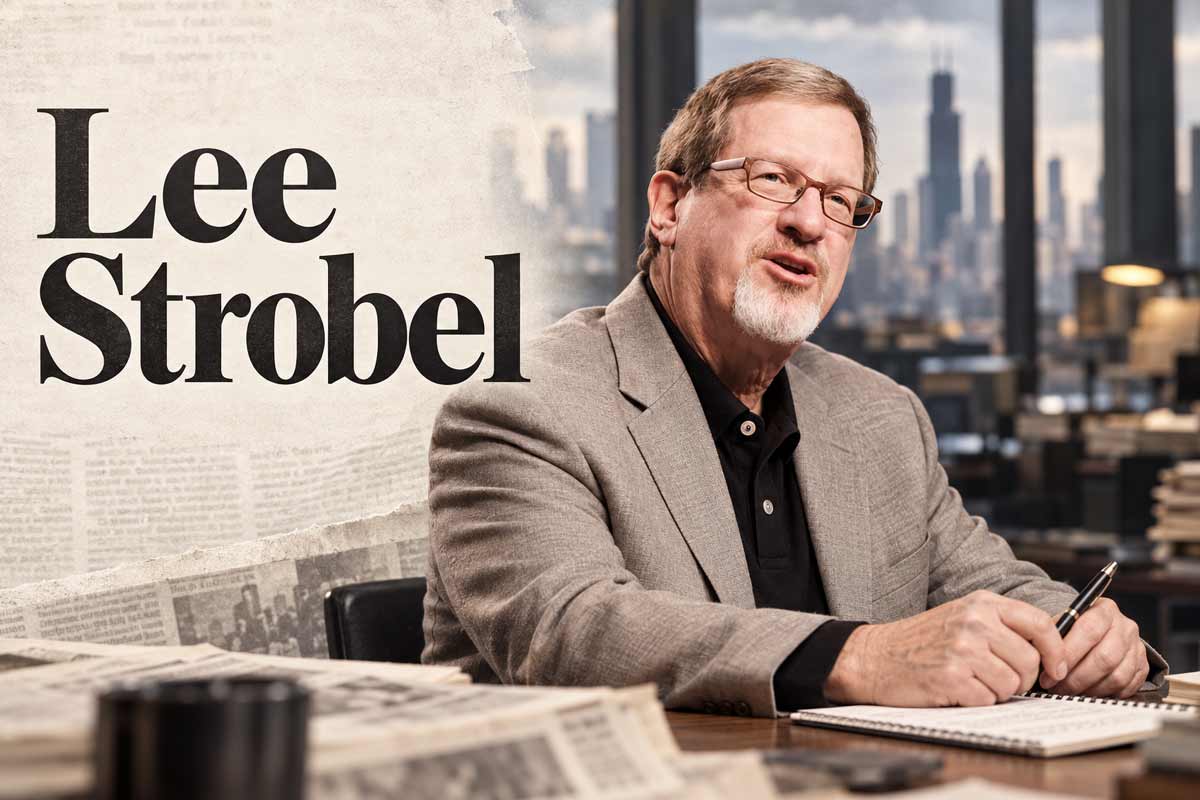
Lee Strobel didn’t begin investigating Christianity because he wanted a second career writing religious books. According to his account, he wanted to understand what had happened to his wife, Leslie, and initially hoped to disprove the faith she had embraced. He brought a reporter’s questions to a subject he had largely dismissed, only to find that the answers required more attention than he expected. His eventual conversion became the starting point for a ministry that has introduced many ordinary readers to Christian apologetics. His contribution has been especially useful for people who want serious answers but aren’t likely to begin with a graduate textbook on New Testament history.
Strobel’s best-known book, The Case for Christ, presents Christianity through interviews with scholars and other specialists. The reader follows him from one question to another, hearing objections raised and answers explained in language that doesn’t require a theological education. That approach has real strengths, although it also requires readers to distinguish an accessible defense of Christianity from a comprehensive survey of every scholarly position. Understanding what Strobel is trying to accomplish helps us appreciate his work without asking it to do everything. He is a journalist, Christian author, and evangelist whose central concern is whether the claims about Jesus deserve our belief and our response.
From the Newsroom to a Question at Home
Strobel earned a journalism degree at the University of Missouri and a Master of Studies in Law at Yale Law School. That second qualification is sometimes described loosely enough to make him sound like a practicing attorney, but his professional background was journalism. He worked at the Chicago Tribune, where he became legal editor, and received recognition for investigative and public service reporting. Reporting on legal matters meant dealing with testimony, documents, conflicting accounts, and people who had reasons to present events in a particular way. Those habits helped shape the questions he would eventually bring to Christianity.
His interest in the faith became personal when Leslie became a Christian. Strobel describes himself during that period as an atheist, while Leslie’s conversion disturbed assumptions they had previously shared. A disagreement about religion inside a marriage isn’t merely a disagreement about an interesting subject; it can affect priorities, friendships, and expectations about raising children. His investigation therefore grew out of a relationship as well as an intellectual dispute. He wanted to know whether his wife had discovered something true or had become convinced of something he believed was false.
Strobel says his inquiry lasted nearly two years and culminated in his conversion on November 8, 1981. He investigated through reading, research, and questions directed to people who could help him evaluate the claims. He continued in journalism afterward, leaving daily newspaper work for church ministry in 1987. That sequence is worth remembering because the familiar version of his story can compress years into a single dramatic turning point. Becoming a Christian, entering ministry, and publishing his most famous apologetics book were separate developments.
There is also a useful lesson in the fact that this story began at home. Christians sometimes imagine apologetics as something that happens on a stage between two men with microphones and a countdown clock. Questions about faith also arise between spouses, among friends, and over dinner with someone who knows us well enough to recognize an evasive answer. In those settings, character and patience affect whether an argument receives a hearing. Leslie’s place in Strobel’s story reminds us that the person asking questions is usually involved in relationships that can’t be reduced to the questions themselves.
What The Case for Christ Actually Is
The Case for Christ was first published in 1998, well after Strobel had become a Christian. The interviews that organize the book were conducted as he retraced and expanded his earlier investigation for publication. They aren’t transcripts from an atheist reporter’s original journey toward conversion. Strobel has explicitly explained this distinction, including in his responses to criticism of the book. Readers should keep the chronology clear without treating the later interviews as evidence that the earlier investigation never happened.
The book’s subjects include the reliability of the New Testament, evidence about Jesus outside the Bible, Jesus’ identity, and the resurrection. Interviews with figures such as New Testament scholar Craig Blomberg and textual scholar Bruce Metzger introduce readers to fields that can seem forbiddingly technical. Strobel’s skill is to turn a general suspicion into a question that a specialist can address. Instead of leaving the reader with the vague impression that the Bible has somehow become unreliable, he asks what kind of evidence bears on a particular concern. That movement from suspicion to a defined question is one of the book’s most useful features.
The interview format also gives the material a sense of movement. Readers don’t have to master an entire field before understanding why a problem matters or what an answer might involve. They can watch an objection being clarified and follow the reasoning offered in response. Of course, an engaging conversation doesn’t make an argument correct, and an impressive degree doesn’t settle a historical dispute. The format serves readers best when it encourages them to examine the reasons, rather than simply transferring their confidence from the author to his interview subjects.
Evidence and the Claims about Jesus
Strobel’s approach belongs broadly within evidential apologetics, which presents reasons for Christian belief drawn from history and other fields of inquiry. He frequently builds a cumulative case, allowing several arguments to contribute to an overall judgment. This resembles the way we make many decisions outside religion, where different kinds of evidence can support the same conclusion. The strength of such a case depends on the quality of its parts and on whether they actually support one another. A collection of weak arguments doesn’t become strong merely because the collection is large.
When considering the New Testament, we need to distinguish the preservation of a text from the truth of the events it describes. Comparing manuscripts can help us determine what an ancient author wrote, but establishing the wording doesn’t automatically establish the accuracy of every claim. A carefully preserved false statement would still be false. Strobel has affirmed this distinction in explaining his treatment of manuscript evidence. Historical reliability requires further questions about sources, circumstances, access to information, and the particular events being reported.
Evidence outside the New Testament can also help establish the setting in which Christianity emerged. Nevertheless, an ancient reference to Jesus or his followers isn’t the same as independent confirmation of everything the Gospels record. Archaeology may support a geographical detail or illuminate a practice without proving that a miracle occurred. We should welcome corroboration for what it actually establishes. Asking evidence to carry more weight than it can bear creates an unnecessary vulnerability in an otherwise worthwhile argument.
The resurrection is central to Strobel’s account of his conversion and to his case for Christianity. The Christian claim concerns something that happened to Jesus, with consequences for how we understand his identity and promises. It therefore raises historical questions about his death, the earliest proclamation, and the testimony of those who believed they had encountered him alive. Evaluating those questions also involves assumptions about whether divine action is possible and how extraordinary claims should be assessed. Christians need to explain their reasoning at those points rather than assuming that every reader begins with the same view of miracles.
Paul makes the importance of the resurrection unmistakable in 1 Corinthians 15. Christianity would lose its foundation if Jesus had remained dead, however inspiring some of his teachings might be. That is why historical inquiry belongs in Christian apologetics, even though historical argument by itself doesn’t produce repentance or a life of discipleship. Strobel directs attention to a claim the apostles themselves treated as decisive. The reader is being asked to consider whether the gospel describes a real act of God, not simply whether Christian ideals make people feel better.
Answering Objections beyond the Resurrection
The Case for Faith broadens the discussion to objections involving suffering, miracles, judgment, religious exclusivity, church history, and doubt. These questions can remain even after someone becomes convinced that Christianity has substantial historical support. A person may believe that Jesus lived and that the resurrection deserves serious consideration while still struggling to reconcile God’s goodness with terrible suffering. Strobel’s attention to these concerns recognizes that unbelief isn’t always organized around a single missing fact. Some barriers involve moral judgments, painful experiences, or fears about what becoming a Christian would mean.
There is an important difference between explaining how suffering could coexist with a good God and knowing why a particular tragedy occurred. A philosophical answer may show that an objection isn’t logically decisive, but it doesn’t give us access to every purpose of God. Christians should be careful when moving from an argument about the possibility of suffering to an explanation directed at someone who is grieving. A person who has just buried a child needs compassion even if we possess a well-organized answer to the problem of evil. Good apologetics makes room for that human reality instead of treating it as an interruption.
Strobel also explores arguments concerning the natural world in The Case for a Creator. The book draws on subjects such as cosmology, biological complexity, and human consciousness to defend belief in a Creator. Its presentation includes arguments associated with intelligent design, which proposes that certain features of nature are better explained by intelligence than by unguided processes. These arguments remain disputed, and Christian belief in creation doesn’t require agreement with every scientific or philosophical claim made in their defense. Readers should distinguish the doctrine that God created the world from a particular argument about how evidence within the world points toward him.
That distinction protects both theology and honest inquiry. If an argument depends entirely on something science hasn’t yet explained, a later explanation may undermine the argument without undermining God’s existence. Other arguments concern why an orderly universe exists or why its features permit life, and those raise questions that differ from identifying a mechanism within nature. They still require careful treatment of competing explanations and their limitations. Strobel can introduce these discussions, but the reader should follow the reasoning far enough to understand precisely what conclusion is being defended.
Grace and the Supernatural
The Case for Grace brings Strobel’s attention to stories of people whose lives have changed through the Christian message. Its subject is especially important because someone could become interested in Christianity’s intellectual claims while misunderstanding the heart of the gospel. Salvation isn’t a reward for successfully completing a religious examination or producing an impressive moral record. God’s grace reaches people who need forgiveness and restoration, including those whose failures have been destructive. Accounts of changed lives can help readers understand what Christians mean when we say that grace is more than an abstract theological category.
Those accounts also need to be used with care. People experience significant changes in many settings, so personal transformation alone doesn’t establish every claim of a religion. Within Christianity, however, repentance, reconciliation, and a changed way of living are appropriate fruits of receiving the gospel. They give the message a visible expression that arguments alone can’t supply. A Christian who can explain the evidence for Jesus but consistently treats other people badly is making the explanation unnecessarily difficult to hear.
In The Case for Miracles, Strobel investigates reports of divine intervention and considers objections to them. The book includes an interview with skeptic Michael Shermer, along with Christian responses and reported experiences of healing and other extraordinary events. It also addresses the painful question of prayers that don’t result in the miracle people hoped for. That question prevents a discussion of miracles from becoming merely a parade of successful stories. Belief that God can act doesn’t tell us that he will provide a particular outcome whenever we ask.
Christians who believe in present-day healing should welcome responsible investigation. Questions about diagnosis, documentation, timing, and possible natural explanations can help distinguish a strong report from a claim that has simply been repeated. An unexplained recovery deserves attention, but the word unexplained isn’t itself a complete account of what happened. We can believe God answers prayer while evaluating individual reports honestly. We should also refuse to turn another person’s continued illness into evidence that he or she lacks faith.
Strobel’s wider work includes The Case for Heaven and Seeing the Supernatural, which address life after death and other claims about the unseen world. These subjects attract considerable interest because they concern both human hope and experiences that people struggle to interpret. They also call for discernment, particularly when dramatic testimony is used to support detailed claims about spiritual realities. Christian teaching about God, salvation, and the life to come must remain grounded in Scripture. An arresting story can prompt investigation without becoming a new authority for doctrine.
Strengths and Limits of the Interview Approach
Strobel’s strongest contribution is his ability to make specialist discussions accessible. Many readers won’t begin with a lengthy academic monograph, but they will follow a journalist who asks the question they have been trying to express. His books can help Christians discover that an objection has a history and that thoughtful people have worked on it seriously. They can also give skeptical readers a more substantial picture of Christian belief than the one they have encountered in popular caricatures. Accessibility becomes valuable when it leads people toward better understanding rather than concealing complexity.
The same format has limitations. In The Case for Christ, Strobel largely presents scholars who defend the Christian conclusions he is advancing. He raises skeptical objections, but the book isn’t an even-handed collection of extended interviews representing the full range of views in the field. That doesn’t disqualify it as apologetics; a defense is expected to defend a position. It does mean that readers should avoid treating its selected interviews as a substitute for examining opposing arguments in their strongest form.
There is also a difference between a scholar’s confidence and the degree of agreement among scholars. A knowledgeable Christian may offer a persuasive argument for a traditional position while other specialists dispute the evidence or its interpretation. Readers benefit from knowing where a conclusion is broadly accepted, where it is contested, and where the argument depends on additional theological assumptions. Christians don’t need to surrender a position merely because it is disputed. We do need to describe the dispute accurately if we want our explanation to earn trust.
The 2017 film The Case for Christ brought Strobel’s conversion story to another audience, but it should be understood as a dramatization. Strobel has acknowledged the use of cinematic devices such as time compression and composite characters. A feature film can communicate the human tension of an investigation without reproducing its exact chronology or every conversation. Viewers who want to assess the evidence should therefore move beyond the film to the arguments themselves. A convincing performance on screen can’t do the work of a historical source.
Apologetics in the Service of Evangelism
Strobel’s work has consistently connected answering questions with inviting people to consider the gospel. In 2019, Colorado Christian University announced the Lee Strobel Center for Evangelism and Applied Apologetics, with Strobel as its founding director and his longtime ministry associate Mark Mittelberg as executive director. Its stated purpose joined training in the defense of Christian belief with practical preparation for sharing the faith. That connection reflects the central direction of Strobel’s career after journalism. The answers are intended to help people understand and respond to Christ, rather than remain material for an interesting argument.
For churches, that emphasis suggests a practical use for his books. They can introduce a discussion, help identify an objection, or give someone a manageable starting point for further study. They work best when Christians listen to the person before deciding which resource to recommend. Someone concerned about the resurrection and someone wounded by a church may need very different conversations. Handing both people the same book without listening first can turn a helpful resource into a substitute for care.
Strobel’s testimony also distinguishes becoming convinced of Christianity’s truth from personally receiving Christ. In explaining his conversion, he has connected that response to John 1:12 and described turning to Jesus in repentance and faith. That distinction belongs at the center of an evangelistic use of apologetics. Agreeing that an argument is strong isn’t identical to trusting the Savior to whom the argument points. Christian faith involves a response to a person whose claims reach into the way we live.
Lee Strobel has helped many readers take Christian claims seriously enough to investigate them. His books provide a useful entrance into questions that deserve more than dismissal, and their limits give us reasons to continue studying rather than reasons to avoid them altogether. We can appreciate his gift for explaining an argument while remaining willing to check its evidence and hear a thoughtful objection. For Christians, the larger responsibility is to join that intellectual honesty with the grace we proclaim. The person across the table should encounter both a reason to consider Jesus and a Christian who has learned something from following him.