

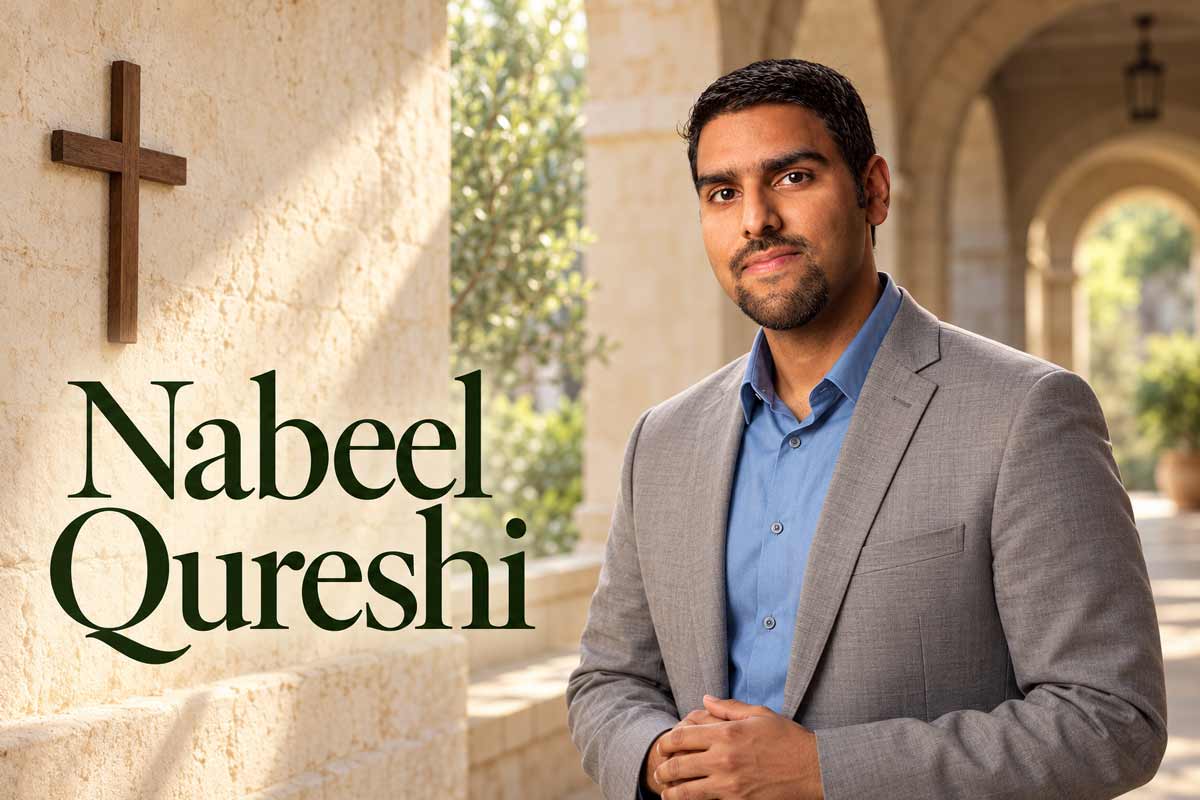
Changing your mind about a religious argument can sound simple when the discussion takes place at a comfortable distance. It becomes much harder when changing your mind could mean breaking your parents’ hearts and losing the community that helped shape your life. Nabeel Qureshi brought that difficulty into Christian apologetics through the account of his conversion from Islam. He didn’t describe himself as somebody who had always wanted to escape his upbringing. He described a man who loved his family and his religion, but eventually became convinced that following Jesus required him to leave the faith he had been taught to defend.
Qureshi’s public ministry was brief, but his books and recorded talks reached a substantial audience. His best-known work, Seeking Allah, Finding Jesus, connected the examination of Christian claims with the emotional cost of accepting them. He also addressed differences between Islam and Christianity, the evidence for Jesus’ death and resurrection, and the proper treatment of Muslims by Christians. His death from stomach cancer at thirty-four brought another painful subject into his public witness: trusting God while facing an outcome he had prayed would be different. His story belongs in apologetics because it concerns reasons for belief and the life a person must live after reaching a conclusion.
A Muslim Upbringing in America
Born in 1983, Qureshi grew up in the United States in a devout Ahmadi Muslim family of Pakistani heritage. Islam was part of his family’s daily life, not merely a label attached to holidays or ancestry. In describing his childhood, he recalled early instruction in the Arabic of the Quran and regular exposure to its recitation. His parents also prepared him to discuss religious questions and defend his beliefs. That background helps explain why he initially approached Christianity as a position to challenge rather than a faith he expected to embrace.
His affection for his parents remained an important part of the story he later told. He presented his home as loving and religiously serious, which complicates the assumption that conversion always follows an unhappy upbringing. Disagreeing with his parents’ beliefs didn’t mean he had stopped appreciating their care or recognizing their sincerity. For them, his decision involved concerns about their son’s spiritual future as well as the loss of a shared religious identity. Those relationships gave theological arguments a weight that an audience hearing them for the first time might not immediately recognize.
The Ahmadi part of his background needs to be explained because it is significant. The Ahmadiyya movement arose in nineteenth-century British India around Mirza Ghulam Ahmad, whom its followers recognize as the promised Messiah and Mahdi. The community also understands his prophetic status in a way that differs from mainstream Muslim teaching about the finality of Muhammad’s prophethood. Many Sunni and Shia Muslims consequently reject Ahmadi claims to Muslim identity, while Ahmadis identify themselves firmly as Muslims. Describing Qureshi accurately means recognizing both his own religious identity and the substantial disagreement surrounding that identity.
This doesn’t make his upbringing irrelevant to Islam, but it does mean that it shouldn’t represent every Muslim upbringing. Ahmadi views of Jesus and other subjects differ from views commonly held in Sunni and Shia communities. Qureshi’s later arguments also extended beyond the beliefs he had learned at home into the wider sources and claims of Islam. Readers should distinguish those parts of his work rather than treating personal experience as a substitute for understanding the tradition being discussed. A former member can offer valuable insight without being an automatic authority on every branch of a religion.
A Friendship That Became an Investigation
An important relationship in Qureshi’s account was his friendship with David Wood. Their discussions became an extended examination of Christianity and Islam rather than a single conversation that settled everything. Qureshi challenged Christian claims, and the exchange required him to consider responses he couldn’t simply dismiss. Friendship kept the discussion going as the subjects became more difficult. The story illustrates how a relationship can give serious questions time to develop instead of demanding that somebody make a life-changing decision at the end of one debate.
This approach also asks something of the Christian who wants to share the gospel. It isn’t enough to regard another person as a potential conversion and then lose interest when the conversation becomes inconvenient. Genuine friendship involves learning about the person’s concerns, respecting the relationships at stake, and being willing to examine objections honestly. That doesn’t require pretending that theological differences are insignificant. It requires caring about the person enough to remain present while those differences are being worked through.
Qureshi described a process lasting several years before his conversion in 2005. The evidence mattered to him, but so did the possibility that his conclusions would hurt people he loved. A person can recognize the force of an argument while resisting what accepting it would require. Christians are subject to the same difficulty when a biblical conviction threatens a familiar practice or a cherished assumption. His story therefore challenges readers to consider whether they are examining a claim fairly or protecting themselves from the consequences of finding it true.
The Questions about Jesus
The central Christian claims Qureshi investigated concerned Jesus’ death, resurrection, and divine identity. These were important because Christianity and Islam give substantially different answers about who Jesus is and what happened to him. Christian faith proclaims his death on the cross and resurrection as essential to the gospel. Mainstream Islamic interpretation of the Quran denies that Jesus was killed by crucifixion and rejects the Christian confession of his deity. The disagreement cannot be resolved by observing that both religions honor Jesus, because the honor each gives him rests on a different understanding of his identity.
Qureshi became persuaded that the historical case for Jesus’ crucifixion was stronger than the explanations he had previously accepted. His Ahmadi background included a different account of Jesus’ survival and subsequent life from the interpretation familiar to many other Muslims. That made the question of whether Jesus actually died particularly important in his investigation. An explanation of survival has to account for the historical evidence surrounding the execution and the subsequent Christian proclamation. Identifying difficulties in such an explanation, however, is one part of a larger case and doesn’t by itself establish every Christian doctrine.
The resurrection required a further step because accepting that Jesus died doesn’t automatically mean accepting that he rose. Christian apologetics considers the earliest testimony, the disciples’ conviction that Jesus appeared to them, and the competing explanations offered for those beliefs. Qureshi came to regard the resurrection as a historical claim with reasons behind it rather than something to reject merely because it was miraculous. First Corinthians 15 places the event at the center of Christian faith, so it cannot be reduced to an encouraging symbol. The question concerns what God did through Jesus and whether the evidence gives people reason to believe it happened.
His investigation also involved learning what Christians meant by the Trinity and Christ’s deity. Christianity doesn’t teach that God produced a son through a sexual relationship, and Trinitarian belief doesn’t mean belief in three separate gods. It confesses one God and distinguishes the Father, Son, and Holy Spirit within that confession. Understanding the claim accurately doesn’t require a Muslim listener to agree with it, but it removes objections aimed at something Christians aren’t actually teaching. Apologetics begins to become useful when both sides are discussing the same claim rather than different caricatures of it.
Evidence and Personal Experience
Qureshi’s testimony also included dreams that he understood as part of God’s guidance toward Christ. He described those experiences alongside the investigation and spiritual struggle, rather than presenting conversion as an entirely detached academic exercise. For Christians who believe God can still guide people supernaturally, that aspect of his story isn’t something that must be removed to make his faith respectable. At the same time, his interpretation of a dream remains an account of personal experience. It doesn’t give every reader the same publicly examinable evidence that a historical document or a recorded argument provides.
Those distinctions allow the testimony to be appreciated without turning it into a required pattern. Another person may become a Christian without a dramatic dream, and that person’s faith is no less genuine on that account. Dreams should also be evaluated rather than treated as self-authenticating whenever they feel powerful. Qureshi’s account brought his experiences into a wider examination of Jesus and Scripture. The point for readers is to consider how he understood that process, not to assume that any religious dream settles a theological question by itself.
Three Books and a Wider Ministry
Published in 2014, Seeking Allah, Finding Jesus became Qureshi’s best-known book. Its strength as a memoir is that the reader follows relationships and inner conflict along with the religious questions. The loving home, prolonged discussions, and difficulty of telling his family help explain why conversion involved more than accepting a new proposition. The book invites Christians to recognize that a Muslim considering Christ may need patient support as well as answers. It also gives readers a personal story to examine without making that story the experience of every convert from Islam.
His 2016 book No God but One: Allah or Jesus gave more space to the comparison of the two religions and the arguments underlying his decision. It addressed their differences concerning God, their founders, Scripture, and salvation, then examined the historical claims on which his Christian case depended. Qureshi wanted readers to consider whether either religion’s claims were supported and whether following the truth was worth its cost. This moved beyond the assumption that religious differences could be settled by personal preference alone. Claims about Jesus’ identity and resurrection concern reality, even when the decision to accept them has deeply personal consequences.
The title also needs a clarification for readers unfamiliar with religious language. Allah is the Arabic word for God, and Arabic-speaking Christians use it as well. The disagreement Qureshi addressed wasn’t created by the existence of different words in different languages. It concerned the theological description of God, particularly the Christian confession of the Trinity and Jesus’ deity. Recognizing similarities between Islamic and Christian language doesn’t erase those disagreements, while recognizing the disagreements doesn’t justify treating an Arabic word as exclusively non-Christian.
Answering Jihad: A Better Way Forward, also published in 2016, addressed violence, Islamic sources, and how Christians should respond to Muslim neighbors. Qureshi challenged reassuring slogans that avoided examining difficult texts, but he also called for love rather than fear-driven hostility. His concern included the difference between discussing religious teachings and judging the intentions of an individual Muslim. Christians can take threats and acts of violence seriously without assigning collective guilt to people who have committed neither. A neighbor’s Muslim identity doesn’t tell us that person supports terrorism or shares every interpretation advanced in a political argument.
Readers should still evaluate Qureshi’s treatment of Islam critically. Muslim scholars disagree with his conclusions and with aspects of the way he frames the evidence, and Islamic traditions have their own arguments about scriptural interpretation and warfare. Broad claims about what every serious Muslim must eventually believe require more support than a selection of troubling passages. Fair comparison also means examining Christian history honestly rather than contrasting the best Christian teaching with only the worst conduct associated with another religion. A Christian case gains credibility when it can withstand that kind of scrutiny.
Qureshi’s academic preparation included an MD from Eastern Virginia Medical School and graduate degrees in Christian apologetics at Biola University, religion at Duke University, and Judaism and Christianity at Oxford. After completing medical school in 2009, he chose to devote himself to sharing the Christian message rather than pursuing a medical career. He became a speaker with Ravi Zacharias International Ministries and addressed audiences through lectures, debates, and other public events. His background gave him resources for studying the subjects he discussed, but those qualifications didn’t relieve listeners of evaluating his arguments. His presentations are best understood as contributions to Christian apologetics rather than conclusions that must be accepted because of a speaker’s credentials.
The Cost for His Family
Qureshi repeatedly acknowledged the pain his conversion caused within his family. He didn’t present the discovery of Christian faith as something that immediately removed every difficult relationship or emotion. The decision raised questions about loyalty, religious duty, and his parents’ understanding of his eternal future. For readers accustomed to choosing a different church without much consequence, that cost may be easy to underestimate. In his account, the conviction that Christianity was true existed alongside grief over what following it meant for people he loved.
That is one reason churches should think beyond the moment of conversion. A person leaving a religious community may need friendship, practical help, and opportunities to speak honestly about loss. Celebrating a testimony while leaving the new believer isolated afterward fails to take discipleship seriously. Jesus’ call to follow him can involve costly decisions, but the church is meant to become a community in which people receive care. A convert should be welcomed as a person whose life matters, not valued mainly as an effective story for the next outreach event.
Qureshi’s account also cautions against turning his family into villains to make his conversion appear more impressive. Their disagreement with him was real, and its consequences were painful, but he continued to speak of his love for them. Christians can describe the cost of leaving Islam without assuming that every Muslim parent responds identically or that every strained relationship becomes permanently irreparable. The details belong to particular people and should be represented accordingly. Respect for those people doesn’t weaken the account of conversion; it makes the account more honest.
Faith through Cancer
In 2016, Qureshi announced that he had been diagnosed with stomach cancer. He shared updates publicly, sought treatment, and asked Christians to pray for healing. The illness brought people who knew him mainly through confident presentations into contact with a young husband and father facing uncertainty and suffering. He died on September 16, 2017, leaving his wife, Michelle, and their young daughter. The loss was especially painful because his public ministry had developed so quickly and there appeared to be so much work ahead of him.
His death shouldn’t be turned into an argument that prayer for healing is foolish or that a person who isn’t healed must have lacked faith. Christians can ask God confidently to heal and still face the sorrow of an outcome they do not understand. Nor does the existence of faith give observers permission to invent an explanation for why somebody died. The New Testament contains both accounts of miraculous deliverance and examples of believers enduring suffering. Qureshi’s illness calls for compassion and humility rather than a verdict about his spiritual condition based on the result of his treatment and prayers.
In his final public video, Qureshi emphasized that his ministry should be received and carried forward with love and peace. He didn’t want the arguments he had presented to become an excuse for hostility toward Muslims. The appeal is particularly significant coming from a man whose work included sharp disagreement with Islamic claims. He was asking listeners to consider their purpose and conduct, not merely whether they could repeat his conclusions. The person being addressed remained someone to love, even when the disagreement concerned matters he believed had eternal significance.
A Witness That Involved More Than Answers
Qureshi’s contribution was to bring the evidence for Christian faith into conversation with the personal cost of responding to it. His books show why a theological question may also be a question about family, belonging, and the future a person expected to have. They encourage Christians to learn enough to answer objections while remaining attentive to the people raising them. His work also deserves the ordinary scrutiny applied to any apologist, including accurate quotations, careful historical reasoning, and fair descriptions of competing beliefs. Appreciating his testimony doesn’t require making him incapable of error.
His life ended before the long ministry many listeners expected, but the question his story raises remains useful. Christians who ask another person to follow the truth should be prepared to offer more than applause when that decision becomes costly. They should also examine whether their own conduct reflects the Jesus they are commending. Qureshi’s account combined an extended search for answers with a difficult decision to follow Christ, and his final appeal returned listeners to the responsibility to love. An apologetic that explains why the gospel is true should help its audience recognize why the person hearing it matters.