

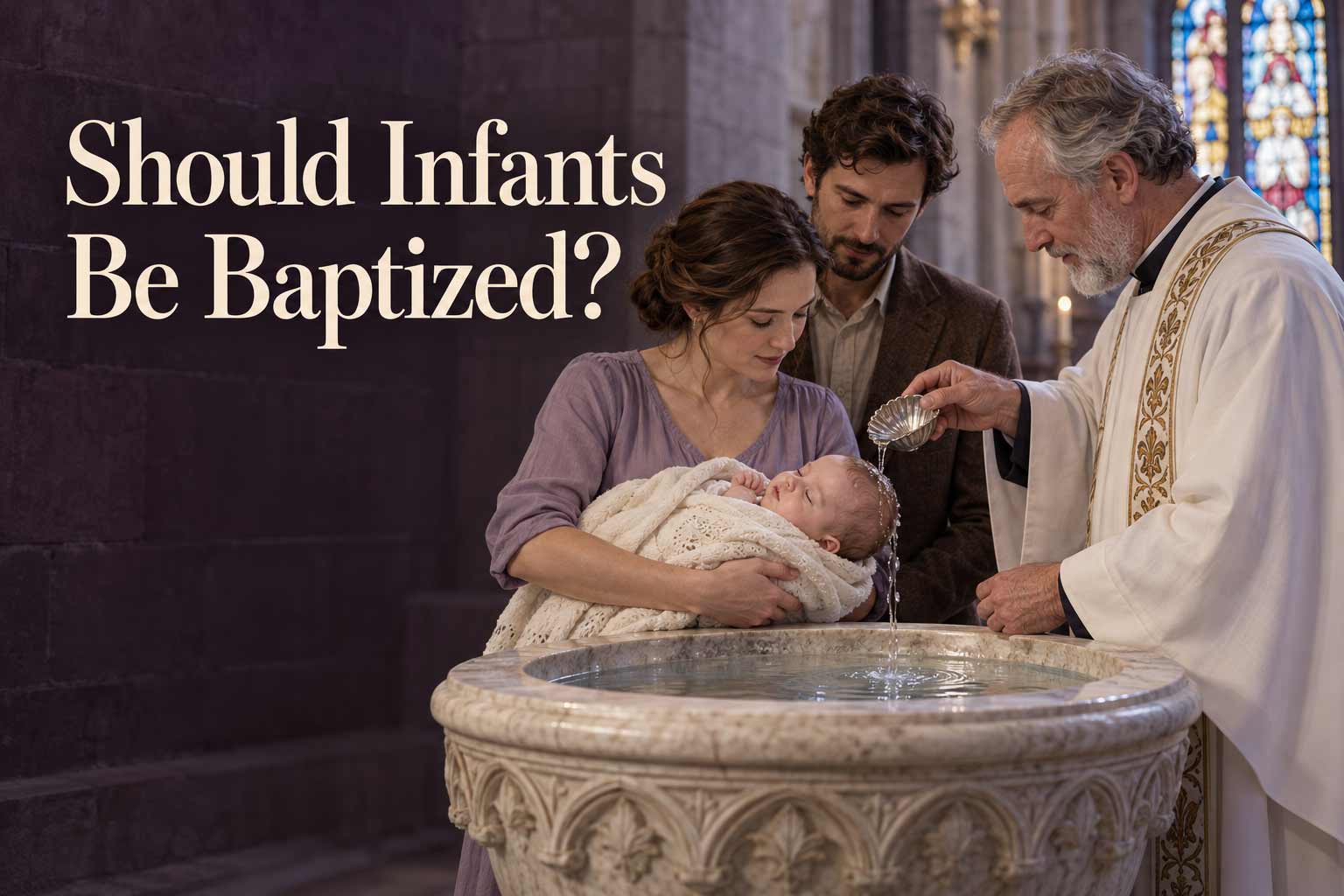
For some Christian families, baptizing a baby is one of the first responsibilities of parenthood. For others, baptism should wait until the child can personally profess faith in Jesus. Both groups may take Scripture seriously and sincerely want to raise their children as Christians. Their disagreement concerns what baptism means and who should receive it.
I believe baptism should follow a person’s own response of repentance and faith. That doesn’t mean children must become adults before they can be baptized, but it does mean they should understand the commitment they’re making. An infant can’t make that response. Before explaining why I favor believers’ baptism, however, we should understand why other Christians reach a different conclusion.
Why Some Christians Baptize Infants
Christians who practice infant baptism don’t all explain it the same way. Catholic teaching understands baptism as a sacrament through which God gives new birth and cleanses the person from original sin. In that understanding, an infant’s inability to articulate faith doesn’t prevent God from giving grace. Parents, godparents, and the church then have responsibilities to nurture the child in Christian faith.
Reformed churches, including many Presbyterian congregations, emphasize the relationship between baptism and God’s covenant promises. They understand the children of believers as belonging within the visible covenant community and therefore as appropriate recipients of its sign. Their argument draws on the inclusion of children under the Old Testament covenant and the continuity they see between that community and the church. Baptism, in this understanding, doesn’t necessarily mean the child has already experienced regeneration.
These positions deserve more than the accusation that parents are trying to save a child through a meaningless ceremony. Their supporters believe God acts graciously toward children and that baptism has a place in that relationship. We can disagree with their interpretation while describing it honestly. The question is whether their reasoning establishes infant baptism as a practice Christians should follow.
Does Baptism Replace Circumcision?
One important argument for infant baptism concerns circumcision. Under God’s covenant with Abraham, male infants received circumcision before they could personally understand or affirm the covenant. Supporters of infant baptism argue that children shouldn’t lose their place in God’s covenant community under the New Testament. They also point to Colossians 2:11–12, where Paul discusses circumcision in Christ and baptism together.
Christians who favor believers’ baptism understand the connection differently. They see Paul emphasizing the spiritual change associated with Christ rather than directing Christians to apply baptism according to the rules governing infant circumcision. The passage also connects being raised with Christ to faith in God’s work. Its imagery is important, but it doesn’t explicitly instruct parents to baptize their babies.
The disagreement therefore involves more than finding two religious practices that resemble one another. We have to consider what continues between the covenants, what changes, and what the apostles actually taught about baptism. I don’t think the circumcision argument provides sufficient grounds for baptizing someone who hasn’t personally responded to Christ. God’s care for children doesn’t depend on our establishing that particular connection.
What About Household Baptisms?
Acts records baptisms involving households, including Lydia’s household and the household of the Philippian jailer. First Corinthians 1:16 also mentions Paul baptizing the household of Stephanas. Christians who practice infant baptism reasonably point out that ancient households could include children. They understand these accounts as consistent with including infants in baptism.
However, the possibility that a household included infants isn’t proof that a particular household did. Lydia’s account doesn’t tell us the ages of the people baptized. In the jailer’s account, Paul and Silas spoke the word of the Lord to him and those in his house before their baptism. The passage describes a household receiving the gospel, but it doesn’t identify an infant among the recipients.
These accounts shouldn’t be made to say more than they say. They don’t explicitly describe infant baptism, and they don’t give us a complete age list establishing that every person was an adult. Both sides need to recognize those limits. My preference for believers’ baptism rests on the broader pattern of personal response to the gospel rather than on an assumption about every ancient household.
The Pattern of Faith Followed by Baptism
In Acts 2:41, those who received Peter’s message were baptized. Acts 8:12 describes men and women being baptized after believing Philip’s preaching. Acts 18:8 likewise connects hearing, believing, and baptism. These accounts present baptism as a response to the gospel by people who have received its message.
Supporters of infant baptism respond that these are accounts of converts entering Christianity, so a personal profession of faith is exactly what we should expect. That’s a fair observation, and it prevents us from treating every conversion account as an explicit prohibition of infant baptism. Nevertheless, this is the clearly described pattern the New Testament gives us. I believe churches should follow it unless there’s sufficient biblical reason to apply baptism differently.
Baptism expresses identification with Christ and a commitment to the life of discipleship. Parents can teach that faith, demonstrate it, and pray for their children to embrace it. They can’t make the child’s personal response on the child’s behalf. Waiting for that response gives baptism an intelligible connection to what the person actually believes.
Does Waiting Put a Baby’s Salvation at Risk?
Parents shouldn’t be frightened into baptizing an infant by the claim that failing to arrange the ceremony places the child beyond God’s mercy. I don’t believe water baptism automatically regenerates a person, and I don’t believe an unbaptized baby should be treated as rejected by God. Our confidence rests in His character and grace. Baptism is important, but the water isn’t more merciful than the Savior.
It’s also important not to misrepresent traditions that baptize infants. Catholic teaching, for example, entrusts children who die without baptism to God’s mercy and allows hope for their salvation. The disagreement shouldn’t be framed as though every supporter of infant baptism condemns every unbaptized child. Christians should discuss the actual teachings rather than the most alarming version they’ve heard.
When Is a Child Ready?
Believers’ baptism doesn’t require an adult vocabulary or a sophisticated understanding of theology. A child can genuinely trust Jesus without being able to explain every doctrine associated with salvation. The relevant question is whether the child understands, at an appropriate level, who Jesus is and what it means to follow Him. That understanding should be more than repeating phrases supplied by an adult.
Parents and pastors can explore this through patient conversation. Ask the child to explain why they want to be baptized and what they believe about Jesus. Give them room to answer honestly, including saying they don’t understand something. Pressure to please parents or follow friends can produce the expected answers without a personal commitment.
There isn’t a biblical age at which every child becomes ready. Children develop differently, and spiritual understanding doesn’t follow an identical timetable. We should avoid rushing them into baptism, but we should also avoid dismissing genuine faith merely because it belongs to a young person. Thoughtful preparation is more useful than an arbitrary age requirement.
What About Dedicating a Child?
Many churches that practice believers’ baptism hold child dedications. Parents publicly commit to raising their child in the Christian faith, and the congregation prays for the family. Such a gathering can be meaningful without claiming that it saves the child or functions as infant baptism under another name. It expresses the adults’ responsibilities rather than the infant’s profession of faith.
Those responsibilities continue long after the service. Children need patient instruction, prayer, and examples of faith expressed through ordinary conduct. They learn something about Christianity from how adults apologize, handle disagreements, and treat vulnerable people. No ceremony can replace the work of helping a child come to know and trust Jesus.
What If I Was Baptized as an Infant?
If you were baptized as an infant, you don’t need to despise your parents’ intentions or assume that their faith was insincere. They may have acted according to their church’s teaching with a genuine desire to place you within its Christian life. Your responsibility now is to consider what you believe and how you should respond to Christ. That calls for study and honest conversation rather than resentment.
Churches answer the question of subsequent baptism differently. Traditions that recognize your infant baptism generally regard another baptism as unnecessary, while churches practicing believers’ baptism may encourage baptism following your personal profession of faith. My view favors that personal profession followed by baptism. The purpose is to respond faithfully to Jesus, not to stage a public rejection of everyone who understood the subject differently.
I wouldn’t recommend baptizing infants, because I believe the clearest New Testament pattern connects baptism with a person’s own response to the gospel. I would encourage parents to pray for their children, teach them faithfully, and help them understand the commitment baptism expresses. When a child genuinely comes to faith, that response deserves to be taken seriously. Baptism should mark the beginning of a life of discipleship that the family and church continue to nurture.