

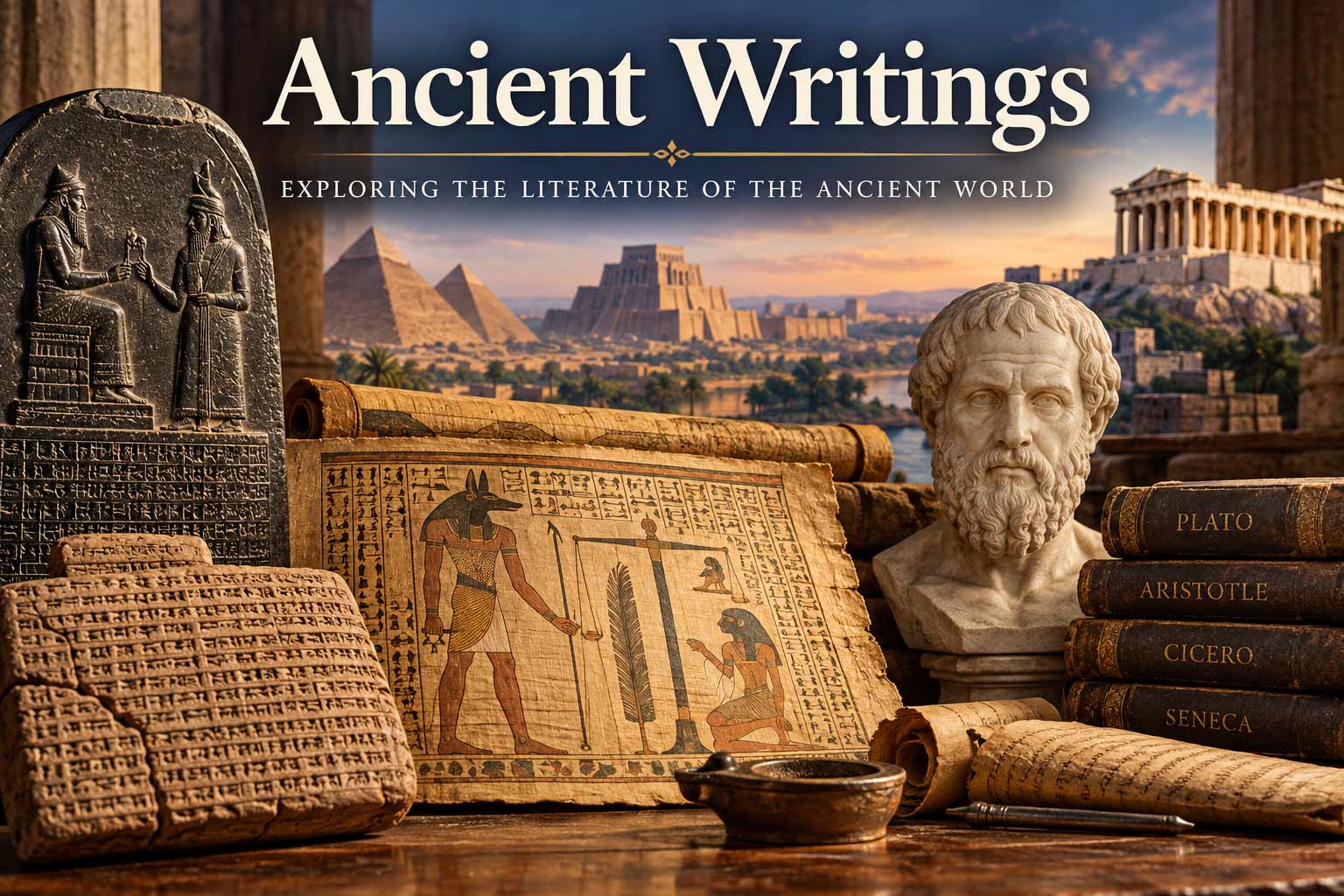
Long before the printing press, before modern universities, and even before the rise of many of the civilizations we recognize today, people were recording their laws, beliefs, histories, prayers, and stories. They carved words into stone, pressed symbols into clay tablets, and wrote on papyrus and parchment. Some of those writings disappeared for thousands of years before archaeologists recovered them. Others were carefully copied and preserved through generations. Together, they provide a remarkable window into the civilizations that shaped the ancient world.
The Ancient Writings Library at Jew & Greek brings together important works from Mesopotamia, Egypt, Greece, Rome, and other civilizations. These texts reveal how ancient people understood the gods, explained the origins of the world, organized their societies, wrestled with questions of justice, and confronted the mysteries of suffering and death. Some are literary masterpieces. Others are collections of laws, religious instructions, philosophical arguments, or accounts of historical events. Each has something to tell us about the world in which it was written.
For students of the Bible, these writings are particularly valuable. The biblical authors didn’t live in isolation from the surrounding world. Abraham came from Mesopotamia, Israel spent generations in Egypt, and the early church emerged in a world shaped by Greek philosophy and Roman government. Reading the literature of these civilizations helps us understand the ideas, customs, and religious traditions that formed the historical background of Scripture.
That doesn’t mean every resemblance between an ancient text and the Bible demonstrates borrowing or dependence. Similar stories and ideas can arise for several reasons, and the relationship between particular writings often remains a matter of scholarly debate. Nevertheless, comparing these sources can help us appreciate both the similarities and the distinctive features of the biblical accounts.
Our purpose isn’t to treat every ancient writing as equally authoritative or historically reliable. It’s to make these important sources available for readers who want to investigate the ancient world for themselves. Wherever possible, we use public-domain editions and translations, preserve their historical character, and provide access to the original translator’s notes and supporting material.
Mesopotamian Writings
Mesopotamia, the region between the Tigris and Euphrates rivers, produced some of the world’s earliest surviving literature. The Sumerians, Akkadians, Babylonians, and Assyrians recorded myths, royal inscriptions, legal collections, prayers, and works of wisdom on clay tablets using cuneiform writing. Their literature provides an extraordinary record of religious beliefs and social institutions extending back thousands of years.
Among the best-known Mesopotamian writings are the Epic of Gilgamesh and the Atra-Hasis Epic, both of which contain traditions concerning a catastrophic flood. These accounts are especially interesting to readers familiar with Genesis, although their literary histories and relationships to the biblical narrative require careful examination. The Code of Hammurabi offers a different kind of insight, illustrating how an ancient Babylonian king presented justice, social order, and royal responsibility.
Explore Mesopotamian Writings
- The Epic of Gilgamesh — An ancient epic exploring friendship, mortality, kingship, and the human search for life beyond death.
- The Atra-Hasis Epic — A Mesopotamian account of humanity’s creation, the relationship between gods and human beings, and a devastating flood.
- The Code of Hammurabi — A celebrated Babylonian legal collection offering insight into justice, social hierarchy, and daily life in the ancient Near East.
Egyptian Writings
Ancient Egyptian literature developed within a civilization whose religious traditions endured for thousands of years. Egyptian scribes preserved hymns, wisdom instructions, royal inscriptions, funerary compositions, and stories reflecting their understanding of divine order, human responsibility, and the afterlife.
Egyptian religious writings are particularly revealing because they show how closely ideas about death and the afterlife were connected with everyday religious practice. Egyptians prepared extensively for death, believing that the deceased would face dangers, judgments, and challenges on the journey beyond the grave. Their funerary literature was intended to provide knowledge and assistance for that journey.
The Egyptian Book of the Dead is among the most famous collections of these compositions. Rather than a single book written by one author, it developed from a long tradition of funerary texts and existed in different arrangements and manuscripts. Its spells, prayers, declarations, and illustrations provide a fascinating introduction to ancient Egyptian religious thought.
Explore Egyptian Writings
- The Egyptian Book of the Dead — A collection of funerary compositions concerning death, judgment, divine powers, and the hope of continued existence in the afterlife. Our library presents the Renouf/Naville edition with its scholarly notes and illustrations.
Greek Writings
Ancient Greece produced some of the most influential philosophical, historical, dramatic, and literary works in Western civilization. Greek thinkers asked fundamental questions about reality, knowledge, morality, government, and the nature of the human soul. Their writings continue to shape discussions in philosophy, theology, politics, and ethics.
Socrates, Plato, and Aristotle occupy a particularly important place in this tradition. Although Socrates left no writings of his own, his ideas and methods are preserved primarily through the works of others, especially Plato. Aristotle’s surviving writings address an astonishing range of subjects, including logic, metaphysics, ethics, politics, rhetoric, biology, and the natural world.
Greek philosophy also forms part of the intellectual background of early Christianity. The New Testament was written in Greek, and Christian thinkers eventually engaged extensively with Greek philosophical ideas. Understanding these traditions helps explain many of the questions and concepts that appear in later Christian theology.
Explore Greek Writings
- The Dialogues of Plato — Philosophical conversations exploring justice, virtue, knowledge, the soul, government, and the search for truth.
- The Works of Aristotle — Treatises examining logic, ethics, politics, metaphysics, nature, and human reasoning.
Roman Writings
Roman literature reflects a civilization deeply concerned with law, public duty, political authority, moral character, and the responsibilities of citizenship. Roman authors inherited much from Greek culture while developing their own approaches to history, philosophy, rhetoric, and government.
Writers such as Cicero, Seneca, and Marcus Aurelius explored questions that remain familiar today. What makes a person virtuous? How should we respond to suffering and uncertainty? What responsibilities do we owe to others? How should a person exercise authority? Their answers were shaped by philosophical traditions, especially Stoicism, and by the practical concerns of life in the Roman world.
Roman writings are also valuable for understanding the historical setting of the New Testament. Jesus was crucified under Roman authority, Paul traveled through cities governed by Roman institutions, and the early church developed within the political and social structures of the empire. Roman literature provides important background for understanding that environment.
Explore Roman Writings
- The Writings of Cicero — Works addressing public life, rhetoric, political philosophy, moral duties, and the nature of the gods.
- The Writings of Seneca — Stoic reflections on virtue, suffering, anger, mortality, and the proper conduct of life.
- The Meditations of Marcus Aurelius — Personal philosophical reflections by a Roman emperor on duty, self-discipline, and the challenges of human existence.
Why Read Ancient Writings Today?
It’s easy to imagine that people who lived thousands of years ago inhabited a world completely unlike our own. Their technology, political institutions, religious practices, and explanations of nature were certainly different. Yet their writings reveal concerns that remain remarkably familiar. They worried about injustice, feared death, struggled with suffering, sought wisdom, questioned political authority, and wondered whether human life had a purpose beyond the grave.
Ancient writings also remind us that history is more complicated than the simplified accounts we sometimes encounter. Civilizations influenced one another through trade, warfare, migration, and the exchange of ideas. Religious traditions developed over time. Philosophers disagreed with their predecessors. Legal systems reflected both aspirations toward justice and the inequalities of their societies. Reading the original sources allows us to encounter some of that complexity rather than relying entirely on modern summaries.
For Christians, the study of ancient literature can deepen our understanding of the historical world of Scripture without requiring us to accept the religious claims of every civilization we examine. We can appreciate the literary beauty of Gilgamesh, investigate Egyptian beliefs about judgment, and learn from Greek and Roman philosophers while evaluating their ideas critically.
The ancient world has left us a vast inheritance of literature, and much of it remains unfamiliar to modern readers. This library is intended to make that inheritance more accessible, one work at a time. As additional texts become available, we’ll continue expanding the collection, providing readers with opportunities to explore the writings that helped shape the intellectual and religious history of the world.