

Two people can look at the same evidence and reach very different conclusions. One sees a miracle, while the other sees a story that needs a more ordinary explanation. One regards the universe as creation, while the other regards it as a reality that doesn’t require a Creator. Cornelius Van Til wanted Christians to pay attention to the assumptions already operating before either person began presenting a case. His contribution to apologetics was to ask what makes the whole discussion possible in the first place.
Van Til became one of the most influential voices in presuppositional apologetics, an approach that examines the basic commitments behind our reasoning. He challenged Christians who thought they could temporarily set aside their faith, join the unbeliever on supposedly neutral ground, and then reason their way back to the God of Scripture. That approach, he believed, conceded too much before the argument even started. His alternative shaped generations of Reformed pastors, scholars, and apologists. It also produced substantial disagreements among Christians who shared his commitment to biblical authority.
From a Dutch Farm to Westminster
Cornelius Van Til was born on May 3, 1895, in Grootegast, in the Netherlands. He grew up in a farming family within the Dutch Reformed tradition, where Christianity was part of ordinary home life. His family immigrated to the United States in 1905 and settled in Indiana. The boy who had begun life in the Dutch countryside would eventually spend much of his adult life teaching American seminarians. The faith of his childhood remained central to his work even as his education took him into demanding philosophical territory.
He studied at Calvin College, spent a year at Calvin Theological Seminary, and continued his education at Princeton. There he encountered the biblical scholarship and Presbyterian theology associated with men such as Geerhardus Vos and J. Gresham Machen. He also studied philosophy, earning a doctorate from Princeton University in 1927. After serving a church in Spring Lake, Michigan, he returned to Princeton to teach. In 1929, Machen recruited him for the faculty of the newly established Westminster Theological Seminary.
Van Til’s decision to join Westminster placed him within a struggle over the identity of American Presbyterianism. Machen and his colleagues believed theological liberalism had abandoned essential Christian doctrines while retaining Christian vocabulary. Van Til spent decades teaching apologetics at Westminster and became a minister in the denomination now known as the Orthodox Presbyterian Church in 1936. His work was therefore connected to a church, a confession, and the training of pastors. He wanted the defense of Christianity to agree with the Christianity those pastors would actually preach.
What Is a Presupposition?
A presupposition is a basic assumption that helps determine how we understand other things. We assume that our minds can grasp truth, that contradictions matter, and that evidence can tell us something about reality. Most of us don’t stop to defend those assumptions whenever we begin a conversation. We use them while examining everything else. Van Til wanted to bring these background commitments into view and ask whether a person’s understanding of the world could account for them.
Consider a discussion about the resurrection of Jesus. If someone has already decided that miracles cannot happen, historical testimony about a resurrection will be rejected or reinterpreted before its particular details receive much attention. Another person may regard miracles as possible but still question whether this one occurred. Those are different objections, and they require different conversations. An apologist who treats both people as though they simply need one more piece of evidence may miss the actual source of the disagreement.
Presuppositional apologetics therefore reaches beneath individual objections to examine a worldview. A worldview includes beliefs about what exists, how we know things, what human beings are, and whether moral obligations have a real foundation. Van Til believed Christianity supplied a coherent account of these matters because the world belongs to the God who created it. He wanted the unbeliever’s alternative examined with the same seriousness. The question becomes whether that alternative can sustain the standards of truth and rationality it uses to criticize Christianity.
The Creator and the Creature
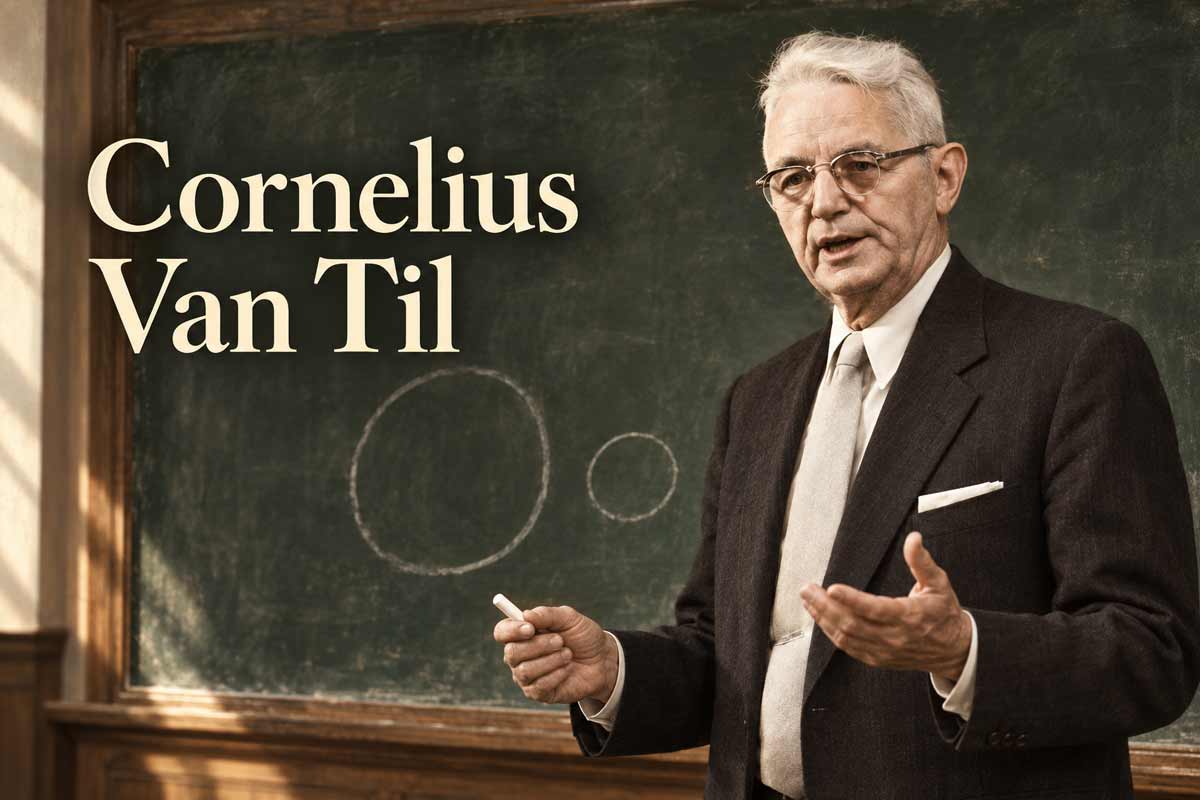
At the center of Van Til’s theology was the distinction between God and everything God has made. God is self-existent and independent, while human beings and the world depend upon him. God doesn’t gradually discover what the universe means. His knowledge is complete, and our knowledge is limited and dependent. Van Til sometimes illustrated this distinction with two circles on a classroom blackboard, representing the Creator and the creation.
This distinction shaped his understanding of human knowledge. We can know things truly without knowing them as comprehensively as God does. A child can correctly identify a tree without understanding its cellular processes, its history, or every consequence of its existence. The child’s limited understanding doesn’t make the tree imaginary or the identification false. Likewise, acknowledging the limitations of human knowledge needn’t lead us to conclude that nothing can be known.
Van Til described our knowledge as analogical: it is dependent upon God’s knowledge and suited to our condition as creatures. The term can sound as though we possess only vague comparisons, but that wasn’t what he intended. God can communicate truth to people without making them omniscient. Scripture’s description of God as incomprehensible means that we cannot exhaust his being or understanding. It doesn’t mean that he is unknowable or that his revelation leaves us guessing about everything.
Common Ground and Neutral Ground
Van Til denied that human reasoning could occupy a position independent of God and then decide whether God deserved recognition. In his view, the human mind already belongs to the Creator whose existence is being debated. Treating that mind as the final authority over divine revelation reverses the proper relationship. His criticism concerned the claim to ultimate independence, often called autonomy. He wasn’t objecting to careful thought, honest questions, or the ordinary use of reason.
This is where an important distinction can easily get lost. Van Til recognized that Christians and non-Christians inhabit the same world and can agree about many things within it. They can examine the same document, solve the same equation, or identify the same medical problem. The dispute concerns the ultimate explanation of the world and of their ability to know it. For Van Til, the shared reality that makes discussion possible is itself God’s creation, even when one participant denies its Creator.
Imagine two people disagreeing about who owns the house in which they are standing. Their disagreement doesn’t prevent them from noticing the same doors, windows, and staircase. Nor does the disagreement remove the foundation beneath their feet. That illustration helps explain the difference between sharing a reality and agreeing about its source. It also reminds the Christian that understanding someone’s assumptions requires more than announcing that the other person has them.
Can an Unbeliever Know the Truth?
Van Til’s language about the opposition between belief and unbelief was sometimes so sweeping that readers thought he denied non-Christians could know anything. That interpretation creates an obvious problem the moment an atheist correctly performs arithmetic or makes a scientific discovery. Van Til acknowledged that unbelievers possess real knowledge. His claim was that their achievements depend upon a God they may deny and a created order their stated philosophy cannot adequately explain. The distinction is between knowing something and giving a satisfactory account of why knowledge is possible.
He understood this situation through the biblical teaching that human beings bear God’s image and through Romans 1’s account of suppressing the truth about God. Sin affects our reasoning, but it doesn’t erase our humanity or remove us from creation. God’s common grace restrains evil and allows people who reject him to contribute to human life. A Christian can benefit from an unbelieving physician, historian, or engineer without creating an exception to this principle. The useful work itself takes place within the world God sustains.
Van Til’s followers often explain this dependence with the expression borrowed capital. It doesn’t mean that atheists secretly copied their scientific discoveries from Christians or that believers invented logic. It means, within this argument, that a person relies upon features of reality that fit the Christian account while denying that account. Whether the accusation succeeds has to be demonstrated by examining the person’s actual beliefs. Simply telling someone that he is borrowing from Christianity doesn’t establish where his explanation fails.
The Argument Beneath the Arguments
Van Til’s approach is often described as transcendental because it asks about the conditions necessary for knowledge and reasoning. What must be true for a meaningful argument to occur? What accounts for an intelligible world, minds capable of understanding it, and standards that distinguish sound reasoning from error? Van Til maintained that the triune God revealed in Scripture supplies those conditions. He sought to expose the failure of opposing accounts by considering what would follow if they were true.
We can see the kind of question involved by considering the difference between a logical rule and a description of popular behavior. People sometimes contradict themselves, so the law of noncontradiction cannot simply mean that human beings always think consistently. We use it to evaluate their thinking even when they ignore it. Similarly, a moral obligation claims more than that a particular society happens to approve of something. Questions about why such standards hold take the discussion beyond counting how many people accept them.
These questions don’t automatically complete an argument for Christianity. A critic may offer another account of logic, moral truth, or the relationship between mind and world. Showing that one explanation has a weakness doesn’t establish that every possible alternative has failed. The presuppositionalist also needs to explain why the conclusion points specifically to the Christian God rather than merely to some transcendent foundation. These are serious philosophical tasks, and Van Til’s importance doesn’t depend upon pretending they can be settled with a clever question in a comment section.
What Happens to the Evidence?
Van Til’s opposition to neutral reasoning is sometimes presented as an instruction to ignore historical evidence. His work included Christian Theistic Evidences, which should make us cautious about that conclusion. His concern was how evidence was interpreted and what assumptions governed its interpretation. The facts of history, like the facts studied by science, exist within God’s creation and providence. He rejected the idea of brute facts understood as facts whose ultimate meaning is independent of God.
For example, the Christian can discuss the testimony concerning Jesus, the circumstances of his death, and the claims of his followers. An objection based upon the premise that supernatural events are impossible should also be examined. Otherwise, an argument may appear to concern the reliability of witnesses while its conclusion has already been determined by a broader philosophy. Van Til wanted apologetics to expose that relationship. His objection was to a method that effectively made human independence the condition under which God would be allowed a hearing.
His Reformed understanding of conversion also shaped his expectations. He believed the Holy Spirit must overcome the sinner’s resistance and bring a person to faith. An argument could serve the proclamation of the gospel without possessing the power to regenerate anyone. Christians from other traditions may disagree with elements of that theology while recognizing that persuasion alone doesn’t produce spiritual transformation. The important point for understanding Van Til is that his method grew out of his theology rather than functioning as a detachable debating technique.
The Charge of Circular Reasoning
One of the most persistent objections to Van Til is that he assumes the Christianity he is supposed to prove. The objection deserves a fair hearing, because a narrow circular argument establishes very little. Saying that a book is trustworthy because the book declares itself trustworthy won’t, by itself, give an unconvinced reader much reason to agree. Van Til’s response addressed a broader issue: any attempt to defend our ultimate standard of knowledge must somehow use the capacities and standards under discussion. We cannot defend reasoning while refusing to reason.
That observation opens a real philosophical problem, but it doesn’t mean every circular argument becomes acceptable. Someone can still offer a bad argument, misread evidence, or assume the very point his opponent has challenged. A defense of a whole worldview needs to show explanatory strength and answer meaningful objections. It should also identify inconsistencies in alternatives accurately. The distinction between examining ultimate commitments and merely repeating a conclusion is crucial if presuppositional apologetics is to persuade rather than frustrate.
Other Christian apologists have challenged Van Til’s description of their methods. A Christian who begins with historical evidence or an argument for God’s existence may still believe that God grounds reason and that sin affects human judgment. Using premises another person accepts doesn’t necessarily mean granting that person ultimate authority over God. The disagreement concerns how those shared beliefs should govern the order and form of an argument. Christians can recognize Van Til’s challenge without concluding that every other approach has surrendered the faith before speaking.
Gordon Clark and Karl Barth
Van Til’s most famous controversy within conservative Presbyterianism involved the philosopher Gordon Clark. After Clark’s ordination in 1944, Van Til joined other church officers in a complaint concerning the ordination and Clark’s theological positions. One central dispute concerned the relationship between divine and human knowledge. Clark emphasized that a true proposition known by a human being is also true in God’s knowledge. Van Til and his colleagues stressed the qualitative difference between the Creator’s knowledge and that of a creature.
The controversy also involved divine sovereignty, human responsibility, and the free offer of the gospel. Both men defended biblical authority and stood within the Reformed tradition, so this was a disagreement among committed Christian scholars. Clark’s ordination was not overturned, and he left the Orthodox Presbyterian Church in 1948. Looking back, we should distinguish legitimate questions about theology from the additional question of whether a particular philosophical formulation should determine a minister’s standing. Their later friendly meetings provide a welcome reminder that a difficult history needn’t have the final word in a relationship.
Van Til also wrote major criticisms of Karl Barth in The New Modernism and Christianity and Barthianism. He believed Barth’s account of revelation and Scripture failed to preserve the authority claimed by historic Christian orthodoxy. Barth’s use of Christian language therefore didn’t settle the issue for him. Fair treatment requires us to recognize that Barth himself opposed liberal theology and sought to recover a theology centered upon God’s revelation. Van Til’s verdict was a theological interpretation to be assessed, rather than a substitute for reading Barth and understanding the disagreement.
A Lasting Challenge to Apologetics
Van Til’s books, including The Defense of the Faith and Christian Apologetics, helped establish presuppositional apologetics as a significant approach within modern evangelical thought. His writing can be demanding, partly because his arguments involve several theological and philosophical questions at once. Later interpreters such as Greg Bahnsen and John Frame helped make his ideas accessible and developed their own treatments of them. Those interpreters don’t agree on every detail. The tradition he influenced has continued through debate as well as through admiration.
Cornelius Van Til died on April 17, 1987, at the age of ninety-one. People who knew him remembered a pastor and teacher whose personal warmth could surprise readers familiar mainly with his forceful criticisms. That combination matters because a method centered upon exposing another person’s assumptions can easily become an excuse for dismissing the person. Careful apologetics requires us to understand an objection before pronouncing it inconsistent. The dignity of the person asking the question remains part of the Christian account of the world.
Van Til left Christians with a demanding question about the relationship between their faith and their reasoning. If God is the Creator of the mind, the world, and the truths we seek to understand, that conviction should shape the way we defend the gospel. His particular answers remain open to examination, especially where he identified his Reformed theology so closely with the only consistent Christian method. We can take his central concern seriously while doing that examination. The God Christians worship on Sunday is also the God of the world they investigate, the people they address, and the reasoning they bring to the conversation.