

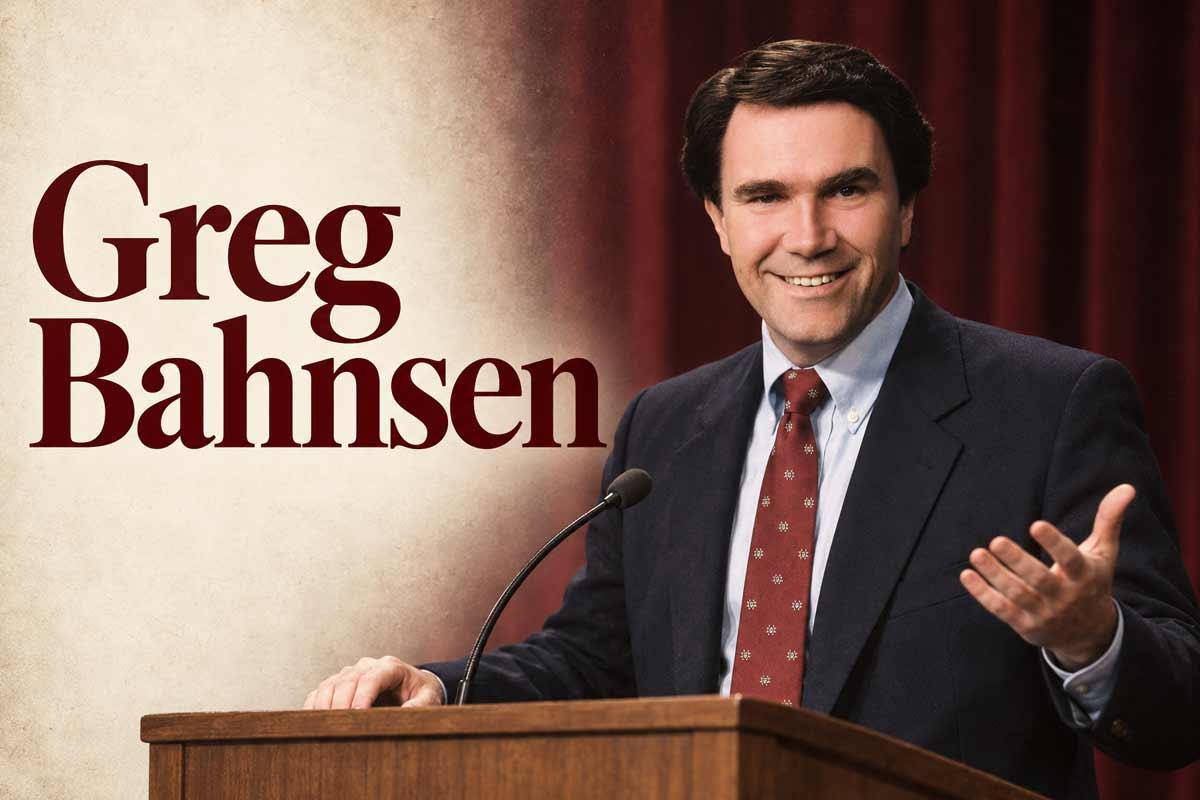
Most arguments about religion begin with somebody asking for evidence. Greg Bahnsen wanted to know what the person asking meant by evidence, why he trusted his reasoning, and what made truth something either of them should care about. That could make a conversation more demanding than the skeptic had anticipated, but Bahnsen wasn’t changing the subject merely to avoid answering. He believed that questions about God reach down into the assumptions we use to answer every other question. Before debating what Christianity explains, he wanted to examine what makes explanation possible.
Bahnsen was a Presbyterian minister, philosopher, teacher, and Christian apologist whose influence extends well beyond the relatively short life he lived. He developed and defended the approach associated with Cornelius Van Til, became known for his debates with atheists, and argued for an extensive application of biblical law to public life. Those contributions don’t all receive the same reception among Christians. Someone can appreciate the questions Bahnsen asked about reason and unbelief while remaining unconvinced by his political theology, and understanding that distinction helps us give the man a fair hearing.
A Philosopher in the Presbyterian Pulpit
Born in 1948, Bahnsen studied at Westmont College before earning his Master of Divinity and Master of Theology degrees at Westminster Theological Seminary. He later earned a doctorate in philosophy at the University of Southern California. At Westminster he studied under Van Til, whose approach to defending Christianity became a lasting influence on his work. Bahnsen wasn’t simply repeating the vocabulary of a favorite professor. He became one of the teachers who made Van Til’s difficult arguments more accessible and showed how they could be used in actual conversations.
He was ordained in the Orthodox Presbyterian Church in 1975, taught apologetics and ethics at Reformed Theological Seminary in Jackson, Mississippi, and later pastored churches in Southern California. His identity as a churchman helps explain the character of his work. Philosophy mattered to him because people live according to what they believe, and because the church has a responsibility to explain the gospel it proclaims. His Reformed theology supplied the framework for that explanation, including his convictions about God’s sovereignty, human sin, and the authority of Scripture. We shouldn’t treat those commitments as though they were shared by every Christian who finds his arguments useful.
The Assumptions Beneath the Argument
Bahnsen practiced what is usually called presuppositional apologetics. A presupposition is a basic commitment that helps govern the way someone interprets everything else. A person who assumes miracles cannot happen will approach the resurrection differently from someone who believes that the Creator can act within His creation. Both may examine the same documents, but their judgments about what those documents could establish will already differ. Bahnsen thought Christians often lost sight of that problem when they approached a disagreement as though adding another historical fact would automatically settle it.
For him, there was no position from which a human being could consider God while having no commitments about reality, knowledge, or authority. That didn’t mean Christians and non-Christians couldn’t understand each other or discuss facts they both recognized. It meant that shared facts don’t necessarily imply a shared explanation of those facts. Bahnsen refused to begin by treating human judgment as an independent authority to which God must submit. His Christian starting point was that our reasoning already takes place within a world God made and sustains.
There’s a useful lesson here even for readers who don’t follow him through every philosophical conclusion. When someone announces that only scientific statements count as knowledge, we can ask whether that announcement is itself a scientific finding. When someone insists that every moral judgment is merely a preference, we can ask what that means for his condemnation of cruelty. Those questions don’t require us to insult the person or dismiss his intelligence. They ask him to examine whether the standards he’s applying to Christianity fit the rest of what he believes.
What Makes Reasoning Possible
Bahnsen’s best-known philosophical argument is the transcendental argument for God’s existence. The word sounds more mysterious than the basic question it identifies: what must be true for reasoning, knowledge, and meaningful experience to be possible? Rather than beginning with an effect and arguing backward to a cause, this approach examines the conditions required for any argument to make sense. Bahnsen claimed that the Christian understanding of God provides those conditions. His aim was stronger than showing that Christianity was one attractive explanation among several.
Consider the role of logic. If a statement and its direct denial could both be true in the same respect at the same time, disagreement would lose much of its meaning. People arguing against Christianity depend on logical standards just as Christians do when answering them. Bahnsen pressed the question of what those standards are and why they apply beyond an individual’s preferences. In his view, their authority and consistency belong within a reality governed by the truthful, rational God revealed in Scripture. This was a claim about the foundation of reasoning, rather than a claim that atheists are incapable of using it.
That distinction is essential. An unbeliever can solve a mathematical problem, conduct an experiment, or recognize a dishonest argument. Bahnsen didn’t deny those accomplishments; he disputed whether the unbeliever’s stated worldview could adequately explain them. We can use something successfully without possessing a satisfactory account of why it works. His argument was that people who deny God nevertheless depend on features of God’s world whenever they think and communicate. Whether that argument succeeds requires examining the explanation he offers and the alternatives, not merely observing that non-Christians can reason.
Science and the Expectation of Order
Scientific investigation also gave Bahnsen an opportunity to ask about foundations. Experiments depend on the expectation that nature has enough regularity for repeated observations to be informative. Our confidence that an experiment will work tomorrow involves more than the fact that it worked yesterday. The philosopher David Hume had already raised the difficulty of justifying such expectations without assuming the very regularity we are trying to establish. Bahnsen argued that creation and divine providence provide a basis for understanding an ordered world and our ability to investigate it.
We should distinguish that philosophical question from the practical success of science. Scientists can gather evidence and make reliable predictions without first agreeing on an ultimate explanation of nature’s order. The deeper disagreement concerns what accounts for the possibility of that success. Bahnsen believed a self-sufficient naturalism couldn’t provide an adequate answer, while a Christian could appeal to God’s faithful government of creation. Readers can take that challenge seriously without pretending that a brief appeal to God settles every difficult question about scientific reasoning or biblical interpretation.
The Debate with Gordon Stein
In 1985 Bahnsen debated atheist Gordon Stein at the University of California, Irvine, on the question of God’s existence. The recording became one of the most widely discussed examples of presuppositional apologetics, often circulated under the title The Great Debate. Its lasting appeal comes partly from hearing a philosophical method put to work rather than merely described. Bahnsen pursued the assumptions behind Stein’s arguments, especially the status of logic and the grounds for scientific reasoning. Listeners could hear why a dispute over God might become a dispute over what makes proof possible.
The exchange also illustrates the limits of judging an argument by a debate performance. A participant may answer poorly, misunderstand the question, or fail to develop an objection that another thinker could present more effectively. None of those possibilities makes the debate worthless, but they do mean that an opponent’s difficulty isn’t the same thing as a final refutation of every alternative worldview. Christians should resist turning an important discussion into a collection of moments in which somebody supposedly destroyed the other side. We learn more by following the reasoning than by keeping a scoreboard.
Evidence Still Has a Place
It’s easy to hear the word presuppositional and conclude that Bahnsen thought evidence was unnecessary. He explicitly rejected that interpretation. He believed Christians should use facts from history and nature when defending their faith, including evidence concerning Christ’s resurrection. His objection concerned the framework in which those facts were presented. He didn’t want an apologist to act as though historical evidence had meaning independently of every larger commitment about truth, God, and the possibility of divine action.
Other Christian apologists organize the case differently. Some begin with arguments for a Creator and then examine the historical claims of Christianity; others give particular attention to the resurrection or the reliability of the New Testament. Those approaches can produce valuable discussions even when their practitioners disagree about method. Bahnsen’s contribution was to keep pressing the question of how evidence is understood. We needn’t choose between knowing historical facts and asking philosophical questions, although Christians will continue to disagree about which questions should come first and how much a particular argument can establish.
The Questions His Method Must Answer
A natural objection is that Bahnsen begins by assuming what he wants to prove. If Christianity is his starting point, how does the person who doesn’t accept Christianity gain a reason to accept it? His answer involved comparing worldviews and examining their ability to make sense of knowledge and experience. The Christian position, he argued, supplies the foundation its opponents need even while opposing it. That is more ambitious than simply insisting that the Bible is true because the Bible says so, but explaining the difference requires more than using the word transcendental.
A second question concerns the specifically Christian conclusion. Even if an argument establishes the need for something beyond matter, that alone doesn’t establish the Trinity, the incarnation, or the authority of the biblical canon. Bahnsen understood his defense as a defense of the Christian worldview as a whole, and he also addressed competing religious claims. Still, the person presenting his method has work to do: explain why the Christian account succeeds where an alternative doesn’t. Identifying a weakness in one form of atheism isn’t automatically a demonstration that every other position has been excluded.
These are questions about the argument’s burden of proof, not reasons to avoid discussing foundations. A good Christian argument should survive careful questions from Christians as well as objections from outsiders. We should also understand an opponent’s actual position before announcing that it has collapsed. Some non-Christians regard logical truths as necessary truths; others offer accounts of knowledge or morality that deserve a more specific answer than a stock description of materialism. Bahnsen’s concern with basic commitments is most useful when it leads to patient examination of those commitments.
Sin and Self Deception
Bahnsen also connected apologetics with the biblical description of unbelief. Romans 1 portrays human beings as suppressing truth, rather than merely lacking information, and that passage had an important place in the tradition he inherited. His philosophical work on self-deception explored how people can resist truths they have reason to recognize. From that perspective, an argument about God is never exclusively an exchange between disembodied intellects. Pride, desire, fear, and moral responsibility can influence the judgments people make.
That insight should make Christians more watchful over their own reasoning as well. We don’t stop making excuses or protecting comfortable assumptions simply because we believe in Jesus. Nor does the biblical teaching about sin give us permission to invent a personal motive for every skeptical question. A person may be grieving, confused by something a church taught him, or trying to understand an objection he finds persuasive. We can believe that human beings need God’s grace while listening carefully to what the particular human being in front of us is saying.
Theonomy and the Authority of Biblical Law
Bahnsen’s most controversial teaching concerned theonomy, a word referring to God’s law. In its broadest sense, the claim that God determines right and wrong is ordinary Christian teaching. Bahnsen’s position went considerably further, especially concerning the continuing relevance of the laws given to ancient Israel. He argued that their moral requirements should be presumed to continue unless subsequent biblical revelation changes their application. His book Theonomy in Christian Ethics presented an extensive defense of that position, and the debate it generated reached into his own Reformed community.
He wasn’t calling for renewed animal sacrifices or teaching that obedience to the law earns salvation. He recognized changes brought by Christ and maintained justification by faith. The sharper disagreement concerned civil government: Bahnsen believed that biblical judicial laws supplied standards of justice that modern rulers remained obligated to honor. This included the moral authority of Mosaic penalties, not merely an appreciation for the Ten Commandments. Describing his position as simply wanting politicians to behave decently would leave out the part that made it controversial.
For example, his argument supported the continuing validity of the death penalty for adultery. That is a substantial claim about the state’s authority, and readers should know it before treating theonomy as an innocuous synonym for biblical ethics. Bahnsen distinguished the work of church and state and didn’t propose that civil officials manufacture conversions. Nevertheless, applying Israel’s judicial penalties in modern society raises serious questions about the new covenant, religious liberty, and the relationship between sin and civil crime. Those questions can’t be answered merely by saying that God cares about public justice.
The disagreement is therefore partly about how to read the Bible across its covenants. Christians can regard Israel’s laws as divinely given and morally instructive while disputing whether their judicial provisions continue to bind other nations. They can also affirm that governments answer to God without concluding that a modern state should reproduce Israel’s penalties. The question is what Christ’s fulfillment of the law means for those provisions, and what authority the New Testament gives to civil rulers. Respect for Scripture requires working through that interpretation rather than assuming that disagreement with Bahnsen amounts to disagreement with God.
Reconstruction and the Future of the Kingdom
Bahnsen was associated with Christian Reconstruction, the movement closely connected with Rousas John Rushdoony. Its concern extended beyond the private conduct of believers to the ordering of institutions and society according to biblical standards. Bahnsen’s theonomy supplied a developed account of the law within that larger project. This helps explain why his ethics and apologetics were connected in his own thinking. If God is the authority on which knowledge depends, he reasoned, public life cannot legitimately declare its independence from Him either.
He was also a postmillennialist. In that understanding of the future, the gospel’s advance and Christ’s reign bring a broad transformation of the world before His return, rather than requiring His return to inaugurate the period of widespread blessing. Bahnsen’s expectation was grounded in his reading of biblical promises, rather than a belief that humanity would improve itself without grace. Christians who hold other views can appreciate his confidence in Christ while disagreeing with his account of the sequence and extent of that transformation. Postmillennialism and theonomy also remain distinguishable positions; accepting one doesn’t automatically require accepting the other.
A Teacher Whose Work Outlived Him
Bahnsen died on December 11, 1995, at the age of forty-seven. His books and recorded teaching continued to introduce readers and listeners to his approach after his death. Always Ready provides a more accessible entry into his apologetics, while Van Til’s Apologetic offers a detailed engagement with the work of his mentor. The recordings are particularly useful for hearing him explain an argument, take a question, and distinguish an objection from the assumptions beneath it. They preserve a teacher at work, rather than just a reputation attached to a famous debate.
For Christians outside his Reformed tradition, reading Bahnsen can be both useful and demanding. We can learn from his insistence that faith concerns the whole of life without adopting all of his conclusions about Calvinism, civil penalties, or the millennium. Appreciation doesn’t require us to switch off our judgment, and disagreement doesn’t require us to pretend that he asked no important questions. The responsible approach is to identify the claim under discussion and examine the biblical or philosophical reasons offered for it. That takes longer than deciding whether somebody belongs on our team, but it gives us a much better chance of learning something.
Bahnsen leaves us with a question worth carrying into our own defense of the faith: have we examined the assumptions beneath the argument, including our own? We should be able to explain why we trust the standards we use, listen to an objection without caricaturing it, and distinguish confidence in God from confidence in our favorite debating technique. Christian apologetics serves the gospel when it helps people understand the truth and brings them toward Christ. It serves that purpose poorly when the satisfaction of winning becomes more important than the person we’re trying to reach.