

Some religious teachers don’t ask people to abandon Christianity. They offer to explain what Christianity really means, including the things ordinary Christians have supposedly been too uninformed to recognize. Jesus remains in the discussion, the Bible continues to be quoted, and familiar words acquire unfamiliar meanings. Irenaeus encountered that approach long before anyone could advertise the missing revelation through a video channel. His response was to ask whether the deeper teaching actually belonged to the gospel the apostles had proclaimed.
Irenaeus was a second-century bishop whose most important work defended Christianity against rival teachings developing around it and within its communities. He wasn’t primarily trying to persuade a pagan emperor that Christians deserved toleration, as some other early apologists did. His concern was the identity of the faith itself: who God is, who Jesus is, what salvation accomplishes, and how we distinguish apostolic teaching from an impressive invention. That makes him especially useful for Christian apologetics. Before defending Christianity, we ought to know which version we’re defending and whether it bears a recognizable relationship to the one we received.
From Polycarp to the Church at Lyons
Irenaeus came from Asia Minor, in what is now Turkey, and was born during the first half of the second century. His exact birth date is uncertain, but his own recollections connect his youth with Polycarp, the bishop of Smyrna. In a letter preserved by the historian Eusebius, Irenaeus remembered Polycarp’s appearance, manner of speaking, and accounts of people who had seen the Lord. He also maintained that Polycarp had received teaching from the apostles. This wasn’t a claim that Irenaeus had personally known Jesus or John; it was an appeal to a remembered connection with the generation that had heard the apostolic witnesses.
He eventually became a presbyter, or elder, in the church at Lyons in Roman Gaul, now Lyon in France. During the persecution of 177, Christians there entrusted him with a letter to Eleutherus, the bishop of Rome. Pothinus, the elderly bishop of Lyons, died following brutal mistreatment and imprisonment, and Irenaeus succeeded him. His leadership therefore developed within a community acquainted with suffering rather than one protected by political influence. When he defended the resurrection of the body, he was addressing Christians whose neighbors had tried very hard to demonstrate how little protection a Christian body possessed.
The circumstances of Irenaeus’s own death are less certain than popular timelines suggest. He is traditionally remembered as a martyr, and his death is often placed around the beginning of the third century, but the early evidence doesn’t establish the familiar details securely. We can respect the tradition while distinguishing it from what we can document. His surviving writings tell us much more about the convictions he defended than about the end of his life. Those convictions, rather than an elaborately reconstructed biography, explain his enduring importance.
What the Gnostic Teachers Were Offering
The teachings commonly grouped under Gnosticism weren’t one neatly organized religion with a headquarters and an approved handbook. Different teachers offered different accounts of divine beings, creation, humanity, and salvation. Many associated salvation with a special knowledge of our spiritual origin and of the powers governing the world. In influential systems, the highest God was distinguished from the lesser creator responsible for material existence. The human problem could therefore be described as imprisonment in a world from which enlightened people needed to escape.
Irenaeus paid particular attention to teachers associated with Valentinus, whose followers developed elaborate accounts of spiritual beings and the origins of the lower world. Their teaching could incorporate Scripture, Christ, and Christian practices while rearranging the relationships among them. Jesus might become the vehicle for a heavenly figure, and biblical events might conceal a drama involving beings the biblical writers had never identified in that fashion. The attraction was partly intellectual and partly spiritual: ordinary church teaching appeared to be the introductory course, while the advanced students possessed the real explanation. People have been willing to pay considerable attention to that distinction ever since.
We should still read Irenaeus as an opponent rather than a disinterested reporter. He wanted to expose error, and his descriptions sometimes include ridicule and severe accusations. That doesn’t make his accounts worthless, especially when he engages recognizable arguments and writings, but it means we shouldn’t assume every rival teacher held everything he criticizes. His strongest challenge survives the diversity among those movements. If a system changes the identity of God, the nature of Christ, and the meaning of redemption, its continued use of Christian language doesn’t settle whether it remains Christianity.
Against Heresies and the Problem of Secret Knowledge
Irenaeus’s best-known work, usually called Against Heresies, consists of five books written in the later second century. He describes rival systems, examines their claims, and develops a positive account of Christian teaching through extensive engagement with Scripture. The work can be demanding because the theological machinery he dismantles includes more divine relationships than most readers want to keep track of before breakfast. Yet understanding that machinery helps explain his method. He wanted readers to recognize what the systems were actually saying before being impressed by their claims of superior insight.
One recurring question concerns the alleged transmission of secret teaching. If the apostles possessed a higher doctrine essential to understanding salvation, why had they failed to make it known through the churches they established? Irenaeus argued that those churches preserved a publicly recognizable message rather than an inner religion reserved for a spiritual aristocracy. Christianity certainly contains mysteries that exceed our understanding, but that isn’t the same as a hidden gospel that contradicts the one proclaimed openly. A teacher claiming access to that hidden gospel owes us more than confidence in his own importance.
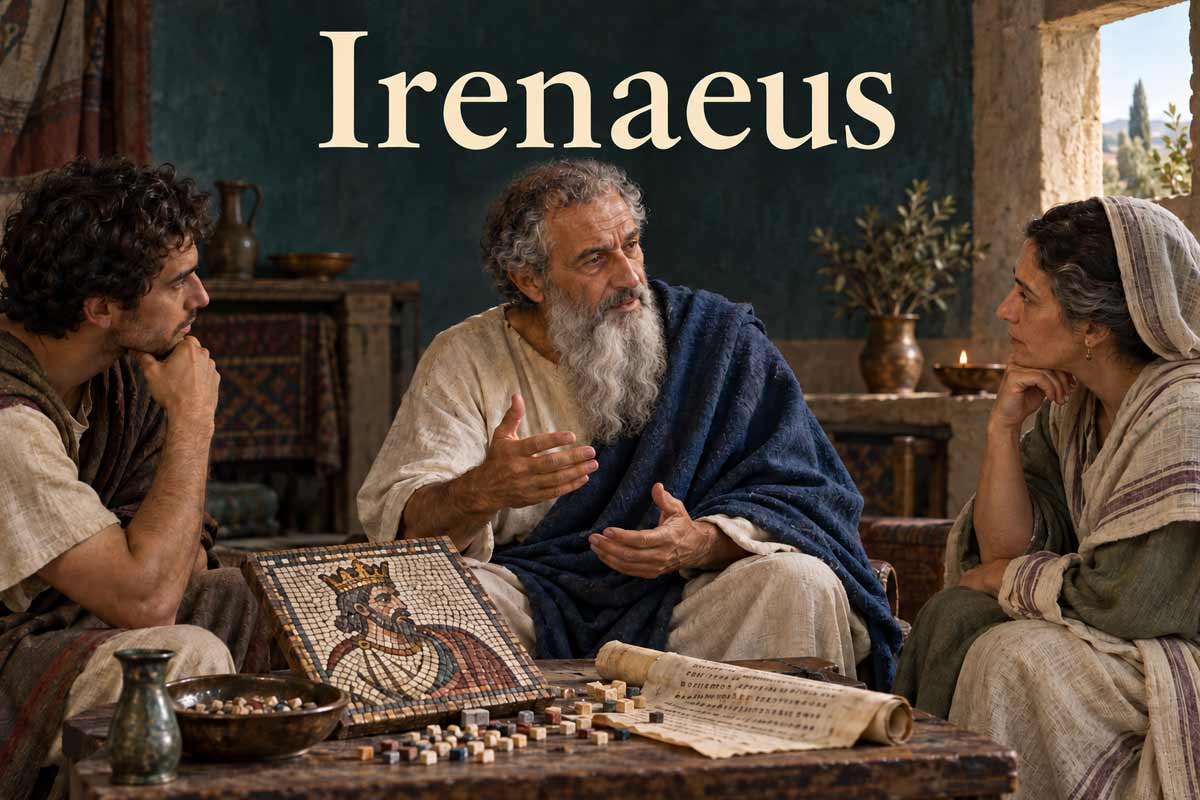
He also challenged the way rival interpreters used biblical passages. In Book I, chapter 8, he compares their procedure to dismantling a beautiful portrait of a king made from precious stones and rearranging the stones into a fox. The materials remain genuine, but the resulting picture no longer represents what the artist made. His point is more useful than simply announcing that someone has quoted the wrong verse. A person can use authentic biblical words while imposing a framework that changes what those words mean in their original setting.
The Rule of Faith and the Public Message
Irenaeus describes a shared confession often called the rule of faith. In Book I, chapter 10, its substance includes one God who made everything, Jesus Christ the Son who became incarnate for our salvation, and the Holy Spirit who spoke through the prophets. It includes Christ’s birth, suffering, resurrection, ascension, future appearing, and judgment. This is a summary of the story Christians confessed, not an alternative set of secret propositions. It supplies a framework within which particular biblical passages can be understood without being detached from the larger account.
That framework also establishes continuity between Israel’s Scriptures and the Christian gospel. The Father of Jesus isn’t a newly discovered deity rescuing us from the unfortunate handiwork of another god. The Creator is the God who acted in Israel’s history and brought his saving purposes to fulfillment in Christ. Irenaeus opposed attempts to separate these identities, including the radical contrast between the creator and the saving God associated with Marcion. Christians still have to explain difficult Old Testament passages, but declaring their God someone other than Jesus’ Father changes the problem by changing the faith.
This doesn’t mean every Christian interpretation inherited from the past is automatically correct. A summary can be faithful or distorted, and traditions require examination rather than immunity from it. Irenaeus’s argument works best when the rule helps us recognize the scriptural story instead of replacing the work of reading Scripture. The confession identifies what the church claims to have received and gives us something definite to examine. It is harder to test a teacher’s interpretation when the teacher can redefine the governing story every time a passage becomes inconvenient.
Apostolic Succession and the Appeal to Rome
Irenaeus appealed to the succession of teachers and bishops in churches connected with the apostles. In Book III, chapter 3, he gives special attention to Rome and also invokes Polycarp and the church at Ephesus. His argument concerns the public transmission of teaching: identifiable communities and leaders can be compared with the recent appearance of a supposedly ancient secret doctrine. Succession mattered because it provided a historical setting in which the content of the faith had been preserved. He wasn’t arguing merely that an impressive list of names makes any doctrine attached to it true.
Catholics, Orthodox Christians, and Protestants differ over how this argument relates to later claims about church authority. His language concerning Rome has a significant place in those discussions, and it shouldn’t be explained away simply because it complicates a Protestant reading. Neither should a second-century passage be treated as though it answers every question later raised about papal authority or institutional infallibility. We need to distinguish what Irenaeus was defending from the fuller structures different traditions developed afterward. His immediate challenge was whether a new teaching could plausibly claim apostolic origins while disagreeing with the churches that publicly preserved the apostolic message.
The Four Gospels Before Nicaea
Irenaeus explicitly defended Matthew, Mark, Luke, and John as the church’s four Gospels. That makes him an important witness against the familiar claim that Christians waited until the fourth century to decide which accounts of Jesus they wanted. Whatever questions remain about the development of the biblical canon, his testimony demonstrates that these four already possessed recognized authority in his second-century setting. He didn’t create their contents or describe himself as selecting them at a council. He appealed to writings already received and used in Christian communities.
Some of his supporting reasoning is less persuasive than the historical testimony. He associated the fourfold Gospel with four winds, four regions of the world, and the four living creatures of biblical imagery. Those connections reflect his conviction that God’s work possesses a coherent order, but the number of winds doesn’t establish the authority of a document. We can appreciate his witness without borrowing every argument he offered in its defense. The important historical point is the recognizable four-Gospel collection he defended, not the claim that geography makes any other number impossible.
A Real Incarnation and a Real Salvation
Irenaeus insisted that the Son of God genuinely became human. He opposed accounts that reduced Christ’s humanity to an appearance or separated the suffering Jesus from a heavenly Christ who escaped the suffering. The hunger, weariness, grief, wounds, and death described in the Gospels belong to the actual life of the Savior. His argument is that salvation requires a real relationship between the one who saves and the people being saved. If Christ never truly shared our humanity, the connection between his victory and our condition becomes difficult to explain.
One of his most important themes is recapitulation, which can be understood as Christ taking up humanity’s story and bringing it to its proper fulfillment. Drawing on Paul’s contrast between Adam and Christ, Irenaeus explains how Christ’s obedience answers humanity’s disobedience and restores fellowship with God. Jesus enters the life that has gone wrong and accomplishes what fallen human beings cannot accomplish for themselves. This includes his life, death, and resurrection rather than treating the incarnation as an incidental preliminary to salvation. We don’t have to force his account into a single later theory of the atonement to recognize the biblical force of the connection.
His comparison of Eve and Mary belongs within that pattern. Eve’s disobedience is answered by Mary’s faithful acceptance of God’s purpose, and Irenaeus gives Mary’s participation strong language that later Christians developed in different directions. Protestants shouldn’t pretend that emphasis isn’t present, but neither does the passage by itself establish every later Marian doctrine. The comparison places Mary’s obedience within the saving work accomplished through Christ. Reading it in context lets us evaluate the argument without reducing it either to an embarrassment to conceal or a shortcut around centuries of theological debate.
God Does Not Abandon His Creation
Irenaeus’s defense of the incarnation connects directly with his defense of bodily resurrection. The body is God’s workmanship, and salvation cannot be reduced to the escape of a spiritual element from an unwanted material shell. Sin and death damage creation, but they don’t establish that creation itself was a mistake. God saves the people he made, and his power can restore bodies that decay. This gives Christian hope a very different direction from systems in which the highest achievement is leaving the created order behind.
His teaching about the Eucharist, or Communion, reinforces the same conviction. He treats the bread and cup as participation in Christ’s body and blood and argues that bodies nourished through God’s gifts are capable of receiving resurrection life. His sacramental language is stronger than a casual account of Communion as an illustration, although it shouldn’t be equated without explanation with every later Catholic formulation. The immediate argument links creation, Christ’s real humanity, the church’s worship, and the future of the body. For Irenaeus, these belong together because the Savior hasn’t come to rescue us from a world somebody else made.
He also expected an earthly kingdom following the resurrection of the righteous, before the final judgment. This is an early form of the expectation usually called premillennialism, not a complete presentation of modern dispensational teaching. His concern was that God’s promises should find fulfillment within a renewed creation instead of being dissolved into a purely spiritual destination. Christians who disagree about the millennium can still recognize the larger claim behind his interpretation. Resurrection hope concerns God’s victory over death and the restoration of his creatures, not our successful discovery that bodies never mattered.
Human Freedom and the Gifts of the Spirit
Irenaeus rejected the idea that human beings are divided by nature into fixed spiritual classes whose final destiny follows automatically from their composition. He argued that God’s commands, invitations, and judgments address creatures capable of responding and resisting. In Book IV, chapter 37, he appeals to Jesus’ lament over Jerusalem and to the practical force of biblical exhortations. Obedience and refusal possess moral significance because people aren’t merely carrying out an unavoidable spiritual mechanism. This places his account at a considerable distance from the assumption that every early Christian thinker already expressed the categories of later debates over predestination.
He also reported continuing gifts of the Spirit, including healing, prophetic speech, visions, and deliverance, and even accounts of people restored from death. Those reports in Book II, chapter 32, deserve to be recognized as evidence of what he believed was occurring in Christian communities after the apostles. They don’t provide enough detail to verify every reported event independently, and they shouldn’t be made to endorse every modern ministry claiming similar experiences. His emphasis is on gifts serving other people through prayer in Christ’s name. Supernatural claims still require examination, especially when they become a means of elevating the person making them above correction.
Defending Doctrine Without Dividing Over Everything
Irenaeus could be uncompromising about the gospel while opposing unnecessary division over Christian practice. Near the end of the second century, Victor, the bishop of Rome, tried to exclude Asian churches from fellowship over their observance of the paschal celebration. Those churches followed a date associated with Passover, while Rome and many others observed the resurrection celebration on Sunday. Irenaeus favored the Sunday practice, yet urged Victor not to sever fellowship with whole churches maintaining an ancient custom. As Eusebius preserves the dispute, Irenaeus distinguished defending the faith from demanding uniformity in every inherited observance.
That distinction is valuable for apologetics because the instinct to protect truth can expand until almost every disagreement becomes a test of whether someone belongs to Christ. Irenaeus didn’t treat the identity of the Creator as negotiable, and he didn’t consider a merely apparent incarnation a harmless alternative. A disagreement over the date of a celebration belonged to a different category. We won’t always agree about where the boundaries should be drawn, but we ought to explain why we draw them. Otherwise, defending Christianity can gradually become defending our expectation that every Christian should do everything our way.
Reading Irenaeus With Appreciation and Judgment
Irenaeus wasn’t right about everything, and his proximity to earlier Christian generations didn’t make him infallible. In Book II, chapter 22, he argued that Jesus had reached an older stage of life extending beyond forty, partly from the remark in John 8:57 that Jesus wasn’t yet fifty. That conclusion goes beyond what the remark establishes and isn’t the usual understanding of the Gospel chronology. It supplies a useful warning about treating any early writer’s appeal to received testimony as the end of an argument. We can value his historical position while still examining his reasoning and checking his conclusions.
For readers wanting a shorter introduction, The Demonstration of the Apostolic Preaching, also called Proof of the Apostolic Preaching, presents a positive account of Christian faith and its relationship to the Old Testament. Against Heresies offers the fuller encounter with competing systems and the arguments used to answer them. Reading both helps us recognize that Irenaeus wanted more than successful refutations. He wanted Christians to understand the saving work of the God they confessed. A defense of the faith becomes much more useful when it also teaches people what there is to believe.
Irenaeus brings us back to a question that remains central whenever someone offers a new revelation or a recovered Christianity. Does the teaching illuminate the gospel, or has it rearranged the gospel into something else? Answering requires attention to Scripture, historical testimony, the identity of Christ, and the actual content of the claim. Familiar terminology and spiritual confidence can’t do that work for us. The stones may all have come from the right place, but we still need to look carefully at the picture they’ve been made to form.