

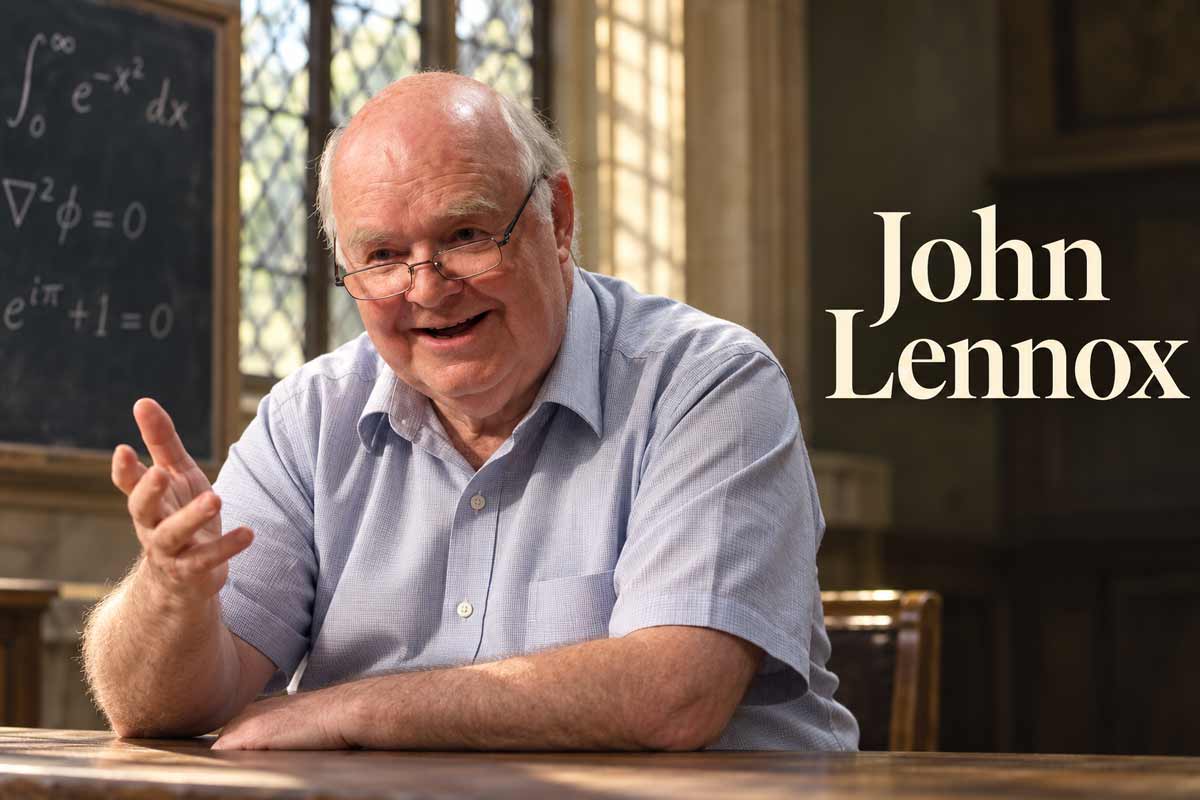
If science explains how the universe works, has it explained God out of existence? John Lennox has spent much of his public life challenging the assumption behind that question. He doesn’t ask people to choose between scientific investigation and Christian faith. He asks whether discovering the processes at work in nature settles the separate question of why there is a universe with those processes in the first place. A description of how something operates can be accurate and enormously useful without being a complete explanation of its existence.
Lennox is an Oxford mathematician, Christian apologist, and Bible teacher whose public debates have brought that argument to audiences well beyond the university. His books address science, miracles, human freedom, suffering, and artificial intelligence. He is particularly effective at identifying a philosophical claim that has been presented as though it were simply a scientific discovery. His central contention is that Christianity can explain why a rationally ordered universe exists and why human beings can understand it. That conviction leads him toward scientific inquiry rather than away from it.
A Home Where Questions Were Welcome
Lennox grew up in Northern Ireland in a committed Christian family. In his account of those years, his parents gave him room to think and encouraged him to encounter beliefs different from their own. His father even put the Communist Manifesto in his hands because he wanted his son to understand what other people thought. The point wasn’t that every worldview was equally sound. It was that a young Christian needed to learn how to assess ideas instead of relying on the reassurance that he had never read them.
His father also taught him something about how beliefs should affect the treatment of people. In a society divided along religious lines, he employed both Catholics and Protestants in his shop in Armagh. He explained that people of different backgrounds were made in God’s image and deserved to be treated accordingly. Lennox has described that example as a lasting influence. Conviction and respect weren’t competing obligations in his childhood home; the family’s Christian convictions supplied a reason to respect people with whom they disagreed.
Lennox studied at Emmanuel College, Cambridge, where he earned his doctorate in mathematics. He later worked for many years at the University of Wales in Cardiff and carried out research in Germany as well. His academic publications include more than seventy mathematical papers and two coauthored research texts in algebra. He became an Oxford professor and is now emeritus professor of mathematics and an emeritus fellow of Green Templeton College. Those credentials establish that his engagement with science grows from a serious academic career, although no university appointment can make an argument correct merely because its holder presents it.
What Science Can Tell Us
Lennox celebrates the achievements of science while questioning the claim that scientific methods provide the only route to knowledge. That stronger claim is often called scientism. Science can investigate the effects of a medical treatment, but deciding whether patients should receive it also involves judgments about their dignity, needs, and consent. Measurements inform those judgments without making them for us. The distinction is between recognizing the extraordinary usefulness of scientific inquiry and turning that usefulness into an exclusive theory of what people can know.
The same issue arises when we ask about history, moral responsibility, or the meaning of a person’s actions. Evidence remains important in all of those fields, but evidence isn’t limited to what can be reproduced in a laboratory. We assess testimony, documents, intentions, and arguments. A scientist’s methods are designed to answer particular kinds of questions, and their success doesn’t require that every meaningful question take that form. In Can Science Explain Everything?, published in 2019, Lennox brings this distinction to readers who may have been told that religious belief survives only where scientific knowledge is missing.
This doesn’t mean that Christianity gets a protected area in which evidence no longer matters. Christian claims sometimes concern events in the physical world, and those claims can encounter scientific and historical questions. Nor does identifying the limits of a method establish that any particular religious answer is true. It establishes that the answer must be considered using the reasoning appropriate to the question. Lennox’s approach opens the discussion by challenging a premature dismissal of faith, but Christians still have to explain why their beliefs deserve to be accepted.
Explaining a Mechanism and Explaining Its Source
One of Lennox’s recurring illustrations concerns a motorcar. An explanation involving its designer doesn’t compete with an explanation involving the workings of its engine. Those accounts address different aspects of the same object. In the same way, Lennox argues that God isn’t an alternative mechanism inserted where physics has failed to provide one. Christians understand God as the Creator of the reality that physics investigates, including the regularities that make its investigation possible.
This is his answer to the objection that Christianity relies on a God of the gaps. If our entire case amounts to saying that nobody currently understands a phenomenon, therefore God caused it, a later discovery can remove the premise on which the case depended. Lennox argues that belief in a Creator concerns understood nature as well as unexplained nature. Discovering a process can deepen our understanding of creation without removing the question of its ultimate source. The comparison with a designed machine illustrates the compatibility of those explanations; it isn’t, by itself, proof that the universe had a designer.
His book God and Stephen Hawking challenges claims that physical laws make a Creator unnecessary. Lennox questions whether an account that already invokes laws and a physical framework has explained existence from absolute nothingness. He also distinguishes describing a regularity from explaining why there is a reality that behaves according to it. To borrow an ordinary example, a correct account of compound interest won’t produce money in an empty account. The cosmological debate is much more sophisticated than that illustration, but the distinction helps readers see why an equation and an ultimate explanation aren’t automatically the same thing.
The disagreement should be evaluated at the level where it occurs. A mathematical model may explain phenomena successfully while leaving questions about the existence of the modeled reality open. A critic may respond that the physical world requires no further explanation or that invoking God raises questions of its own. Those are philosophical disagreements that need philosophical arguments. Lennox’s useful contribution is to insist that expertise in physics doesn’t make every conclusion a physicist draws about God a result of physics.
Why the Universe Makes Sense to Us
As a mathematician, Lennox is struck by the relationship between abstract reasoning and the world outside our minds. Mathematical ideas can describe physical events with remarkable accuracy. Scientific work also depends on the expectation that nature has an order we can investigate and that our reasoning can disclose something true about it. Lennox sees those expectations as fitting a Christian understanding of creation. A rational Creator and human beings made in his image provide, he argues, a coherent setting for a knowable universe and minds capable of knowing it.
He points to figures such as Johannes Kepler and Isaac Newton to challenge the idea that serious science necessarily develops by abandoning God. Their religious convictions could motivate their investigation of nature. That observation doesn’t mean the history of science belongs exclusively to Christianity, nor does it deny the contributions of people from other traditions or none. It does undermine the claim that belief in a Creator must obstruct scientific curiosity. For those investigators, the order they discovered could be a reason for wonder rather than an argument against faith.
In God’s Undertaker and the later Cosmic Chemistry, Lennox also examines arguments involving the universe, life, and information in biological systems. He distinguishes observations about nature from the larger worldview conclusions people draw from them. Evidence for a particular biological process isn’t automatically evidence that existence as a whole is purposeless. At the same time, a disputed scientific explanation doesn’t automatically establish design. These discussions are strongest when each specific argument is examined on its merits, with attention to the evidence and to the steps connecting it with a conclusion about God.
Debating the New Atheists
Lennox became widely known through public exchanges with prominent critics of religion, including Richard Dawkins, Christopher Hitchens, and Peter Singer. His 2007 debate with Dawkins in Birmingham, Alabama, addressed claims associated with The God Delusion. A later encounter took place at the Oxford Museum of Natural History. These events gave viewers an opportunity to hear competing accounts of religion, evidence, and morality in an extended conversation. They also challenged the impression that the scientific side of such a discussion must belong to the atheist.
Lennox’s manner is an important part of his effectiveness. He can be direct about a disagreement while remaining conversational, often using an accessible illustration to expose a difficult assumption. That helps audiences follow questions that would otherwise disappear beneath technical language or mutual irritation. His approach provides an example of how Christians can defend a conviction without treating a skeptic as an enemy. A person can disagree strongly with us and still be someone whose objections we should understand.
A debate nevertheless has limits. An engaging answer can clarify a point without settling every question behind it, and a short exchange rarely permits a full examination of the relevant scholarship. Apologetics also suffers when edited clips encourage viewers to enjoy an opponent’s embarrassment more than to understand the issue. Lennox’s arguments deserve to be assessed in their fuller form, including the objections made against them. The purpose of listening should be to learn what is true, not merely to collect moments that make our own side look good.
Reading Genesis Carefully
Lennox addresses disagreements within Christianity as well as objections from outside it. In Seven Days That Divide the World, first published in 2011, he considers how to read the opening chapters of Genesis in relation to scientific knowledge. He rejects the assumption that accepting an ancient earth necessarily means abandoning biblical authority. His approach asks readers to distinguish the meaning of the text from a particular interpretation they may have inherited. A conviction that Scripture is true doesn’t make every explanation Christians have offered of Scripture equally reliable.
He also resists making the age of the earth the entire meaning of the creation account. Genesis speaks about God’s relationship to creation and the significance of human beings within it. Those teachings deserve attention even where Christians disagree about chronology. Lennox wants readers to examine the biblical language seriously while also considering what can be learned through the study of nature. He treats the relationship between those sources of knowledge as a question requiring careful interpretation rather than a choice between trusting God and examining evidence.
Young-earth Christians and some other readers dispute his conclusions. Their disagreement can involve the wording of Genesis, its relationship to other biblical passages, and the extent to which scientific accounts should influence interpretation. Those questions shouldn’t be dismissed merely because Lennox is a distinguished mathematician. Nor should his commitment to Scripture be dismissed merely because he reaches a different conclusion about the creation days. The useful question is whether a reading does justice to what the passage actually communicates.
Miracles and the Resurrection
Lennox’s confidence in the regularity of nature doesn’t lead him to rule out miracles. He argues that knowledge of ordinary processes helps us recognize when an event would be extraordinary. The claim that Jesus rose from the dead is significant precisely because dead people don’t ordinarily return to life. Christianity has never required people to believe that resurrection is a routine biological process. It claims that God acted in a way the normal course of nature doesn’t produce.
That raises a different question from whether a scientist can reproduce a resurrection experimentally. If God exists, scientific descriptions of ordinary nature don’t by themselves establish that he cannot act within it. We must then consider whether there are adequate reasons to believe that he did so in a particular case. Lennox connects the question of miracles with the evidence concerning Jesus rather than leaving it as an abstract possibility. An argument that makes room for divine action must still be followed by an investigation of the historical claim.
This is where his apologetics becomes specifically Christian. Belief in a source of cosmic order isn’t yet belief in the incarnation, the cross, or Jesus’ resurrection. Those claims bring us to the testimony of the New Testament and the identity of the person it describes. For Lennox, Jesus isn’t an optional devotional addition to an argument about the universe. His faith concerns the God who has made himself known in Christ and who offers a relationship with himself, not simply an explanation of physical existence.
Freedom and Responsibility
In Determined to Believe?, Lennox considers the relationship between God’s sovereignty and human freedom. He examines theological determinism, election, and the responsibility of people who receive or reject the gospel. The issue reaches beyond a technical disagreement about predestination. It concerns how we understand biblical invitations, warnings, and assurances, and what it means to respond to God. Lennox encourages readers to examine the biblical material before letting an inherited theological label determine what every passage is allowed to say.
The book challenges assumptions associated with theological determinism while taking divine sovereignty seriously. Christians who disagree with its arguments still face the questions it raises about meaningful human response and moral responsibility. Simply repeating that God is sovereign doesn’t explain how a particular account of human action works. Likewise, affirming human freedom doesn’t explain how it relates to God’s purposes. Lennox brings the discussion back to careful reasoning and biblical interpretation, where disagreements can be examined rather than settled by a slogan.
Artificial Intelligence and Being Human
Lennox’s more recent work extends his concern with human identity into artificial intelligence. His 2020 book 2084 was later expanded as 2084 and the AI Revolution. It discusses technological developments alongside questions about power, surveillance, and proposals to transform humanity. The title deliberately recalls George Orwell’s 1984, directing attention to what people with powerful tools may do to other people. Lennox’s concerns include the human ambitions surrounding technology as well as the capabilities of the technology itself.
AI makes an older philosophical question more immediate: what is a person? Performance at a task, however impressive, doesn’t by itself settle questions about consciousness, moral responsibility, or personal worth. Lennox approaches those issues through the Christian understanding of human beings as made in God’s image. Our value isn’t earned by outperforming a computer, and it doesn’t disappear when a machine does something faster than we do. That conviction also has implications for how we regard people whose abilities are limited by disability, illness, or age.
His book God, AI and the End of History connects these concerns with Revelation, deception, and the use of power. That introduces interpretive questions beyond the ethics of an existing technology. Readers can take the dangers of manipulation and concentrated power seriously while carefully assessing proposed connections with biblical prophecy. A possible future use of a technology isn’t the same thing as a demonstrated fulfillment of a passage. The enduring Christian concern is how human beings exercise power, whom they trust, and whether their hope has become attached to something they have made.
Faith When Life Hurts
Lennox also addresses suffering, including in Where Is God in a Coronavirus World?, published during the pandemic in 2020. In explaining his purpose, he explicitly resisted easy answers to pain and uncertainty. A discussion about God changes character when someone is grieving or afraid of death. The objection may still have an intellectual dimension, but it also belongs to a person trying to live through a crisis. A response needs to acknowledge that reality rather than using an argument to hurry past it.
There is an important Christian distinction between explaining why suffering can occur and claiming to know why a particular person suffered. We aren’t given a complete account of every tragedy. Christianity instead directs us toward Christ, who entered a suffering world, and toward the hope of resurrection. That hope doesn’t require calling an illness good or treating grief as a failure of faith. Lennox’s engagement with suffering helps connect the God discussed in philosophical arguments with the God Christians trust when those arguments can’t remove their pain.
A Bible Teacher as Well as an Apologist
Lennox’s public reputation can obscure how much of his work concerns the biblical text itself. He has described the Bible scholar David Gooding as a major influence on his approach to Scripture. His own Against the Flow studies Daniel and the challenge of remaining faithful while serving in a society that doesn’t share one’s beliefs. The emphasis includes both competence and conviction. Daniel’s story raises questions about how believers can participate responsibly in public life while recognizing that their ultimate allegiance belongs to God.
Lennox also serves as president of OCCA, the Oxford Centre for Christian Apologetics, supporting the preparation of other Christians to explain and defend the gospel. That teaching role fits the pattern of his work: understanding Scripture and answering objections belong together. His contribution isn’t that a mathematical career allows him to bypass theology or history. It is that he brings habits of careful reasoning into conversations where people are often told they must stop thinking in order to believe.
The strongest lesson to draw from Lennox is a willingness to examine what an explanation actually explains. A scientific discovery can be celebrated without requiring it to settle every philosophical question, and a Christian argument can be taken seriously without declaring it immune to criticism. His work encourages believers to understand the world more carefully and to speak about Christ with confidence grounded in reasons. It also asks skeptics to consider Christianity’s actual claims before rejecting a simplified version of them. That is a conversation worth having, especially in a culture where scientific achievement and religious conviction are so often presented as though one must come at the other’s expense.