

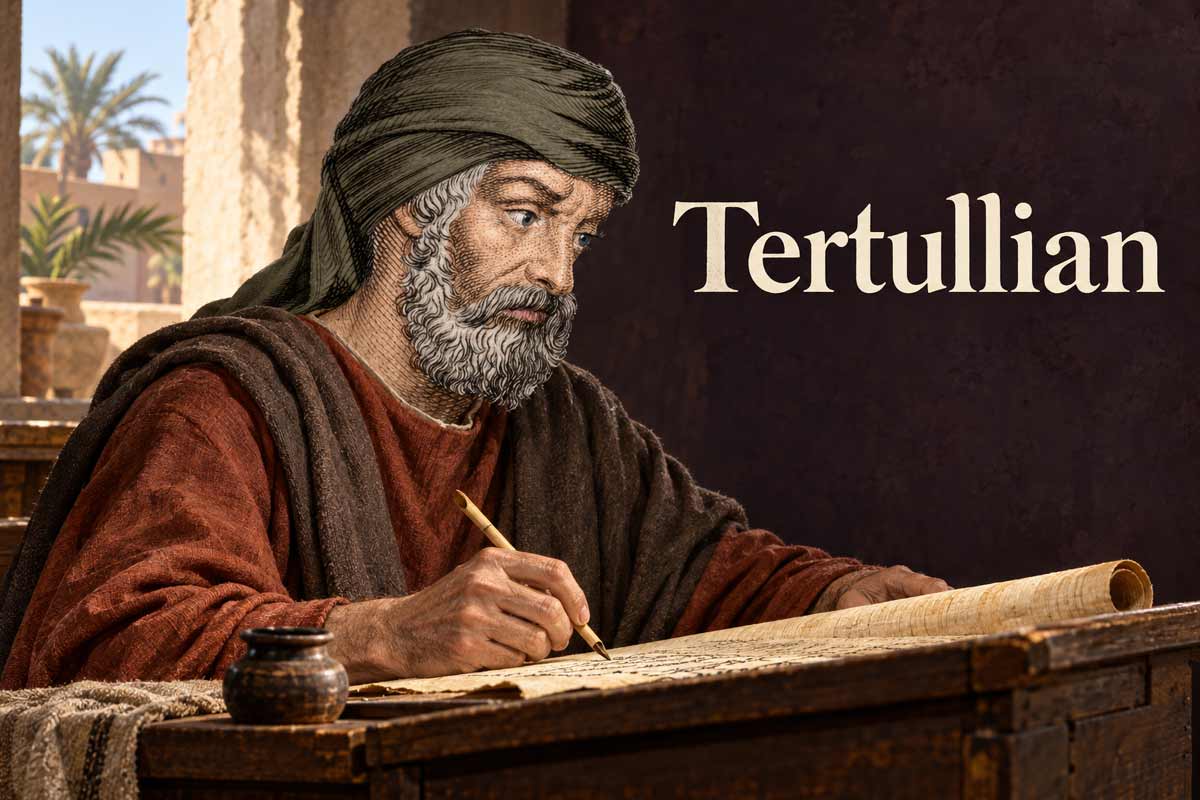
Tertullian could spot a contradiction in an opponent’s argument and make sure everybody else saw it too. When Roman officials treated the name “Christian” as evidence of a crime, he asked why they weren’t investigating an actual crime. When teachers tried to protect Jesus from the indignity of having a real human body, he argued that they were removing the very humanity through which He saves us. When Christians became comfortable with practices he considered worldly, he was just as willing to challenge them. His writing can be brilliant, combative, and exhausting, sometimes within the same paragraph. If Justin Martyr often sounds like a philosopher inviting you into a conversation, Tertullian can sound like someone who has already prepared the cross-examination.
He helped give Latin Christianity some of the vocabulary it would use to explain the Trinity and the person of Christ. He also defended believers against persecution and insisted that Christianity should produce a visibly different life. Yet his increasing commitment to strict discipline and to the movement known as the New Prophecy created serious tensions with other Christians. That makes him a useful figure to read without trying to turn him into either a flawless hero or a cautionary tale with nothing left to teach us. Some of his arguments remain remarkably strong, while some of his conclusions show how easily zeal can outrun judgment.
A Christian Voice from Roman North Africa
Tertullian lived and wrote in Carthage, in Roman North Africa, near present-day Tunis. He was born sometime in the second century and was active as a Christian author around the end of that century and the beginning of the third. Exact dates for his birth, conversion, and death are uncertain. He had a pagan background, knew the surrounding culture well, and wrote with an education that included rhetoric and familiarity with law. The familiar biography describing him as the son of a military officer, a professional lawyer, and an ordained priest depends heavily on later testimony. Those details shouldn’t be repeated as though we had his employment records and ordination certificate.
What we do have is a substantial collection of writings that shows him addressing persecution, heresy, worship, marriage, repentance, and Christian conduct. He wrote in Latin at a time when much of the church’s theological literature was still being produced in Greek. That required more than changing the words from one language to another. He had to find ways to express Christian distinctions in a Latin intellectual setting, and his choices helped shape later Western theology. Calling him an important early Latin theologian is well supported, even when the details of his personal biography remain frustratingly thin.
A Defense That Put Roman Justice on Trial
Tertullian’s Apology, generally dated to AD 197, addresses the treatment of Christians under Roman authority. Like Justin before him, he argues that accusations should be investigated rather than assumed to be true. Christians were charged with terrible secret practices, including murder, cannibalism, and incest, yet the proceedings could focus almost entirely on whether an accused person admitted being a Christian. Tertullian asks why authorities who supposedly cared about these crimes weren’t establishing the circumstances, identifying witnesses, and producing evidence. A frightening rumor could travel much farther than a careful investigation, especially when the people being accused were already unpopular.
He also notices a peculiar feature of the interrogations. Ordinarily, officials used pressure to get a suspected criminal to confess, but Christians could be pressured to deny the identity they had already confessed. If admitting to Christianity established the crime, why was denying it enough to make the problem disappear? Tertullian uses that inconsistency to challenge the claim that these proceedings were about justice. He isn’t simply asking the government to like Christians better. He’s arguing that a system which abandons its own ordinary standards whenever Christianity is involved has allowed prejudice to govern the courtroom.
The refusal to sacrifice to the gods raised a related accusation of disloyalty. Tertullian answers that Christians pray for the emperor, for peace, and for the stability of the world. Their loyalty doesn’t extend to treating an emperor or a manufactured idol as God. He also challenges the moral credibility of pagan worship by pointing to the conduct attributed to the gods and to the behavior of the society defending them. His language is often much sharper than a modern interfaith discussion would permit, and he sometimes paints opponents too broadly. Still, the central distinction is clear enough: a citizen can refuse a religious act without becoming an enemy of every legitimate civil obligation.
What Outsiders Could See in the Church
Tertullian doesn’t limit his defense to exposing bad arguments. In chapter 39 of the Apology, he describes Christians gathering for prayer, the reading of Scripture, instruction, and discipline. Their leaders are supposed to be recognized for tested character rather than for purchasing a position. Contributions are voluntary, and the money supports people who need help, including the poor, children without parents, the elderly, and believers suffering imprisonment or other hardship. This is part of his answer to the suspicion surrounding Christian meetings. He gives outsiders a picture of a community whose common faith carries practical obligations.
His account also preserves the famous observation that outsiders noticed the love Christians showed one another. We shouldn’t turn an apologetic description into a claim that every early congregation was free from selfishness or conflict. Tertullian’s own disciplinary writings make it clear that the church had plenty of problems. But he understood that Christian conduct belonged in a defense of Christian belief. If a church claims to follow a Savior who cares for the vulnerable, outsiders are entitled to wonder where that care is happening. Tertullian points them toward actual people receiving help rather than leaving the argument at the level of religious vocabulary.
Near the end of the Apology, he argues that persecution can produce the opposite of what persecutors intend. The familiar saying about the blood of martyrs being the seed of the church summarizes his statement that the blood of Christians is seed. He sees the courage of suffering believers as something that makes observers ask what could sustain them. That doesn’t mean persecution always increases the church’s numbers, or that suffering by itself proves a belief true. Tertullian is making a claim about the witness of Christians who remain faithful under pressure. He is also warning Rome that killing a believer doesn’t necessarily kill the conviction that brought the believer to court.
Athens and Jerusalem
Tertullian is remembered for asking what Athens has to do with Jerusalem. The question appears in The Prescription Against Heretics, where he attacks the use of philosophical speculation to reshape Christian teaching. Athens represents the philosophical schools, while Jerusalem represents the faith received through Christ and His apostles. He was especially concerned about systems that used Christian language while constructing a very different account of God, creation, and salvation. His complaint is that a teacher can begin with an outside theory, force the gospel into it, and then present the resulting mixture as deeper Christianity.
That concern deserves a hearing, but it doesn’t make Tertullian a man who rejected all reasoning or learned nothing from the wider culture. His own works use sophisticated argument, rhetorical training, and ideas drawn from the intellectual world around him. The tension between his rejection of philosophical authority and his use of philosophical concepts is part of what makes him interesting. Compared with Justin, he is much less welcoming toward philosophy as a partner in explaining the faith. Nevertheless, both men are trying to answer a question Christians still face: when does a useful tool for understanding become a rule that decides in advance what God is allowed to reveal?
Who Had the Right to Redefine the Gospel
The title The Prescription Against Heretics sounds as though Tertullian is handing someone medicine. Here, however, “prescription” has a legal sense involving a prior objection that can prevent a case from proceeding on the opponent’s terms. Before entering an endless dispute over individual verses, Tertullian asks who received the Christian Scriptures and the message they contain. He points to the churches founded by the apostles and to the public teaching handed down through them. A later teacher who offers a radically different gospel must explain why the communities entrusted with the apostolic message supposedly lost it. Tertullian wants the question of historical continuity settled before accepting the claim of a newly recovered secret.
Like Irenaeus, he appeals to a rule of faith that summarizes the church’s central confession. That confession concerns the Creator, Jesus Christ’s incarnation and saving work, the Spirit, and the future resurrection and judgment. It provides a way to recognize when someone is using biblical phrases inside a framework that contradicts the message the church received. Yet Tertullian’s approach also raises a danger if it becomes a way to declare an institution correct without allowing its claims to be examined. Christians can value public continuity and inherited teaching while still testing interpretations against Scripture. An appeal to tradition becomes less helpful when it is used to prevent the very examination needed to distinguish faithful inheritance from accumulated error.
Giving Latin Christians Language for the Trinity
In Against Praxeas, Tertullian responds to an account of God that collapses the distinction between Father and Son. Praxeas, as Tertullian presents him, wants to defend God’s unity by identifying the Father with the One who was born and suffered as Jesus. This belongs to the family of views commonly called modalism, in which Father, Son, and Spirit don’t have the enduring personal distinctions recognized in Trinitarian theology. Tertullian argues that God’s unity doesn’t require erasing the relationships Scripture describes. The Son addresses the Father, is sent by the Father, and promises the Spirit. Those relationships need to be explained rather than treated as a problem to be removed.
Tertullian uses the Latin word trinitas and speaks of unity of substance alongside the distinction of persons. His terms helped establish a vocabulary that later Western theologians would develop more fully. He didn’t invent the Father, Son, and Holy Spirit, and he wasn’t the first Christian to regard Jesus as divine. Nor was every detail of his explanation identical to the formulations adopted in later councils. Some of his descriptions of the Son’s derivation from the Father and the ordering of the three require careful historical interpretation. His importance lies in his effort to hold divine unity and real distinction together, and in the lasting usefulness of language he brought to that task.
He also makes a significant contribution to explaining Christ’s divine and human identity. In chapter 27 of Against Praxeas, he describes divinity and humanity as joined in the one person of Jesus without being confused. This anticipates concerns that would receive fuller treatment in later controversies and councils. In On the Flesh of Christ, he attacks the idea that Jesus only appeared to possess a human body. If Christ’s suffering, death, and resurrection are merely appearances, the salvation Christians hope for has lost its connection with real human life. Tertullian’s insistence on Christ’s flesh also supports his defense of the resurrection of our bodies.
Did He Believe Because It Was Absurd
Another expression attached to Tertullian is “I believe because it is absurd.” That familiar slogan isn’t an exact quotation from him, although it reflects a striking passage in chapter 5 of On the Flesh of Christ. There he speaks paradoxically of Christ’s death being believable because it is absurd, and His resurrection being certain because it is impossible. He is arguing against the attempt to remove the scandal of the incarnation and cross by making Christ less fully human. His wording is deliberately provocative, and it shouldn’t be softened until it sounds like an ordinary modern argument. But it also shouldn’t be detached from that controversy and made into a universal rule that the least reasonable belief is always the best one.
Tertullian’s broader method makes that reading difficult to sustain. He spends a great deal of time finding contradictions, interpreting texts, and demanding evidence from his opponents. A writer who thinks rational examination is worthless has chosen an unusually laborious way to demonstrate it. His point in the controversial passage is that the gospel’s humiliation shouldn’t be edited out merely because it offends an opponent’s expectations about divine dignity. Christians can recognize that point while judging the rhetoric excessive. Believing that God can act beyond ordinary human expectations doesn’t oblige us to accept a claim simply because it sounds ridiculous.
Baptism and the Seriousness of Christian Commitment
Tertullian’s On Baptism is an important early witness to the meaning and practice of baptism. He connects the washing with forgiveness and new birth, describes preparation through prayer and repentance, and relates it to the work of the Holy Spirit. His account includes anointing and the laying on of hands, showing a pattern of initiation more developed than a brief public testimony followed by immersion. We shouldn’t remove those details to make him sound like a member of a particular modern denomination. We also shouldn’t assume that every later sacramental explanation is already present in his treatise. He gives us a view of Christian practice around his time, with both continuities and differences that deserve attention.
In chapter 18, he recommends delaying baptism in certain cases, especially for little children. He wants candidates to understand their commitment and questions the burden placed on sponsors who promise on a child’s behalf. That passage shows that the baptism of young children was a live issue, but it doesn’t establish that every early church either practiced it or rejected it. His advice also belongs to a wider concern about the seriousness of sins committed after baptism, which helps explain why he recommended caution for other candidates as well. At the end of the work, he encourages newly baptized believers to ask God for His gifts. His baptismal teaching combines a strong expectation of divine grace with a very demanding understanding of responsibility.
The New Prophecy and the Pull of Stricter Discipline
Tertullian became a defender of the movement commonly called Montanism, whose supporters spoke of the New Prophecy. It originated in second-century Phrygia in Asia Minor and was associated with Montanus and the prophetesses Prisca, also called Priscilla, and Maximilla. The movement claimed continuing prophetic activity and urged rigorous Christian living. Tertullian regarded it as a work of the promised Paraclete, the Holy Spirit, bringing the church into fuller discipline. His later writings openly defend that claim and attack Christians who reject it. The exact course of his institutional relationship with the wider church is harder to establish than a neat story in which he simply resigned one day and joined an entirely separate denomination.
It would be misleading to describe the controversy as a straightforward fight between people who believed in spiritual gifts and people who didn’t. Claims to prophecy required evaluation, and the disputes involved authority, the character of prophetic speech, and the demands imposed in God’s name. Tertullian himself describes a woman receiving visions during Christian worship in chapter 9 of On the Soul, with her reports afterward examined. That is evidence of what he and his community believed was occurring, without independently verifying the revelations. Christians who believe the Spirit continues to give gifts can still question whether a particular claimed revelation is true. A claim to spiritual authority doesn’t become exempt from testing because its supporters are sincere or strict.
Tertullian’s increasingly severe discipline appears particularly in his treatment of marriage and repentance. In On Monogamy, he opposes a second marriage even after the death of a spouse, arguing that the New Prophecy demands a more exacting standard. That goes beyond the permission Paul gives a widow to marry in 1 Corinthians 7:39. In On Modesty, he disputes the church’s authority to restore believers guilty of certain serious sexual sins after baptism. He doesn’t simply deny that God can forgive, but he sharply limits the forgiveness and restoration church leaders may grant. His concern that grace shouldn’t become an excuse for sin is understandable; the difficulty comes when protecting holiness restricts restoration more severely than Scripture warrants.
Reading Tertullian with Appreciation and Judgment
Tertullian’s weaknesses aren’t limited to the demands of his later discipline. His treatment of opponents can become contemptuous, and some of his language about women is harsh and unfair. His historical assertions also need checking rather than automatic acceptance just because they appear in an early Christian source. These limitations belong in an honest account of his work, alongside his powerful defense of persecuted believers and his contribution to Christian doctrine. His books show both how necessary it is to challenge false teaching and how tempting it is to confuse the force of an argument with the faithfulness of every conclusion. He can be right about the need for holiness and wrong about what holiness requires in a particular case.
The value of reading Tertullian is that he makes it difficult to treat Christianity as a collection of harmless religious preferences. He expects the truth about God to affect worship, conduct, and courage under pressure, and he insists that Christian claims can withstand serious examination. At the same time, his own development shows why even a gifted defender of the faith needs correction. We don’t have to choose between gratitude for his contribution and disagreement with his excesses. The church needs people who can identify a bad argument and defend the truth clearly. It also needs those people to remain teachable when the argument that needs correction is their own.