

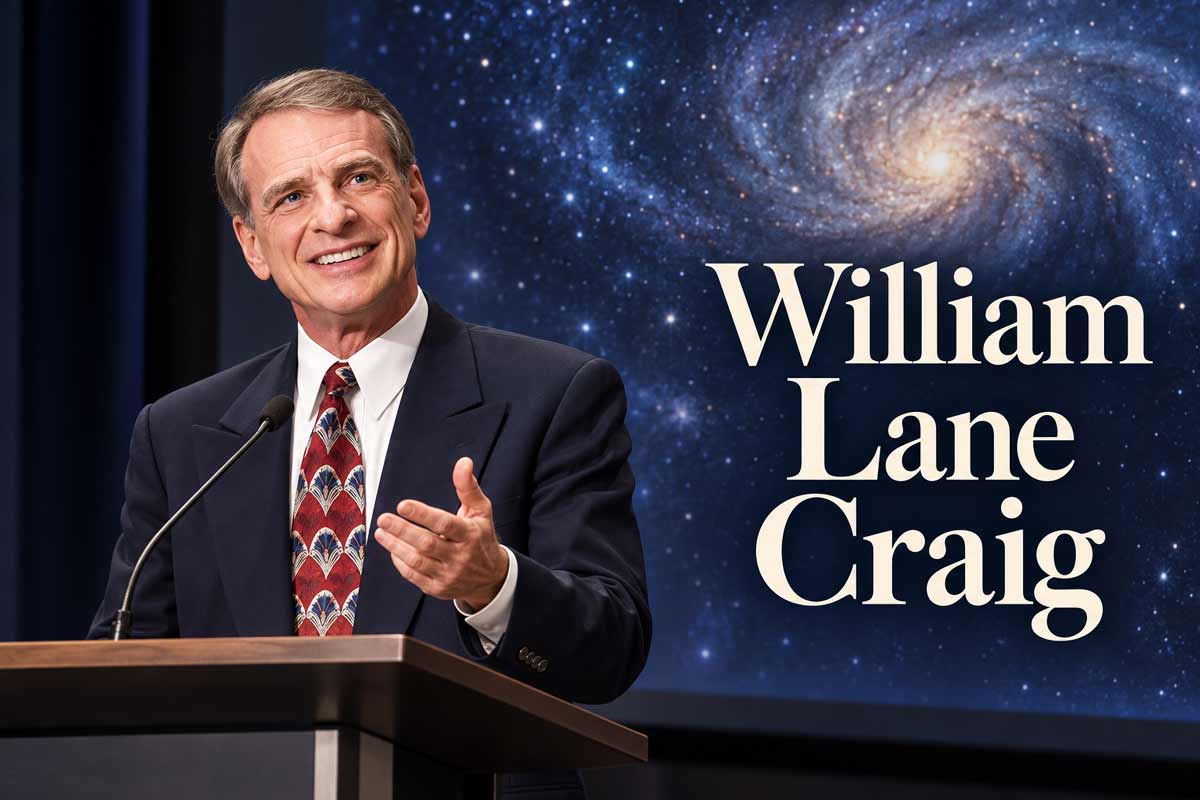
Some people hear the word faith and assume it means believing something without a reason. Others assume that a scientific education will eventually make religious belief unnecessary. William Lane Craig has spent much of his career challenging both assumptions, often in front of an audience that includes people who strongly disagree with him. His approach asks Christians to explain their beliefs and asks skeptics to explain their objections with the same care. A confident dismissal of Christianity doesn’t become an argument simply because the person delivering it sounds very sure of himself.
Craig is a philosopher, theologian, and Christian apologist whose work connects academic research with public discussion. He is particularly associated with the kalam cosmological argument, the moral argument for God’s existence, and the historical case for the resurrection of Jesus. His debates have helped make questions about the origin of the universe, the foundation of morality, and the credibility of Christianity accessible to a much wider audience. He also holds distinctive positions on divine foreknowledge, human freedom, and God’s relationship to time. Understanding his contribution requires looking at the reasoning behind those positions rather than treating him as either the man who has answered every objection or the man whose arguments can safely be ignored.
From Christian Conversion to Academic Philosophy
Born in 1949, Craig became a Christian during his high school years. He studied at Wheaton College and Trinity Evangelical Divinity School before earning doctorates at the University of Birmingham and the University of Munich. At Birmingham he worked under John Hick, and at Munich he studied with Wolfhart Pannenberg. The subjects that became central to his apologetics were already taking shape through his research into the existence of God and the resurrection of Jesus. His career grew from the conviction that Christian belief could be examined through serious philosophical and historical inquiry.
Craig’s teaching and research have included work at Trinity, the University of Louvain, Talbot School of Theology, and Houston Christian University. Alongside scholarly publications, he has written for readers who aren’t professional philosophers, especially through Reasonable Faith and On Guard. The Reasonable Faith ministry makes his teaching available through articles, lectures, debates, podcasts, and other resources. His Defenders teaching also addresses Christian doctrine more broadly than the arguments for which he is best known. That combination allows a reader to move from an introductory explanation into a much more demanding discussion of the same subject.
His work belongs to the tradition sometimes called natural theology, which considers what reason and the world around us can tell us about God. A natural theological argument doesn’t begin by requiring the listener to accept the Bible as inspired. It begins with something the listener may already recognize, such as the existence of the universe or the reality of moral obligation, and asks what follows from it. Historical apologetics then brings a different set of questions into the discussion, especially concerning Jesus. The distinction helps explain why establishing a case for a Creator and establishing a case for Christianity are related tasks that require different evidence.
The Kalam Cosmological Argument
Craig helped revive a cosmological argument with roots in medieval Islamic theology, including the work of al-Ghazali. Its basic reasoning is that whatever begins to exist has a cause, the universe began to exist, and therefore the universe has a cause. The wording matters because the argument doesn’t claim that everything has a cause. It applies the causal principle to things that begin to exist, while the God Craig defends has no beginning. Asking who created God therefore challenges a claim the argument hasn’t made, although a critic can still challenge its actual premises.
Craig supports the claim that the universe began through both philosophical reasoning and scientific considerations. His philosophical discussion questions whether an actually infinite series of past events could exist, while his scientific discussion appeals to cosmology. He then argues that the cause of the universe must transcend the physical reality it brings into existence and develops a further case for a personal Creator. Those additional steps deserve attention in their own right. The short argument reaches a cause of the universe; identifying the nature of that cause requires more reasoning than simply adding the word God to the conclusion.
The objections are substantial enough that Christians should learn them accurately. In his discussion with Craig, physicist Sean Carroll questioned whether ordinary ideas of causation apply to the universe as a whole and disputed the claim that cosmology establishes an absolute beginning. Those objections concern both how the argument reasons and how it uses scientific evidence. A critic may accept the history of the universe described by a physical model while rejecting the philosophical conclusion Craig draws from it. Calling that disagreement a refusal to face science would obscure the very point being debated.
For an ordinary reader, the most useful lesson is to distinguish a conclusion from the reasons supporting it. Accepting the kalam argument involves accepting its premises, and rejecting it requires identifying where the reasoning fails or where a premise lacks adequate support. An objection to one cosmological model doesn’t automatically defeat every argument for God, and an objection to one atheist response doesn’t automatically establish Christianity. These distinctions can feel less exciting than a video announcing that somebody has demolished somebody else. They are considerably more helpful if the goal is understanding what has actually been established.
Fine-Tuning and the Conditions for Life
Craig also argues from the life-permitting conditions of the universe. Fine-tuning, in this discussion, concerns features such as physical constants and initial conditions rather than the observation that a sunset is attractive. He considers whether those conditions are best explained by physical necessity, chance, or design, and he defends design as the strongest explanation. This is an argument about the conditions that make a life-permitting universe possible. It should be distinguished from the separate biological questions about how living things developed within that universe.
The explanation involves more than announcing that the odds are small and declaring the discussion over. Evaluating a probability requires assumptions about the relevant possibilities, and comparing explanations requires considering the design proposal as well as its alternatives. Craig himself describes the argument as an inference to the best explanation, even when he presents a simplified version in debate. A reader should therefore ask how each candidate explanation accounts for the evidence and what assumptions it requires. That approach gives the discussion more substance than trading enormous numbers whose significance neither participant has explained.
Morality and the Existence of God
Craig’s moral argument begins with the claim that without God, objective moral values and duties would not exist. He then argues that such values and duties do exist and concludes that God exists. Objective here means that the truth of a moral judgment isn’t merely a matter of personal preference or social approval. For example, a society’s acceptance of cruelty wouldn’t, by itself, make cruelty right. The argument asks what makes a moral obligation real even when the person violating it doesn’t recognize or respect it.
This is easily misunderstood as an accusation that atheists can’t behave morally. The issue is the foundation of morality, which differs from whether a particular person recognizes or practices it. Someone can reject belief in God and still be generous, honest, and courageous, while someone who professes faith can behave appallingly. Craig’s argument concerns what ultimately grounds moral truth, rather than who gets better marks for behavior. A criticism of the argument needs to address that claim, perhaps by proposing a different foundation for objective morality or by questioning the existence of objective morality itself.
One longstanding objection asks whether something is good because God commands it or whether God commands it because it is already good. The first option appears to make morality arbitrary, while the second appears to place a moral standard above God. Craig answers by grounding goodness in God’s necessarily good nature and understanding moral duties in relation to His commands. On this account, God doesn’t invent goodness through an unpredictable decision or consult a rule book superior to Himself. Whether that explanation succeeds remains a subject of philosophical disagreement, but it deserves to be evaluated as the explanation Craig actually gives.
From a Creator to the Resurrection
An argument for a Creator doesn’t, on its own, establish the Trinity, the incarnation, or the resurrection. Craig recognizes that Christianity makes claims about particular events as well as about ultimate reality. His case for Jesus therefore examines the historical material rather than treating the conclusion of a cosmological argument as proof of the entire New Testament. When addressing someone who doesn’t accept biblical inspiration, he approaches the New Testament writings as ancient sources that can be investigated. That gives the discussion a starting point other than requiring the skeptic to accept the conclusion before considering the evidence.
His resurrection case emphasizes Jesus’ burial, the empty tomb, the reported appearances after His death, and the origin of the disciples’ belief that He had risen. He considers alternative explanations and argues that God raising Jesus provides the best account of the evidence. The tradition Paul recounts in 1 Corinthians 15 is especially important because it places the resurrection proclamation within the early Christian movement. Craig’s argument distinguishes the evidence for what the earliest Christians claimed from the further question of what explains those claims. Both parts need examination if the historical discussion is going to support the theological conclusion.
Readers should also distinguish scholarly agreement about an individual historical claim from agreement that a miracle occurred. A scholar may accept that the disciples sincerely believed they had seen Jesus without concluding that God raised Him bodily from the dead. Different claims in the resurrection case also receive different levels of acceptance, so blanket statements that scholars agree with everything can mislead. The Christian argument needs to explain why the resurrection accounts for the evidence better than its competitors. It also needs to address the assumptions about miracles that influence what a critic considers possible in the first place.
The resurrection has a role in Christianity that goes beyond supplying another argument in a debate. If Jesus rose, His death wasn’t simply the tragic end of an inspiring teacher, and His claims require a different kind of attention. First Corinthians 15 connects the resurrection with the credibility of Christian proclamation and the believer’s hope. That relationship explains why Craig moves from general arguments about God toward the person and work of Jesus. A universe with a Creator and a world in which Christ has risen present related questions, but the second brings the discussion directly to the gospel.
Public Debates and Their Limits
Craig’s public debates have made him especially recognizable outside academic philosophy. The format encourages him to present arguments clearly, identify their premises, and ask his opponent to address them. A debate can help listeners see where two positions actually diverge instead of allowing both speakers to make speeches that never meet. His 2014 discussion with Sean Carroll about God and cosmology provides an example of that exchange between a philosopher defending theism and a physicist defending a naturalistic account. Such encounters let an audience hear serious disagreement in something closer to real time than a sequence of books published years apart.
Debates also come with limitations that viewers should keep in mind. A speaker has a fixed amount of time, a complex objection may need more explanation than the format allows, and an audience may mistake quickness for accuracy. Someone can present a weak case effectively or present a strong objection awkwardly. Christians should therefore be cautious about treating debate results as though the existence of God had been decided by a sporting event. The better response is to use the exchange to identify questions for further reading, including what each participant says after having time to develop his answer.
Molinism and Human Freedom
One of Craig’s most distinctive theological commitments is Molinism, named after the sixteenth-century Jesuit theologian Luis de Molina. Its central idea is God’s middle knowledge: His knowledge of what free creatures would do in particular circumstances. That knowledge is distinguished from His knowledge of everything possible and His knowledge of what actually happens. The distinctions concern the logical relationship between God’s knowledge and His decision to create, rather than a sequence in which God learns new information. Craig uses this account to explain how divine providence can encompass history while human decisions remain free.
Consider the difference between knowing that a person could accept an invitation and knowing that the person would accept it under specified circumstances. Molinism holds that God possesses the latter kind of knowledge perfectly and can govern providentially with that knowledge. He doesn’t have to force a person’s decision in order to know what that decision would be. Critics question what makes such statements true before the person acts, a difficulty commonly called the grounding objection. Craig responds that the objection requires a defended account of why those truths need a particular kind of grounding, and he disputes the claim that it defeats middle knowledge.
The attraction of Molinism is understandable for Christians who want to affirm both God’s sovereignty and meaningful human responsibility. It offers a detailed account of their relationship rather than leaving them as two statements with no explanation of how they fit together. Its complexity also creates questions that an introductory description can’t resolve, including which combinations of free decisions God can bring about. Christians who appreciate Craig’s apologetics don’t have to accept Molinism as a condition of accepting his arguments for the resurrection. A theological model should be assessed through its own biblical and philosophical reasoning rather than borrowed automatically from a respected teacher.
Knowing and Showing
Despite his emphasis on arguments, Craig doesn’t believe that every Christian must master philosophy before having a justified faith. He distinguishes between knowing Christianity is true and showing someone else that it is true. In his account, a believer can know through the inner witness of the Holy Spirit, while arguments and evidence help demonstrate Christian truth claims to another person. He understands that witness as God’s actual activity, rather than simply a strong emotion the believer generates. The distinction allows him to affirm both personal knowledge of God and the value of public reasoning.
That position raises an understandable objection when people in different religions claim experiences that seem equally convincing to them. Craig argues that a false claim elsewhere doesn’t logically invalidate a genuine witness of God’s Spirit. A skeptic can still ask how competing claims are to be evaluated by someone who doesn’t already share the believer’s experience. Christians should recognize the difference between personal assurance and evidence they expect another person to accept. Explaining that distinction carefully avoids both reducing faith to a philosophical exam and assuming that our certainty, by itself, settles someone else’s questions.
A Philosopher Whose Theology Can Be Disputed
Craig’s work on God’s relationship to time shows how far his interests extend beyond public debates. He defends the view that God is timeless without creation and temporal with creation. That means God has no beginning, while His relationship with a temporal world involves real engagement with its history. Other Christian thinkers defend a consistently timeless understanding of God and disagree with Craig’s account. These differences concern how divine eternity, knowledge, and action fit together, and they remind readers that sharing belief in God doesn’t settle every philosophical question about Him.
His book In Quest of the Historical Adam, published in 2021, brought another disputed position to a wider Christian audience. Craig defends the historical reality of Adam and Eve while describing the early chapters of Genesis as mytho-history, combining historical reference with figurative features. He also considers how a historical human pair might fit the scientific evidence for human origins. The proposal differs from a straightforwardly literal reading of the whole narrative, and Christians can disagree with it on exegetical as well as scientific grounds. Appreciating his defense of Christianity doesn’t require treating his interpretation of Genesis as the required Christian position.
Those disagreements provide a useful way to approach his work as a whole. An argument can be sound even when the person presenting it holds another position we reject, and an argument can be weak even when its presenter belongs to our own theological circle. Craig’s breadth makes it particularly important to separate the various claims under discussion. Molinism, the kalam argument, biblical interpretation, and the historical case for the resurrection don’t stand or fall simply because they appear in the same author’s work. Reading carefully means giving each claim the attention its particular evidence requires.
William Lane Craig has helped many Christians see that difficult questions can be addressed through patient thought rather than avoided. His work gives believers reasons to learn what an argument actually says, understand a serious objection, and recognize the difference between proving a limited conclusion and establishing everything they believe. That kind of preparation can serve a conversation even when the other person remains unconvinced. Christianity asks people to trust Christ, and apologetics serves that message when it helps them understand why such trust is warranted. A well-constructed argument has done useful work when it opens that question honestly, even if nobody gets to announce that the other side has been demolished.