

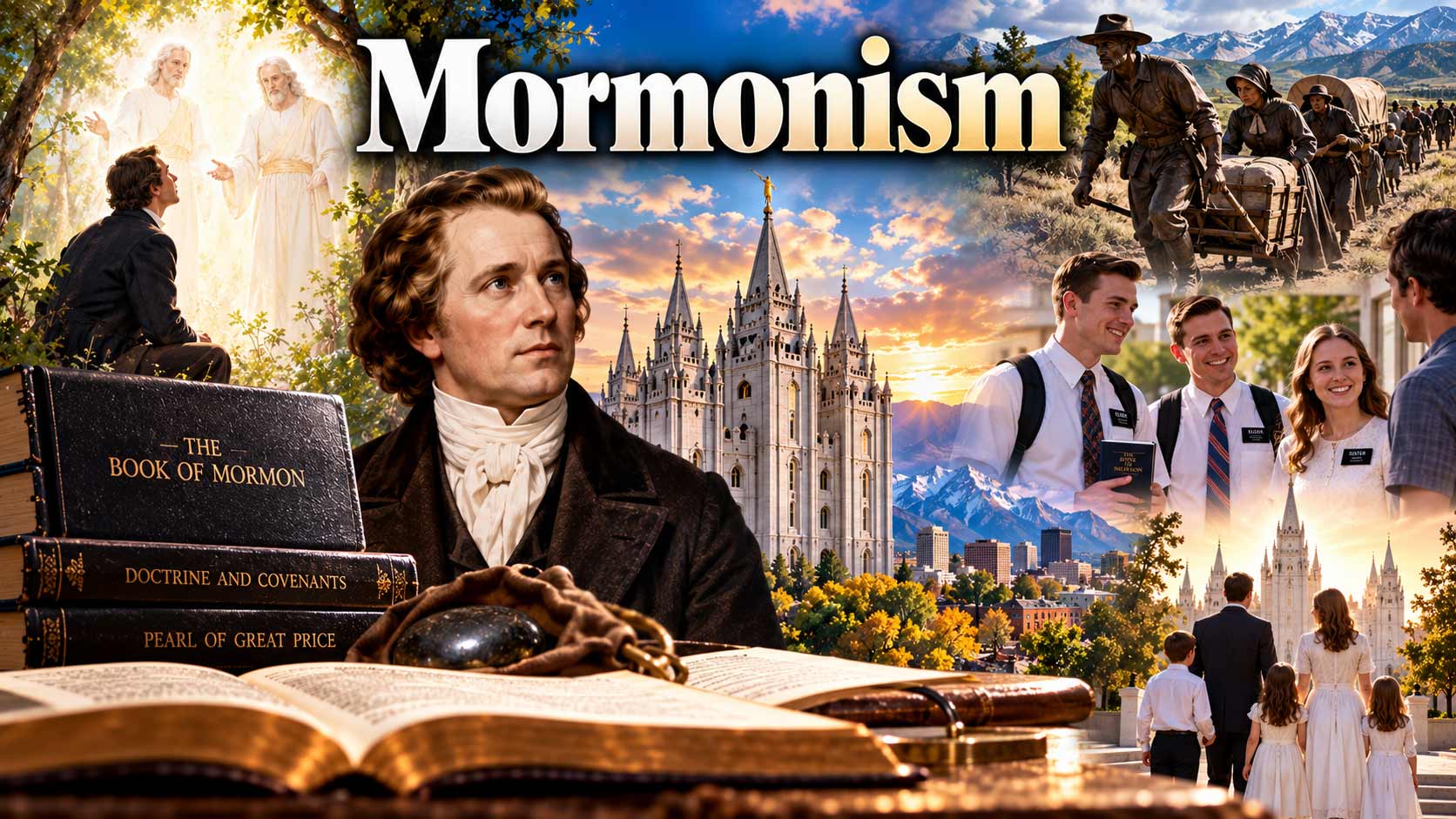
Few American religious movements have traveled farther from their beginnings than Mormonism. In less than two centuries, a movement that began with a young man claiming to have discovered an ancient record on gold plates became a worldwide religion with temples across the globe, a sophisticated institutional structure, enormous missionary activity, and millions of members. Its adherents prefer the name The Church of Jesus Christ of Latter-day Saints, and in recent years church leaders have strongly encouraged the use of the church’s full name rather than “Mormon Church.” The term Mormonism, however, remains useful when discussing the broader religious tradition that grew out of Joseph Smith’s teachings.
Latter-day Saints emphatically consider themselves Christians. They worship Jesus Christ as Savior, read the Bible, baptize converts, celebrate Christ’s resurrection, and place His name at the center of their church. Historic Catholic, Orthodox, and Protestant Christianity nevertheless rejects Latter-day Saint theology as orthodox Christianity because Mormon teachings concerning God, humanity, revelation, salvation, and the nature of Christ differ substantially from the historic creeds. Understanding Mormonism therefore requires more than asking whether Latter-day Saints “believe in Jesus.” They certainly do. The important question is what larger theological system gives that statement its meaning.
Joseph Smith and the First Vision
Joseph Smith was born in Vermont in 1805 and grew up in upstate New York during a period of extraordinary religious excitement. Revivalists, Baptists, Methodists, Presbyterians, restorationists, Adventist movements, folk religion, and various prophetic claims circulated through the region. Historians later called western New York the “Burned-over District” because revival fires had supposedly swept through it so frequently.
According to the account that eventually became official within Mormonism, the teenage Smith was confused by competing Christian denominations and turned to James 1:5: “If any of you lacks wisdom, let him ask of God.” Smith later said that while praying in a grove in 1820, he experienced a vision of God the Father and Jesus Christ. When Smith asked which church he should join, he was told that he should join none of them because existing churches had departed from the truth.
This event is known as the First Vision, and it eventually became foundational to the Latter-day Saint understanding of the Restoration. The problem, from the standpoint of historians, is that Smith left multiple accounts of the experience that differ in details, and the earliest surviving written account dates from years after the event. Latter-day Saints argue that different accounts emphasize different aspects of the same experience, much as a person may recount the same event differently for different audiences. Critics argue that the variations raise questions about how the story developed.
Whatever one concludes about the First Vision historically, its theological function is clear. Mormonism doesn’t claim merely that Joseph Smith discovered a better denomination. It claims that authentic apostolic authority and essential truths had been lost and that God initiated their restoration through Smith.
The Gold Plates and the Book of Mormon
Smith said another heavenly messenger appeared to him several years later. This figure, Moroni, told him of an ancient record written on gold plates and buried in a hill near his home. Smith eventually said he received the plates and translated their inscriptions by divine assistance.
The resulting work, the Book of Mormon, was published in 1830. It presents itself as a record of ancient peoples in the Americas and describes God’s dealings with them over many centuries. Its climactic event is an appearance of the resurrected Jesus Christ to people in the Americas following His resurrection in Jerusalem.
The book gave the emerging movement both its popular nickname and a new sacred history. Smith’s followers didn’t simply possess another devotional book about Christianity. They believed God had brought forth an additional witness to Jesus Christ and evidence that revelation hadn’t ended with the biblical apostles.
Questions about how Smith produced the text have remained central to arguments over Mormon origins. Early artistic depictions often showed Smith studying the gold plates while dictating a translation. Historical accounts also describe his use of seer stones, including placing a stone in a hat and looking into it while dictating portions of the text. The Church of Jesus Christ of Latter-day Saints now discusses this aspect of the translation process much more openly than was common in earlier generations.
Believers regard the production of the Book of Mormon as miraculous. Critics have proposed numerous alternative explanations involving Smith’s environment, biblical language, contemporary religious debates, and nineteenth-century ideas about the origins of Native Americans. The disagreement is ultimately unavoidable because Mormonism stakes an extraordinary amount on whether Joseph Smith was actually receiving revelation.
The Restoration of the Church
The Church of Christ was formally organized by Smith and his followers in 1830. The movement grew rapidly but also encountered intense opposition. Mormon communities developed in Ohio, Missouri, and Illinois, repeatedly coming into conflict with neighbors and government authorities.
Some of those conflicts arose from religious prejudice, but religion wasn’t the only factor. Latter-day Saints tended to gather geographically, vote in blocs, build their own institutions, and follow leaders who claimed divine revelation. Their rapid growth could dramatically alter the political balance of a community. Rumors, genuine grievances, theological hostility, economic competition, and fear reinforced one another until conflicts sometimes became violent.
Missouri proved especially disastrous. Tensions eventually produced armed conflict, and in 1838 Missouri governor Lilburn Boggs issued the infamous order declaring that Mormons should be “exterminated or driven from the State.” Latter-day Saints were expelled and eventually established a new center at Nauvoo, Illinois.
Nauvoo rapidly became a substantial city, with Smith exercising religious, political, and military influence. By this point Mormonism had developed considerably beyond the religion presented publicly at its beginning. Smith introduced temple ceremonies, teachings about eternal marriage, baptism for the dead, and doctrines concerning the nature and destiny of human beings that moved Latter-day Saint theology increasingly farther from traditional Christianity.
Joseph Smith and Plural Marriage
One of the most controversial developments was plural marriage. Joseph Smith secretly married multiple women while publicly associated with his first wife, Emma. His plural wives included both unmarried women and women who were already legally married to other men, and historical evidence concerning these relationships has produced extensive debate over their circumstances and sexual dimensions.
Smith and his followers understood plural marriage as a practice revealed by God and connected it with Old Testament patriarchs such as Abraham, Jacob, David, and Solomon. The revelation later published as Doctrine and Covenants 132 linked plural marriage with eternal covenant and exaltation.
Emma Smith struggled profoundly with the practice, and Joseph’s secrecy surrounding plural marriages contributed to conflicts within Nauvoo. When the Nauvoo Expositor, a newspaper established by Mormon dissidents, published accusations against Smith and church leadership, the Nauvoo city council declared the paper a nuisance and ordered its press destroyed. The destruction intensified already serious political tensions.
Smith was arrested and imprisoned at Carthage, Illinois. On June 27, 1844, an armed mob attacked the jail and killed Joseph Smith and his brother Hyrum. Smith was thirty-eight years old.
His death left the movement without an obvious universally accepted successor, and Mormonism fractured into competing groups. The largest eventually followed Brigham Young.
Brigham Young and the Journey West
Brigham Young led thousands of Latter-day Saints westward, eventually settling in the Great Salt Lake Valley beginning in 1847. The region was then outside effective United States control but soon became American territory following the Mexican-American War.
Under Young, Mormon settlements spread throughout what became Utah and surrounding areas. The isolation allowed the church to build a distinctive religious society with unusual cohesion. Plural marriage became publicly acknowledged and was practiced by a minority of Latter-day Saint families, including many prominent leaders.
The practice produced decades of conflict with the United States government. Federal legislation increasingly targeted polygamy and church property, while Latter-day Saints defended plural marriage as a religious obligation. The confrontation became serious enough to threaten the institutional survival of the church.
In 1890 church president Wilford Woodruff issued what became known as the Manifesto, announcing an end to church-sanctioned plural marriages. The transition wasn’t instantaneous, and some plural marriages continued for a period afterward, but the mainstream church eventually enforced monogamy. Groups that rejected the change separated from the church and continued plural marriage.
This distinction remains important today. The Church of Jesus Christ of Latter-day Saints does not practice polygamy and excommunicates members who enter plural marriages. Modern polygamous groups commonly called “Mormon fundamentalists” aren’t part of the mainstream LDS Church, even though they trace their beliefs to earlier Mormon teachings.
Scripture Beyond the Bible
Latter-day Saints accept the Bible as the word of God “as far as it is translated correctly,” but they don’t believe the Bible is God’s only scripture. Their standard works also include the Book of Mormon, Doctrine and Covenants, and Pearl of Great Price.
The Book of Mormon is presented as another testament of Jesus Christ. Doctrine and Covenants contains revelations and instructions associated particularly with Joseph Smith and later church history. The Pearl of Great Price contains several shorter works, including the books of Moses and Abraham, Joseph Smith’s account of his history, and his revision of Matthew 24.
The Book of Abraham has generated particularly serious historical controversy. Smith said the text came from Egyptian papyri he acquired in the 1830s. After Egyptian hieroglyphics became decipherable and surviving portions of the papyri could be examined by Egyptologists, critics argued that the Egyptian material consisted of ordinary funerary texts and didn’t correspond to Smith’s Book of Abraham translation.
Latter-day Saint responses have varied. Some have proposed that the surviving papyri aren’t the portions from which Smith produced the Book of Abraham. Others understand the papyri as a catalyst through which Smith received revelation rather than requiring a conventional linguistic translation. The controversy matters because it brings the larger question of Smith’s prophetic claims into unusually concrete historical territory.
God Was Once as We Are?
Perhaps the greatest theological difference between Mormonism and historic Christianity concerns the nature of God. Joseph Smith’s theology developed considerably during his lifetime, and his later teachings presented a dramatically different understanding of God and humanity from Nicene Christianity.
In his famous King Follett discourse of 1844, Smith taught that God was once as human beings are and that human beings must learn how to become gods. This concept developed into the Latter-day Saint doctrine of exaltation. Human beings are literally spirit children of heavenly parents and possess the potential, through Christ and God’s plan, to become like their Heavenly Father.
Latter-day Saints strongly object when this belief is caricatured as everyone receiving a private planet and becoming a science-fiction deity. Their actual doctrine is expressed through ideas of eternal families, divine parentage, covenant, resurrection, and participation in God’s divine life. Nevertheless, the difference from historic Christianity remains substantial.
Catholic, Orthodox, and Protestant Christianity all teach in different ways that redeemed human beings can share in God’s life and become like Christ. Eastern Orthodoxy even uses the strong language of theosis, or participation in the divine nature. But historic Christianity maintains an absolute distinction between the uncreated God and created beings. Human beings can be glorified; they don’t become Gods in the same ontological sense that God eternally is God.
Mormon theology operates with a different understanding of that boundary.
The Father, Son, and Holy Ghost
Latter-day Saints believe in the Father, Son, and Holy Ghost, but they reject the traditional doctrine of the Trinity. The Father and Son are distinct embodied persons, while the Holy Ghost is a person of spirit. Together they constitute the Godhead and are perfectly united in purpose.
This allows Latter-day Saints to affirm strongly that Jesus is divine while still differing substantially from Nicene Christianity. Historic Trinitarianism teaches that Father, Son, and Holy Spirit are three distinct persons sharing one divine being. Mormon theology understands their unity differently.
Jesus occupies the central role in the Latter-day Saint plan of salvation. He is Jehovah of the Old Testament, the premortal Son of God who became incarnate as Jesus of Nazareth. His suffering, death, and resurrection make salvation and resurrection possible for humanity.
Mormon Christology therefore shouldn’t be described as though Latter-day Saints regard Jesus as merely another prophet. They don’t. The disagreement concerns the larger doctrine of God within which Jesus is understood.
Premortal Life and the Plan of Salvation
Latter-day Saint theology teaches that human beings existed before birth as spirit children of heavenly parents. Earthly life is one stage within a much larger eternal existence. God presented a plan through which His children could receive physical bodies, experience mortality, exercise moral agency, and eventually become more like Him.
Jesus accepted the Father’s plan. Lucifer rebelled and sought to destroy human agency, becoming Satan. Those who followed Satan were cast out, while the rest entered mortality.
This doctrine gives earthly life a distinctive meaning. People aren’t beings who begin to exist at conception or birth; they have a premortal identity and divine parentage. Marriage, family, moral choice, temple ordinances, and eternal destiny all fit within this larger story.
That story can sound superficially similar to Christian themes because it contains God, Jesus, Satan, creation, sin, salvation, resurrection, and eternal life. But once those concepts are placed within premortal existence, divine parentage, exaltation, and multiple degrees of glory, Mormonism becomes recognizably its own theological system.
Salvation and Exaltation
Mormon theology distinguishes several aspects of salvation that Christians sometimes collapse into one word. Because of Christ’s resurrection, virtually all humanity will ultimately be resurrected. Eternal destiny then involves different degrees of glory.
Latter-day Saint teaching traditionally describes three principal kingdoms: celestial, terrestrial, and telestial. The celestial kingdom represents the highest degree of glory and the presence of Heavenly Father. Exaltation within the highest celestial glory is associated with covenant faithfulness and eternal family relationships.
This means Mormonism doesn’t teach the simple popular picture in which everyone outside the LDS Church automatically goes to hell. Its afterlife is actually far more expansive than that. Most people receive some degree of glory, while the gravest final condemnation is reserved for a much narrower category.
Faith in Jesus Christ, repentance, baptism by proper authority, reception of the Holy Ghost, covenant faithfulness, and enduring to the end form part of the Latter-day Saint path. Temple ordinances also become important in the fullest understanding of exaltation.
Historic Protestants particularly object that this system compromises justification by grace through faith. Latter-day Saints respond that salvation is possible only because of Christ’s grace and that obedience and ordinances are the covenant response to that grace. As with many theological disputes, simply saying one side believes in “works” and the other believes in “grace” doesn’t adequately describe what either side thinks it is saying.
Temples and Eternal Families
Latter-day Saint temples aren’t ordinary Sunday meetinghouses. Regular worship services occur in local chapels, while temples are reserved for sacred ordinances associated with the church’s understanding of salvation and eternal family relationships.
Among the most important temple practices is sealing, through which marriages and family relationships can be bound for eternity. The familiar Mormon emphasis on family therefore isn’t merely a cultural preference for large families and clean-cut family photographs. It grows directly from the movement’s theology of eternal relationships.
Temples also perform ordinances on behalf of the dead. The best-known is baptism for the dead, based partly on Paul’s reference in 1 Corinthians 15:29. Latter-day Saints believe deceased people retain the freedom to accept or reject these ordinances in the spirit world; performing a baptism on someone’s behalf isn’t understood as automatically converting the dead person.
This practice explains the church’s enormous historical interest in genealogy. Identifying ancestors isn’t merely a hobby. Family history makes it possible to perform temple ordinances on behalf of previous generations.
Prophets and Continuing Revelation
The Church of Jesus Christ of Latter-day Saints is led by a president who is regarded as a prophet, seer, and revelator. Apostles also serve in the church’s highest governing bodies. This structure reflects the Mormon conviction that Christ restored not merely correct doctrine but apostolic authority.
Continuing revelation is therefore built into the system. Latter-day Saints don’t believe God spoke through prophets in biblical times and then permanently stopped speaking to His Church. Modern prophets can provide direction appropriate to changing circumstances.
That principle has allowed significant changes in church practice. The end of plural marriage is one obvious example. Another occurred in 1978, when church president Spencer W. Kimball announced a revelation extending priesthood ordination to worthy male members regardless of race. Before that change, Black men of African descent had generally been excluded from priesthood ordination, and Black members were restricted from certain temple ordinances.
The church now disavows earlier theories offered to justify the racial restrictions. The history nevertheless raises the same question that continuing revelation raises in other religious movements: how should believers distinguish genuine divine development from institutional correction of earlier mistakes? Latter-day Saints answer that question through faith in continuing prophetic leadership. Critics see the revisions as evidence against the reliability of that leadership.
Missionaries
Few things identify Mormonism more readily than its missionaries. Young men in white shirts and ties, often accompanied by name badges reading “Elder,” became one of the most recognizable religious sights in the world. Women also serve missions, as do older married couples and other members in various capacities.
Missionary service combines evangelism with intense religious formation. Missionaries spend an extended period living under structured rules, studying scripture, teaching potential converts, serving communities, and representing the church. Many learn foreign languages and live outside their home countries.
The result has been one of the most extensive missionary systems created by a modern religious movement. Like Jehovah’s Witnesses, Latter-day Saints have made evangelism something ordinary members actually do rather than something everyone agrees is important while quietly hoping someone else handles it.
Mormonism Today
Modern Latter-day Saint life looks considerably less exotic than nineteenth-century Mormon history might suggest. Members attend Sunday services, study Scripture, raise families, participate in congregational activities, serve in unpaid local callings, and generally live within ordinary communities rather than isolated religious settlements.
The church strongly emphasizes personal morality. Members are expected to avoid premarital and extramarital sexual relationships, pornography, tobacco, alcohol, coffee, tea, and illegal drugs. The dietary restrictions derive from the Word of Wisdom, a revelation given through Joseph Smith that eventually became an important standard of Latter-day Saint practice.
Tithing is also strongly emphasized, particularly for members seeking full participation in temple worship. Local congregations are led largely by lay members rather than a professional parish clergy. Bishops ordinarily serve while maintaining their regular occupations, which gives local Mormon congregations a substantial culture of volunteer service.
At the same time, the church has increasingly tried to clarify misconceptions about itself. Leaders emphasize the name of Jesus Christ, discourage careless use of “Mormon” as a substitute for the church’s name, and present the movement explicitly as Christian. That has sometimes created an odd public situation in which evangelical Christians say, “Mormons aren’t Christians,” while Latter-day Saints reply, quite reasonably from their own perspective, “Jesus Christ is literally in the name of our church.”
The disagreement can’t be settled by the sign outside the building.
Is Mormonism Christian?
As with Jehovah’s Witnesses, the answer depends upon what the question means. If Christian means a person who identifies as a follower of Jesus Christ, Latter-day Saints unquestionably understand themselves that way. Describing them as though Jesus were incidental to their religion would be inaccurate.
If Christian refers to the theological tradition defined by the historic Christian creeds, Mormonism falls outside those boundaries. Its additional scriptures, continuing prophets, doctrine of God, premortal existence, understanding of the Godhead, exaltation, temple ordinances, and restoration of priesthood authority form a religious system significantly different from Catholicism, Orthodoxy, and Protestantism.
That is why Jew & Greek places Mormonism under Christian Cults rather than treating it as another Protestant denomination. The classification isn’t intended as an insult to Latter-day Saints. It describes a movement that arose from a Christian environment, claims to restore authentic Christianity, uses Christian Scripture and language extensively, yet reconstructs central Christian doctrines in ways historic Christianity doesn’t recognize as orthodox.
The most productive Christian response is therefore neither mockery nor pretending the differences don’t matter. Latter-day Saints tend to be serious about their religion, strongly committed to family and community, willing to devote remarkable amounts of time to their church, and often much better acquainted with their own religious system than outsiders assume. If Christians believe Mormonism gives the wrong answers about God and Christ, we should at least understand the questions well enough to explain why.
Joseph Smith’s original claim wasn’t that Christianity needed another denomination. It was that Christianity needed to be restored. Nearly two centuries later, that remains the central issue separating Latter-day Saints from historic Christianity: whether Joseph Smith recovered an apostolic faith that had been lost, or created a new religious system using Christianity as its starting point.