

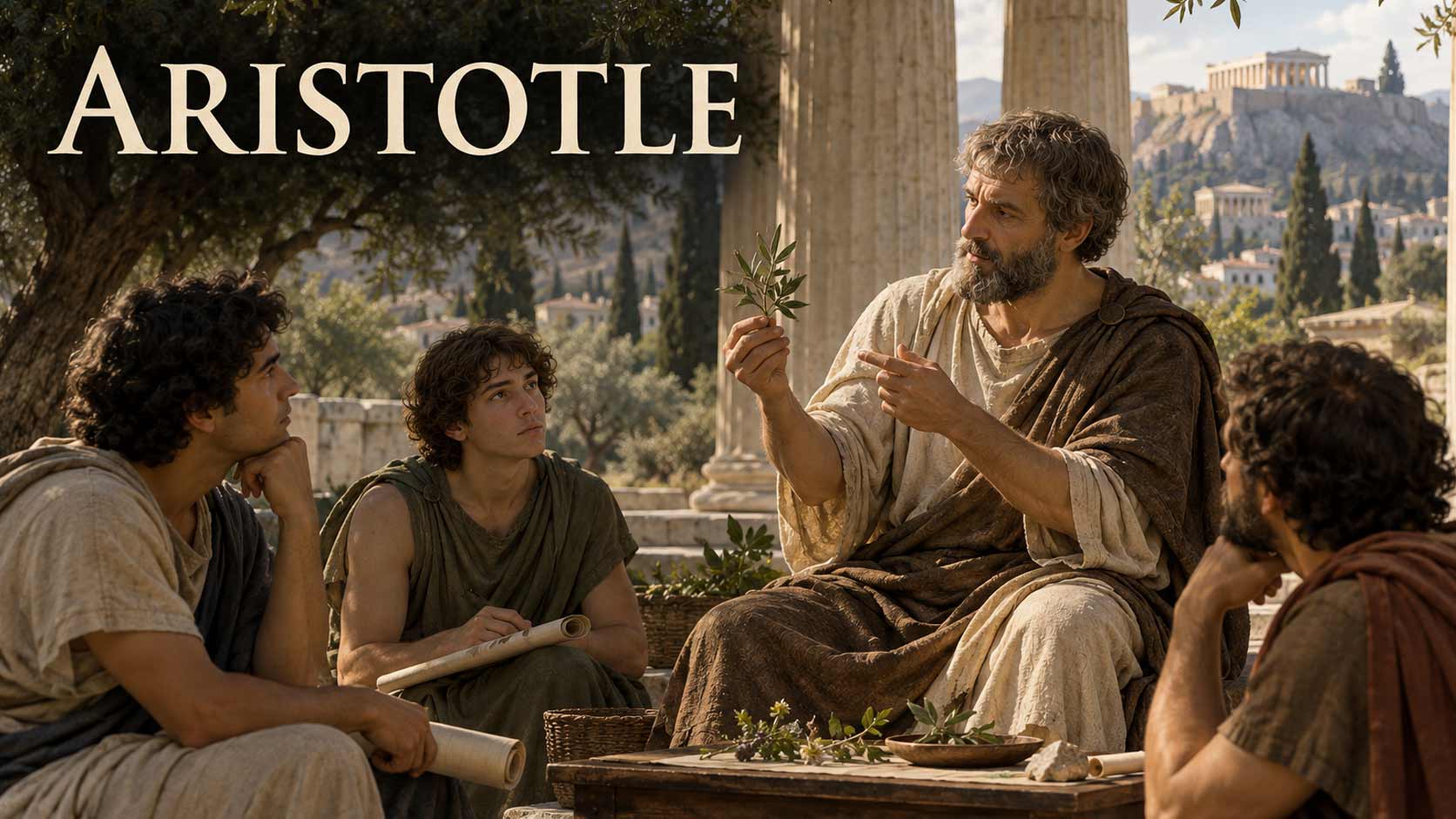
Plato’s most famous student didn’t spend his career repeating what his teacher had said. Aristotle took the questions he’d inherited and developed answers that often challenged Plato’s conclusions. He wanted to know what things are, how they change, what makes an argument work, and what kind of life a human being ought to live. That’s a fairly ambitious job description, especially for somebody who also found time to study animals.
For Christians, Aristotle matters partly because his ideas became so influential in later theology. Discussions about God, human nature, morality, and the relationship between faith and reason often carry traces of his thinking. We don’t have to agree with him to benefit from understanding him, but we should know what he actually said before either embracing or dismissing his influence.
From Plato’s Academy to the Lyceum
Aristotle was born in Stagira in 384 BC and went to Athens at about seventeen to study at Plato’s Academy. He remained associated with the school for roughly twenty years, until Plato died in 347 BC. After leaving Athens, he continued his philosophical work and research into living things. He later became a tutor to the young Alexander, who would become Alexander the Great, although we shouldn’t pretend that we know exactly how much of Alexander’s thinking came from his teacher.
In 335 BC, Aristotle returned to Athens and established his own school, the Lyceum. Its interests included logic, biology, politics, ethics, and the study of nature. After Alexander’s death in 323 BC, hostility toward Macedonia made Athens dangerous for somebody with Aristotle’s connections, and he left the city. He died the following year, leaving a body of thought that would remain influential long after the political world around him had changed.
How He Differed from Plato
One of the major disagreements concerned Plato’s theory of Forms. In that account, the particular things we encounter are understood in relation to intelligible realities such as Beauty or Justice, which aren’t simply identical with the objects around us. Aristotle questioned whether placing Forms apart from particular things actually explained those things. If we want to understand a living horse, identifying a separate Form of Horse still leaves us needing to explain this animal’s nature, its development, and its activities.
Aristotle’s alternative made the relationship between matter and form central to understanding ordinary substances. Matter is what something is made of, while form is what makes it the particular kind of thing it is. Form here means more than outward shape. A living organism’s organization and capacities are essential to what it is, which is why a living horse and a collection of its physical ingredients aren’t interchangeable. This approach encouraged attention to actual things without abandoning questions about their nature and meaning.
That doesn’t make Aristotle a modern materialist who believed that everything could be reduced to particles. In On the Soul, he described the soul as the form of a living body, the principle by which it lives and performs its characteristic activities. Plants, animals, and human beings possess different capacities, and his use of “soul” is therefore broader than the way Christians commonly use the word. His account ties life closely to the organized body, while raising further questions about intellect that later philosophers would debate.
Learning to Reason
Aristotle didn’t invent the practice of reasoning, but he developed a systematic study of how conclusions follow from premises. His work on syllogisms examined arguments in which certain statements, if accepted, require a further conclusion. A familiar example is that all human beings are mortal, Socrates is a human being, and therefore Socrates is mortal. The conclusion follows because of the relationship between the statements, rather than because the speaker sounds confident.
Of course, an argument can have a valid structure while beginning with a false premise. If somebody claims that all Christians are dishonest and then concludes that a particular Christian is dishonest, the structure doesn’t rescue the opening accusation. We still have to ask whether the premises are true. This distinction is useful in apologetics, political arguments, and ordinary conversation, where confidence can easily be mistaken for evidence. Aristotle’s contribution helps us slow down and examine what an argument actually establishes.
Causes and Change
When Aristotle asked why something exists or happens, he thought a complete answer could involve four kinds of cause. Consider a wooden chair. Its material cause is the wood, its formal cause is the arrangement that makes it a chair, its efficient cause is the source of its production, and its final cause is the purpose for which it was made. The carpenter’s work and the chair’s usefulness answer different questions, even though both help explain the same object.
The final cause is especially important because Aristotle also understood nature in terms of ends and characteristic activities. An eye is understood partly through its capacity for sight, just as the development of a living thing can be understood through the mature life toward which it grows. This doesn’t mean that every natural process involves somebody consciously making a plan. It means that, for Aristotle, understanding how a thing functions belongs alongside understanding its materials and the processes that produced it.
He also distinguished between potentiality and actuality. An acorn has the potential to become an oak, while a mature oak has realized capacities that the acorn hasn’t yet developed. Potentiality isn’t just anything we can imagine; it concerns what a thing is actually capable of becoming under appropriate conditions. An acorn doesn’t have the same potential as a lump of iron. This distinction allowed Aristotle to describe change as the realization of capacities rather than as something appearing from absolute nothingness.
What Makes a Good Life
In the Nicomachean Ethics, Aristotle asked what human beings are ultimately trying to achieve. His answer was eudaimonia, a word often translated as happiness but better understood here as flourishing or living well. He wasn’t describing the pleasant feeling that comes from getting what we want this afternoon. He was concerned with a whole life in which our distinctively human capacities, especially reason, are exercised well. Pleasure, wealth, and recognition may have their place, but none of them alone supplies an adequate account of a good human life.
That leads to his emphasis on virtue, the qualities of character that enable us to live well. In Aristotle’s account, moral character develops through repeated action: we learn to act justly by doing just things and learn self-control by practicing it. Knowing the right definition doesn’t automatically make us the right kind of person. For Christians, there’s an obvious point of contact with the importance of practice and obedience, although Aristotle’s account isn’t a doctrine of salvation or a substitute for the work of God’s grace.
His famous account of the mean also needs some explanation. Courage lies between cowardice and recklessness, but that doesn’t mean the correct response is always a mathematical halfway point. The appropriate response depends on the circumstances and requires sound judgment. Aristotle also recognized that some actions, including theft and adultery, are wrong in themselves rather than acceptable in moderate amounts. He wasn’t recommending that we commit just enough adultery to avoid becoming extreme.
The Unmoved Mover
Aristotle’s thinking about change eventually brought him to the question of its ultimate explanation. In his account of an eternal cosmos, he argued for a highest unmoved mover, something that accounts for motion without itself undergoing change. This first principle is eternally actual rather than waiting to realize some unrealized capacity. He described its life in terms of perfect intellectual activity, with thought directed toward itself. Its perfection moves other things as an object of desire or thought can move them.
This is an important part of the history of arguments for God, but we shouldn’t simply substitute “the God of the Bible” whenever Aristotle discusses the first mover. His explanation assumes eternal cosmic motion and isn’t the biblical account of a freely created universe. Nor does the argument establish the incarnation, redemption, or God’s covenant dealings with humanity. From a Christian standpoint, it opens questions about ultimate reality while leaving much of what we mean by God unaddressed.
Aristotle and Christian Theology
Aristotle’s later influence reached Christian thinkers through a complicated history of study and translation. Greek texts entered the Latin world directly, while Arabic translations and the work of philosophers such as Avicenna and Averroes also helped shape medieval discussion. Jewish scholars participated in parts of that translation work as well. This was a conversation across languages and religious traditions, involving interpretation and disagreement as well as the preservation of texts.
Thomas Aquinas became one of the most influential Christian thinkers to work extensively with Aristotle’s ideas. Aristotle’s accounts of causation, change, knowledge, and human nature supplied tools that Aquinas used within a Christian theological framework. That didn’t mean accepting Aristotle’s conclusions wholesale. Aquinas affirmed creation from nothing and distinguished what reason could establish from truths, such as the Trinity and incarnation, that required revelation. A useful philosophical argument and a complete Christian theology weren’t the same thing.
Reading Him Critically
Aristotle’s achievements don’t make every part of his thinking defensible. In the Politics, he argued that some people were naturally suited to slavery and defended a hierarchy in which women were subordinate to men. These weren’t merely unfortunate remarks unrelated to his system; he tried to justify them through his understanding of nature and human capacities. We should recognize that historical setting without using it to avoid evaluating the arguments. A gifted thinker can reason carefully in some areas while treating the assumptions of his own society as though they were settled facts.
That’s one reason to read Aristotle with both appreciation and judgment. The Nicomachean Ethics provides an entry into his account of character and the good life, while the Politics, Physics, and Metaphysics take us into other parts of his thought. Christians can learn from his questions and methods while testing his conclusions against Scripture and sound reasoning. If we’re going to borrow an idea from Aristotle, we ought to understand what we’ve borrowed and whether it belongs in the argument we’re making.