

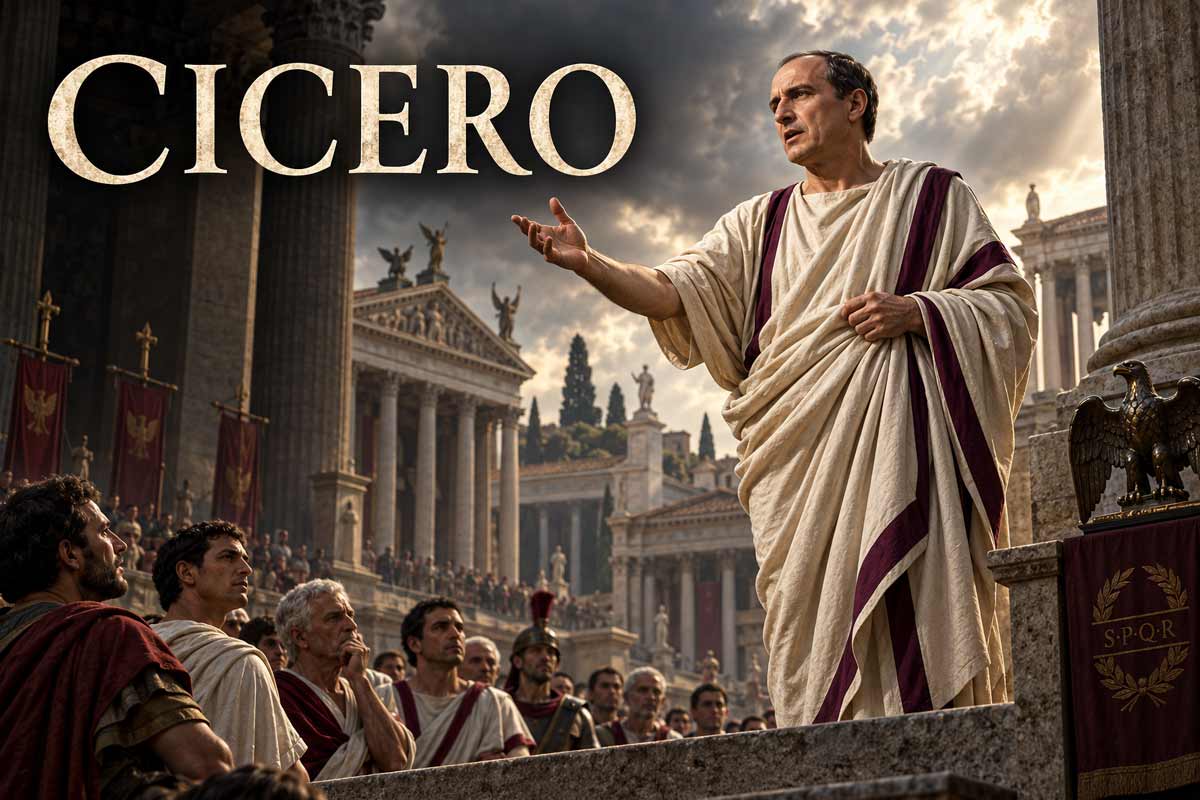
Cicero spent much of his life defending a republic that was coming apart around him. He believed that public life should be governed by justice, duty, and reason, while living among men who increasingly preferred armies and personal power. That gave his philosophy a practical urgency. It also left him facing a question that still confronts people who enter politics with principles: what happens to those principles when preserving them seems to require compromising them?
Marcus Tullius Cicero was a lawyer, orator, statesman, and philosopher. His speeches made him famous in Rome, but his philosophical writings helped carry Greek debates into the Latin-speaking world. He wasn’t simply a messenger delivering somebody else’s ideas. He examined competing arguments, adapted them to Roman concerns, and asked what they meant for the way people actually lived. For Christian readers, his importance includes his thinking about moral obligation and the influence his writings later had on Augustine.
A Career in a Collapsing Republic
Cicero was born in 106 BC and rose to the consulship, Rome’s highest regular political office, in 63 BC. He didn’t come from one of the families that had long dominated that office, and his ability as a lawyer and public speaker helped him advance. During his consulship, he exposed Catiline’s conspiracy against the state. He also arranged the execution of five conspirators without a trial, a decision that became a serious point of controversy and later helped drive him into exile.
The Republic’s troubles involved far more than that one conspiracy. Competition among powerful leaders, military loyalties, and political violence steadily weakened the institutions Cicero wanted to preserve. After Julius Caesar’s assassination in 44 BC, Cicero opposed Mark Antony in speeches known as the Philippics. When Antony, Octavian, and Lepidus formed their alliance, Cicero was placed among the men marked for death. He was killed in 43 BC, and the Republic he had defended didn’t recover.
Calling Cicero a defender of the Republic shouldn’t turn him into a flawless champion of liberty. The executions under his consulship raise an uncomfortable question about his willingness to bypass protections when he believed the state was threatened. His opposition to personal domination also existed within an aristocratic political order that didn’t grant equal participation to everybody. We can recognize his courage and achievements while examining the boundaries of the freedom he defended. Admiration becomes less useful when it requires us to stop asking questions.
Philosophy Without Blind Allegiance
Cicero’s philosophical method was closely associated with Academic skepticism, the tradition that developed within Plato’s Academy. That doesn’t mean he thought every opinion was equally good or that truth didn’t matter. He was suspicious of claims to certainty and interested in comparing the strongest arguments on competing sides. Where certainty wasn’t available, a well-supported and plausible judgment could still guide action. Doubt was supposed to encourage investigation rather than become an excuse for never deciding anything.
This helps explain the dialogue form of many of his works. Instead of simply announcing a conclusion, Cicero allowed representatives of different schools to present their cases and answer objections. He drew extensively on Stoic thought without accepting every Stoic claim, and his willingness to criticize a position didn’t prevent him from learning from it. His allegiance was to examination rather than to defending a system at any cost. That freedom is worth appreciating, especially when loyalty to a group starts replacing the work of thinking.
Christians will approach certainty and revelation differently from Cicero, but we can still learn from the discipline of hearing an argument before answering it. If we can only refute a weak version of somebody’s position, we haven’t accomplished very much. We should also be willing to correct our understanding when the evidence requires it. That doesn’t mean changing convictions whenever a new speaker sounds persuasive. It means caring enough about truth to distinguish a settled conviction from an assumption we’ve never seriously examined.
Law Above the Lawmakers
One of Cicero’s most important contributions concerns natural law. In his discussions of law and political community, justice isn’t simply whatever a ruler commands or a population approves. There is a moral order grounded in nature and accessible through reason, and human legislation must be judged in relation to it. A law’s legal standing therefore doesn’t settle whether it is just. The people who make laws are themselves accountable to a standard they didn’t create.
The force of that idea becomes clearer when we consider an unjust government. If morality were nothing more than the rules a society happened to establish, that society could make cruelty right by approving it. Cicero’s account provides a basis for saying that an action can remain wrong even when officials authorize it. This doesn’t eliminate disagreements about what justice requires. It does insist that power, custom, and majority preference can’t by themselves answer the question.
Christian readers can see a point of contact with the conviction that human authority is accountable to God. Romans 2 also discusses Gentiles who show the work of the law written on their hearts, with conscience bearing witness. That passage belongs within Paul’s argument about sin and judgment, rather than serving as a blanket endorsement of Cicero’s philosophy. Still, both discussions raise the question of moral awareness beyond a society’s written statutes. We should notice the connection without pretending that the theological explanations are identical.
Duty and Apparent Advantage
In On Duties, written for his son Marcus, Cicero explored the relationship between honorable conduct and practical benefit. He drew heavily on Stoic ethics while working through problems involving justice, generosity, promises, and public responsibility. A central concern is the apparent conflict between doing what is right and doing what seems advantageous. Cicero’s answer is that genuinely wrongful conduct cannot become truly beneficial just because it produces a desirable result. The appearance of advantage needs to be tested against moral obligation.
That question is easy to understand without becoming an expert in Roman philosophy. A dishonest transaction may produce a profit, and a misleading accusation may help a politician win an election. Neither result establishes that the action was good for the person who performed it or for the community affected by it. Cicero wanted people to consider what apparent success cost them in justice and character. We frequently ask whether a strategy will work when the earlier question should be whether it ought to be used.
The Christian application needs more than a general preference for respectable behavior. Our calling includes truthfulness, love of neighbor, and faithfulness to God when obedience is inconvenient. We shouldn’t excuse wrongdoing simply because we think it will advance a worthy cause. The cause doesn’t remove the moral character of the means we choose. Cicero’s discussion is useful here because it forces us to examine the claim that an immediate gain can justify the conduct that produced it.
Friendship and Growing Older
Cicero also addressed concerns closer to home. In On Friendship, he explored a relationship grounded in character and mutual goodwill rather than simply usefulness. Friendship carried responsibilities, but loyalty wasn’t permission to participate in wrongdoing. A friend should neither demand an unjust action nor treat refusal as betrayal. That makes friendship a relationship in which moral judgment remains active, rather than an agreement to defend each other regardless of what either person does.
In On Old Age, Cicero used the figure of Cato the Elder to consider the supposed burdens of growing older. Reduced physical strength, changes in activity and pleasure, and the approach of death become subjects for reflection rather than reasons to assume that useful life has ended. Judgment, experience, and worthwhile interests can remain valuable when youthful capacities decline. The dialogue doesn’t provide a guarantee that aging will be easy. It challenges the habit of measuring a person’s worth entirely by what younger bodies can do.
Both discussions are useful because they place philosophy inside ordinary human relationships and stages of life. Christians have additional reasons to value faithful friendship and honor older people, but we can appreciate questions that help us examine our conduct. Loyalty should make room for correction, and aging should make room for forms of service that differ from those of youth. A community that recognizes only visible strength or immediate usefulness will overlook much of what makes people valuable.
What He Said About the Gods
Cicero’s religious writings also reflect his willingness to examine rival explanations. On the Nature of the Gods presents arguments associated with Epicureanism, Stoicism, and Academic skepticism. The discussion considers divine existence, the character of the gods, providence, and the relationship between religion and the order of the world. Its speakers don’t all represent Cicero’s personal conclusions, and their arguments shouldn’t be lifted out of the dialogue as though they were straightforward statements of his creed.
That distinction is important for readers looking for ancient arguments that resemble later apologetics. A defense of providence may appear alongside a serious critique of that defense, and respect for inherited religious practice may coexist with questions about its philosophical justification. Cicero preserves the dispute instead of flattening it into a simple formula. Christians can learn from those arguments while remembering that a conversation about the gods of ancient philosophy isn’t a confession of Christian faith. Similar questions can arise within quite different understandings of reality.
Cicero and Augustine
Cicero’s connection with Christianity becomes especially clear in Augustine’s account of his own intellectual development. In the Confessions, Augustine described reading Cicero’s Hortensius, an encouragement to pursue philosophy, when he was about nineteen. The book stirred a desire for wisdom and redirected his ambitions beyond the enjoyment of impressive language. Augustine also remembered a limitation: he didn’t find the name of Christ in it. The book awakened a search without providing the Christian answer to that search.
That is a useful way to understand what a philosopher can and cannot contribute. An argument may expose a shallow ambition, challenge an inconsistency, or make us take moral questions seriously. It doesn’t follow that it supplies everything necessary for reconciliation with God. Christianity includes claims about Christ, sin, redemption, and grace that aren’t established by an appreciation for philosophy. Augustine’s experience allows us to recognize a real intellectual benefit without confusing that benefit with the gospel.
Reading Cicero
On Duties offers an introduction to Cicero’s moral concerns, while On Friendship and On Old Age bring his reasoning into familiar human situations. On the Republic, On the Laws, and On the Nature of the Gods open other parts of the conversation. His dialogue method requires us to pay attention to who is speaking and what objections follow. That extra care is worthwhile because it helps us distinguish the presentation of an argument from its endorsement.
Cicero’s life also keeps the reading from becoming too comfortable. He could speak eloquently about justice while making choices that leave us questioning how consistently he applied it. That tension doesn’t make moral reasoning pointless; it makes the need to examine ourselves more obvious. We can admire his defense of duty without assuming that admiration settles every judgment about his politics. His writings leave us with a question that belongs as much to our lives as to his: whether the principles we defend in public also govern the choices we make when something important is at stake.