

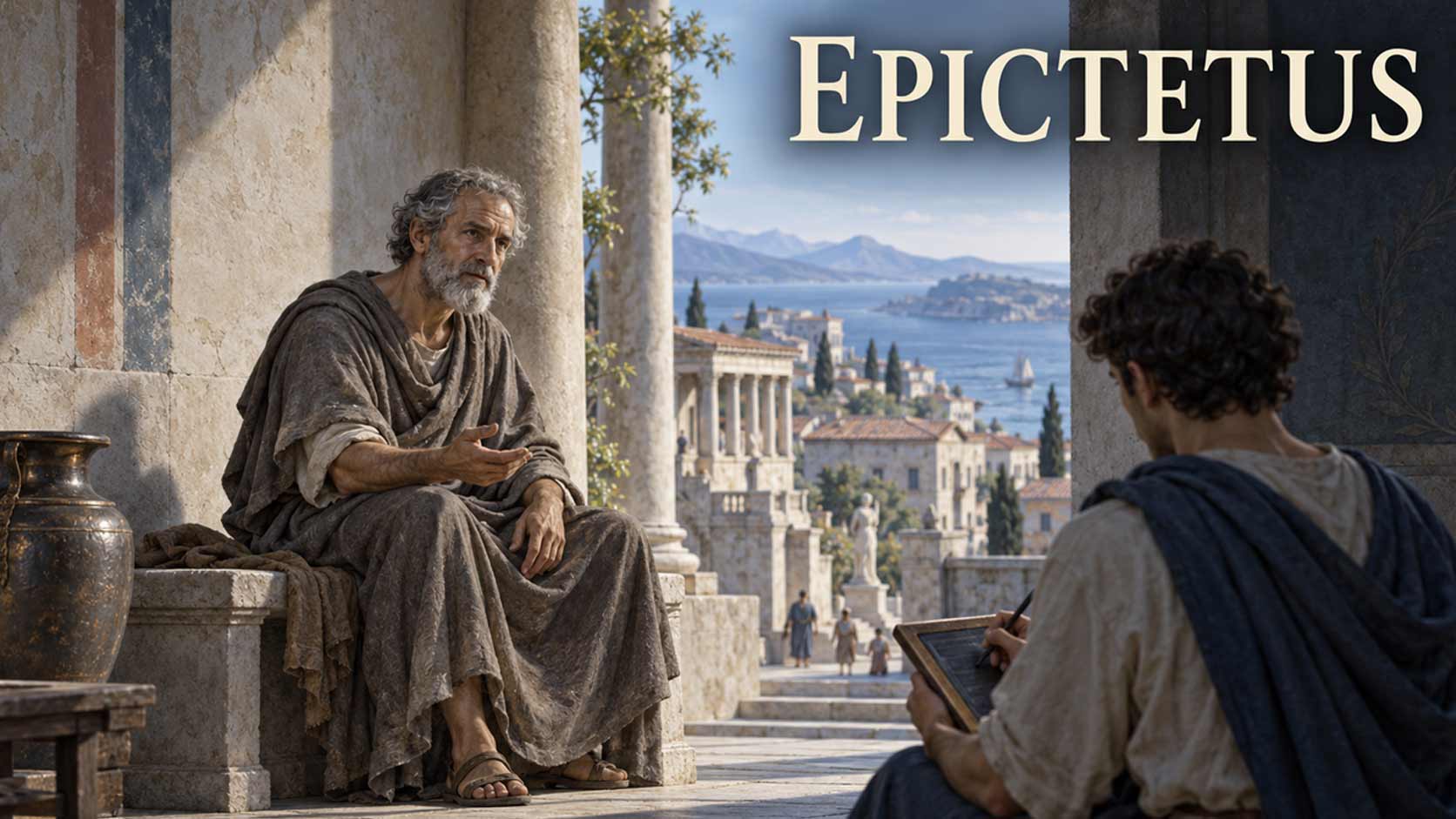
It’s easy to tell people that their circumstances don’t have to control them when your own circumstances are comfortable. Epictetus had spent part of his life enslaved, which gives his teaching on freedom a different kind of weight. He wasn’t offering advice from a position where everybody else’s problems were safely theoretical. His central concern was how a person could live with integrity in a world that could take away possessions, status, security, and even physical freedom.
That question helps explain why Christians may find him both helpful and challenging. There are points of contact with biblical teaching about self-control, contentment, and refusing to let fear govern our lives. There are also differences that shouldn’t disappear just because a quotation sounds like something we might hear in a sermon. Epictetus was a Stoic philosopher, and understanding that setting is essential to understanding his answers.
From Slavery to Teaching
Epictetus was born around AD 50 in Hierapolis, in what is now Turkey. He was enslaved in Rome in the household of Epaphroditus, who had served in Nero’s court, and studied under the Stoic teacher Musonius Rufus. He eventually gained his freedom and began teaching. When the emperor Domitian’s expulsion of philosophers forced him to leave Rome, he established a school at Nicopolis in northwestern Greece, where he taught until his death around AD 135.
His teaching survives chiefly through his student Arrian. The Discourses preserve discussions and instruction, while the Enchiridion, usually translated as the Handbook or Manual, provides a shorter collection of practical guidance. Four books of the Discourses survive from a larger ancient collection. We should therefore remember that we’re reading teaching preserved and arranged by a student, rather than assuming that Epictetus sat down and wrote these books in their present form.
What Is Actually Up to Us
The Enchiridion begins by distinguishing what is up to us from what isn’t. Our judgments, choices, desires, and responses belong on one side, while possessions, reputation, bodily circumstances, and public office belong on the other. The point isn’t that our actions have no effect on the world. We can work, prepare, seek medical care, and act responsibly, but we can’t guarantee the outcome. Confusing influence with complete control leaves us demanding something life can’t deliver.
Consider somebody who prepares carefully for an important interview. Preparation is their responsibility, but the employer’s final decision isn’t theirs to command. They can speak honestly and present their qualifications well, but they can’t force somebody else to approve of them. Epictetus would have them place their moral attention on the choices they make, instead of treating another person’s decision as the final verdict on their worth. That doesn’t eliminate disappointment, but it gives disappointment a boundary.
This principle also needs careful handling. We shouldn’t use it to tell somebody that abuse, illness, or injustice is merely an attitude problem, or that distress proves a failure of character. Human beings have vulnerabilities, and helping somebody may require protection, treatment, material assistance, or changes in their circumstances. We can recognize the importance of our responses without pretending that everything outside us is harmless. Used carelessly, a lesson about responsibility can become an excuse for withholding compassion.
Freedom Beyond Legal Status
Epictetus’s discussion of freedom goes beyond whether a person is legally enslaved. Somebody may possess wealth and influence while remaining dependent on praise, terrified of losing favor, or willing to betray their convictions to satisfy another person. In that sense, an outwardly powerful person may still live under somebody else’s control. Epictetus wanted his students to examine the desires and fears that made them vulnerable to this kind of dependence. The person who must have approval at any cost has handed other people considerable power.
We don’t have to look very far to understand his concern. A person can insist that they think independently while changing their opinions whenever the crowd becomes unhappy. Another can condemn dishonesty while making exceptions whenever honesty threatens their income. Epictetus’s challenge is to ask what we’re prepared to surrender in order to keep something we want. If our answer includes integrity, then whatever we’re protecting has become more than a preference.
This isn’t a reason to minimize actual slavery. Legal bondage and other forms of coercion are real evils, and describing inward freedom doesn’t make them acceptable. The useful distinction is that gaining outward freedom doesn’t automatically settle every question about how we live. Christian teaching also recognizes that people can be in bondage to sin while enjoying considerable social liberty, although its account of freedom and deliverance rests on foundations different from Epictetus’s.
Examining Our Reactions
Epictetus wanted people to examine the judgments they formed when something happened. An insult, a setback, or a threatening possibility can produce an immediate interpretation, and that interpretation may be mistaken. Before accepting it, we should ask what actually occurred and what we’ve added to it. This practice requires training because familiar responses can become deeply ingrained. Knowing that we ought to think carefully is easier than remembering to do it when we’re angry.
In his discussion of anxiety, he used the example of a performer who can play confidently alone but becomes anxious before an audience. The performer hasn’t suddenly lost the skill; the new concern is whether the audience will applaud. That response depends on other people and therefore can’t be secured by musical ability alone. The example exposes how easily a reasonable desire to do something well becomes a demand to receive a particular response. For us, the same distinction may apply to teaching, preaching, or posting an opinion online.
There’s a practical lesson here without making a sweeping claim about every form of anxiety. Sometimes we need to distinguish the task in front of us from the imagined verdict of everybody watching. At other times, anxiety involves conditions that need professional care and more than a philosophical exercise. We can learn to question an interpretation without assuming that emotional suffering always comes from defective reasoning. A helpful observation becomes less helpful when we turn it into an explanation for everybody.
Character in Everyday Life
Epictetus treated philosophy as something to practice. His exercises concerned the judgments, desires, and choices that shape ordinary conduct, rather than simply the ability to explain a theory. He also recognized responsibilities within relationships, including those of family life. The character of a good brother or son had to appear in how that person acted, even when relatives behaved badly. Another person’s failure didn’t excuse abandoning fidelity, justice, or self-restraint.
This is one of the more useful challenges in his teaching. We may be able to describe patience while becoming impatient with everybody who interrupts us. We may defend generosity while finding reasons that every actual request is inconvenient. Epictetus asks us to look at the distance between what we understand and what we practice. Christians should recognize the problem, since James likewise warns against hearing the word without doing it. The agreement concerns the importance of lived conduct, rather than a shared explanation of salvation.
Providence and the Christian Comparison
Epictetus’s philosophy wasn’t simply a secular technique for staying calm. He spoke about Zeus, divine providence, gratitude, and the rational capacities human beings had been given. He understood the world as ordered and wanted his students to recognize their place within it. His teaching encouraged accepting that order rather than demanding that events conform to personal wishes. Those religious convictions belong to the reasoning behind his practical advice.
Christians can appreciate gratitude and the willingness to trust God when circumstances disappoint us. Philippians 4 speaks of contentment, and Jesus teaches against being consumed by anxiety about life’s necessities. But biblical trust is directed toward the God revealed in Scripture, with His character, promises, and redemptive purposes. We shouldn’t assume that similar language about providence makes the two accounts interchangeable. Agreement at the level of an observation doesn’t establish agreement about the God in whom we place our confidence.
There’s also a difference between training ourselves to live wisely and the Christian account of grace. Christianity certainly calls for discipline and obedience, but reconciliation with God isn’t something we accomplish by becoming sufficiently composed or rational. We need forgiveness, redemption, and the work of the Holy Spirit. A person may exercise remarkable self-control and still need the same Savior as somebody whose weaknesses are more obvious. Moral steadiness has value, but it isn’t the gospel.
Where Detachment Needs Limits
Some of Epictetus’s advice can sound severe, especially when he urges readers to remember the mortality of loved ones so that their deaths won’t disturb them. We can understand the desire to face reality without concluding that grief is a failure of wisdom. Christianity makes room for lament and mourning, and Jesus wept at the tomb of Lazarus. Trust in God doesn’t require us to become emotionally untouched by losing somebody we love.
The same distinction applies to suffering and injustice. We may need to accept a fact we can’t immediately change while continuing to seek healing, oppose wrongdoing, or protect somebody else. Contentment doesn’t mean approving of evil, and self-control doesn’t mean remaining passive. For Christian readers, that’s an essential boundary when drawing practical lessons from Stoicism. We should judge both the advice and the view of human life that supports it.
Reading Epictetus
The Enchiridion provides a short introduction, but its compressed instructions are best read alongside the fuller discussions in the Discourses. A sentence removed from its setting can become a slogan that sounds simpler than the philosophy behind it. Reading more slowly gives us room to understand the question being addressed, the reasoning offered, and the assumptions involved. We can then decide what’s useful without treating every memorable line as settled wisdom.
Epictetus is worth reading because he makes us examine where we’ve placed our sense of security and how easily we excuse our own choices. His teaching can expose the habit of blaming every failure of character on circumstances while leaving that character unexamined. Christians can take that challenge seriously while retaining a biblical understanding of compassion, grief, grace, and hope. We may not control the outcome of everything we do, but we’re still responsible for how faithfully we do it.