

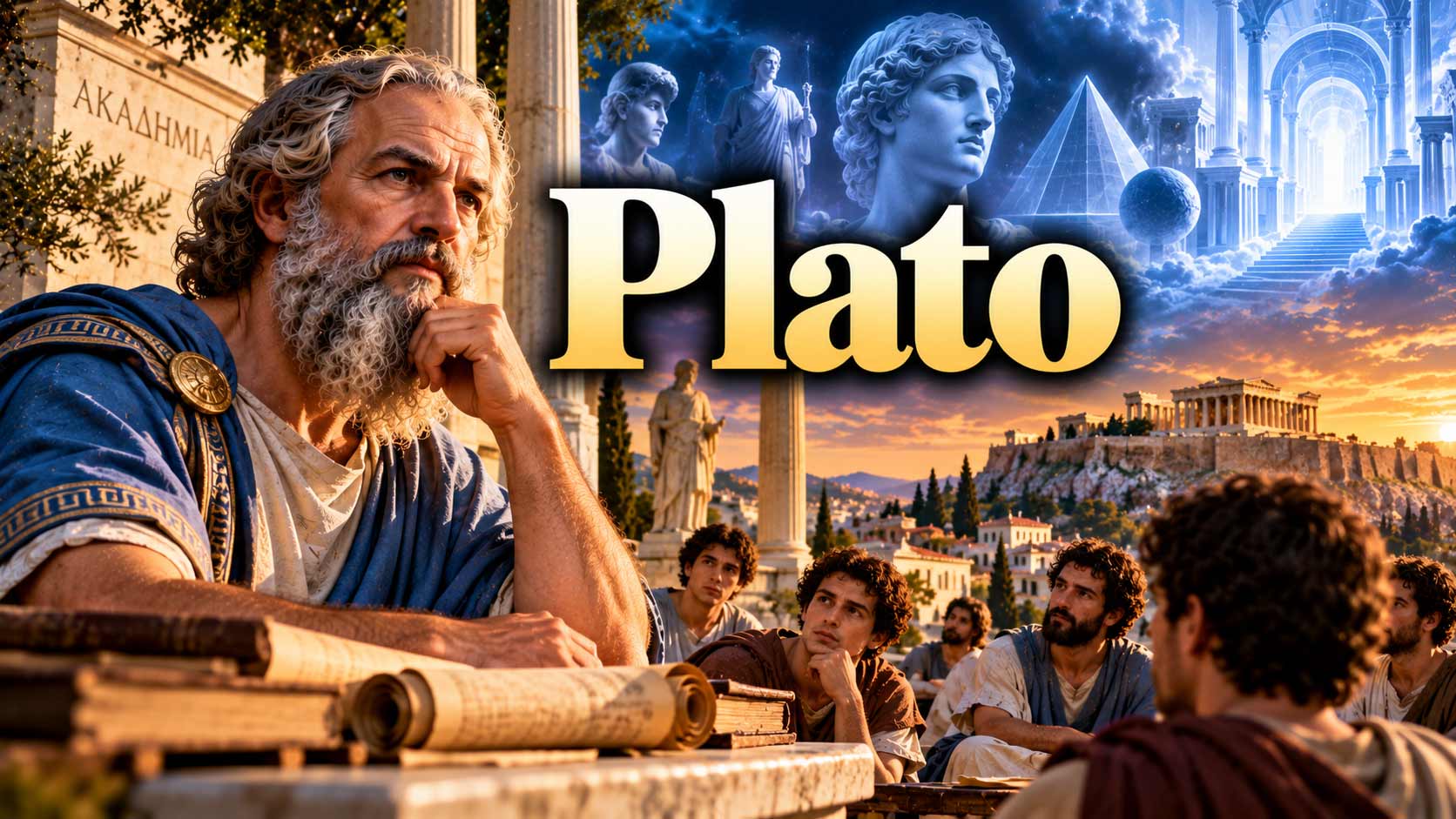
If Socrates was the man who kept asking questions, Plato was the student who decided somebody eventually needed to start giving answers. He took Socrates’ relentless search for definitions and developed it into one of the most ambitious philosophical systems ever attempted. What is real? How can we know anything? What makes something good? What is the soul? What is justice? What kind of government should we have? Plato had opinions about all of it.
His influence is difficult to exaggerate. Plato shaped later Greek philosophy, early Christian intellectual culture, medieval theology, Islamic philosophy, Renaissance thought, and modern debates about knowledge, morality, politics, and reality. The twentieth-century philosopher Alfred North Whitehead famously described the European philosophical tradition as a series of footnotes to Plato. That’s an exaggeration, but not nearly as much of one as you might think.
For Christians, Plato is especially important because some of his ideas sound remarkably familiar. He believed physical reality isn’t the highest reality, that the soul matters more than material possessions, that objective goodness exists, and that human beings need to turn from appearances toward truth. Early Christians found useful intellectual tools in those ideas.
But Plato wasn’t teaching Christianity four centuries early. Sometimes the similarities are illuminating precisely because the differences are so important.
From Aristocratic Athens to Socrates
Plato was born in Athens around 428 or 427 BC, near the beginning of the final phase of the Peloponnesian War. His birth name may have been Aristocles, with “Plato” later becoming a nickname, though the details are uncertain. He came from an aristocratic and politically connected Athenian family, which meant politics could easily have become his career.
Unfortunately for anyone developing romantic ideas about Athenian democracy, Plato grew up watching Athens make some spectacularly bad decisions.
The long war with Sparta ended in Athenian defeat in 404 BC. Sparta supported an oligarchic government known as the Thirty Tyrants, whose brief rule became notorious for executions, confiscations, and political repression. Several of Plato’s relatives, including Critias, were associated with the regime. Democracy was restored, but only a few years later that restored democracy put Socrates to death.
Plato therefore had reasons to distrust both oligarchy and democracy. One political system produced the Thirty Tyrants. The other executed the man Plato considered the wisest person he knew. That experience never really left his philosophy.
Plato and Socrates
Plato became a follower of Socrates while still a young man, and Socrates became the decisive intellectual influence on his life. When Socrates was executed in 399 BC, Plato was probably around twenty-eight years old. The event appears to have permanently altered his ambitions. Rather than entering Athenian politics, Plato devoted himself to philosophy.
Socrates also became the principal character in most of Plato’s philosophical dialogues. Instead of writing treatises that simply announced his conclusions, Plato often presented philosophical arguments as conversations between Socrates and other figures.
This creates the same problem we encountered when discussing Socrates. In Plato’s earlier dialogues, the character Socrates may remain relatively close to the historical Socrates. In later works, “Socrates” increasingly appears to express philosophical ideas that probably belong primarily to Plato.
The transition isn’t always obvious. Plato never inserted a note saying, “Socrates has now stopped talking and I have taken over.” That uncertainty is part of what scholars mean by the Socratic problem.
Philosophy as Dialogue
Plato’s decision to write dialogues was more than a literary trick. A philosophical treatise can make the reader passive. The author explains the argument, and the reader either accepts or rejects it. A Platonic dialogue forces the reader to follow the conversation, notice assumptions, consider objections, and sometimes decide what the conclusion should be.
Some dialogues end without a final answer at all. That fits the influence of Socrates. Philosophy isn’t merely a collection of correct statements. It is a disciplined process of learning how to think.
Plato was also an excellent writer. His dialogues contain humor, irony, mythology, dramatic settings, memorable characters, philosophical puzzles, and arguments that can still make readers stop halfway through a paragraph and realize they’re no longer sure what they believe.
Among the most important are the Apology, Crito, Phaedo, Symposium, Meno, Gorgias, Phaedrus, Timaeus, Theaetetus, Parmenides, Laws, and above all the Republic.
The Academy
Around 387 BC, Plato established a philosophical school in Athens known as the Academy. The name came from its location near a grove associated with the legendary hero Academus. The institution wasn’t a university in the modern sense, but it became an enduring center for philosophical, mathematical, scientific, and political study.
The Academy survived in various forms for centuries and became one of the most influential intellectual institutions of the ancient world. Its most famous student was Aristotle, who studied there for roughly twenty years before eventually developing a philosophical system very different from Plato’s in several important respects.
That sequence alone is remarkable: Socrates taught Plato, Plato taught Aristotle, and those three men became foundational figures in Western philosophy. It was a productive few generations in Athens.
The World of Forms
Plato’s most famous philosophical idea is the Theory of Forms. Consider a circle. Every physical circle we draw is imperfect. The line has thickness. The shape may be slightly irregular. Even the best circle made by a machine remains a physical approximation. Yet we can understand what a perfect circle would be. Where did that standard come from?
Plato argued that the physical things we encounter aren’t ultimate reality. They participate in or reflect eternal, unchanging realities he called Forms. There are particular beautiful things, but there is also Beauty itself. There are just actions, but there is Justice itself. There are many particular triangles, but the intelligible reality of triangularity doesn’t change when someone draws a bad triangle.
Physical objects come and go. The Forms don’t. This allowed Plato to explain how objective knowledge is possible in a changing world. If everything were constantly changing and nothing possessed a stable nature, genuine knowledge would be difficult to achieve. Knowledge requires something permanent enough to be known. The Forms provided that permanence.
The Form of the Good
At the summit of Plato’s hierarchy stands the Form of the Good. The Good isn’t merely one Form among many. It provides the ultimate foundation for intelligibility and value. Plato compares its role in the intelligible realm to the role of the sun in the visible world.
The sun makes sight possible by illuminating physical objects. In a similar way, the Good makes knowledge possible by illuminating intelligible reality. This becomes enormously important for later philosophy and theology because Plato refuses to reduce morality to personal preference or social convention. Goodness is objective. A society doesn’t make injustice good simply by voting for it.
Christians can appreciate that conclusion while disagreeing with Plato’s metaphysical explanation. Christianity doesn’t ultimately ground goodness in an abstract Form existing independently somewhere beyond the world. Goodness is grounded in the nature and character of the personal God.
Plato was reaching toward an objective foundation for goodness. Christianity says that foundation isn’t an abstraction. He has a name.
The Allegory of the Cave
Plato’s most famous illustration appears in Book VII of the Republic: the Allegory of the Cave. Imagine people who have spent their entire lives chained inside a cave. They face a wall and can’t turn around. Behind them is a fire, and between the fire and the prisoners other people carry objects that cast shadows onto the wall.
The prisoners see only the shadows. Because shadows are all they’ve ever experienced, they assume the shadows are reality.
Now imagine that one prisoner is freed. At first the fire hurts his eyes. Gradually he sees the objects that produced the shadows. Then he leaves the cave and encounters the outside world. Eventually he can look toward the sun itself. His entire understanding of reality has changed.
If he returns to the cave and tells the other prisoners that their shadows aren’t the real world, they may think he has gone mad. Plato even suggests they might kill anyone who tried to free them.
It’s difficult to read that passage without remembering Socrates. The allegory captures Plato’s understanding of education. Education isn’t merely putting information into someone’s mind. It is turning the soul around so that it can see reality properly.
The problem isn’t simply that we don’t have enough facts. We’re facing the wrong direction.
Knowledge and Opinion
The Cave illustrates another major Platonic distinction: knowledge and opinion. The physical world gives us appearances that constantly change. We can form opinions about those things, sometimes very good opinions, but genuine knowledge concerns realities that don’t change.
This is one reason mathematics fascinated Plato and his followers. Mathematical truths aren’t altered by physical circumstances. Two plus two doesn’t become five because the weather changes or Athens loses another war. Mathematics therefore seemed to provide a bridge between ordinary sensory experience and higher intellectual reality.
Plato believed reason could move the mind beyond appearances toward what is eternally true. This places him in opposition to philosophical relativism. Truth isn’t created by the individual, the city, or the majority. The task of philosophy is to discover it.
That conviction would eventually make Plato extremely attractive to Christian thinkers living in cultures filled with competing religious and philosophical claims.
The Divided Line
In the Republic, Plato supplements the Cave with another image known as the Divided Line. Human understanding can be arranged in levels. At the lowest level are images, reflections, and shadows. Above them are physical objects. Higher still is mathematical reasoning. At the highest level is direct intellectual understanding of the Forms. The movement is from appearance toward reality and from opinion toward knowledge.
Plato’s philosophy therefore has a strongly upward direction. The philosopher learns to move beyond what the senses immediately present and apprehend realities accessible to reason.
That doesn’t mean Plato thought the physical world was completely unreal. It means physical things possess a lower and less stable kind of reality than the eternal Forms they reflect. This distinction would have an enormous afterlife, especially when later Platonists developed it into much more elaborate metaphysical systems.
The Soul
Plato believed the human being possesses an immortal soul that exists independently of the body. In dialogues such as the Phaedo, he presents arguments for the soul’s immortality and portrays philosophy as preparation for death. The philosopher learns to detach the soul from domination by bodily appetites so it can pursue truth.
This idea fit naturally with the Theory of Forms. If the soul can know eternal realities that aren’t available directly to the senses, perhaps the soul itself belongs more naturally to the intelligible realm than to the physical one.
Plato sometimes goes further and suggests that the soul existed before birth. Learning can therefore be described as recollection. The soul recognizes truths because, in some sense, it encountered them before entering embodied life.
Christianity would eventually reject that idea. Human souls don’t preexist their bodies and then descend into them from a heavenly realm. But Christians living in the Greek world found Plato’s emphasis on the immaterial soul much easier to work with than philosophies that reduced human beings entirely to matter.
That compatibility would prove both useful and occasionally troublesome.
The Chariot of the Soul
In the Phaedrus, Plato gives another memorable picture of the soul. He compares it to a charioteer driving two horses. One horse is noble and responsive, representing higher impulses. The other is unruly and difficult, representing lower appetites and passions. The charioteer represents reason, which must control and direct the whole.
The image complements the account of the soul in the Republic, where Plato distinguishes three parts: reason, spirit, and appetite. Reason seeks truth and should govern. Spirit includes courage, ambition, anger, and the desire for honor. Appetite includes bodily desires for food, sex, possessions, and pleasure.
A properly ordered person is one in whom reason governs, spirit supports reason, and appetite remains under control. For Plato, morality is therefore partly about order within the soul. A person can appear successful while being internally disordered.
That idea will become crucial to his definition of justice.
What Is Justice?
The Republic begins with a deceptively simple question: What is justice?
Several answers are proposed and rejected. One particularly memorable argument comes from Thrasymachus, who claims that justice is essentially the advantage of the stronger. Those in power create laws that serve their interests and then call obedience “justice.” The argument sounds remarkably modern.
Plato’s response eventually moves from the individual to the entire structure of society. He constructs an ideal city in order to see justice on a larger scale and then applies the same structure back to the human soul. The city contains three broad classes: rulers, guardians or auxiliaries, and producers. Each performs the function appropriate to it. Justice occurs when each part performs its proper role without usurping the others.
Likewise, justice within the person occurs when reason governs, spirit supports reason, and appetite occupies its proper place. A just person isn’t merely someone who follows rules. He is someone whose soul is properly ordered.
The Philosopher-King
Plato’s political solution produces one of his most famous and controversial ideas: the philosopher-king. The people best qualified to govern are philosophers because they understand the Good. Political power should therefore be joined with philosophical wisdom.
From Plato’s perspective, this makes sense. If governing is a skill requiring knowledge of justice and goodness, why would we assume everyone is equally qualified to do it? We don’t select surgeons by popular vote and hope enthusiasm compensates for the lack of medical training. Plato thought government deserved at least as much attention.
The difficulty is obvious: who decides which philosophers actually know the Good? History has supplied plenty of rulers convinced that they possessed superior wisdom and that ordinary people would be better off doing what they were told. Plato’s philosopher-king is supposed to be reluctant to rule, disciplined, educated, and oriented toward truth rather than personal gain.
Finding one has proved considerably harder than describing one.
Plato and Democracy
Plato’s distrust of democracy becomes explicit in the Republic. He believed democratic societies could elevate freedom above every other good until authority, discipline, and expertise became suspect. Citizens would pursue whatever desires pleased them, and politicians would compete by flattering the public.
Eventually, Plato argued, excessive freedom could produce disorder. A charismatic leader could then promise to protect the people, concentrate power, eliminate opponents, and become a tyrant. In Plato’s sequence of political decline, democracy can therefore lead to tyranny.
We don’t have to accept his political system to recognize the question he raises. Does popular rule automatically produce wise rule? Plato had watched democratic Athens execute Socrates. He wasn’t asking that question as a theoretical exercise.
Women in Plato’s Republic
One of the more surprising features of Plato’s ideal society concerns women. Plato argues that women among the guardian class should receive the same kind of education as men and could perform many of the same political and military functions. If a woman possessed the qualities necessary to become a guardian, her sex alone shouldn’t disqualify her.
For fourth-century BC Greece, this was an unusually radical proposal. Plato wasn’t advocating modern ideas of equality in every respect, and some of his assumptions about women remain unmistakably ancient. Still, the argument that ability rather than sex should determine participation in the guardian class stands out sharply against the social structure of Athens, where women had very limited political rights.
Philosophy sometimes allows a thinker to challenge assumptions so deeply embedded in his own culture that most people never notice they’re assumptions. Socrates would have appreciated that.
The Noble Lie
Plato’s politics also contains ideas that make modern readers considerably less comfortable. In the Republic, Socrates proposes what later became known as the noble lie or magnificent myth. Citizens would be taught a founding story suggesting that they were born from the earth and possessed different metals within their souls corresponding to their roles in society. The purpose is social unity and political stability.
The proposal creates an obvious problem. Can a society supposedly devoted to truth legitimately maintain itself through deliberate falsehood? Defenders sometimes argue that “noble lie” oversimplifies Plato’s idea and that political myth is a better description. Even so, Plato clearly recognizes that societies depend partly upon shared narratives and that rulers may shape those narratives for political purposes.
The question hasn’t gone away. We have simply acquired considerably more efficient methods of distributing the narratives.
The Ring of Gyges
Another unforgettable passage in the Republic concerns the Ring of Gyges. The story imagines a ring that makes its wearer invisible. If someone could commit crimes without being caught, would he still behave justly?
The argument challenges the idea that people are good because they genuinely value goodness. Perhaps they behave well simply because they’re afraid of consequences. Take away accountability and discover the person’s real character.
Plato’s answer is that injustice damages the person who commits it even when nobody else knows. The unjust person becomes internally disordered. Justice is therefore good not merely because it produces a good reputation or avoids punishment but because it makes the soul what it ought to be.
Christians can recognize the importance of the question immediately. Biblical morality repeatedly moves beyond outward behavior toward the heart. A person isn’t righteous merely because circumstances prevented him from doing what he wanted to do.
Plato on Love
Plato’s Symposium contains one of antiquity’s most famous discussions of love. Different speakers offer accounts of love before Socrates presents teachings attributed to a woman named Diotima. Love begins with attraction to a particular beautiful body but can rise toward appreciation of beauty in all bodies, then beautiful souls, beautiful institutions and knowledge, and finally Beauty itself.
This ascent is sometimes called the Ladder of Love. The idea fits Plato’s entire philosophical system. Particular beautiful things awaken desire, but they point beyond themselves toward the eternal Form of Beauty.
Modern usage of the phrase “Platonic love” usually means a nonsexual friendship. That’s related only loosely to Plato’s actual discussion, which is considerably more complicated. For Plato, eros can become a force that draws the soul upward from physical attraction toward contemplation of eternal beauty.
Christian thinkers would later develop their own accounts of earthly beauty pointing beyond itself toward God, although Christianity again makes the ultimate reality personal rather than an impersonal Form.
The Demiurge and the Timaeus
Plato’s Timaeus became especially important for later Jewish and Christian thinkers because it presents an account of the cosmos involving a divine craftsman known as the Demiurge. The Demiurge is good and therefore wants the cosmos to be as good as possible. He orders preexisting disorder according to eternal patterns, producing a rational and beautiful universe.
This can sound remarkably close to biblical creation until we examine it carefully. The Demiurge isn’t necessarily the omnipotent Creator of Genesis who brings everything into existence. He is more like a cosmic craftsman who imposes order according to realities that already exist.
Still, Plato’s insistence that the cosmos reflects rational order and goodness created an important bridge between Greek philosophy and later theological reflection. Christians could agree that creation is rational because it comes from divine wisdom. They couldn’t simply identify Plato’s Demiurge with the biblical God without substantially changing Plato’s system.
Plato’s Unwritten Teaching?
Ancient writers sometimes suggested that Plato taught certain doctrines orally within the Academy that weren’t fully expressed in his dialogues. Scholars continue debating how much importance should be assigned to these reports. Aristotle occasionally describes Platonic doctrines in ways that aren’t easy to locate directly in Plato’s surviving works. This has led some interpreters to propose that Plato maintained an unwritten teaching concerning first principles underlying the Forms.
The question reminds us that the dialogues may not contain everything Plato taught. Unlike Socrates, Plato certainly wrote a great deal. But even with Plato, the surviving texts don’t necessarily give us a neat philosophical handbook explaining every part of the system.
Maybe that was intentional. Plato wanted readers to think, not merely memorize Platonic answers.
Plato and Aristotle
Plato’s greatest student eventually became his greatest philosophical rival. Aristotle studied at the Academy for about twenty years, but he became increasingly dissatisfied with Plato’s separation of the Forms from physical objects.
If we want to understand what a horse is, Aristotle thought, we don’t need an eternal Horse existing in a separate realm. The form of horse exists in actual horses. That difference represents a major shift.
Plato tends to move upward from the physical world toward transcendent realities. Aristotle pays much closer attention to the concrete world and asks how form and matter work together within actual things.
Western philosophy would spend centuries moving back and forth between impulses we can loosely call Platonic and Aristotelian. Christian theology eventually made extensive use of both.
Plato and Early Christianity
Plato’s influence on Christianity is real, but it needs to be described carefully.
The New Testament wasn’t written by Platonists trying to disguise Greek philosophy as Jewish religion. Christianity emerged from the world of Second Temple Judaism and centers on Israel’s Scriptures, Jesus of Nazareth, His crucifixion, and the claim that God raised Him bodily from the dead.
But Christianity spread through a Greek-speaking world in which Platonic ideas were intellectually important. Christian thinkers therefore used philosophical vocabulary and concepts available in their culture when explaining and defending Christian doctrine. Justin Martyr, Clement of Alexandria, Origen, Augustine, and many others interacted extensively with Platonic and later Neoplatonic thought.
They could affirm that reality includes more than what the senses detect, that objective truth exists, that goodness is real, that the soul matters, and that material possessions aren’t humanity’s highest good. But they also had to correct Plato.
The Body Is Not the Problem
One of the most important corrections concerns the body. Platonic thought can create a strong contrast between soul and body, sometimes making the body appear like a prison from which the soul should escape. Later Platonists developed that tendency even further.
Christianity certainly distinguishes body and soul, but the Bible doesn’t treat physical creation as an unfortunate mistake.
Genesis calls creation good. The Son of God becomes flesh. Jesus rises bodily from the dead. Christian hope culminates in resurrection and new creation.
This difference is enormous. If the basic human problem is embodiment, salvation means escape from the body. If the basic human problem is sin and death, salvation can include the redemption of the body. Paul doesn’t tell Christians that Christ has come to rescue their immortal souls from physical existence. He tells them that the dead will be raised.
Did Christianity Borrow Heaven from Plato?
A popular claim says Christianity simply borrowed its idea of heaven and the immortal soul from Plato. The history is much more complicated.
Greek philosophy certainly influenced the vocabulary and conceptual categories used by later Christians, especially when Christians discussed the soul’s existence after death. But biblical hope is deeply rooted in Jewish expectations of resurrection and God’s restoration of creation.
The resurrection of Jesus doesn’t fit comfortably into a philosophy that regards escape from the body as the goal. In Acts 17, Paul’s proclamation of resurrection appears to strike his Greek audience as strange rather than reassuringly Platonic. Some listeners mock him.
That is an important historical clue. If Christianity were simply Platonism with Jesus added, resurrection would be one of the strangest doctrines to insist upon. Yet it became the center of the Christian message.
Augustine and Christian Platonism
No major Western Christian thinker demonstrates Plato’s influence more clearly than Augustine of Hippo. Before his conversion to Christianity, Augustine struggled intellectually with crude conceptions of God and evil. Reading philosophers influenced by Plato helped him understand how reality could be nonmaterial and how evil might be understood as a corruption or deprivation of good rather than a substance in its own right.
That helped remove intellectual obstacles to Christianity. But Augustine didn’t simply become a Platonist and rename the Forms. He believed Christianity supplied what philosophy couldn’t. Plato could point the mind toward eternal truth, but he couldn’t provide the incarnation, cross, grace, forgiveness, or resurrection.
Augustine’s relationship with Platonism therefore illustrates one of the most productive ways Christians have engaged philosophy: receive what is true, reject what conflicts with revelation, and refuse to confuse useful philosophical tools with the gospel itself.
Plato and Objective Truth
Plato may be particularly valuable in the modern world because he refuses to accept the idea that truth and goodness are simply whatever individuals or societies decide they are. The prisoners in the Cave don’t create reality by agreeing about the shadows. Their consensus can be unanimous and still be wrong.
That is an uncomfortable thought in every age because communities naturally treat their assumptions as obvious. Plato asks whether the things everyone accepts might merely be shadows on the wall. Christians should be comfortable with that question. Biblical prophets spent a considerable amount of time telling entire societies that nearly everyone around them was wrong.
Majority opinion is evidence of popularity, but it isn’t a test of truth.
Why Plato Still Matters
Plato wanted to know what reality looks like when we stop confusing appearance with truth.
That question connects nearly everything he wrote. The Forms distinguish changing appearances from eternal realities. The Cave distinguishes shadows from what produces them. The philosopher distinguishes knowledge from opinion. The just person distinguishes genuine goodness from immediate appetite. The philosopher-king distinguishes wisdom from political popularity.
Christians won’t follow Plato all the way. We don’t need an eternal realm containing abstract Forms in order to explain why truth and goodness are objective. We don’t believe souls existed before birth. We don’t regard the body as something from which salvation finally liberates us. We don’t believe philosophers can reason their way into the redemption humanity needs.
But Plato understood something essential: reality doesn’t have to conform to what we happen to think about it. That alone makes him worth reading.
Socrates taught Plato to question the world everyone took for granted. Plato responded by proposing another world, an eternal reality behind the changing appearances we see.
Christianity makes an even more startling claim. The highest reality isn’t a Form. It’s a Person.