

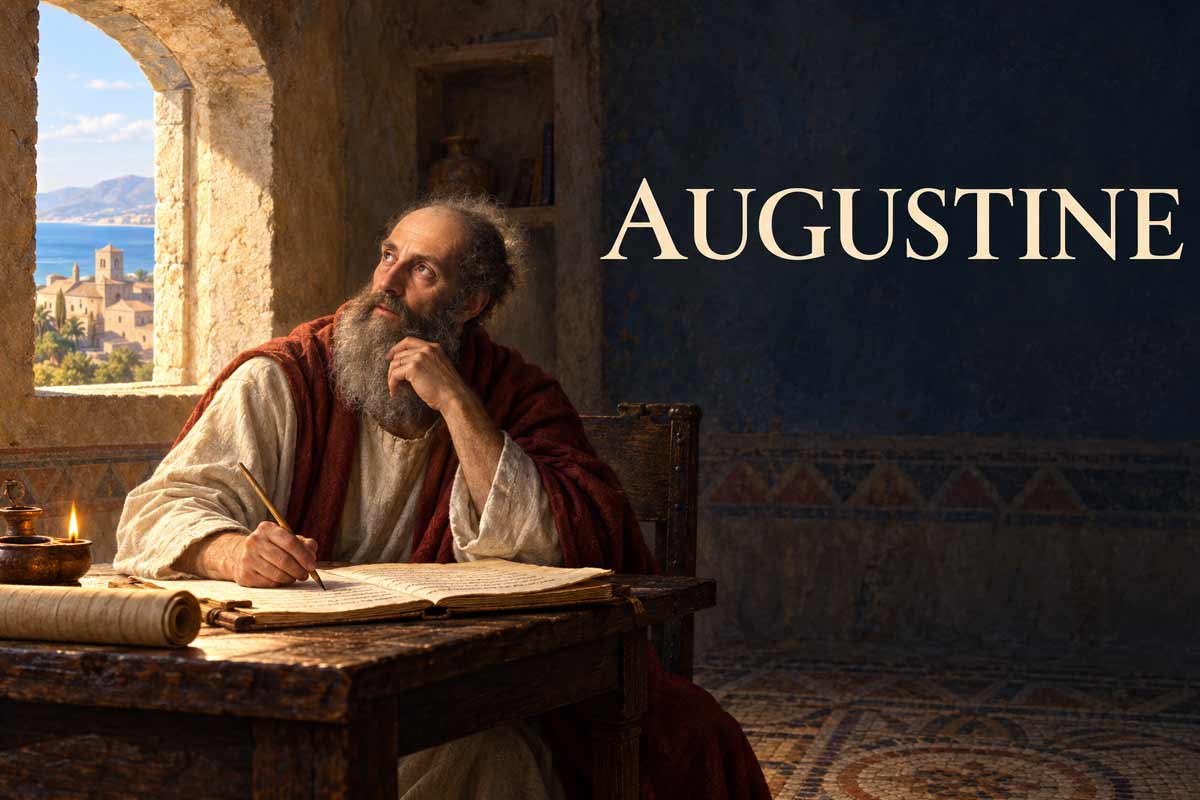
Augustine understood that a person can know what ought to be done and still resist doing it. He had spent years pursuing learning, recognition, and pleasure, and intellectual progress didn’t automatically straighten out his life. When he looked back on that experience, he examined more than the beliefs he had held. He asked what he had loved, why his desires had pulled him in different directions, and why knowing the truth had not been enough to make him willing to follow it.
That makes Augustine an important philosopher as well as a theologian. His questions concern knowledge, freedom, evil, time, memory, and the nature of a good life. They also concern God, creation, sin, and grace, because he didn’t believe that those subjects could be separated from a full understanding of human beings. Christian readers don’t have to accept every Augustinian conclusion to recognize the seriousness of the questions. Sometimes his most useful contribution is making us face a problem we would rather explain away.
From Roman Africa to Hippo
Augustine was born in AD 354 in Thagaste, in Roman North Africa, in what is now Algeria. His mother, Monica, was a Christian, but his path toward the faith she wanted for him was neither quick nor straightforward. He studied rhetoric and pursued a career in teaching and public speaking. Reading Cicero’s Hortensius helped awaken his interest in wisdom, while his religious search led him for a time into Manichaeism, a movement that explained the world through a conflict between good and evil principles.
He eventually became dissatisfied with Manichaeism and encountered other philosophical possibilities. In Milan, the preaching of Ambrose and his reading of Platonist writings helped him reconsider Christian belief. His conversion in 386 involved both a change in understanding and a struggle over how he would live. Ambrose baptized him in 387, and Augustine later returned to Africa, became a priest, and then bishop of Hippo. He died in 430, leaving writings that would shape centuries of Christian thought.
Philosophy in the Service of Faith
Augustine’s use of philosophy wasn’t an attempt to make Christianity disappear into a Greek system. Platonist writings helped him think beyond the assumption that everything real must be a physical thing. They also offered ways of discussing the relationship between changing things and an unchanging source of reality. But in the Confessions, he distinguished what he found in those writings from the Christian proclamation of the Word made flesh. A philosophical account of spiritual reality didn’t supply the incarnation or the humility of Christ.
That distinction is useful for Christian readers. Philosophy can help us clarify a question, uncover an assumption, or recognize that a proposed explanation is inadequate. It doesn’t follow that the philosopher has supplied the gospel or that every part of the system belongs in Christian theology. Augustine’s experience shows both the usefulness and the limitations of intellectual borrowing. We should be willing to learn while continuing to ask what we’ve learned, where it came from, and whether it agrees with Scripture.
What Is Evil
Augustine’s earlier involvement with Manichaeism made the problem of evil especially important to him. If evil were a separate substance or an independent power opposed to goodness, we would have to explain its relationship to God and creation. His mature answer was that evil is a privation of good, a lack or corruption of goodness that ought to be present. Created things are good insofar as they exist, but they can lose the order, integrity, or proper functioning that belongs to them. Evil depends on something good that it damages rather than existing as a rival kind of substance.
We can understand the distinction by considering dishonesty. Speech and human intelligence are good capacities, but lying corrupts their use. The liar hasn’t created a new substance called evil; the wrong consists in using real abilities contrary to their proper purpose. Likewise, calling an injury a loss of bodily integrity doesn’t make the injury imaginary. Augustine’s account is about what evil is, not an attempt to deny its reality or lessen the suffering it causes.
This explanation also leaves further questions to address. Saying that evil is a corruption of good doesn’t, by itself, explain why God permits a particular tragedy or why one person suffers while another doesn’t. It provides a way to think about evil without treating it as an equal opponent to God. We should recognize what that argument accomplishes without asking it to accomplish everything. A useful distinction can clarify the problem while leaving us with moral, pastoral, and theological work still to do.
The Divided Will
Augustine’s account of his conversion brought the discussion of evil into his own choices. In Book VIII of the Confessions, he described wanting to change while remaining attached to the life he would have to leave behind. He didn’t explain the conflict as two separate beings inside him, one good and another evil. The struggle belonged to one person whose willing was divided. Habit had strengthened desires that didn’t disappear merely because he had reached a better judgment.
That observation still has force. We can recognize that resentment is destructive while continuing to rehearse an old offense. We can know that a habit needs to change while carefully arranging for the change to begin at some more convenient time. Better information may be necessary, but it doesn’t always resolve the resistance. Augustine presses us to examine what we want and how those wants have been trained, rather than assuming that every moral failure comes from not knowing enough.
There is also an important difference between describing that conflict and excusing it. Augustine’s account doesn’t allow him to treat his own choices as somebody else’s responsibility. The habits he laments were connected to conduct in which he had participated. That gives his examination of the will a personal seriousness. He wasn’t merely diagnosing humanity from a safe distance; he was admitting that the problem he described included himself.
Freedom and Grace
Augustine’s teaching about grace developed through reflection and controversy, especially his disputes with Pelagius and his followers. He insisted that human beings need more than an external command or a good example to overcome sin. God’s grace is necessary for healing and rightly directing the will. At the same time, in On Grace and Free Will, he argued that the existence of grace doesn’t eliminate human willing or responsibility. The relationship between divine action and human choice became one of the most difficult and influential parts of his thought.
Christians can affirm our need for grace without assuming that every conclusion Augustine reached settles every later debate. Questions about original sin, predestination, the scope of grace, and the character of human freedom require careful consideration of Scripture. Augustine’s writings help us see why those questions are difficult, but his authority doesn’t replace that examination. We should also distinguish his own changing arguments from systems that developed centuries later. Reading him carefully is more useful than turning his name into a shortcut for a modern theological position.
His challenge to moral self-sufficiency nevertheless deserves attention. Christianity isn’t simply a program in which sufficiently informed people improve themselves until they qualify for acceptance by God. We need forgiveness and the transforming work of grace. Discipline and obedience matter, but they don’t make redemption unnecessary. Augustine understood that the person who can explain holiness may still need help becoming holy, and that need shouldn’t surprise us.
Knowing the Mind
Augustine also challenged the idea that doubt could undermine every kind of certainty. In Book XI of The City of God, he pointed out that even being deceived requires the existence of the person who is deceived. A mistake about something outside me doesn’t establish that there is no one here making the mistake. This doesn’t answer every question about knowledge, but it identifies something radical doubt has difficulty removing. The act of questioning reveals a questioner.
His examination of memory in Book X of the Confessions takes us into another part of the mind’s activity. We remember things that aren’t presently before our senses, recall emotions without necessarily experiencing them again, and recognize truths that aren’t simply pictures of physical objects. Augustine found these capacities remarkable and difficult to explain. His reflections show how philosophical inquiry can begin with experiences so familiar that we rarely stop to consider them. Remembering something is ordinary; explaining what memory is turns out to be a much larger undertaking.
Time and Eternity
Augustine’s discussion of time is another example of that approach. We regularly speak about the past, present, and future, yet the past is no longer here and the future hasn’t arrived. The present, meanwhile, doesn’t stand still long enough to become a permanent possession. In Book XI of the Confessions, he explored our experience of time through memory, attention, and expectation. We encounter the past and future in present acts of remembering and anticipating.
This discussion also shaped his response to questions about creation. If time belongs to the created order, asking what God was doing during a long period before creation assumes the existence of the very thing being explained. For Augustine, God’s eternity isn’t simply an endlessly extended version of our succession of moments. God creates time rather than waiting inside it for the opportunity to create the world. That distinction doesn’t make eternity easy to comprehend, but it helps expose an assumption that can hide inside an apparently simple question.
The Two Cities
Augustine began The City of God in response to the crisis surrounding Rome’s sack in 410 and accusations against Christianity. The work grew into a much larger examination of history, worship, justice, and humanity’s ultimate good. In Book XIV, he distinguished two cities through the loves that shape them: love of self carried into contempt for God, and love of God that displaces self-glorification. The deepest division therefore concerns allegiance and the direction of human love. It can’t be reduced to a neat division between a government building and a church building.
That doesn’t mean ordinary political life has no value. In Book XIX, Augustine recognized the importance of earthly peace and the cooperation needed to sustain it. People with different ultimate commitments can share an interest in social order, safety, and the conditions that make common life possible. Christians can work for those goods while recognizing that no political arrangement supplies their final hope. The distinction protects us from both indifference to public responsibility and the expectation that a state can provide what belongs to God.
Reading Augustine Critically
Augustine’s influence also includes conclusions that deserve criticism. In his conflict with the Donatists, he came to defend religious coercion, arguing that pressure could help bring people back to what he regarded as the true church. He understood that position as a form of corrective concern, but explaining his intention doesn’t remove the problems with the method. Using civil power to enforce religious conformity raises serious questions about conscience, genuine faith, and the church’s treatment of those who disagree. We shouldn’t overlook those questions because the same writer offered valuable insights elsewhere.
That is part of reading any influential Christian thinker responsibly. A person may help us understand grace while reaching conclusions about coercion that we should resist. We can also learn from Augustine’s examination of desire without treating every feature of his outlook as a command for the church. His writings require judgment as well as appreciation. The standard isn’t whether a position is famous or old, but whether it is true and faithful to the teaching we claim to follow.
Where to Begin
The Confessions is a useful starting point because it connects philosophical questions with a recognizable human struggle. It is also a prayer addressed to God, so we should read it as more than a modern autobiography. The City of God opens a broader discussion of history and political life, while works such as On Grace and Free Will concentrate on particular questions. Reading across those works helps us see a thinker engaged in inquiry, explanation, and controversy rather than a collection of isolated quotations.
Augustine brings us back to the relationship between what we believe and what we love. We may defend the right proposition while arranging our lives around something that contradicts it. We may even use learning to avoid admitting what needs to change. His questions about knowledge and freedom are therefore also questions about the direction of our lives. Understanding an argument has value, but sooner or later we have to ask what the truth we’ve recognized requires of us.