

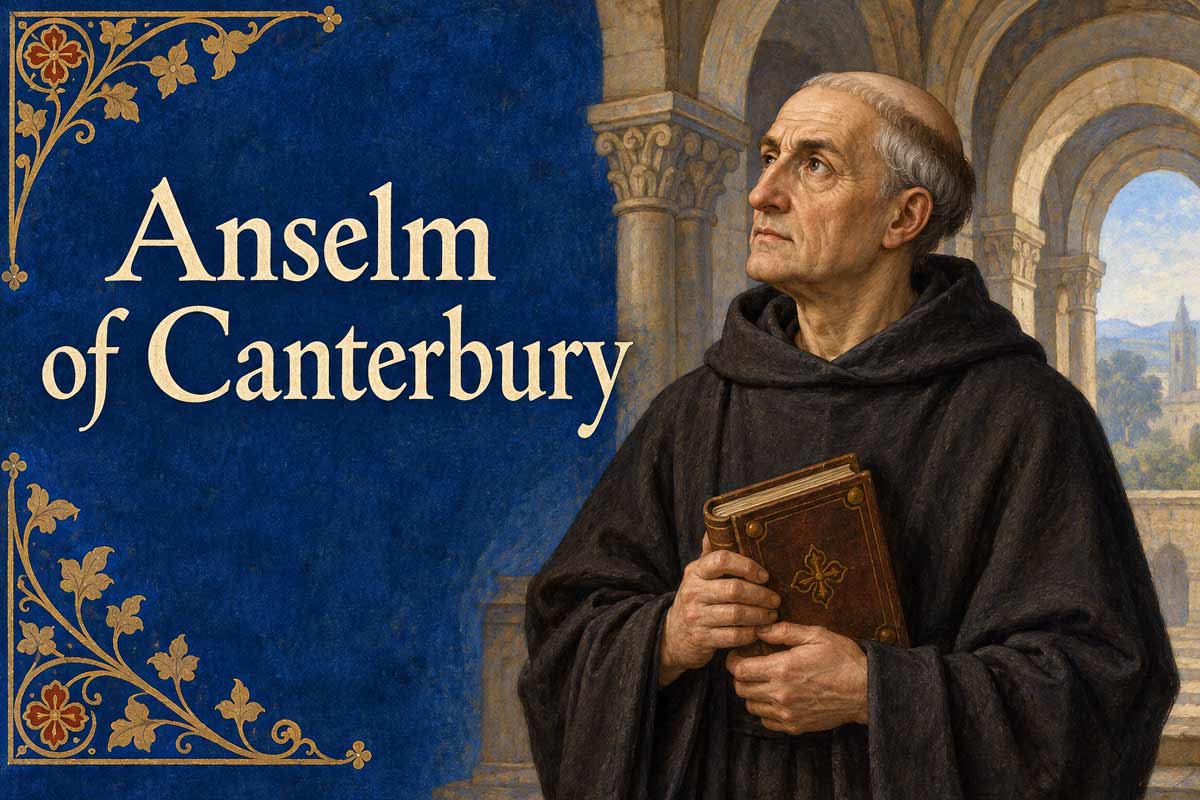
Some Christians are suspicious of philosophy because they think it means replacing faith with human reasoning. Anselm of Canterbury approached it differently. He believed in God, prayed to God, and wanted to understand more clearly what he believed about God. For him, thinking carefully was part of devotion. His arguments can be difficult, and we don’t have to agree with every conclusion, but his example challenges the assumption that serious faith requires us to stop asking serious questions.
Anselm lived from 1033 to 1109 and became one of the major Christian thinkers of the medieval period. He’s best known for an argument that tries to establish God’s existence by considering what we mean by God. His explanation of Christ’s saving work also helped shape Western theology for centuries. Those two contributions make him relevant to both philosophy and theology, although reducing him to a clever proof and an atonement theory leaves out much of what he was trying to accomplish.
From the Monastery to Canterbury
Anselm was born near Aosta, in what is now northwestern Italy. As a young man he traveled through parts of Europe before arriving at the Benedictine monastery of Bec in Normandy, where the teacher Lanfranc attracted students interested in religious learning and logical argument. Anselm entered the monastery in 1060, became its prior in 1063, and later served as abbot. Much of his intellectual work grew out of this setting, where teaching, prayer, and discussion belonged to the same daily life.
In 1093 he became archbishop of Canterbury, a position that involved considerably more than writing books. Disputes with William II and Henry I over royal control of the church led to periods of exile. Anselm’s defense of ecclesiastical independence belonged to the medieval struggle over who could appoint and govern church leaders. We shouldn’t mistake that struggle for a modern separation of church and state, but it does remind us that theological questions were entangled with money, authority, and political power. Even a philosopher who preferred the monastery could find himself dealing with a king who had other plans.
Faith Seeking Understanding
Anselm’s approach is often summarized by the phrase “faith seeking understanding.” He began as a Christian believer who wanted to think through the meaning and coherence of his convictions. This wasn’t a plan to graduate from faith into something supposedly more sophisticated. Understanding was meant to deepen his relationship with the God he already trusted. His reasoning grew out of worship rather than treating worship as an unfortunate habit that thinking would eventually cure.
That starting point didn’t mean he thought every argument could persuade only people who already agreed with him. He believed reason could establish important truths about God, and he offered arguments intended to have force beyond an appeal to church authority. There’s a useful distinction here between someone’s reason for investigating a question and the reasons offered in support of an answer. A believer may investigate because he loves God, while an unbeliever evaluates the argument because he wants to know whether it works. The argument still has to be examined on its merits.
For Christians, Anselm’s example offers a healthier response to questions than simply telling people not to ask them. We can affirm a doctrine while admitting that we haven’t fully understood its implications. We can also distinguish what Scripture teaches from the explanation a theologian has constructed around it. Faith gives us reasons to keep thinking, but it doesn’t make every explanation offered by a believer automatically correct.
The Argument for God
In the Monologion, Anselm developed several arguments concerning the source of existence and goodness. In the Proslogion, he sought a single argument that could support both God’s existence and an understanding of God’s nature. The work is written as an address to God, so the famous argument appears inside a prayerful meditation. Pulling a few sentences out of that setting can make Anselm sound like someone doing a logical trick at a dinner party. He was pursuing a larger question about what it means for God to be supreme.
His starting description of God is a being beyond which nothing greater can be conceived. In a familiar presentation of the argument, someone can understand this description even while denying that such a being exists. Anselm then distinguishes existing in the understanding from existing in reality. If the supreme being existed only as an idea, he argues, we could conceive of something greater: such a being actually existing. That would contradict the description with which we began, so he concludes that God exists in reality.
Anselm also argues that a being whose nonexistence is impossible is greater than one that could fail to exist. This brings us to the idea of necessary existence. Ordinary things depend on conditions outside themselves and might never have existed at all. Anselm’s God belongs to a different category, with existence that doesn’t depend on another cause. His argument therefore involves more than the observation that people can imagine impressive things.
The argument came to be called ontological because it concerns being or existence, rather than beginning with observations about the universe. Its difficulty lies in whether reasoning about the concept of God can establish that anything answering to that concept actually exists. We shouldn’t dismiss it as “I can imagine God, therefore God is real,” because that leaves out the distinction on which Anselm relies. We also shouldn’t treat an argument as successful merely because its conclusion agrees with our faith. The important work is examining whether the conclusion follows from premises we have good reason to accept.
Gaunilo and the Lost Island
One of Anselm’s critics was a fellow monk named Gaunilo. He suggested that similar reasoning could appear to prove the existence of an island surpassing every other island. We could understand the description, and an island that really existed would seem superior to one existing only in thought. If that were enough to establish reality, an excellent holiday destination could be argued into existence without anyone having to book a boat. Gaunilo’s challenge was directed at the movement from an understood description to an existing thing.
Anselm replied that Gaunilo hadn’t adequately captured the special character of his argument. A supreme being with necessary existence cannot simply be exchanged for an excellent instance of an ordinary object. An island is still something that can come and go, depend on other things, and admit improvements. Whether this distinction answers the objection depends on how we interpret and evaluate the original argument. The exchange is worth reading because both men were believers, yet agreement about God didn’t prevent disagreement about a proposed proof.
That distinction remains useful in apologetics. A weak argument for a true conclusion is still a weak argument, and identifying the weakness doesn’t require us to reject the conclusion. Christians sometimes treat criticism of a particular defense of faith as an attack on faith itself. Anselm and Gaunilo show why those judgments should be kept separate. We serve the discussion better by explaining the reasoning and answering the objection than by questioning the critic’s motives.
Why God Became Human
Anselm’s Cur Deus Homo, usually translated Why God Became Man, examines the relationship between human sin and the incarnation. Written as a dialogue with Boso, it asks why salvation involved the Son of God becoming human and dying. Anselm treats sin as a failure to give God the obedience and honor owed to him. Simply beginning to obey doesn’t repair the earlier wrong, because obedience was already our obligation. On his account, humanity owes a satisfaction it cannot provide.
This language of honor can sound strange to readers accustomed to courtroom explanations of salvation. Anselm isn’t saying that God has a fragile ego that needs flattering. The issue concerns the proper relationship between Creator and creature and the disorder introduced by sin. His language reflects a medieval world familiar with obligations and restitution, but his intention is to explain why moral wrongdoing cannot be treated as inconsequential. Readers can recognize that concern while still asking whether his particular account captures everything Scripture says about forgiveness.
Anselm’s answer connects the need for satisfaction to the identity of Christ. Humanity ought to make satisfaction, but only God can provide what the situation requires. The one who accomplishes salvation must therefore be both divine and human. Christ’s voluntary self-offering supplies what sinners cannot supply for themselves. Grace remains central to the explanation because God provides the remedy instead of leaving humanity to solve a problem beyond its ability.
Anselm also rejects the idea that the devil possesses a rightful claim that God must satisfy by paying him. His concern is the relationship between humanity and God. That helps distinguish his account from explanations of the cross presented as a transaction with Satan. We should still read biblical language about ransom and deliverance in its own context rather than assuming that one historical theory determines the meaning of every passage.
Satisfaction and Penal Substitution
Anselm’s satisfaction theory influenced later Western discussions of the atonement, but it shouldn’t simply be identified with penal substitution. In penal substitution, the emphasis falls on Christ bearing the punishment due to sinners. Anselm’s account emphasizes the satisfaction rendered through Christ’s voluntary offering, with satisfaction and punishment distinguished as ways the disorder of sin is addressed. There are connections between the accounts, but they don’t explain the saving work of Christ in exactly the same terms.
This is especially important when someone claims that Anselm invented the idea that Christ died for us. Christians were proclaiming Christ’s saving death long before the eleventh century. What Anselm supplied was a particular explanation of how that death addresses human sin and why the incarnation is fitting. Biblical claims and later theological models aren’t interchangeable. A model may illuminate a biblical theme without becoming the complete definition of the gospel.
From a Christian perspective, Anselm gives us good reasons to take sin seriously and to see salvation as God’s gracious provision. We should also ask whether an explanation centered on satisfaction gives sufficient attention to resurrection, reconciliation, and liberation from the power of sin. Scripture describes Christ’s work through several related themes. Evaluating Anselm fairly means acknowledging what his account helps us understand while resisting the temptation to make it answer every question about salvation.
Freedom and Doing What Is Right
Anselm’s discussions of freedom also deserve attention. He doesn’t define freedom simply as the ability to choose between sinning and not sinning. Instead, he associates it with the ability to maintain a right will for the sake of what is right. On this view, the capacity to ruin ourselves isn’t what makes freedom valuable. A will firmly directed toward goodness possesses a kind of strength that a will easily drawn into evil lacks.
That approach challenges the assumption that we’re most free whenever we have the greatest number of options. An addiction can offer choices while making a person increasingly unable to resist what harms him. A good habit can narrow certain possibilities while helping him act according to commitments he actually endorses. Anselm’s account doesn’t settle every debate about human choice, temptation, or grace, but it makes us consider what freedom is for. The moral quality of our willing deserves attention alongside the mere availability of alternatives.
Reading Anselm Today
The Proslogion is a natural starting point, especially when read with Gaunilo’s objection and Anselm’s reply. Why God Became Man provides a different kind of reading, with questions and answers developing an explanation over the course of a dialogue. Neither work needs to be accepted without criticism to reward careful attention. It helps to ask what Anselm assumes, what he argues, and where the argument reaches further than its premises appear to allow.
Anselm belongs in both Medieval Philosophy and Christian Philosophy because his questions cross the boundary between them. He wanted to understand God’s existence, the nature of freedom, and the meaning of Christ’s saving work, all within a life committed to Christian faith. His enduring challenge is that belief should invite reflection rather than excuse us from it. We can read him with appreciation, disagree where necessary, and keep doing the patient work of understanding what we confess.