

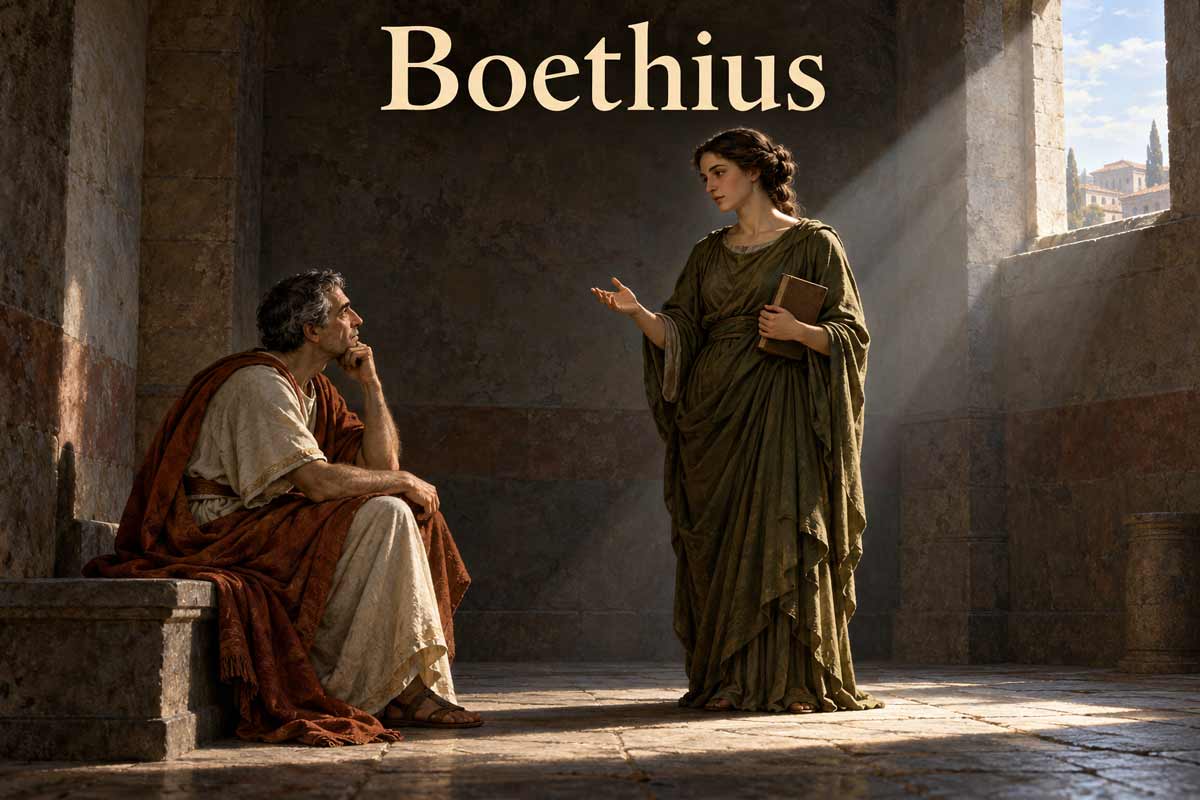
It’s easier to talk about the uncertainty of wealth and power while you still have both. Boethius had been a prominent Roman statesman with an impressive education and a respected family. Then he was accused of treason, imprisoned, and eventually executed. His best-known book asks what remains worth trusting when the things that once made life comfortable have been taken away. That gives The Consolation of Philosophy a seriousness that an ordinary discussion of happiness might lack.
Boethius lived during the transition from the ancient Roman world to the medieval period. Born in the late fifth century, usually dated around 480, he died in the 520s; the precise dates remain disputed. He was a Christian thinker deeply familiar with Greek philosophy, and his work helped later Latin readers inherit that intellectual tradition. He’s often remembered for the book he wrote in confinement, but his translations, logical writings, and theological works also shaped the education of generations who came after him.
A Roman Scholar in a Changing World
Boethius belonged to the Roman aristocracy and lived in Italy under Theodoric, the Ostrogothic king. The western imperial government had fallen, but Roman institutions, educated families, and habits of administration hadn’t simply disappeared. Theodoric governed through a political arrangement that preserved much of that older world. Boethius could therefore live as a Roman scholar and public official even though Italy was ruled by a Gothic king. The transition between historical periods was considerably messier than the neat dividing lines on a classroom timeline.
His knowledge of Greek allowed him to study works that many Latin readers couldn’t access directly. He undertook an ambitious project involving Plato and Aristotle, although he never completed the whole plan. His translations and commentaries on logic became especially important in medieval education. Preserving an argument, explaining its vocabulary, and making it available in another language can have consequences far beyond the translator’s own lifetime. Boethius helped supply later thinkers with tools they would use to ask questions he never lived to hear.
He also wrote on arithmetic and music, subjects understood within an ancient tradition concerned with number, proportion, and order. His intellectual interests weren’t confined to what we now place in the philosophy department. They reflected a broader conviction that reasoning could disclose relationships within the world. For Boethius, learning how to argue and learning how things fit together were closely connected activities.
Power and Imprisonment
Boethius rose to a senior position in Theodoric’s government, but his political standing eventually collapsed. Accusations of treason arose in a setting of suspicion between the Gothic court and members of the Roman elite. He maintained his innocence and presented his public service as an effort to oppose corruption and protect others. His account deserves attention, while remembering that the Consolation is a literary work told from the prisoner’s perspective rather than a complete record of the proceedings. The circumstances of his condemnation remain less clear than the fact that his career ended in imprisonment and death.
This background helps explain the questions that drive the book. Boethius isn’t merely disappointed because he missed a promotion. He believes he tried to do what was right and received ruin in return, while less deserving people prospered. If the world is governed by a good God, how can that happen? The problem of evil becomes particularly difficult when it concerns the people who accused you and the authorities who hold your life in their hands.
The Visitor Called Philosophy
The Consolation of Philosophy presents an imagined conversation between the imprisoned Boethius and a woman who personifies Philosophy. Prose discussions alternate with poems, giving the book a different rhythm from a philosophical textbook. Philosophy arrives as a teacher and healer who finds her former student overwhelmed by grief. She doesn’t begin by handing him an argument and telling him to get over it. The conversation gradually challenges the beliefs that have made his loss seem like the destruction of everything good.
We should distinguish the author from the distressed character who bears his name. Boethius has constructed a dialogue in which objections can be raised, assumptions examined, and answers developed. Philosophy’s voice also draws on traditions older than Christianity, especially Platonic thought. The literary form lets the reader watch a process of correction rather than simply receive a list of conclusions. It invites us to notice how our judgment can change when fear and disappointment stop deciding every question in advance.
The Trouble with Fortune
One of the book’s central themes is the instability of Fortune. Wealth, office, reputation, and influence may arrive, but none comes with a promise of permanent possession. Philosophy challenges Boethius for treating these uncertain gifts as if they belonged to him securely. Their loss is painful, but their ability to disappear reveals something about what they were all along. A thing that can be taken away without your consent makes a precarious foundation for lasting happiness.
That criticism doesn’t require us to pretend that poverty and imprisonment are pleasant. Money can meet real needs, and political power can be used responsibly. The question is whether possessing them makes a person genuinely good or guarantees a fulfilled life. We still confuse those categories when we treat popularity as evidence of wisdom or financial success as proof of divine approval. Boethius asks us to examine what we’ve allowed outward circumstances to tell us about our worth.
The book also recognizes that adversity can expose relationships more accurately than prosperity does. People who enjoy being near someone influential may disappear when influence disappears. Losing their company hurts, but it can distinguish loyalty from convenience. That observation should encourage discernment rather than suspicion of everybody who offers help. A difficult season can reveal genuine friendship as well as expose its imitation.
Happiness and the Highest Good
Philosophy leads Boethius beyond unstable goods toward the question of complete happiness. People pursue different things because they believe those things will satisfy some need, whether for security, recognition, or pleasure. Yet each ordinary possession proves limited, and the pursuit of one can undermine another. Power may bring fear, wealth may create anxiety, and fame may leave a person dependent on the judgment of strangers. The book argues that genuine happiness must be found in a good that doesn’t suffer from these defects.
That highest good is identified with God. The argument belongs to a Platonic account in which particular goods depend on a perfect source of goodness. Readers don’t need to accept every philosophical step to recognize the question it raises. Can a life be made secure by accumulating things that are themselves insecure? Christians can connect that question with biblical warnings about trusting riches, while still examining Boethius’s reasoning instead of treating a familiar conclusion as proof that every premise is sound.
Evil and the Appearance of Success
Boethius presses the difficulty that wicked people often seem powerful while good people suffer. Philosophy responds by challenging the equation between power and the ability to obtain whatever one desires. Someone governed by destructive appetites may dominate other people while remaining unable to govern himself. Evil damages the person who practices it, even when his behavior brings money or political advantage. Outward success doesn’t make that damage disappear.
This is a moral argument about what wrongdoing does to its agent, and it shouldn’t be used to minimize what wrongdoing does to its victims. An abusive ruler can be spiritually disordered and still inflict terrible harm. Saying that his apparent success isn’t genuine happiness doesn’t rescue the people he imprisons. A Christian reading should preserve Boethius’s insight about the corruption of character while retaining the biblical call to defend the vulnerable and confront injustice.
Providence and Human Freedom
The book’s later discussions ask how divine government relates to the changing events of human life. Boethius distinguishes providence, the ordering understood in the divine mind, from the unfolding of that order within time, which he calls fate. The vocabulary can mislead modern readers who associate fate with impersonal forces or a reason to give up. He is trying to explain how temporal events belong within a greater order, although that explanation immediately raises questions about whether our choices are really free.
The sharpest question concerns God’s knowledge. If God knows without error what I will choose tomorrow, it seems impossible for me to choose anything else. Yet if I must choose that way, how can I be responsible? Boethius takes the objection seriously because moral judgment, reward, punishment, and prayer all depend on the kind of agency human beings possess. Merely saying that God knows everything doesn’t explain how knowledge and freedom fit together.
His answer appeals to divine eternity. God, on this account, doesn’t move from yesterday through today toward a future he hasn’t yet experienced. He knows the whole of temporal life in an eternal present. What we call foreknowledge is therefore unlike a human prediction made at an earlier moment. God sees an action without making its occurrence a compelled choice, just as observing someone walk doesn’t force that person to walk.
The comparison helps explain the distinction between knowing and causing, but it doesn’t settle every objection by itself. God’s infallibility raises questions that ordinary human observation doesn’t raise, and the claim that God is timeless also requires consideration. Boethius wants to maintain both God’s complete knowledge and meaningful human choice. Christians can appreciate that purpose without pretending that a few sentences have resolved a debate that has occupied thinkers for centuries. His contribution is a serious account to examine, rather than a label to attach to anyone who believes in free will.
A Christian Book with an Unusual Silence
Boethius was a Christian, and his theological writings address the Trinity and the person of Christ. Yet the Consolation offers remarkably little explicitly Christian teaching. Its central conversation doesn’t turn to Christ’s death and resurrection or develop its answers through biblical exposition. That silence has prompted different interpretations of what Boethius intended philosophy to accomplish. It shouldn’t simply be treated as evidence that he abandoned Christianity before his death.
His theological works show a concern for distinctions that might otherwise sound like verbal hairsplitting. In discussing Christ, he examined the difference between nature and person and defended the union of divine and human natures in one person. Those terms help Christians explain how Jesus can truly be divine and truly human without becoming two separate individuals. We can recognize the usefulness of such clarification while remembering that philosophical vocabulary serves an explanation of faith; it doesn’t replace the biblical witness on which the explanation depends.
For a Christian reader, the relative silence of the Consolation also reveals the limits of reading it as a complete account of hope. Its arguments about goodness and providence can challenge false expectations and help us think clearly. Christian hope also concerns resurrection and God’s action in history, not simply a more accurate assessment of unstable possessions. We can receive what the book offers without expecting it to do the work of the Gospels or the apostolic letters.
Reading Boethius Today
The Consolation of Philosophy is the best place to begin because its questions are recognizably human even when its philosophical language is unfamiliar. Read the objections as carefully as the answers, and remember that the conversation develops across the whole book. Its arguments about happiness, evil, and divine knowledge deserve patient attention rather than a search for an encouraging quotation. Boethius belongs at the meeting point of Ancient Philosophy, Medieval Philosophy, and Christian Philosophy because his work carries older intellectual traditions into a later Christian world.
The circumstances of the book keep its questions from becoming merely academic. Boethius had to consider what goodness meant when good conduct hadn’t protected him from disaster. We may disagree with parts of his explanation, but the distinction between being good and being fortunate remains worth making. A person can lose influence without losing integrity, and prosperity can conceal a life badly damaged by the pursuit of it. Boethius asks us to judge the things we depend on before their disappearance forces the question upon us.