

Most of us go through the day assuming that the world will behave much as it did yesterday. We expect a chair to support us, a fire to burn, and a familiar road to take us where it usually takes us. David Hume wanted to know what justified that confidence. Experience tells us what has happened, but how does it establish what must happen next? That question led him into an examination of human knowledge that still troubles philosophers, and it also shaped his criticism of some familiar arguments for religious belief.
Christians often encounter Hume through his argument against believing reports of miracles. That argument deserves attention, but it belongs within a much broader account of human nature. Hume wrote about the way we form beliefs, the role of emotion in moral judgment, and the limits of what reason can establish. He could challenge religious arguments without thinking that ordinary life should grind to a halt until every philosophical doubt had been resolved. His work is useful partly because it asks us to notice how much of our confidence rests on habits and assumptions that we rarely stop to examine.
A Thinker of the Scottish Enlightenment
Hume was born in 1711 and died in 1776. He was a Scottish philosopher whose interests extended into history, politics, and the study of human behavior. His Treatise of Human Nature, published in 1739 and 1740, attempted a broad explanation of the mind, the passions, and morality. He later presented important parts of his philosophy in more accessible works, including An Enquiry Concerning Human Understanding and An Enquiry Concerning the Principles of Morals. His reputation during his lifetime also owed much to his essays and historical writing.
Hume belongs to the Scottish Enlightenment, a period in which thinkers examined human society and its institutions with considerable confidence in the value of inquiry. His own contribution included a persistent caution about how far that confidence could take us. He wanted to study human understanding through experience and observation, rather than assuming that the mind could reason its way to complete certainty about reality. This approach makes him a major figure in empiricism, the tradition that emphasizes experience as a source of knowledge. It also makes him an awkward companion for anyone who expects philosophy to produce an airtight demonstration of everything worth believing.
Impressions and Ideas
Hume distinguishes between impressions and ideas. Impressions are our more vivid experiences, such as seeing a bright color, feeling pain, or being angry. Ideas are the less vivid contents of thought, including our recollections and imaginings of those experiences. Remembering a toothache and having one are different in a way that doesn’t require much philosophical training to appreciate. Hume uses that distinction to examine where the contents of our thinking come from.
His general claim is that our ideas derive from impressions. The imagination can combine materials in new ways, so we can picture a golden mountain without having seen one, provided we already have experience of gold and mountains. When somebody uses an obscure philosophical term, Hume therefore asks what experience gives that term its meaning. He recognizes complications in this account, but the central demand is clear enough. We shouldn’t assume that an impressive word corresponds to a clear idea simply because people have been using it for centuries.
What We Know and What We Expect
Hume distinguishes relations of ideas from matters of fact. Mathematical truths illustrate the first category: their denial produces a contradiction, and their certainty doesn’t depend on whether a particular object exists in the world. Matters of fact concern what actually happens or exists. We can imagine their being otherwise without contradicting ourselves. The sun’s failing to rise tomorrow would be an extraordinary event, but the sentence describing it isn’t contradictory in the way that an arithmetical falsehood is.
This distinction becomes important when we reason beyond what we presently see or remember. We expect future events because past experience has taught us to associate one thing with another. Fire has burned us or others before, so we expect it to burn again. But an attempt to prove that the future must resemble the past raises a difficulty. If we appeal to the previous reliability of experience, we’re using the very kind of inference whose justification is in question.
This is commonly called the problem of induction. Induction moves from observed cases toward a general conclusion or an expectation about an unobserved case. Hume asks how that movement can be justified without assuming the dependability of the pattern we’re trying to establish. He isn’t advising us to stop using experience or abandon scientific investigation. He is showing that our everyday expectations don’t possess the same kind of demonstrative certainty as a mathematical proof.
His explanation is that custom or habit leads the mind to expect the familiar connection. After repeatedly experiencing events together, we anticipate one when we encounter the other. This is an indispensable feature of human life, even though it doesn’t answer every skeptical challenge we can raise about it. Hume’s skepticism therefore coexists with an account of how people naturally think and act. Nobody needs to complete a philosophical defense of induction before deciding not to put his hand in the fire.
Cause and Effect
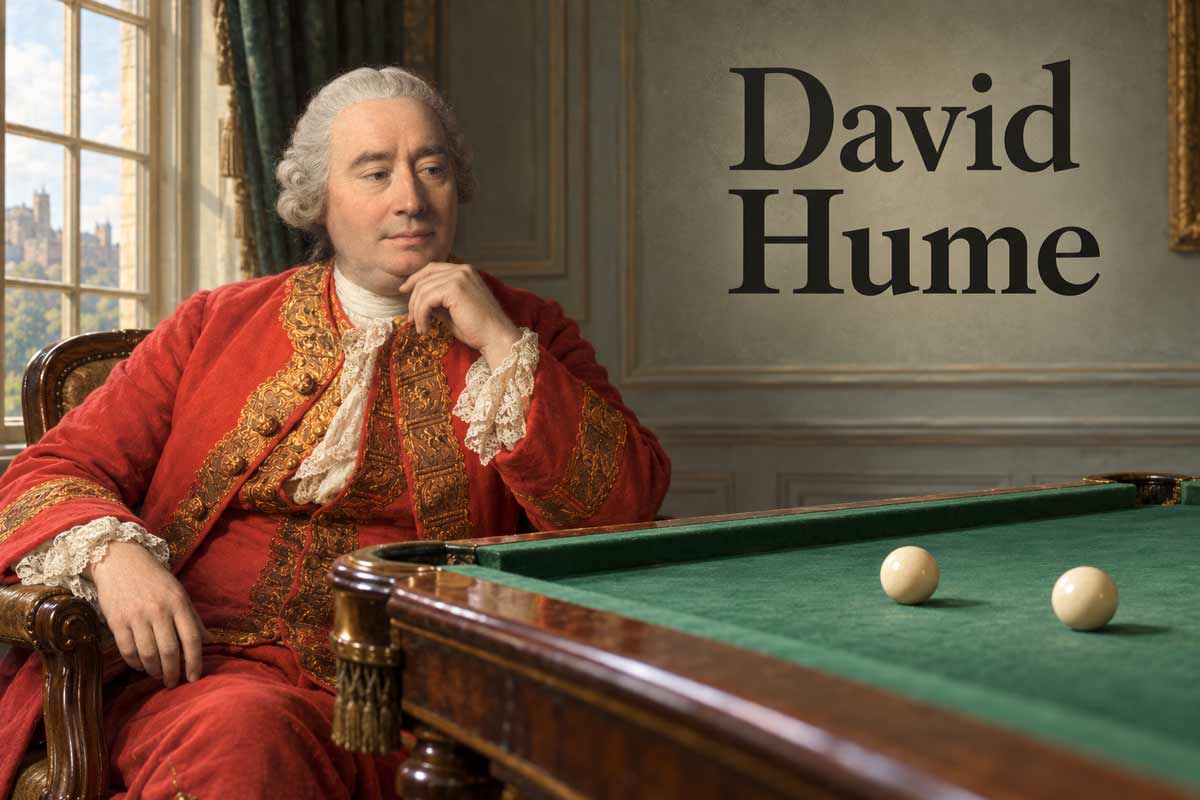
Hume applies similar scrutiny to causation. When one billiard ball strikes another and the second moves, we observe a sequence of events. We don’t also see a separate object called necessary connection, which makes the effect logically unavoidable. Repeated experience produces an expectation that the second event will follow the first under similar conditions. Hume examines that expectation as part of his explanation of what our idea of cause means.
We should be careful about summarizing this as the claim that nothing causes anything. His concern is with what experience reveals and what we are entitled to infer from it. We don’t grasp a hidden necessity merely by observing two events together. This creates difficulties for arguments that claim to reason from a cause to an effect, or from an effect to a cause, with more certainty than experience permits. It also makes Hume important for the philosophy of science, where questions about explanation and justified prediction remain central.
The Self We Think We Know
Hume also questions whether we directly experience a permanent, unchanging self underneath our mental life. When he looks inward, he finds particular perceptions, feelings, and thoughts. He doesn’t find an additional impression of a simple self existing apart from them. In the Treatise, he describes human beings in terms of a succession or collection of perceptions, which has become known as the bundle account of the self. Memory and the connections among our experiences help explain why we regard ourselves as continuing persons.
That argument challenges a straightforward claim that introspection reveals an immaterial soul as clearly as sensation reveals a color. It doesn’t settle every question about personal identity, and Hume himself later acknowledged difficulties in his treatment of the subject. A Christian reader can distinguish the experience of being a continuing person from a philosophical explanation of what makes that continuity possible. Belief in a soul requires more argument than simply insisting that we must be observing one whenever we notice our thoughts. Hume’s challenge is to explain what our experience establishes and what further conclusions we’re adding to it.
Morality and Human Feeling
Hume gives sentiment a central place in moral judgment. Reason can inform us about facts, explain consequences, and show which means will achieve a desired end. But knowing the facts doesn’t by itself supply the concern that moves us to act. A person can understand that somebody is suffering without caring enough to help. Hume thinks our approval of virtue and disapproval of vice involve the responses of human feeling, including sympathy with others.
This doesn’t amount to telling everybody to do whatever feels good at the moment. Hume examines how sympathy, a more general point of view, and the usefulness of certain qualities help shape moral approval. People can correct judgments distorted by their immediate interests and consider how a character or action affects others. Justice also involves practices and conventions that enable people to live together under conditions in which generosity alone won’t settle every dispute. His account tries to explain morality as a feature of human social life, rather than dismissing it as an illusion.
Hume’s discussion of the transition from “is” to “ought” raises a related problem. An account of how people behave doesn’t automatically establish how they should behave. The fact that people often lie, for example, doesn’t supply a reason why lying is right. Some further moral premise is needed to support that conclusion. Christians can take this warning seriously without accepting Hume’s entire moral philosophy, because describing a practice and justifying it are different tasks even when we believe moral obligations are grounded in God.
His Argument About Miracles
In the Enquiry Concerning Human Understanding, Hume examines whether testimony can justify belief in a miracle. He understands a miracle as a violation of a law of nature, with divine or other invisible agency involved in his fuller definition. Our confidence in those laws comes from extensive experience of the regular behavior of the world. Testimony, meanwhile, is also evaluated through experience, including what we know about people’s honesty and their capacity for error. A report of a miracle therefore presents us with competing considerations that must be weighed.
Hume argues that the testimony would need to be so strong that its being false would be more extraordinary than the event it reports. If somebody says a dead person returned to life, we must consider the possibility of deception or mistake alongside the claim that the event really happened. He then argues that actual miracle reports fail to meet the necessary standard. His discussion includes the human appetite for astonishing stories, the opportunities for religious enthusiasm to distort judgment, and the existence of competing miracle claims. The argument is stronger than the observation that some people lie, and answering it requires more than reminding him that witnesses sometimes tell the truth.
There is debate about whether Hume’s reasoning leaves any practical room for testimony to establish a miracle. His conditional standard initially allows us to consider what sufficiently strong evidence would require, while his broader conclusion is deeply hostile to using miracles as a foundation for religion. We shouldn’t turn that complex argument into the simple statement that he proves miracles are logically impossible. The possibility of an event and the justification for believing a report of it are different questions. Hume is principally pressing the second, even though his view of the evidence has substantial consequences for the first in practice.
Christians can question whether the appeal to uniform experience is being used fairly. If reports of exceptions are dismissed simply because they are exceptions, the argument can become circular. Still, a critic of Hume must show that this is actually happening, rather than treating every appeal to ordinary experience as a prejudice. The normal course of nature gives us good reasons to investigate an unusual claim carefully. Evaluating a report also requires attention to its specific evidence and to whether the background we use to assess it allows for God’s existence and action.
Belief in an all-powerful God makes a miracle possible, but it doesn’t establish that any particular miracle report is true. A Christian can affirm divine healing while recognizing the need for reliable medical information and careful testimony. The resurrection of Jesus likewise requires examination of the relevant historical evidence, rather than an appeal to the mere possibility of resurrection. Hume’s challenge can help us distinguish conviction from an insufficiently examined report. We don’t defend Christianity well by accepting every extraordinary story that happens to support something we already believe.
Design and the Problem of Evil
Hume’s Dialogues Concerning Natural Religion, published after his death, examines arguments about God through a conversation among different characters. Cleanthes argues from the apparent order of the world toward an intelligent designer. Demea emphasizes God’s incomprehensibility, while Philo subjects the reasoning to skeptical criticism. Their roles matter because we shouldn’t treat every sentence spoken by one character as a direct declaration of Hume’s settled position. The dialogue allows competing arguments to develop and exposes tensions among them.
One difficulty concerns how much the analogy with human workmanship can establish. We know that houses have builders because we have experience of houses being built. We don’t have the same experience of universes being constructed, and an inference to something like intelligence wouldn’t by itself establish all the attributes Christians ascribe to God. The dialogue also asks how suffering fits with the claim that the world’s maker is perfectly powerful and good. These are challenges to the reach of particular arguments, and a Christian response needs to explain the additional reasoning rather than assuming that the conclusion of one argument supplies a complete theology.
Hume’s criticism of religious belief makes him important for apologetics, but his religious outlook is not helpfully reduced to a caricature of a man who never considered the subject seriously. His writings show a sustained skepticism toward claims that reason or historical testimony securely establishes traditional religion. Readers disagree about the precise description of his own religious position. What is clear is that he wanted to limit the conclusions we draw when our evidence doesn’t support the certainty we claim. Christians can disagree with those limits while taking responsibility for stating their arguments accurately.
Reading Hume Today
David Hume belongs in Modern Philosophy, with connections to Epistemology, Ethics, and Philosophy of Religion. The Enquiry Concerning Human Understanding is a useful starting point because it presents major questions about experience, causation, and miracles more compactly than the Treatise. The Dialogues Concerning Natural Religion is valuable for readers interested in arguments for God and the problem of evil. Reading him alongside philosophers who defend stronger claims for reason or religious knowledge helps reveal where the disagreements actually lie. His work rewards patience because an argument that initially sounds destructive may also contain an explanation of how ordinary belief continues.
Hume makes us examine the distance between what we believe and what our stated reasons establish. That examination applies to skeptics as well as believers, since ordinary life and scientific inquiry also depend on expectations that aren’t mathematical certainties. Christians don’t have to accept his account of knowledge or morality in order to recognize the value of careful distinctions. We can investigate miracle claims without denying God’s power and acknowledge the limits of one argument without abandoning every reason for faith. A confident answer to Hume begins with understanding the question he is actually asking, rather than the easier one we might prefer to answer.