

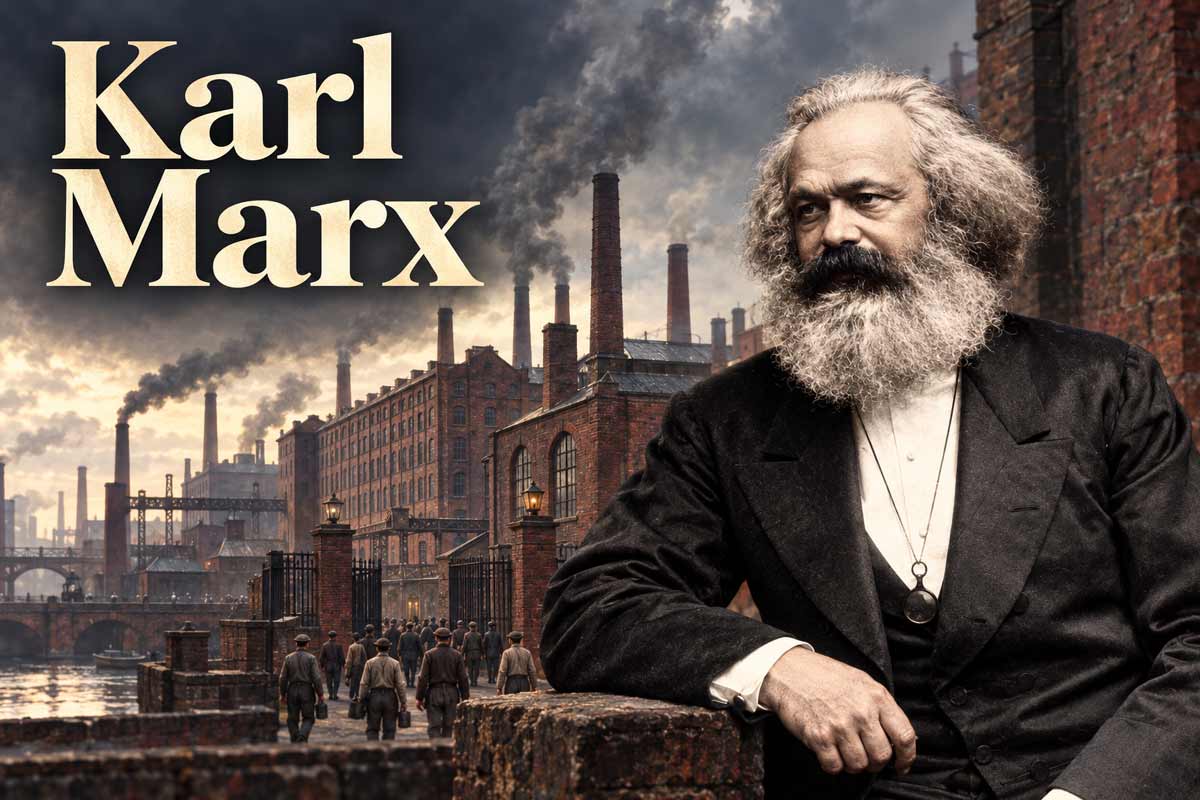
Karl Marx is one of those thinkers whose name often arrives in a conversation before his ideas do. Someone proposes a government program, criticizes a corporation, or mentions economic inequality, and somebody else announces that it’s Marxism. Sometimes the label fits, but often it serves as a substitute for finding out what the person actually said. Marx offered a particular explanation of history, capitalism, and human freedom, together with a revolutionary alternative. Understanding that explanation gives us a better basis for judging both his influence and the claims made in his name.
For Christians, Marx raises questions that we can’t dismiss merely because we reject his answers. What happens when economic arrangements reward people who control resources while leaving others vulnerable? Can religious teaching comfort the suffering while also helping the powerful avoid accountability? Marx examined those problems through an atheistic framework that treated human emancipation as something to be accomplished within history. Christianity has a different understanding of God, human nature, and salvation, but responding well to Marx requires us to address the suffering he was trying to explain.
A Philosopher in an Industrial World
Marx was born in Trier in 1818, in what is now Germany, and died in London in 1883. He studied philosophy, worked as a journalist, and became involved in revolutionary politics. Friedrich Engels became his close collaborator and provided substantial financial support during his years of research and writing. Together they published The Communist Manifesto in 1848. Marx published the first volume of Capital in 1867, while Engels later prepared additional volumes from his manuscripts after Marx’s death.
The world Marx studied was being transformed by industrial production. Factories could produce goods on a scale earlier generations had never imagined, while workers frequently faced exhausting hours and precarious living conditions. Legal freedom didn’t necessarily give a person meaningful bargaining power when the alternative to taking a job was going hungry. Marx wanted to understand how a system capable of producing extraordinary wealth could also reproduce dependence and insecurity. His criticism developed from that tension, rather than from the simple belief that machines, trade, or productive work were bad.
Marx drew heavily on Hegel, whose philosophy interpreted history through conflict and development. He also engaged with British political economy and the socialist movements of his time. He shifted attention toward the material conditions under which people lived and worked, asking how those conditions shaped their institutions and ideas. Philosophy, in his view, should contribute to changing the world rather than remain content with interpreting it. His books therefore combine analysis with a political purpose, and we misunderstand them if we read them as detached observations from someone who had no preferred outcome.
History and Material Conditions
Marx’s approach to history is commonly called historical materialism. Here, material refers especially to the practical organization of life: how people produce what they need, who controls productive resources, and how labor is arranged. A society organized around landowning aristocrats and agricultural labor will develop differently from one organized around factories and wage employment. Marx believed those relationships helped explain its laws, political institutions, and prevailing beliefs. To understand what a society says about itself, we need to examine how it actually sustains itself.
He described an economic foundation upon which a legal and political superstructure develops. That language can sound as though every sermon, law, or painting is mechanically determined by the economy. Marx’s historical writings are more complicated than that simplified formula, and later Marxists have disagreed about how strong the relationship should be understood to be. Still, he gave economic relationships a fundamental explanatory role. The question is whether that role helps illuminate history or becomes so dominant that religious conviction, moral choice, and other motives are interpreted mainly as expressions of material interests.
There is something useful in asking who benefits from an arrangement that everyone is told to regard as natural. People with power can become remarkably convinced that the system which benefits them is also the only sensible system available. Churches aren’t immune to that temptation, especially when they depend on influential patrons. But identifying someone’s interests doesn’t by itself settle whether his argument is true. A wealthy person can make a sound argument, a poor person can make a mistaken one, and either can act from motives that don’t fit neatly into an economic explanation.
Class Conflict and Capitalism
In The Communist Manifesto, Marx and Engels presented class struggle as a central force in history. Under capitalism, the main conflict is between the bourgeoisie, who own and control the means of production, and the proletariat, who depend on selling their capacity to work. The means of production include resources such as factories, machinery, and land used in producing goods. These terms concern people’s relationship to production, rather than simply dividing everyone into the rich and the poor. A worker with a relatively good income may still occupy a different position from an owner who controls the business and its output.
Marx believed that this relationship generated conflict even when individual employers were personally decent. Owners had incentives to contain costs, increase productivity, and compete successfully, while workers sought better compensation and conditions. A kindhearted factory owner couldn’t simply ignore competitive pressure indefinitely. Marx therefore directed his criticism at the structure of capitalist production, rather than treating every problem as the result of an unusually nasty boss. His proposed remedy would change ownership and control, which is much more extensive than asking employers to be generous.
He also recognized capitalism’s extraordinary productive achievements. The bourgeoisie had transformed production, expanded markets, and disrupted older forms of hierarchy and dependence. Marx wasn’t calling for a return to feudal society or a world without industrial technology. He believed capitalism developed productive capacities that could eventually support a different social order. His argument was that a system which had helped create those capacities would become an obstacle to using them for human freedom.
Alienation and the Meaning of Work
Alienation is one of Marx’s most important philosophical ideas. He argued that workers under capitalism become separated from the products they create, the activity of producing them, other people, and the human capacities that work ought to express. A person may spend his life making things he doesn’t control through a process he has little power to shape. His productive ability becomes something another person purchases and directs. Marx saw this as a distortion of an activity that could otherwise express creativity and contribute meaningfully to shared life.
This criticism goes deeper than disliking a job or wanting a larger paycheck. In Marx’s account, a worker can be relatively well paid while still having little control over the purpose and organization of his work. Christians can recognize that people should be treated as more than replaceable units of production. Scripture gives work dignity while also describing the frustration and toil associated with a fallen world. The difference becomes important when we ask whether reorganizing ownership can eliminate those deeper frustrations, or whether the problem includes human brokenness that persists under any economic arrangement.
Exploitation and Surplus Value
Marx’s economic account distinguishes labor from labor power, the worker’s capacity to perform labor. The capitalist purchases that capacity through wages and then puts it to use in production. Marx argued that workers can create more value during the working day than the value represented by what they receive in wages. The additional value is surplus value, which the capitalist appropriates. Exploitation, in this technical sense, can therefore occur even when the employer pays the agreed wage and breaks no law.
This argument depends on Marx’s account of value, which connects the value of commodities with the socially necessary labor time required to produce them. That means labor under prevailing conditions and ordinary levels of skill and productivity, rather than whatever time a particular person happens to spend. Taking twice as long to make a chair doesn’t automatically make it twice as valuable in his theory. We also need to distinguish his concept of value from a claim that every market price directly equals the number of hours worked. The relationship between value, prices, and profit is a more complicated part of his economic analysis.
We can question whether this account adequately explains the contribution of investment, organization, and risk without pretending that unfair treatment of workers is imaginary. A business needs resources before it can produce anything, and someone must organize its activity and accept the possibility of loss. At the same time, the existence of those contributions doesn’t justify every wage arrangement or use of economic power. Christians shouldn’t have to choose between calling all profit theft and treating every profitable business practice as morally acceptable. Economic analysis and moral judgment both require more care than that.
The Revolutionary Alternative
Marx sought the abolition of capitalist private ownership of the means of production. That proposal shouldn’t be reduced to the claim that nobody would be allowed personal belongings. His target was a form of property that enabled an owning class to direct production and appropriate its results through wage labor. Collective control would, he believed, remove the basis of that class relationship. The proposal reaches much further than public assistance, regulation, or a government providing certain services within an economy that retains private businesses.
In his Critique of the Gotha Programme, Marx distinguished between an initial phase of communist society and a more developed phase. The initial phase would still bear features inherited from capitalism, including a distribution tied to individual contributions after common needs had been provided for. In the higher phase, productive abundance and transformed social relationships would permit distribution according to need. He associated that possibility with people contributing according to their abilities. His vision therefore assumed significant changes in how people worked and related to one another, rather than simply an immediate order to divide all existing wealth into equal portions.
Marx also described a transitional dictatorship of the proletariat, meaning political rule by the working class during the transformation of society. The expression doesn’t by itself amount to a detailed plan for the later Soviet one-party state. Nevertheless, his commitment to revolutionary power raises questions about coercion and accountability that cannot be waved away. Who decides which policies represent the workers, and what happens to workers who disagree? Announcing that power is being exercised on behalf of the people doesn’t guarantee that the people will be able to remove those exercising it.
Religion as the Opium of the People
Marx’s description of religion as the “opium of the people” is often repeated without its surrounding argument. He regarded religion as both an expression of suffering and a protest against it. Faith offered consolation in a painful world and could express a longing for justice that existing society failed to provide. Opium could relieve pain, and that function is part of the comparison. Marx’s objection was that religious consolation depended on an illusion and could help people endure conditions that needed to be changed.
His argument therefore involved more than accusing every minister of knowingly inventing religion to control the poor. Religious people could sincerely believe what they taught and genuinely care about those who suffered. Marx nevertheless treated their faith as a human response to conditions of alienation, rather than a response to a real God. He wanted to overcome the circumstances that made religious consolation necessary. The Christian disagreement reaches the foundation of that explanation: God isn’t made unreal because people turn to him in distress.
Explaining why someone finds a belief comforting doesn’t establish whether the belief is true. A person may hope a missing family member is alive because the alternative is unbearable, but that emotional motive doesn’t tell us whether the family member is actually alive. In the same way, identifying a psychological or social function of religion cannot settle the question of God’s existence or Christ’s resurrection. Those claims require examination on their own grounds. Marx’s interpretation of religion assumes an answer to a question that his account of religion’s social role cannot by itself resolve.
However, Christians should take seriously the criticism of religious comfort used to excuse injustice. Telling an exploited worker that heaven will make everything right can become a convenient way to avoid asking whether we’re treating him rightly now. Biblical hope doesn’t give employers permission to withhold wages or churches permission to ignore suffering. James condemns the withholding of workers’ pay, and the prophets repeatedly confront those who exploit the vulnerable. A church that offers spiritual reassurance while protecting abusive arrangements has a problem that deserves correction even when the critic offering the diagnosis is an atheist.
Marx and the Movements That Followed
Marx’s writings helped inspire revolutionary parties and states, most famously the Soviet Union. Later leaders developed distinct strategies and institutions that Marx himself had never fully described. Marxism also produced competing interpretations, including approaches that rejected the repression associated with communist regimes. We should therefore distinguish Marx’s texts from every policy adopted by people who claimed his authority. The distinctions help us make precise judgments about where later developments followed his arguments and where they added something of their own.
Those distinctions don’t make the history irrelevant. Soviet authorities confiscated church property, closed religious institutions, and persecuted believers, alongside broader campaigns of political repression. A promised liberation could coexist with power concentrated in officials who decided what liberation required. That history gives practical urgency to questions about the transition Marx envisioned and the safeguards he left insufficiently developed. A theory that opposes domination needs to explain how its proposed remedy will prevent a new group from becoming dominant.
Nor does every proposal to address poverty qualify as Marxism. Labor protections, assistance for the vulnerable, and criticism of concentrated wealth can arise from Christian convictions or other political traditions. Christians can disagree about which policies work without treating concern for the poor as evidence of communist sympathies. We should examine a proposal’s actual assumptions about ownership, authority, and human nature. Calling everything we dislike Marxist makes it harder to explain what is distinctive about Marx when the distinction really matters.
A Christian Assessment of Marx
Marx belongs in Modern Philosophy, especially in discussions of political philosophy, economics, and the philosophy of religion. His influence reaches well into contemporary thought, but he was a nineteenth-century thinker addressing the industrial society of his time. His strongest questions concern how power operates through economic relationships and whether formal freedom is enough when people lack practical alternatives. Christians can engage those questions while rejecting his treatment of God as a human invention and his expectation that emancipation can be accomplished through a transformation of material conditions. Fair criticism allows us to recognize a problem without accepting the proposed cure.
Christianity locates human wrongdoing more broadly than any single class relationship. Owners can exploit workers, workers can act unjustly, and revolutionary leaders can become oppressive. Institutions can restrain or encourage those tendencies, so reform matters, but changing ownership doesn’t automatically change the heart. If we take sin seriously, every arrangement of political and economic power needs accountability. Nobody becomes safe to trust with unlimited authority simply by announcing that he represents the oppressed.
The Christian response to Marx should include both an explanation of why his worldview is inadequate and a visible commitment to people who suffer. Our hope rests in God’s redemption through Christ, and that hope gives us reasons to act responsibly toward our neighbors now. We can defend the truth of the gospel while admitting when Christians have used religious language to protect their own interests. Marx was wrong to treat faith as an illusion, but Christians can make his criticism sound plausible when our concern ends with defending the arrangement that benefits us. The answer should be evident in how we live as well as in what we argue.