

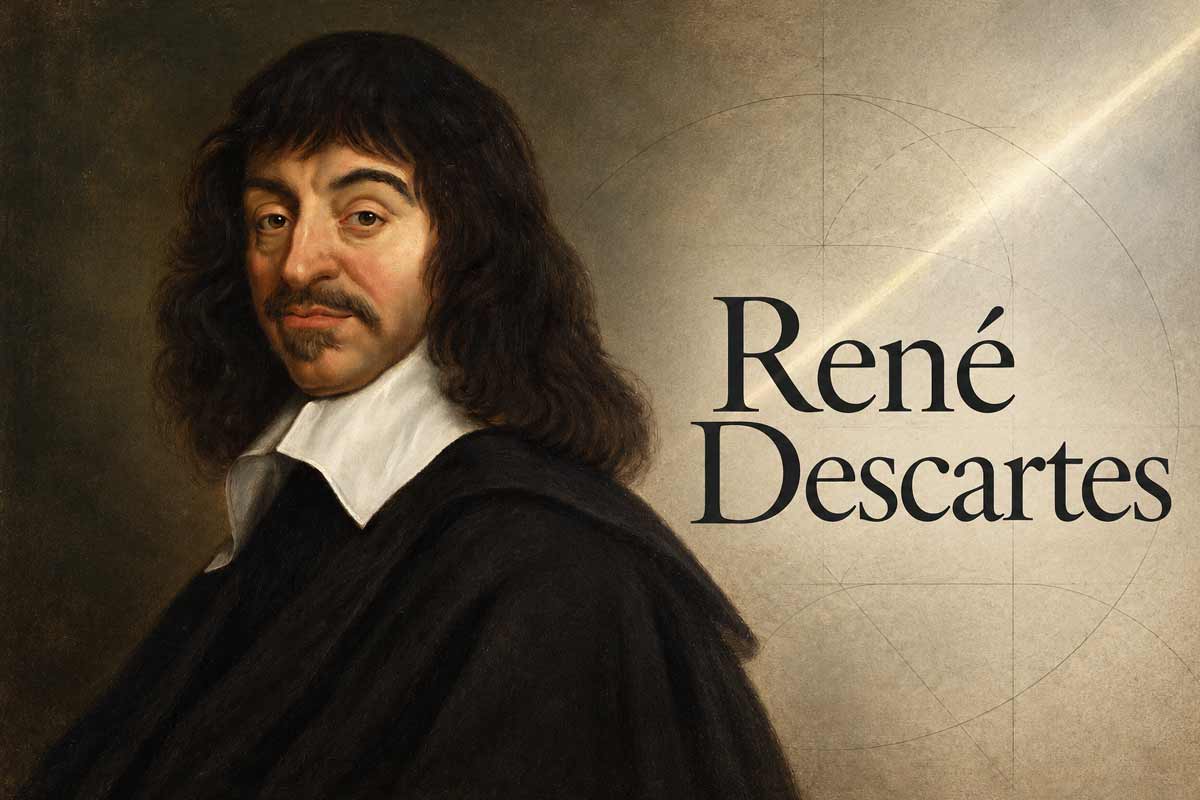
“I think, therefore I am” is one of the few philosophical statements almost everybody recognizes. It’s also easy to misunderstand. René Descartes wasn’t claiming that thinking creates our existence, or that people who don’t think very much cease to exist. He was looking for a truth that could survive the most extreme doubts he could construct. Even if he were mistaken about everything else, the very act of doubting meant there had to be someone doing the doubting.
Descartes lived from 1596 to 1650 and became a major figure in early modern philosophy, mathematics, and the study of nature. His questions concerned how we know anything, what the mind is, and whether the physical world can be understood through mathematical laws. God also occupied a central place in his philosophical system. Reading him as a man who simply replaced faith with reason misses both his religious commitments and the job he expected belief in God to perform within his arguments.
An Educated Man with Doubts about Education
Descartes was born in France and received a substantial education at the Jesuit college of La Flèche. He learned within a tradition strongly influenced by Aristotle, although his studies also introduced him to other ancient thinkers and to mathematics. He later earned a law degree, traveled, and spent much of his productive life in the Netherlands. His intellectual development took place during a period when inherited accounts of nature faced challenges from new discoveries and methods. He wanted foundations strong enough to support a more reliable body of knowledge.
His dissatisfaction with the schools didn’t amount to a belief that educated people had nothing useful to teach. The problem was that accomplished thinkers could defend conflicting positions without producing the kind of certainty he admired in mathematics. If the foundations remained unsettled, later conclusions might inherit that uncertainty. Descartes therefore proposed examining the foundations themselves rather than merely adding another opinion to the collection. That ambition explains both the strength of his project and the considerable demands he placed on it.
A Method for Thinking Carefully
The Discourse on the Method, published in 1637, describes an approach to inquiry based on orderly reasoning. Descartes advises caution about accepting claims, dividing difficult problems into manageable parts, proceeding from simpler matters to more complex ones, and reviewing the work thoroughly. These are recognizable habits even for readers who have no interest in seventeenth-century philosophy. Their usefulness doesn’t depend on pretending that every difficult question can be solved as neatly as a mathematical exercise. They encourage us to identify where our confidence comes from and where a conclusion may have outrun its support.
His mathematical work helped connect geometry with algebra, contributing to the development of analytic geometry. The name Cartesian, used in expressions such as Cartesian coordinates, comes from the Latin form of his name. This background helps explain his attraction to clear starting points and orderly deductions. He had experienced how a method could open new possibilities in mathematics and hoped comparable discipline could improve other fields. The challenge was whether the kinds of certainty available in one subject could be carried into questions about God, the mind, and the world.
Doubt as an Intellectual Exercise
In Meditations on First Philosophy, published in 1641, Descartes deliberately subjects familiar beliefs to severe doubt. The senses sometimes deceive us, and dreams can seem convincing while we’re having them. How can he establish that his present experience isn’t misleading in a similar way? He eventually imagines a powerful deceiver capable of confusing even judgments that seem obvious. The purpose is to test what remains secure when ordinary grounds for confidence are temporarily suspended.
This is methodical doubt, an exercise undertaken for a particular investigation. Descartes doesn’t expect us to spend our lives unable to decide whether the door in front of us exists. He wants to expose uncertain assumptions so that knowledge can be rebuilt on firmer foundations. The imagined deceiver belongs to that test and shouldn’t be mistaken for a statement of his actual theology. His goal is to overcome skepticism, although critics have questioned whether the route he takes gets him all the way back out.
What the Cogito Establishes
The famous cogito identifies a limit to doubt. If I am thinking, even through confusion or deception, I exist while that thinking occurs. A deceiver could mislead me about the world, but deception itself would require a subject being deceived. Descartes expresses the point in different ways across his writings; the familiar “I think, therefore I am” appears in the Discourse. In the Meditations, the recognition takes the form of the certainty of his existence whenever he thinks it.
That starting point is narrower than people sometimes assume. It doesn’t immediately establish the reliability of the senses, the existence of other people, or a complete account of the self. Descartes still has considerable work to do after recognizing that he exists as a thinker. We should also distinguish the force of that recognition from the later claim that mind and body are separate substances. Being more certain that I am thinking than that I possess a body doesn’t, by itself, establish everything he later wants to say about their relationship.
The Piece of Wax
Descartes illustrates the role of the intellect through a piece of wax. Before heating, it has a particular appearance, smell, texture, and shape. Heat changes those features, yet we still judge that it’s the same wax. Our recognition therefore involves more than simply collecting an unchanged set of sensory impressions. The mind understands the wax as something capable of taking different forms.
He uses the example to argue that bodily things are known through intellectual judgment, even when we ordinarily say that we see them. The senses give us information, but understanding involves interpreting what that information means. This doesn’t require us to deny the value of observation. It raises a question about how perception and judgment work together, and about whether the mind knows itself more directly than it knows physical things. We can recognize the question without accepting every conclusion Descartes draws from it.
God in the Philosophical System
God’s existence is central to Descartes’s effort to move beyond radical doubt. In the Third Meditation, he considers his idea of an infinite and perfect being and asks what could adequately account for it. He argues that a finite, imperfect thinker cannot be the sufficient source of the reality represented in that idea. God must therefore exist as its ultimate cause. The reasoning depends on assumptions about causation and the content of ideas, so it needs more examination than the loose claim that having an idea of God proves God exists.
In the Fifth Meditation, Descartes offers a different argument associated with the ontological tradition. He maintains that necessary existence belongs to the idea of a supremely perfect being. A God lacking existence would lack a perfection and therefore wouldn’t be the being under consideration. This recalls Anselm’s effort to reason from an understanding of God to God’s existence, although the arguments aren’t identical. Their appeal depends partly on whether existence can be handled in the way the reasoning requires.
Descartes also maintains that a perfect God cannot be a deceiver. This provides the assurance he needs that properly used intellectual faculties can reach truth. He doesn’t infer that every impression or judgment is correct. In his explanation of error, our willingness to affirm or deny can extend beyond what we adequately understand. The practical warning is familiar: confidence in our ability to reason shouldn’t become permission to make confident judgments where our understanding is incomplete.
The Problem Called the Cartesian Circle
A major objection asks whether this assurance rests on circular reasoning. Descartes uses clear and distinct understanding to establish God’s existence, then appeals to God to secure the reliability of clear and distinct understanding. If each claim requires the other to be established first, the argument appears to borrow the very certainty it is meant to provide. Antoine Arnauld raised this difficulty among the objections published with the Meditations. The question concerns the structure of the proof, regardless of whether someone agrees with its conclusion.
Descartes responded by distinguishing what is clearly apprehended while the mind attends to it from conclusions recalled after that attention has shifted. His answer has generated continuing debate about exactly what certainty is available at each stage of the argument. We don’t need to settle the dispute to see why it matters. A Christian defense of God’s existence must make its reasons clear enough to be evaluated, and a familiar theological conclusion doesn’t repair a gap in the reasoning. We can appreciate Descartes’s purpose while examining whether he has accomplished it.
Mind and Body
Descartes describes the mind as a thinking substance and body as an extended substance, something occupying space. Thinking includes more than formal reasoning; doubting, willing, imagining, and sensing belong within his account of mental activity. He argues that mind and body are genuinely distinct, even though they are closely united in a human being. This position became known as Cartesian dualism. It strongly influenced later debates about consciousness and the relationship between mental life and physical processes.
The distinction creates a difficult question about interaction. If mind has no spatial dimensions and body operates through physical movement, how can a decision cause an arm to rise? How can an injured body produce the conscious experience of pain? Princess Elisabeth of Bohemia pressed Descartes on precisely this problem in their correspondence. Her questions deserve attention because she asked him to explain how the relationship could work, rather than merely repeat that the two were distinct.
Descartes insisted that the union of mind and body is a basic feature of human experience. We experience hunger, pain, and emotion as embodied persons, rather than as detached spectators watching a physical machine. Yet recognizing that interaction occurs doesn’t automatically provide a satisfactory explanation of it. His discussions of bodily mechanisms and the pineal gland addressed aspects of the relationship without making the deeper question disappear. Later thinkers inherited both his distinction and the difficulty of accounting for the connection.
Nature and the New Science
Descartes sought to explain the physical world through matter, motion, and laws, giving mathematics an important role in the investigation. That approach challenged substantial parts of the older Aristotelian account of nature. Some of his particular physical theories were later rejected, while his mathematical achievements and questions about knowledge remained influential. We should therefore resist judging the entire project by either its successes or its mistakes. An important thinker can change the questions a field asks without getting all the answers right.
His account of nature also helps explain why the mind posed such a persistent difficulty. A world described through spatial properties and mechanical processes doesn’t obviously account for conscious thought. Descartes answered by distinguishing mental substance from bodily substance. Other philosophers would respond by revising or rejecting that answer. The continuing debate over consciousness shows why his problem remains recognizable even to people who haven’t read a page of his work.
Reading Descartes as a Christian
Descartes was a Roman Catholic who intended his philosophy to support belief in God and the distinction between soul and body. His use of doubt shouldn’t be confused with an attempt to promote atheism. At the same time, his decision to begin with the individual thinker and rebuild knowledge from there raised questions that later philosophers pursued in directions he didn’t intend. A thinker’s purposes help us understand his work, but they don’t determine every consequence of it.
Christians can appreciate his insistence that inherited confidence should be examined and that careless judgment contributes to error. We should also ask whether his standard of certainty fits every kind of knowledge on which human life depends. Much of what we know comes through testimony, historical evidence, and trust that can be well grounded without amounting to mathematical demonstration. Christian belief includes claims about events and persons, so its evaluation cannot be reduced to inspecting ideas within one’s own mind. Descartes offers an approach to consider, rather than a rule that all responsible belief must follow.
The Discourse on the Method provides a useful introduction, while the Meditations lets readers follow the movement from doubt toward his proposed foundations. The objections and replies are especially valuable because they show the reasoning being challenged by other serious thinkers. Reading the argument and its criticism together helps us avoid both easy dismissal and uncritical admiration. Descartes belongs under Modern Philosophy, with strong connections to Epistemology and Philosophy of Mind.
His lasting challenge is to ask what justifies the confidence with which we hold our beliefs. We may decide that some of his proposed foundations don’t bear the weight he puts on them. We may also find that his questions expose assumptions we hadn’t recognized in our own thinking. The recognition that we exist as thinkers starts the discussion; it doesn’t excuse us from the more demanding work of deciding which thoughts deserve to be believed.