

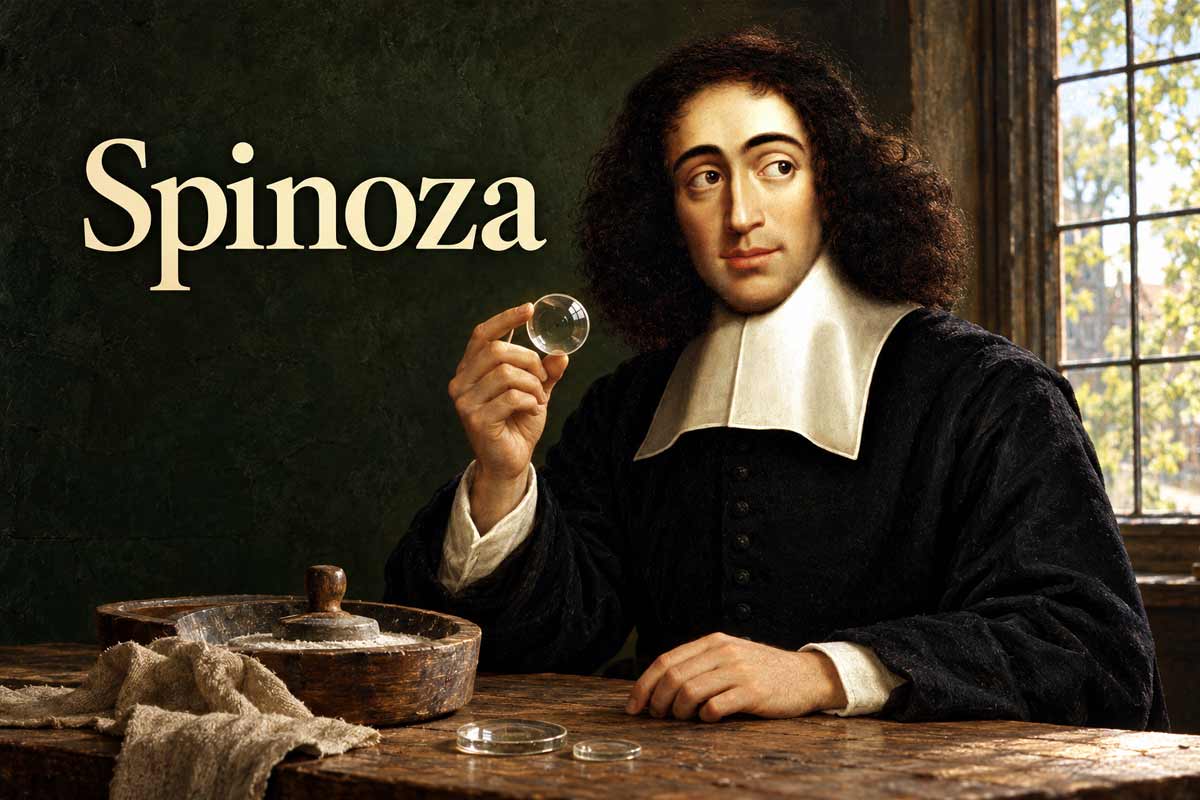
Spinoza wrote a great deal about God, but that didn’t make religious authorities comfortable with him. His philosophy challenged the idea of a personal Creator who freely brings the world into existence, responds to prayer, and acts within history. He also questioned traditional claims about biblical authorship and rejected miracles understood as violations of nature’s order. The problem wasn’t that he had forgotten to include God in his system. It was that the God he included looked very different from the God worshiped in the synagogue where he grew up or the churches surrounding it.
Baruch Spinoza belongs in Modern Philosophy as one of the seventeenth century’s major rationalists. Alongside thinkers such as Descartes, he sought an account of reality that reason could establish through a coherent system of ideas. His conclusions were unusually demanding because he tried to bring God, human beings, nature, and moral life within a single explanatory framework. Readers can admire the seriousness of that effort without accepting its foundations. With Spinoza, the first task is to understand what his words mean before deciding whether the argument behind them works.
A Break with His Community
Spinoza was born in Amsterdam in 1632 into a Portuguese-Jewish family and received a religious education within its Sephardic community. He is also known as Benedict de Spinoza, the Latin form associated with the name Baruch. Amsterdam offered opportunities unavailable in many other European settings, but religious tolerance had limits. The community that raised him maintained its own standards of belief and conduct within a wider Christian society. Those circumstances made challenges to religious authority more complicated than a disagreement between two people who could simply go their separate ways.
In 1656, when he was twenty-three, the community imposed a severe ban, or herem, on him. Its wording condemned his opinions and prohibited normal contact with him, although it didn’t provide a detailed philosophical explanation of the charges. Historians connect the break with radical religious views, but we shouldn’t assume that every proposition of his later system was already complete at that point. The consequences were nevertheless serious, separating him from the community in which he had been formed. The episode became an enduring symbol of the conflict between intellectual independence and enforced religious conformity.
Spinoza supported himself in part through grinding lenses and lived outside Amsterdam before eventually settling in The Hague. He published his Theological-Political Treatise anonymously in 1670, while his best-known philosophical work, the Ethics, appeared after his death in 1677. He declined an academic appointment at Heidelberg in 1673, preferring to preserve his independence. His relatively quiet personal life contrasts with the hostility his ideas provoked. He didn’t need a dramatic public manner to produce a dramatic philosophical challenge.
Philosophy Arranged Like Geometry
The Ethics doesn’t read like an ordinary book of advice about how to behave. Spinoza organizes it through definitions, axioms, propositions, demonstrations, and explanatory notes, following a pattern associated with geometry. The subject begins with God and moves through the mind, emotions, human bondage, and freedom. That organization reflects his conviction that moral life can’t be understood properly until we understand the reality of which we are a part. His answer to an emotional problem may therefore depend on an argument introduced much earlier about the nature of existence.
The method gives the work a strong appearance of precision, but mathematical presentation doesn’t make philosophical assumptions immune to criticism. We still have to ask whether the definitions describe reality adequately and whether each conclusion follows. A reader may reject a premise without misunderstanding the later demonstration. Spinoza’s system deserves careful examination because its claims are connected, not because putting them into numbered propositions settles the debate. Geometry is difficult enough without assuming every philosophical argument formatted like it has acquired the same certainty.
God or Nature
Spinoza’s central claim is that there is only one substance, which he identifies as God or Nature. Substance here doesn’t simply mean physical material. It means what exists in itself and can be understood through itself, rather than depending on something else for its existence and explanation. Particular things, including human beings, are modes, or determinate expressions, of this single reality. We aren’t independent substances standing outside God, and God isn’t an external maker confronting a world separate from himself.
That position is commonly described as pantheism, although interpreters debate whether the label fully captures his system. The important point is that he rejects the distinction between Creator and creation as Christianity ordinarily understands it. His Nature also means more than trees, mountains, and the visible contents of the universe. It includes the infinite reality and necessary order through which all particular things exist. Saying that Spinoza worshiped the scenery would make his teaching easier to picture, but it wouldn’t make the picture accurate.
For Spinoza, everything follows necessarily from the divine nature. God doesn’t deliberate between alternative worlds and then select one according to a plan. He also rejects the idea that nature operates for purposes designed around human needs. People observe things useful to them and then imagine that those things were arranged specifically for their benefit. Spinoza thinks this habit produces a distorted understanding of both nature and God, turning our preferences into explanations of the universe.
Christianity likewise warns against imagining God as merely a larger version of ourselves, but it doesn’t solve the problem by removing divine intention. Christians understand creation as dependent on God’s free action, with God distinct from what he sustains. God doesn’t need the world to complete his being, and his relationship with creatures includes knowledge, love, and purposeful action. Spinoza offers a different account of dependence in which everything belongs within one necessary order. The disagreement concerns God’s identity and agency, not simply how much divine power Christians are willing to acknowledge.
Mind and Body without Two Separate Worlds
Spinoza’s account of the mind also challenges Descartes’ distinction between thinking substance and extended substance. He treats thought and extension as attributes of the same infinite substance. Extension concerns the bodily or spatial order, while thought concerns the order of ideas. A human mind and its body aren’t two independent substances that somehow have to reach across a gap to interact. They express the same reality under different attributes, with the mind understood as the idea of the body.
This shouldn’t be reduced to the modern claim that nothing exists except physical matter. Spinoza doesn’t explain thought by simply eliminating it in favor of bodily processes. Both thought and extension belong to his account, and neither is a separate substance outside God. His framework avoids the particular interaction problem created by Cartesian dualism, but it raises other questions about personal identity and consciousness. Whether it resolves those questions depends on whether we accept his underlying account of substance and attributes.
Freedom in a Necessary Universe
Spinoza denies that human choices escape the causal order of nature. We often regard ourselves as freely choosing because we’re conscious of our desires without understanding all the causes producing them. Feeling strongly that an action is ours doesn’t demonstrate that it was undetermined. The same necessary order that explains other events also explains human conduct. This is a thoroughgoing determinism, although it doesn’t lead Spinoza to abandon the language of freedom.
He instead describes greater freedom through greater understanding and activity. Someone driven by confused ideas, fear, or uncontrolled resentment is less able to act through an adequate understanding of himself and his circumstances. Someone guided more fully by reason is more active, even though his actions remain within nature’s necessity. Freedom therefore concerns how an action arises and how adequately we understand it, rather than the ability to step outside causation. Christians disagree among themselves about divine sovereignty and human freedom, but Spinoza’s position shouldn’t be confused with those debates, since his entire account of God differs from theirs.
Desire and the Discipline of Understanding
Spinoza uses the term conatus for the striving by which a thing persists in its being. In human life, this striving is connected with appetite and desire, and his treatment of emotions examines changes in our power of acting. Joy and sadness concern increases or decreases in that power, while love and hatred involve those emotions together with ideas about their causes. He wants to understand emotional life through its causes rather than treat it as an embarrassing exception to nature. That ambition gives his philosophy a strong interest in the connections between knowledge, desire, and conduct.
Emotional bondage develops when we are governed by passions we don’t adequately understand. We may blame a person for all our unhappiness, pursue something because we imagine it will solve every problem, or remain trapped in a cycle of resentment. Clearer understanding can change those responses by revealing how the emotion arose and what it actually expresses. Spinoza isn’t recommending that we simply order ourselves to stop feeling. His argument is that understanding can transform the way an emotion operates within us.
He also connects rational life with cooperation, friendship, and concern for others. Living according to reason doesn’t mean discovering an ingenious justification for taking everything you want. Human beings often benefit from helping one another develop their capacities, and hatred can produce more of the very hostility we hope to escape. Christians can recognize practical insight in that analysis while retaining a different account of moral responsibility and spiritual renewal. Understanding why we act destructively can help us change, but it doesn’t by itself answer every question about guilt, forgiveness, or the help we need.
Scripture Read through History
The Theological-Political Treatise argues that Scripture should be studied through its languages, historical circumstances, and the intentions of its writers. Spinoza resists the practice of forcing a preferred philosophical system into a biblical passage and then claiming the passage proves it. He also challenges the traditional view that Moses wrote the whole Pentateuch in its received form. Passages describing Moses’ death, referring to later conditions, or looking back across time become evidence for examining how the books were composed. These arguments helped make him an important figure in the development of historical approaches to the Bible.
Believers don’t have to reject historical study to defend biblical authority. Scripture came through human authors using particular languages, literary forms, and settings, and those features affect interpretation. Recognizing later editorial material also doesn’t automatically settle every question about a book’s larger origins or its inspiration. The real disagreement grows when Spinoza connects historical examination with a framework that excludes important theological claims in advance. Questions about how a text developed and whether God revealed himself through it are related, but they aren’t identical questions.
Spinoza distinguishes Scripture’s practical religious purpose from philosophy’s pursuit of truth through reason. In his account, biblical faith principally teaches obedience expressed through justice and love of one’s neighbor. The prophets’ imaginative language addresses people in ways suited to their understanding rather than supplying a precise philosophical account of reality. That distinction allows him to affirm a moral purpose for religion while denying that religious authorities should control philosophical inquiry. Christians can appreciate the concern for conduct while questioning whether faith can be separated so sharply from the truth of what Scripture says God has done.
Miracles and the Limits of the System
For Spinoza, an event contrary to nature’s universal laws would also be contrary to the necessary divine order. Miracles therefore cannot be understood as genuine interruptions of that order. Events called miraculous arise from causes people don’t understand or are described in ways shaped by the narrator’s perspective. This conclusion follows from his account of God and nature, rather than from examining every reported miracle individually. It gives his approach consistency, but that consistency depends on the truth of the metaphysical framework that produces it.
Christian belief begins with a different distinction between God’s ordinary governance of creation and particular acts through which he reveals himself. A miracle needn’t mean that God has become inconsistent or violated something independent of him. It may mean that natural processes alone aren’t the complete explanation of an event. Christians still need to examine claims responsibly, since a surprising occurrence isn’t automatically supernatural. However, dismissing every miracle because one’s philosophy rules it out leaves the underlying philosophy doing the work that evidence would otherwise need to do.
Spinoza treats Christ with unusual respect, attributing to him an exceptional understanding of divine wisdom. Yet that respect shouldn’t be mistaken for acceptance of Christian teaching about the incarnation and resurrection. The Treatise distinguishes Christ’s immediate understanding from the imaginative forms associated with other prophetic revelation. Admirers can therefore find elevated language about Jesus while overlooking the way Spinoza’s system changes its meaning. Christianity identifies Jesus through claims about who he is and what God accomplished through him, not merely through a ranking of his moral insight.
Intellectual Love and Eternal Life
The closing part of the Ethics presents the intellectual love of God as central to blessedness. As understanding becomes more adequate, a person apprehends himself and other things through their place in the eternal divine order. This produces a form of joy and love associated with knowledge rather than dependence on changing circumstances. Spinoza connects it with God’s love of himself as expressed through the human mind. It’s a remarkable conclusion to a book often remembered principally for its technical metaphysics.
His discussion of the mind’s eternity remains difficult and disputed, but it shouldn’t be translated into an ordinary promise that our memories and personality continue indefinitely after death. Spinoza distinguishes eternity from endless duration and doesn’t offer the Christian hope of bodily resurrection and renewed personal communion with God. His blessedness also isn’t a reward added afterward to virtue; it belongs to the activity of understanding itself. The religious language is therefore significant without being interchangeable with Christian language. Recognizing that difference allows us to compare the views without pretending they promise the same future.
Freedom of Thought and Religious Authority
Spinoza argues that attempts to control people’s judgments can damage both religion and political life. A government may compel a public statement without producing genuine conviction, encouraging people to say what they don’t believe. He therefore defends substantial freedom to think and speak, while preserving limits related to public peace and lawful authority. His account isn’t identical to modern liberal democracy, and he gives the state considerable authority over public religious affairs. Nevertheless, his challenge to enforced intellectual conformity became an important part of the history of religious and political freedom.
Christians don’t have to accept Spinoza’s theology to recognize the problem of coerced belief. A church can teach doctrine, identify disagreement, and define the convictions associated with membership without assuming that civil punishment creates faith. Defending someone’s freedom to argue also doesn’t require declaring his argument true. Spinoza’s history puts those distinctions under pressure because his own conclusions were deeply threatening to the communities around him. The freedom to examine belief matters most when the examination produces something we strongly reject.
Reading Spinoza Carefully
Spinoza brings together questions that are often discussed separately: what God is, how nature operates, why we desire what we desire, and what freedom can mean. His system asks readers to reconsider familiar assumptions instead of merely adding another opinion to them. Its coherence is part of its attraction, but it also means that a disputed account of God can reshape everything that follows. Christians should resist both the temptation to dismiss him without understanding him and the temptation to accept familiar religious vocabulary as evidence of agreement. Reading Spinoza seriously makes us ask whether the God our philosophy describes is the God we believe actually exists.