

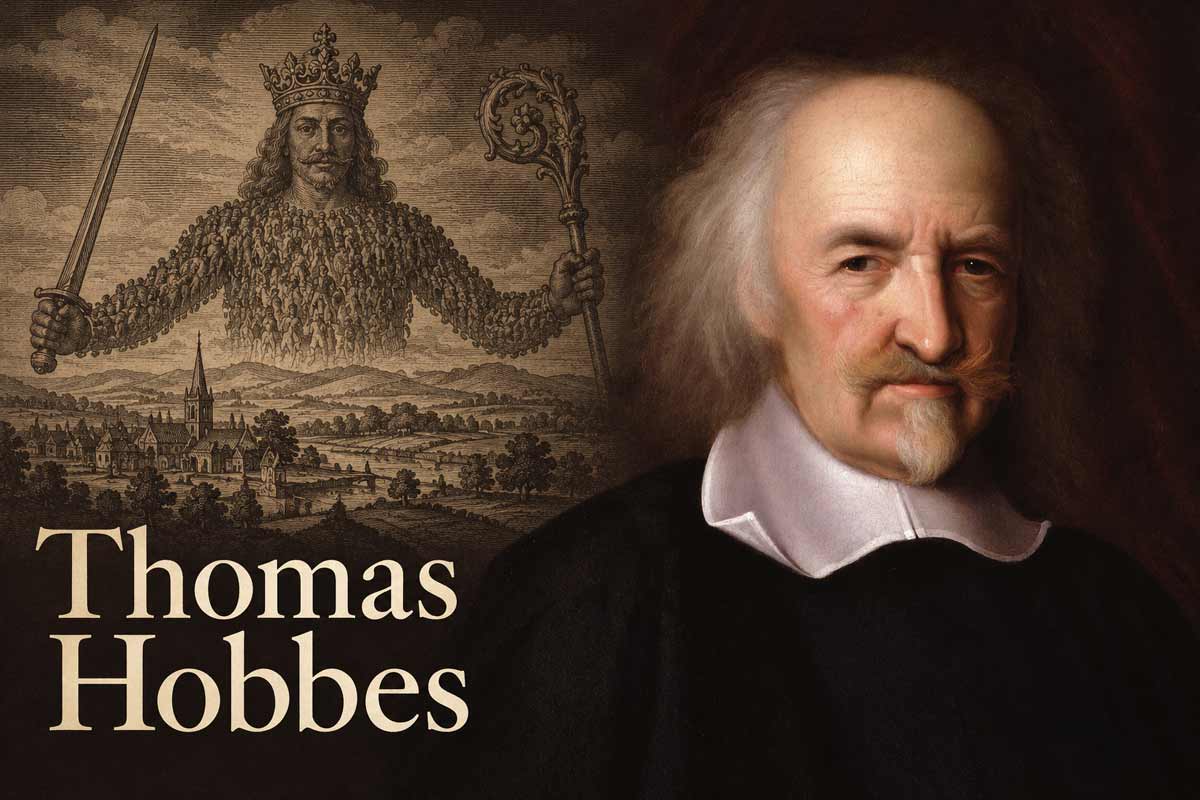
It’s easier to argue about how much government we need when we can assume that somebody will keep the roads safe and the fighting away from our front door. Thomas Hobbes didn’t think we should take that protection for granted. He lived through a period when England’s political and religious disputes helped tear the country apart, and he wanted to explain what could keep that from happening again. His answer was a sovereign authority strong enough to enforce peace, even when its subjects thought they knew better. That answer made him one of the most influential political philosophers of the modern era, and it also created problems that readers have been arguing about ever since.
Hobbes is often remembered as the philosopher who thought people were terrible and kings should have unlimited power. There’s enough truth in that summary to make it recognizable, but it leaves out the reasoning that makes him worth reading. He was concerned with what happens when people who want to survive can’t trust one another, and when competing authorities all claim the right to command obedience. His argument begins with individual vulnerability and ends with an exceptionally powerful state. Understanding how he gets from one to the other helps us see both the force of his argument and the danger in his solution.
A Philosopher Living Through Civil War
Hobbes was born in 1588 near Malmesbury in England and died in 1679. He studied at Oxford and spent much of his working life connected to the Cavendish family, initially as a tutor. That association gave him access to books, travel, and the intellectual conversations of his time. His interests included classical history, mathematics, and the emerging study of nature, as well as politics. He translated Thucydides, whose account of war and political conflict offered plenty of material for someone wondering how societies come apart.
The English Civil Wars gave those questions an immediate urgency. Conflict between the monarchy and Parliament was intertwined with disputes over worship, church government, and the authority of religious leaders. Hobbes spent years in France during this turbulent period, and his best-known work, Leviathan, appeared in 1651. England had already seen the execution of Charles I and the collapse of the monarchy. Readers didn’t need much imagination to understand what a breakdown of political order could look like.
That background helps explain Hobbes’s priorities without settling whether he was right. A person watching a country descend into civil war may become more afraid of disorder than of concentrated power. Someone living under a brutal but stable government may judge those dangers differently. Hobbes deserves to be read with his fear of collapse in view, because it explains why he was willing to give the sovereign powers that many of us would be reluctant to grant. It also gives us a reason to examine whether fear led him to accept too much.
Human Beings and the World of Matter
Hobbes approached human beings as part of the physical world. Sensation, imagination, and desire belonged to his account of bodies and motion, rather than to a separate immaterial mind of the kind defended by Descartes. He placed considerable weight on what we learn through the senses and on the role of language in organizing our thinking. Reasoning required us to use terms carefully and work through their consequences. A dispute could become hopelessly confused when people thought they were discussing the same thing while attaching different meanings to the words.
This physical account of humanity contributed to his controversial reputation, especially when he challenged familiar ways of speaking about spiritual substances. It also shaped his explanation of human action. People pursue what they desire, avoid what they fear, and try to obtain the means of living securely. Their judgments about what is good often reflect their own appetites and circumstances. Hobbes wanted to build political reasoning from an account of people as they actually behave, including the interests and anxieties that polite descriptions of society can overlook.
Life Without a Common Authority
Hobbes asks us to consider what life would be like without a common power capable of keeping people in order. This is his famous state of nature. We shouldn’t picture it simply as an archaeological claim that all humanity once lived in one particular primitive society. It’s a way of examining the condition people face when no dependable authority can settle disputes and provide security. Civil war can bring people toward that condition even after they have enjoyed an established government.
His argument begins with a kind of equality that isn’t especially comforting. Even a physically weaker person may kill someone stronger through planning or by joining with others. People can therefore threaten one another, and several may want something that they can’t all possess. Competition gives them reasons to fight, while distrust gives them reasons to attack before somebody else does. Concern for reputation can make matters worse, because appearing weak may invite further aggression.
Under those conditions, even people who would prefer peace have reasons to prepare for conflict. If I can’t count on you to leave me alone, taking precautions against you may seem sensible. You may interpret those precautions as evidence that I’m planning to attack, and respond accordingly. Neither of us has to enjoy violence for the situation to become dangerous. Hobbes’s account is more troubling than the claim that a few unusually nasty people spoil everything, because it shows how ordinary concern for safety can help produce the insecurity everyone wants to escape.
This is the setting for his description of life as “solitary, poor, nasty, brutish, and short.” He doesn’t mean that everyone must be fighting every minute. A continuing readiness for violence is enough to make normal life precarious. Farming, trade, and learning become difficult when people have no reliable assurance that they can enjoy the results of their work. You don’t need an especially bleak view of humanity to understand why planting a crop is less appealing when somebody with a weapon may take it at harvest.
Why Promises Need Enforcement
Hobbes doesn’t think reason leaves us with no way out. Fear of violent death and the desire for a more comfortable life give people reasons to seek peace. His laws of nature describe principles that guide them toward it, including keeping agreements and dealing fairly with others. These laws aren’t scientific descriptions like the laws of motion. They are rules concerning what people ought to do if they are to live together securely, and Hobbes also discusses them as laws of God.
The difficulty is that knowing peace would be better doesn’t guarantee that everybody will cooperate. A person who lays down his means of defense while others retain theirs may simply make himself an easier victim. An agreement offers little security if breaking it is profitable and nobody can enforce it. Hobbes therefore thinks a dependable common power is necessary to make cooperation safe. His point is easy enough to recognize whenever a perfectly reasonable agreement falls apart because everyone expects somebody else to cheat.
In his account of establishing a commonwealth, people covenant with one another to authorize a person or assembly to act as their sovereign. That authority represents them and has the power to enforce the peace they want. The sovereign isn’t merely another participant who signs the agreement and can then be dismissed whenever a subject believes it has been violated. Hobbes constructs the arrangement to give the public authority a position above the disputes it must settle. This is where his social contract takes a sharply different direction from theories that use consent to justify limited government.
The Power of Leviathan
The title Leviathan invokes the formidable biblical creature to describe the strength of the commonwealth. Hobbes presents the state as an artificial person whose power comes from the people united under its authority. The sovereign must be able to make law, judge disputes, punish offenses, and provide defense. If rival authorities can overrule one another whenever they disagree, he thinks the arrangement risks recreating the very insecurity government was established to overcome. Somebody must have the final authority to decide.
Hobbes preferred monarchy, but his argument doesn’t require the sovereign to be a king. An assembly can occupy the same position. His central commitment is to undivided sovereign authority, whatever form it takes. He consequently rejects the kind of constitutional arrangement in which different branches can check one another as independent holders of final power. What a modern reader may regard as a safeguard against abuse, Hobbes may regard as an invitation to paralysis or civil conflict.
He isn’t unaware that rulers can act badly. He argues that the dangers of sovereign power should be weighed against the much greater misery of losing a common authority altogether. The objection is that this comparison may leave citizens with too little protection against their own government. A ruler can preserve public order while inflicting terrible injustice, and order alone doesn’t tell us whether a political system is good. Hobbes’s explanation of why government needs power doesn’t automatically establish how much power it should have.
What Freedom Remains
Despite the breadth of sovereign authority, Hobbes doesn’t claim that subjects surrender every liberty. Where the law leaves an activity unregulated, people remain free to act according to their own judgment. More fundamentally, the drive to preserve one’s life cannot simply be signed away. A person retains the liberty to resist a direct threat to his life, even when it comes from the sovereign. Hobbes’s account therefore contains qualifications that disappear when we summarize it as absolute obedience under every conceivable circumstance.
Protection also explains the continuing obligation to obey. When the sovereign loses the ability to protect its subjects, that obligation does not continue indefinitely just because the old ruler still claims a title. People may have to seek safety under another authority. This isn’t a general permission to overthrow the government whenever a policy displeases them. It does show that Hobbes grounds political allegiance in the work government does for vulnerable people, rather than in an unconditional attachment to a dynasty.
Those qualifications create tensions within his theory. Subjects retain an interest in survival that even the sovereign cannot eliminate, yet Hobbes wants to prevent private judgment from repeatedly dissolving public authority. We can see why he struggles with the boundary. If obedience has no limits, the state can destroy the people it was meant to protect. If every disagreement permits resistance, the common authority may cease to function at all.
Government and Religion
Religion occupies a large part of Leviathan, because Hobbes knew that political conflict could involve rival claims about what God requires. A ruler might command one thing while a church authority commanded another, and both might demand obedience on pain of severe punishment. Fear of eternal punishment could outweigh fear of the civil magistrate. For Hobbes, any institution able to direct subjects against the sovereign presented a serious threat to peace. He therefore wanted religious authority brought under the same public authority that governed the commonwealth.
In a Christian commonwealth, his sovereign has extensive authority over public religious teaching and church government. This goes well beyond preventing religious groups from committing violence. It places the public administration of religion under civil control, while recognizing that inward belief cannot simply be produced by command. Hobbes treats the confession that Jesus is the Christ as the central necessary article of Christian faith, together with the repentance and obedience he considers necessary for salvation. He also argues that other Christian beliefs are contained in or follow from that confession, so we shouldn’t reduce his position to the claim that nothing else in Christianity matters.
Hobbes was accused of atheism, but that label requires care. His writings speak about God and offer extensive interpretations of Scripture, even while departing from important elements of traditional Christian thought. Readers have disagreed over how to understand his religious commitments. We can evaluate what he actually argues without pretending that a short label settles the question of his private belief. His attempt to make religious teaching serve a comprehensive theory of civil authority is controversial enough on its own.
From a Christian perspective, the difficulty is that obedience to government has limits grounded in obedience to God. Romans 13 recognizes the role of governing authorities, while Acts 5:29 records the apostles’ insistence that they must obey God rather than men. A church can acknowledge the legitimate work of government while refusing to treat the ruler as its final authority in matters of faith. Hobbes rightly notices how religious claims can be used to provoke destructive conflict. His solution gives the state powers over religious life that Christians have strong reasons to question.
Reading Hobbes Today
Hobbes belongs in Modern Philosophy, with a particularly strong connection to political philosophy. Leviathan is the natural starting point, especially its discussion of the state of nature, agreements, sovereign power, and the liberty of subjects. Its later treatment of religion should also be read if we want to understand how the political argument fits together. Comparing Hobbes with Locke helps bring out the difference between establishing an authority strong enough to provide security and establishing one whose powers are limited to protect its citizens. Both questions belong in any serious discussion of government.
The strongest part of Hobbes’s argument is his refusal to assume that cooperation will maintain itself without dependable institutions. Peace requires more than everybody announcing that they prefer it, and a government unable to enforce its laws may fail the people who depend on it. His account of distrust also helps explain why conflict can grow among people who would each describe their own actions as defensive. We can learn from those observations while rejecting the breadth of power he assigns to the sovereign. The people who govern us have the same capacity for fear, ambition, and self-interest that Hobbes sees in everyone else, which gives us a reason to build restraints into government as well as strength.