
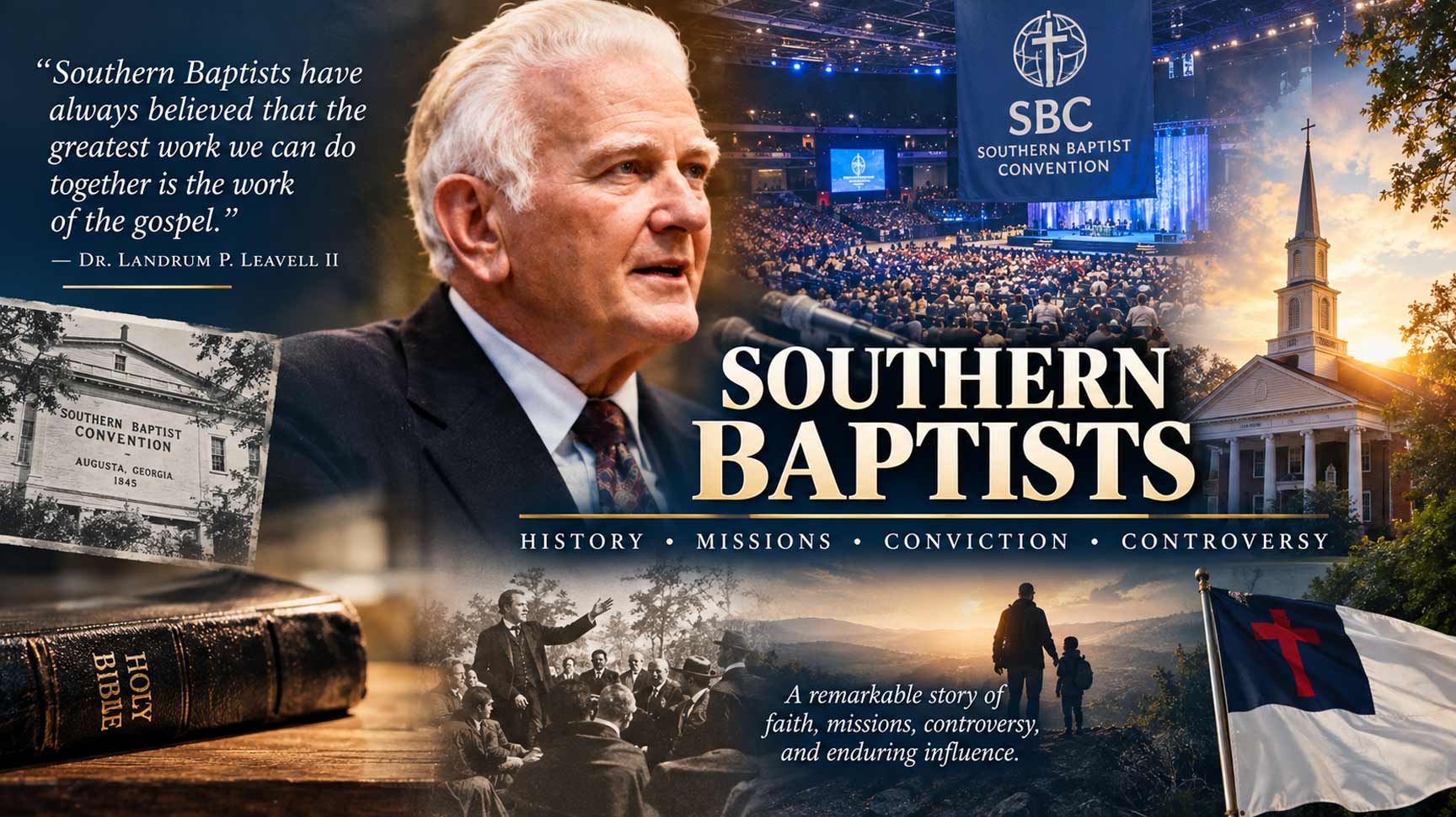
Southern Baptists have never been particularly afraid of an argument. Put several thousand Baptists in a convention hall, give them microphones, parliamentary procedure, strongly held convictions, and the responsibility for deciding the direction of one of America’s largest Protestant bodies, and there’s a reasonable chance something memorable is going to happen.
That’s partly because the Southern Baptist Convention, or SBC, is an unusual institution. It has no pope, archbishop, or denominational president with authority to order its churches around. The churches are autonomous. They voluntarily cooperate to support missionaries, seminaries, church planting, publishing, disaster relief, and other ministries that would be difficult for individual congregations to accomplish alone. The SBC’s own constitution still describes its purpose in essentially those terms: combining Baptist resources for missions and other Kingdom work.
That arrangement has produced an extraordinary amount of cooperation. It has also produced some spectacular fights.
Born in Controversy
The Southern Baptist Convention was organized in Augusta, Georgia, in 1845. Baptists in the United States had already been cooperating nationally through missionary organizations, but growing sectional tensions over slavery made that cooperation increasingly difficult.
The immediate controversy involved whether slaveholders could be appointed as missionaries. Southern Baptists believed slaveholding shouldn’t disqualify a missionary candidate, while the national Baptist mission structure increasingly avoided appointing slaveholders. Southern Baptists responded by creating their own convention. Slavery therefore wasn’t merely something that happened to exist in the background when the SBC was founded. The dispute over slavery was central to the division that produced it. That fact is uncomfortable, but there’s no reason to disguise it.
At the same time, the stated purpose of the new convention was missionary. Its constitution described the organization as a means of combining Baptist energies for spreading the gospel, and one of the convention’s first resolutions in 1845 called for missionary work in New Orleans. Those two realities have to be held together. Southern Baptists organized to cooperate in missions, but the organization emerged from a sectional division in which slavery played a decisive role.
Missions at the Center
Missions quickly became one of the defining features of Southern Baptist life. The convention created separate structures for foreign and domestic missions, eventually developing what are now the International Mission Board and North American Mission Board.
Two women became so closely associated with Southern Baptist missions that generations of Baptist children grew up hearing their names. Lottie Moon served as a missionary in China for nearly forty years. Her letters challenged Southern Baptists to give more generously and send more missionaries overseas. The annual Christmas offering for international missions eventually took her name. Annie Armstrong became a major organizer and advocate for home missions. Southern Baptists similarly named their annual Easter offering for North American missions after her. That’s an interesting feature of a denomination that has spent considerable time debating women’s roles in church leadership. Two of the most recognizable names in Southern Baptist missions belong to women.
Missionary cooperation also helps explain why Southern Baptists continued building increasingly elaborate denominational institutions despite their insistence upon local-church autonomy. Apparently Baptists discovered that independence and cooperation don’t have to be enemies. They just have to renegotiate the relationship every few years.
What Exactly Is the Southern Baptist Convention?
The name can be misleading. The Southern Baptist Convention isn’t a church. A local Southern Baptist congregation isn’t a branch office controlled by denominational headquarters. The convention consists of cooperating autonomous churches that send representatives, traditionally called messengers, to the annual meeting. Those messengers elect officers, vote on resolutions, consider constitutional and bylaw changes, receive reports, determine budgets, and influence the direction of SBC entities.
But the convention doesn’t ordinarily appoint a local church’s pastor, own its building, dictate its worship schedule, or control its internal finances. That distinction becomes particularly important whenever controversy erupts. The SBC can determine which churches it considers to be in friendly cooperation with the convention. It can establish doctrinal expectations for its institutions and employees. But it can’t function like an episcopal denomination in which a bishop exercises direct authority over individual congregations.
Southern Baptists therefore created a national organization powerful enough to operate seminaries and missionary agencies while insisting that the organization doesn’t govern the churches that created it. If that sounds like an arrangement capable of generating arguments, you’ve been paying attention.
The Cooperative Program
One of the most successful solutions to the problem of Baptist cooperation arrived in 1925 with the creation of the Cooperative Program. Before that, Southern Baptist institutions frequently appealed directly to churches for money. Mission boards, schools, seminaries, and other ministries could effectively find themselves competing for contributions.
The Cooperative Program created a more systematic approach. Churches contribute through their state conventions, and portions of those contributions support state ministries while other portions support SBC ministries nationally and internationally. The principle is simple: churches can accomplish more together than they can accomplish separately. That’s still how the SBC describes the philosophy behind the program.
For Baptists, that’s practically an outbreak of collectivism. But it worked. The Cooperative Program helped finance one of the largest missionary and theological-education systems in Protestant Christianity.
Southern Baptist Theology
Southern Baptists stand firmly within the evangelical Baptist tradition. They affirm the authority of Scripture, the Trinity, the full deity and humanity of Jesus Christ, His virgin birth, sinless life, atoning death, bodily resurrection, and future return.
Salvation comes through God’s grace and is received through repentance and faith in Jesus Christ. Southern Baptists practice believer’s baptism by immersion, rejecting infant baptism, and ordinarily understand baptism as an act of obedience and public identification with Christ rather than the means by which a person is regenerated. The Lord’s Supper is likewise understood as an ordinance rather than a sacrament that automatically conveys saving grace.
Southern Baptists traditionally emphasize personal conversion, evangelism, missions, Bible study, congregational worship, and the responsibility of individual Christians to share their faith. If you grew up Southern Baptist, there’s a good chance somebody asked whether you’d been saved before they asked what church you attended.
The Baptist Faith and Message
Southern Baptists don’t have a creed in the same sense that Roman Catholics or some historic Protestant traditions do, but they do have an influential confession of faith called the Baptist Faith and Message. The first version was adopted in 1925, drawing heavily upon an earlier Baptist confession. It was revised substantially in 1963 and again in 2000. Those revisions weren’t merely editorial housekeeping. They reflected changing theological debates within the convention.
The Baptist Faith and Message addresses Scripture, God, humanity, salvation, the church, baptism, the Lord’s Supper, evangelism, missions, education, religious liberty, the family, and other subjects. The 2000 revision became particularly significant during and after the Conservative Resurgence because it expressed the increasingly conservative theological identity of SBC institutions.
But there’s an important Baptist qualification. The Baptist Faith and Message doesn’t function as an infallible decree imposed upon every local congregation. Baptist churches remain autonomous. That’s the theory. Determining exactly what level of doctrinal agreement is necessary for churches and denominational institutions to cooperate has supplied Southern Baptists with enough material for several decades of convention debates.
The Bible
No issue has been more important to modern Southern Baptist controversy than the authority of Scripture. Southern Baptists historically described the Bible as inspired and authoritative, but during the twentieth century disagreements developed over exactly what those words meant. Could the Bible contain historical or scientific errors while remaining spiritually authoritative? Were the biblical narratives necessarily describing events that actually happened? How should professors in Southern Baptist seminaries approach critical scholarship?
Conservatives increasingly argued that the issue was biblical inerrancy: Scripture is truthful in what it affirms and doesn’t contain error in its original manuscripts. Moderates generally insisted that they also believed the Bible was authoritative but resisted some conservative definitions of inerrancy and worried about turning particular theories of inspiration into denominational tests. That disagreement eventually became a battle for control of the convention. And Southern Baptists know how to have a battle for control of a convention.
The Conservative Resurgence
The turning point came in 1979. Conservative Southern Baptists had concluded that some professors and denominational leaders had moved away from historic confidence in biblical inerrancy. Leaders including Paige Patterson and Paul Pressler developed a strategy based upon the SBC’s own governing structure.
It was actually rather clever. The convention president possessed important appointment powers. Those appointments eventually influenced committees. Committees influenced trustee appointments. Trustees governed SBC institutions, including the seminaries. If conservatives could consistently elect conservative presidents, they could eventually change the trustees. And if they changed the trustees, they could change the institutions.
In 1979, Adrian Rogers, the widely respected pastor of Bellevue Baptist Church near Memphis, was elected SBC president. Conservatives continued winning presidential elections year after year, so the strategy worked.
Resurgence or Takeover?
What happened next depends partly upon whom you ask. Conservatives call it the Conservative Resurgence. They believe Southern Baptists recovered institutions that were drifting away from the historic authority and inerrancy of Scripture. The SBC itself later formally celebrated the movement in those terms, describing it as a return to the convention’s biblical foundations. SBC.net
Critics called it the Fundamentalist Takeover. They argued that conservatives exaggerated theological problems, imposed increasingly narrow doctrinal boundaries, politicized denominational life, and drove faithful Baptist professors and leaders from institutions they had served for years.
We don’t need to settle that argument to understand what happened. The point is the convention changed. By the 1990s, conservative trustees controlled the SBC seminaries and major denominational agencies. Seminary leadership changed. Faculty changed. Denominational leadership changed. The Baptist Faith and Message was eventually revised again in 2000.
Moderate Baptists responded by creating or strengthening alternative organizations, including the Cooperative Baptist Fellowship, which we’ll examine separately. The fight that began publicly in 1979 reshaped the Southern Baptist Convention for generations.
The Seminaries Become Battlegrounds
Southern Baptist seminaries became especially important during the Conservative Resurgence because theological education determines what future pastors are taught. The SBC operates six seminaries: Southern, Southwestern, New Orleans, Southeastern, Golden Gate—now Gateway—and Midwestern. Each experienced the denominational conflict differently.
Southern Baptist Theological Seminary in Louisville became particularly important when R. Albert Mohler Jr. became president in 1993 and moved the institution decisively toward conservative theology. But another major story was unfolding in New Orleans. And this one is a little closer to home for me.
Landrum P. Leavell II
Dr. Landrum P. Leavell II was already a prominent Southern Baptist pastor and denominational leader when he became president of New Orleans Baptist Theological Seminary in 1975. He had spent twenty-seven years in pastoral ministry, including a long pastorate at First Baptist Church in Wichita Falls, Texas, and had served in important leadership roles within Southern Baptist life. NOBTS later described him as one of the most influential Southern Baptist leaders of his generation.
He also happened to be my pastor when I was a boy, and Dr. Leavell baptized me when I was eight years old.
In 1975 he left Wichita Falls to lead New Orleans Seminary, where he remained president for roughly twenty years. His presidency overlapped almost perfectly with the Conservative Resurgence and some of the fiercest convention battles in SBC history. NOBTS itself has described that denominational conflict as an SBC-wide theological civil war. Dr. Leavell led the seminary through it.
The Leavell Years at New Orleans
Whatever one’s interpretation of the larger SBC controversy, Dr. Leavell’s tenure was a period of remarkable institutional growth. New Orleans Seminary expanded its enrollment, campus, extension-center network, and endowment. Leavell helped restore undergraduate theological education, which eventually developed into Leavell College. NOBTS credits him with helping pioneer forms of distance theological education through an extensive system of extension centers.
The Leavell name already had deep roots at the seminary. Landrum’s uncle, Roland Q. Leavell, had served as NOBTS president from 1946 to 1958 and played an important role in developing its Gentilly campus. The college was eventually named Leavell College in recognition of the broader Leavell family’s extraordinary record of Baptist ministry rather than for Landrum alone.
For me, that makes the history more than names and dates. The pastor who baptized me as a child went on to lead one of the SBC’s six seminaries through one of the most contentious periods in the convention’s history. It’s a small personal intersection with a much larger Baptist story.
W. A. Criswell
Another towering figure in twentieth-century Southern Baptist life was W. A. Criswell, longtime pastor of First Baptist Church of Dallas. Criswell became famous for expository preaching and conservative theology and exercised enormous influence upon generations of Southern Baptist pastors. He was an early and prominent supporter of the conservative movement within the SBC.
First Baptist Dallas became something of a Southern Baptist institution in its own right, and Criswell helped demonstrate how influential a local pastor could become in a denomination that technically had no hierarchy. That’s another Baptist paradox. Southern Baptists reject bishops, but occasionally they produce pastors who exercise more informal influence than some bishops ever dreamed of having.
Billy Graham
Then there was Billy Graham. Graham’s ministry extended so far beyond denominational boundaries that many people don’t immediately associate him with Southern Baptists. But Graham was a Southern Baptist minister and maintained that connection throughout most of his public ministry. His evangelistic crusades brought together Christians from numerous denominations and placed the evangelical message of personal conversion before enormous audiences around the world.
Graham represents another side of Southern Baptist identity. While convention leaders sometimes fought intensely over denominational boundaries, perhaps the most famous Southern Baptist of the twentieth century became famous precisely because his ministry crossed them.
Charles Stanley and Adrian Rogers
Two other pastors became familiar far beyond Southern Baptist churches through television and radio. Charles Stanley, longtime pastor of First Baptist Church of Atlanta and founder of In Touch Ministries, brought Southern Baptist preaching into homes around the world. Adrian Rogers, pastor of Bellevue Baptist Church and founder of Love Worth Finding, became equally influential through broadcast ministry.
Rogers also occupies a unique place in SBC history because his election as convention president in 1979 is generally regarded as the beginning of the Conservative Resurgence. Both men represented a style of Southern Baptist preaching that combined biblical exposition, evangelistic appeal, pastoral instruction, and mass media. For millions of people, Southern Baptist theology didn’t arrive through a denominational statement. It arrived through a television set on Sunday morning.
Southern Baptists and Race
The SBC’s racial history can’t end with 1845. Southern Baptist churches remained deeply embedded in the segregated culture of the American South long after slavery ended. Many white Southern Baptists defended segregation, resisted the Civil Rights Movement, or remained silent while Black Christians challenged racial injustice. There were exceptions, and individual Southern Baptists responded differently, but institutional repentance came slowly.
A major moment arrived in 1995, the convention’s 150th anniversary, when Southern Baptist messengers adopted a resolution addressing their racial history. The convention repudiated racism, acknowledged the role slavery played in its formation, lamented the defense of slavery by many Southern Baptists, and apologized to African Americans.
That didn’t erase the history. Nor did it instantly resolve racial tensions. But it represented an important public acknowledgment that defending slavery and racism wasn’t merely an unfortunate cultural quirk of nineteenth-century Baptists. It was sin.
Modern Southern Baptists continue debating how racial reconciliation should be pursued and how the denomination should understand both its past and present responsibilities.
Women in Ministry
The role of women has become another major area of Southern Baptist debate. Southern Baptists have always depended heavily upon women for missions, teaching, education, music, children’s ministry, charitable work, and innumerable other ministries. Lottie Moon and Annie Armstrong alone make that obvious.
The controversy concerns pastoral office. The Baptist Faith and Message 2000 states that while both men and women are gifted for service in the church, the office of pastor is limited to men qualified by Scripture. In recent years, disputes have centered on exactly what pastor means. Does the restriction refer only to the senior or lead pastor? Does it include associate pastors? What about a woman carrying the title children’s pastor or worship pastor?
Those questions have resulted in convention debates and decisions concerning whether particular churches remain in friendly cooperation with the SBC. And once again Baptist polity makes the issue more complicated. The convention can’t prevent an autonomous church from ordaining or employing a woman pastor, but it can decide whether it wants to cooperate with that church. That’s the distinction.
Calvinists and Non-Calvinists
Southern Baptists also continue the ancient Baptist argument over Calvinism. Some Southern Baptists strongly affirm Reformed doctrines of election and predestination. Others emphasize human free response and reject several points of Calvinism. Both groups can appeal to important figures in Baptist history.
The disagreement occasionally becomes heated, but the SBC has generally contained both traditions. That makes Southern Baptists a useful reminder that Baptist isn’t synonymous with Calvinist. Ask two Southern Baptist pastors whether regeneration precedes faith and you may accidentally lose your afternoon.
What About Pentecostal Gifts?
Historically, Southern Baptists haven’t been Pentecostal. The denomination doesn’t teach that baptism in the Holy Spirit is a separate post-conversion experience evidenced by speaking in tongues. Many Southern Baptists have also been cessationist or cautious about charismatic gifts.
But Southern Baptist attitudes haven’t been completely uniform. Individual pastors and churches have held continuationist positions, and debates over tongues, private prayer languages, healing, and charismatic practice have occasionally surfaced in missionary and denominational life.
So the line isn’t simply Baptist versus Pentecostal. There are Southern Baptists who believe God continues to distribute supernatural gifts while rejecting classical Pentecostal teaching about Spirit baptism and initial evidence. That’s another important distinction.
The Sexual-Abuse Crisis
One of the darkest recent chapters in SBC life has involved sexual abuse and institutional responses to survivors. Investigations and survivor testimony revealed cases in which abuse allegations were mishandled, victims weren’t adequately protected or heard, and institutional concerns sometimes took precedence over accountability.
Southern Baptist messengers have subsequently adopted measures acknowledging serious failures and calling for repentance, greater accountability, and reforms. The convention itself has publicly lamented instances in which churches and institutions failed survivors or handled abuse improperly.
This issue exposes one of the weaknesses of radical local autonomy. If every congregation governs itself, what can the larger convention do when a church mishandles an abuser? Southern Baptists have been forced to wrestle with whether cooperation requires mechanisms of accountability that earlier generations didn’t envision. That’s not merely an administrative question. It’s an ecclesiological one.
The SBC Is Changing
For much of the twentieth century, the Southern Baptist Convention seemed almost synonymous with Protestant Christianity in large parts of the American South, but those days are gone. America has become more secular and religiously diverse. Southern Baptist membership has declined from its historic peak. The denomination has become more ethnically diverse while continuing to wrestle with its racial history. Churches increasingly exist outside the traditional Southern Bible Belt, and immigrant congregations have become an important part of SBC life.
Meanwhile, arguments continue over theology, politics, women in ministry, sexual-abuse reform, institutional accountability, denominational identity, and how broadly Southern Baptists should define cooperation. In other words, they’re still Baptists.
The Convention Floor
And that brings us back to the annual meeting. Southern Baptist conventions can be contentious because the meeting actually matters. Messengers aren’t merely attending a religious conference to listen to speakers. They vote. They elect leaders. They approve budgets. They amend governing documents. They consider resolutions. And sometimes they line up behind microphones because somebody has said something they absolutely cannot allow to pass without comment. I know, because I grew up Baptist. They like a good fight at their conventions.
Sometimes those fights have been petty. Sometimes they’ve been unnecessarily personal. Sometimes Christians have behaved in ways that didn’t exactly strengthen the case for the fruit of the Spirit. But sometimes the fights have mattered enormously.
Southern Baptists have fought about slavery, segregation, missions, biblical authority, theological education, denominational accountability, women in ministry, sexual abuse, and the meaning of cooperation itself. Some things are worth arguing about. The harder question is learning how Christians should argue about them.
The Southern Baptist Paradox
The Southern Baptist Convention may be the ultimate expression of the Baptist paradox we encountered in our overview. Its churches insist upon autonomy. Yet together they created missionary agencies capable of sending people around the world, six theological seminaries, publishing and educational institutions, disaster-relief ministries, church-planting networks, and one of the most elaborate cooperative funding systems in American Christianity.
Nobody can order the churches to cooperate, yet thousands do. Nobody can prevent them from leaving, and many do.
Nobody possesses final hierarchical authority over all Southern Baptists. So, every generation has to decide again what beliefs and practices are important enough to define their cooperation. That’s simultaneously the strength and weakness of the system.
Why Southern Baptists Matter
You don’t have to agree with Southern Baptists to recognize their enormous influence upon American Christianity. They’ve produced missionaries, pastors, evangelists, theologians, educators, civil-rights leaders, broadcasters, politicians, musicians, and institutions that have reached far beyond the convention itself. They’ve helped carry evangelical Christianity around the world.
They also carry a difficult history. The convention was born amid a dispute over slavery. Southern Baptists participated in segregation and racial injustice. Their institutions have endured bitter theological battles. Abuse survivors have exposed serious institutional failures. The denomination continues wrestling with what accountability should look like in a fellowship built around autonomous churches. But that’s exactly why the Southern Baptist story is worth telling without either romanticizing or caricaturing it.
It’s a story about missions and slavery, revival and racism, biblical conviction and denominational conflict, independence and cooperation, enormous accomplishments and serious failures. And somewhere in that history is an eight-year-old boy standing in a Baptist baptistry while Dr. Landrum P. Leavell II prepares to lower him beneath the water.
I didn’t know anything about denominational politics or theological seminaries. I certainly didn’t know that the pastor baptizing me would eventually leave our church to become one of the important Southern Baptist leaders of his generation. I was just getting baptized.
Years later, that little personal memory sits inside a much bigger story. And I suppose that’s appropriate. Because for all their institutions, conventions, resolutions, arguments, seminaries, mission boards, and occasional Baptist family fights, Southern Baptists have always insisted that Christianity ultimately comes down to something much more personal:
You must decide what you believe about Jesus Christ.