
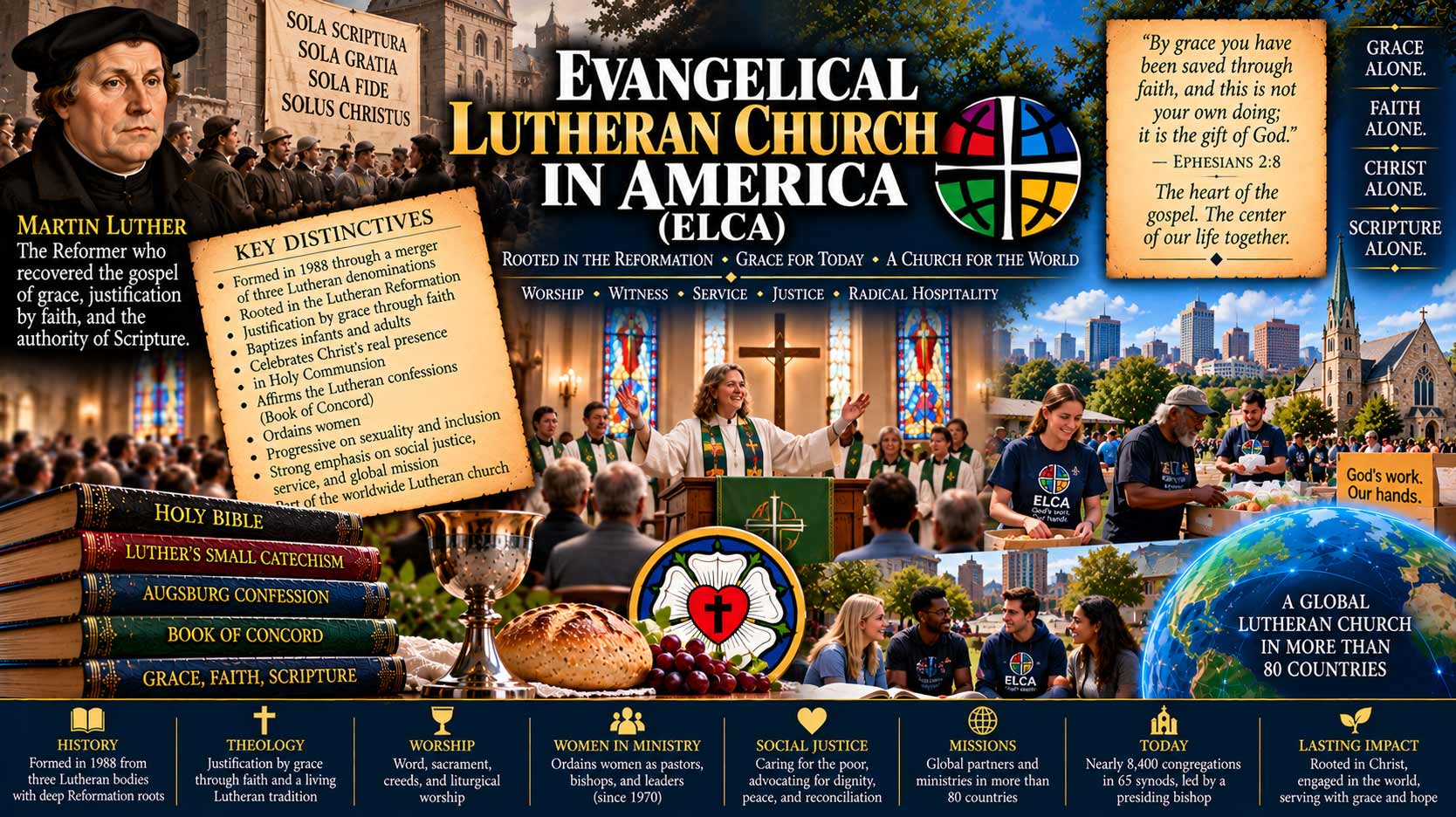
The Evangelical Lutheran Church in America, usually known simply as the ELCA, is the largest Lutheran denomination in the United States. But the word evangelical in its name can confuse Americans who associate evangelicalism with conservative Baptists, Pentecostals, or nondenominational churches. In this case, evangelical reflects the older Lutheran use of the word, referring to the gospel rather than to the modern American evangelical movement.
The ELCA is thoroughly Lutheran in its historical identity. It confesses the Trinity, affirms the ancient Christian creeds, baptizes infants, celebrates Christ’s real presence in Communion, and teaches justification by grace through faith. At the same time, it has become the most theologically and socially progressive of the three major Lutheran bodies we’ll examine in the United States. That combination makes the ELCA particularly interesting because many of its contemporary disagreements with more conservative Lutherans aren’t arguments between Lutherans and non-Lutherans. They’re arguments about what faithfulness to the Lutheran tradition means in the modern world.
Martin Luther Is Still in the Room
To understand the ELCA, we still have to begin with Martin Luther. Luther’s sixteenth-century protest against abuses in the medieval church eventually developed into the Lutheran Reformation, but the theological center of the movement wasn’t merely opposition to Rome. It was the conviction that sinners are justified by God’s grace through faith in Jesus Christ rather than by their works.
That remains at the center of ELCA theology. Human beings don’t climb toward God by accumulating religious merit. God acts first. Christ accomplishes salvation, and sinners receive God’s promise through faith. Good works follow salvation as the fruit of faith rather than functioning as the price paid to obtain it.
This distinction between Law and Gospel remains fundamental to Lutheran theology. God’s Law exposes sin and reveals our inability to make ourselves righteous. The Gospel announces what God has done for sinners through Christ. The Law says what God requires; the Gospel announces what God gives. If we miss that distinction, we can learn quite a bit about Lutherans without ever understanding why they’re Lutheran.
A Denomination Born in 1988
The ELCA itself is surprisingly young. It officially began operations on January 1, 1988, following the merger of three Lutheran denominations: the American Lutheran Church, the Lutheran Church in America, and the Association of Evangelical Lutheran Churches.
Those organizations had their own complicated histories involving earlier mergers among Lutheran churches formed by German, Scandinavian, and other European immigrant communities. American Lutheran history can become an alphabet soup of synods, conferences, mergers, divisions, and reunions remarkably quickly. The 1988 merger was an attempt to bring several major streams of American Lutheranism into one national church. It succeeded in creating the largest Lutheran denomination in the country, but it didn’t unite American Lutheranism completely.
The Lutheran Church—Missouri Synod remained separate. So did the Wisconsin Evangelical Lutheran Synod. Those decisions matter because the differences among the three bodies eventually became substantial.
Scripture and the Lutheran Confessions
The ELCA identifies the Old and New Testaments as the inspired Word of God and the authoritative source and norm of its proclamation, faith, and life. It also accepts the Apostles’, Nicene, and Athanasian Creeds and recognizes the Lutheran confessional writings collected in the Book of Concord.
That collection includes the Augsburg Confession, Luther’s Small and Large Catechisms, the Formula of Concord, and other documents produced during the Reformation era. These writings explain central Lutheran teachings concerning salvation, Christ, the sacraments, the Church, ministry, and numerous other doctrines.
The ELCA therefore isn’t a noncreedal church. Quite the opposite. It stands within one of Protestantism’s most developed confessional traditions. The controversy begins when Christians ask how those authorities should function when interpreting Scripture today. That’s where the ELCA and more conservative Lutheran denominations increasingly part company.
How the ELCA Reads the Bible
The ELCA approaches Scripture with a strong emphasis upon Jesus Christ as the center of the biblical witness. Its theological materials frequently describe Scripture as the means through which the Holy Spirit presents Christ to the Church. This is recognizably Lutheran: Luther himself insisted that Scripture’s central purpose is to bear witness to Christ.
But the ELCA generally allows considerably more historical-critical interpretation than conservative Lutheran denominations. Biblical texts are examined within their literary, historical, cultural, and theological settings, and the denomination doesn’t treat every biblical statement as though it functions identically in determining contemporary Christian practice.
ELCA theologians would argue that this isn’t abandoning biblical authority but interpreting Scripture through the gospel and through the Lutheran distinction between Law and Gospel. Critics, particularly within confessional Lutheranism, argue that the approach can allow contemporary judgments to overrule biblical teachings that the Church previously regarded as clear.
That disagreement will become especially important when we get to the Missouri and Wisconsin synods. Everybody involved says Scripture matters. The argument is over what submitting to Scripture actually requires.
The Book of Concord
The Book of Concord deserves special attention because many Christians know Martin Luther but know very little about Lutheran confessional theology. Published in 1580, the Book of Concord contains the principal doctrinal documents of historic Lutheranism. Among them are the Augsburg Confession of 1530, its Apology, Luther’s catechisms, the Smalcald Articles, and the Formula of Concord.
The ELCA accepts the Unaltered Augsburg Confession as a true witness to the gospel and recognizes the other Lutheran confessional writings as valid interpretations of the Christian faith. That sounds remarkably conservative on paper, and in many respects it is. An ELCA congregation confessing the Nicene Creed on Sunday morning stands within a theological tradition reaching through the Reformation to the ancient Church. The disagreements aren’t usually about whether the Augsburg Confession exists. They’re about how a sixteenth-century confessional tradition should govern a twenty-first-century church.
Baptism
The ELCA practices infant baptism as well as the baptism of previously unbaptized adults and older children. Baptism is normally administered with water in the name of the Father, Son, and Holy Spirit. Unlike Baptists, Lutherans don’t regard baptism primarily as a believer’s public testimony following salvation. Baptism is a means of grace through which God acts. Lutheran theology connects baptism with forgiveness, new birth, incorporation into Christ, and entrance into the Christian community.
That’s why Lutherans baptize infants. The sacrament emphasizes God’s promise rather than the recipient’s intellectual ability to explain what’s happening. An infant doesn’t understand grace. Then again, neither do most theologians as well as they think they do. The Lutheran point is that God’s action comes first.
Communion
The ELCA also maintains the historic Lutheran belief that Christ is truly present in Holy Communion. Luther rejected the Roman Catholic doctrine of transubstantiation as it had been scholastically explained, but he also rejected attempts to reduce the Lord’s Supper to a purely symbolic memorial. When Jesus said, “This is my body,” Luther wasn’t inclined to turn is into represents.
ELCA Christians therefore receive bread and wine while believing Christ genuinely gives himself to his people in the sacrament. Lutherans traditionally describe Christ’s body and blood as truly present “in, with, and under” the bread and wine, although Lutheran theology generally resists trying to explain the mystery by defining exactly how the presence occurs.
This is one of the places where someone accustomed to Baptist or Pentecostal churches can underestimate how different Lutheran Christianity actually is. The sanctuary may look Protestant, but the theology of the altar isn’t Baptist at all.
Grace Alone, Faith Alone
The doctrine of justification remains one of the strongest continuities between the ELCA and historic Lutheranism. Human beings are reconciled to God entirely because of God’s grace in Christ, received through faith. Good works don’t earn justification. Religious observance doesn’t earn it. Moral improvement doesn’t earn it. Baptism and Communion aren’t human achievements offered to God in exchange for salvation. God justifies sinners.
That declaration then frees Christians to serve their neighbors without turning good works into a spiritual payment plan. This produces one of Lutheranism’s most memorable paradoxes: Christians are simultaneously righteous and sinners—simul justus et peccator. We stand righteous before God because of Christ while continuing to struggle with sin in ourselves.
Lutheran theology has little patience with Christians becoming impressed by their own spiritual résumé. That’s probably healthy.
Saints, Mary and the Christian Past
The ELCA, like historic Lutheranism generally, doesn’t reject everything associated with Christianity before the Reformation. It affirms the ancient creeds and respects the witness of Christians throughout church history.
Mary is honored as the Mother of God, or Theotokos, because the title protects the confession that the person born from her is truly God incarnate. Luther himself held Mary in considerably higher regard than many later Protestants realize. But Lutherans don’t ordinarily pray to Mary or the saints as intercessors in the manner found in Roman Catholic and Eastern Orthodox practice. Christ remains the mediator between God and humanity.
This illustrates something important about Lutheranism. It didn’t originally understand itself as throwing away historic Christianity and starting over in 1517. Luther thought he was reforming the Church.
Liturgical Worship
ELCA worship is normally liturgical, although individual congregations can differ considerably in style. A traditional service may include confession and forgiveness, Scripture readings, Psalms, hymns, a sermon, the creeds, prayers, Holy Communion, and a blessing. Clergy commonly wear vestments, and congregations follow the Christian liturgical calendar through Advent, Christmas, Epiphany, Lent, Easter, and Pentecost.
Someone accustomed to contemporary evangelical worship may find an ELCA service surprisingly similar in appearance to Roman Catholic or Anglican worship. That isn’t an accident. Lutheranism retained much of the historic Western liturgy while reforming elements its leaders believed conflicted with the gospel.
Other ELCA congregations use contemporary music and less formal settings while retaining Lutheran sacramental theology underneath. Never judge a church’s theology entirely by the worship band. We’ve learned that lesson several times now.
Pastors and Bishops
The ELCA ordains ministers of Word and Sacrament and organizes its congregations into 65 synods, each led by a bishop. These synods aren’t equivalent to congregations; they’re regional bodies connecting local churches with the wider denomination.
At the churchwide level, the denomination is led by a presiding bishop. As of 2026, that office is held by Yehiel Curry, who began his six-year term in October 2025 after previously serving as bishop of the Metropolitan Chicago Synod. He is the first Black presiding bishop in ELCA history.
Despite the terminology, an ELCA bishop doesn’t function like a Roman Catholic bishop. Lutheran bishops provide pastoral and administrative oversight within a constitutional structure in which congregations, synods, clergy, lay representatives, churchwide assemblies, and councils all exercise authority. The word bishop may be ancient, but the committee meetings remain thoroughly Protestant.
Women in Ministry
The Lutheran bodies that eventually formed the ELCA began ordaining women as pastors in 1970, and women now serve throughout the denomination as pastors, bishops, theologians, chaplains, and churchwide leaders. In 2013, Elizabeth Eaton became the ELCA’s first female presiding bishop and served until 2025.
The ELCA interprets biblical passages restricting women from certain teaching or authority roles differently from conservative Lutheran bodies such as the Missouri and Wisconsin synods. ELCA Christians generally understand the gospel and the gifts of the Holy Spirit as permitting women to exercise ordained pastoral ministry.
This is one of several differences we’ll encounter between American Lutheran denominations. Unlike the Holiness churches we’ve just studied, however, the ELCA’s practice of women’s ordination is comparatively recent rather than something inherited from nineteenth-century denominational founders. That historical distinction is worth keeping clear.
Marriage and Sexuality
Sexuality has produced some of the deepest divisions in the ELCA’s recent history. In 2009, the ELCA Churchwide Assembly adopted a social statement on human sexuality and authorized changes that permitted people in publicly accountable lifelong same-gender relationships to serve as clergy. The denomination subsequently permitted its pastors to officiate same-sex marriages where legally allowed, while providing room for congregations and ministers holding traditional convictions to decline participation.
The ELCA’s sexuality statement has acknowledged that Christians within the denomination hold differing convictions about same-sex relationships. In 2025, the Churchwide Assembly adopted revisions to that statement reflecting developments in law, family life, and the denomination’s understanding of sexuality and gender.
The ELCA today is therefore affirming of same-sex relationships and includes LGBTQ clergy and married same-sex couples within its life. At the same time, individual congregations vary considerably, and not every ELCA Lutheran holds the same theological conclusions. This is one of the clearest dividing lines between the ELCA and the LCMS or WELS, both of which maintain traditional Christian teaching restricting marriage to a man and a woman.
The 2009 Divide
The 2009 decisions didn’t occur without consequences. Some congregations and pastors believed the ELCA had departed from biblical teaching and historic Lutheran Christianity. Congregations subsequently left the denomination, and the controversy contributed to the formation of the North American Lutheran Church (NALC) in 2010. Other dissatisfied Lutherans affiliated with existing conservative Lutheran bodies or independent networks.
Those who remained within the ELCA included both supporters of the changes and some traditionalists who believed continued fellowship despite disagreement was preferable to separation. Supporters described the changes as extending Christian inclusion and recognizing committed relationships among gay and lesbian Christians. Opponents described them as evidence that contemporary cultural judgments had displaced the authority of Scripture.
Those aren’t minor differences in emphasis. They represent fundamentally different approaches to biblical interpretation, Christian ethics, and the boundaries of church fellowship.
Social Teaching
The ELCA has developed an extensive body of social teaching addressing racism, economic life, criminal justice, education, abortion, environmental stewardship, sexuality, immigration, peace, health care, and other public issues. The denomination sees this engagement as flowing from Lutheran theology. Because Christians don’t need to perform good works to earn God’s favor, they’re freed to serve their neighbors without using those neighbors as part of a personal salvation project. That principle can produce substantial social activism. ELCA congregations and agencies participate in hunger relief, refugee assistance, disaster response, advocacy, international development, racial reconciliation, and numerous other ministries.
Critics sometimes argue that the denomination’s public advocacy becomes too closely aligned with contemporary progressive politics. ELCA leaders generally respond that Christian faith necessarily has social consequences and that the Church must address injustice affecting its neighbors. That’s an important distinction to describe fairly. The disagreement isn’t simply between people who care about society and people who don’t. It’s also about how the Church determines when a political or social judgment genuinely follows from the gospel.
Abortion
The ELCA’s position on abortion is more complicated than simply describing it as either pro-life or pro-choice. Its longstanding social teaching treats human life before birth as morally significant and doesn’t describe abortion as morally neutral. At the same time, it doesn’t support an absolute prohibition in every circumstance and recognizes situations in which abortion may be considered morally responsible. The denomination has therefore generally resisted both unrestricted abortion and legal approaches it believes fail to account for difficult circumstances involving women, families, and pregnancies.
That position places the ELCA somewhere different from both the categorical opposition to abortion found in many conservative Christian traditions and the treatment of abortion as primarily an unrestricted individual right found in some secular advocacy. Individual ELCA members, naturally, can be considerably more definite in either direction. Lutherans apparently weren’t satisfied with letting sexuality contain all the complicated ethical discussions.
Ecumenism
One of the ELCA’s strongest institutional commitments is ecumenism—cooperation and visible Christian unity across denominational boundaries. The denomination has entered full communion relationships with several other Protestant churches, including the Episcopal Church, Presbyterian Church (U.S.A.), Reformed Church in America, United Church of Christ, United Methodist Church, and Moravian Church.
Full communion doesn’t mean the denominations have merged or agree on everything. It means they recognize one another sufficiently in doctrine and ministry to share Communion, cooperate in mission, and under agreed circumstances recognize ordained ministers. The ELCA has also participated extensively in dialogue with Roman Catholics and other Christian traditions.
This is another area where Lutheran history becomes interesting. A movement born from one of Christianity’s most famous divisions has become deeply involved in efforts to overcome Christian division. History enjoys irony.
Lutherans and Roman Catholics
The relationship between Lutherans and Roman Catholics deserves special attention because the Reformation began with their separation. Centuries of polemics gradually gave way to formal theological dialogue during the twentieth century. One important result was the Joint Declaration on the Doctrine of Justification, originally signed in 1999 by the Lutheran World Federation and the Roman Catholic Church.
The declaration didn’t erase every disagreement about justification, the sacraments, ministry, papal authority, or the Church. It did conclude that Lutherans and Catholics had reached a significant common understanding concerning salvation by grace and that some sixteenth-century condemnations no longer applied to the positions each side actually teaches today.
For anyone who grew up thinking Catholics and Lutherans had spent five hundred years yelling “works” and “faith” at each other across the street, the development is worth noticing. They still haven’t merged, but they’re talking..
Luther and the Jews
The ELCA has also confronted one of the darkest aspects of Martin Luther’s legacy: his later writings about Jews. Luther produced vicious anti-Jewish rhetoric late in his life, including recommendations that Jewish synagogues and homes be destroyed. Christians sometimes attempt to minimize those writings because Luther played such an important role in the Reformation.
The ELCA hasn’t taken that approach. It has formally repudiated Luther’s anti-Jewish writings and committed itself to opposing antisemitism and developing healthier Christian-Jewish relations. That’s an important example of a denomination distinguishing between honoring a theologian’s genuine contributions and pretending everything the theologian said was defensible.
Martin Luther could be spectacularly right about some things. He could also be spectacularly wrong. Both belong in the history.
A Predominantly White Church
The ELCA has also wrestled openly with its own racial demographics. American Lutheranism developed heavily among European immigrant populations, particularly Germans and Scandinavians, and those historical patterns remain visible.
The denomination has repeatedly expressed a desire to become more racially and ethnically diverse, but demographic change has been slow. Its leadership has consequently emphasized multicultural ministries, racial justice, and the development of congregations within communities historically underrepresented in Lutheranism. The election of Yehiel Curry as the ELCA’s first Black presiding bishop in 2025 was therefore historically significant.
Curry himself has an unusual route into denominational leadership. He became involved with a Lutheran congregation in Riverdale, Illinois, eventually became a mission developer, attended seminary, became the congregation’s pastor, was elected bishop of the Metropolitan Chicago Synod, and then presiding bishop of the entire ELCA.
A Shrinking Denomination
The ELCA also faces a problem shared by many historic American Protestant denominations: membership decline. The denomination remains the largest Lutheran body in the United States, with nearly 8,400 congregations, but it’s considerably smaller than it was when formed in 1988. Declining membership, aging congregations, church closures, fewer clergy, and changing patterns of religious participation present serious institutional challenges.
Those problems aren’t unique to the ELCA. American Christianity has experienced substantial changes in church participation, particularly among denominations with strong roots in historically European-American populations. But the decline raises important questions about the future. Can the ELCA maintain thousands of congregations with fewer members? Can it evangelize younger generations rather than merely manage institutional contraction? Can its social engagement coexist with a clear proclamation of the gospel?
The ELCA and the LCMS
The difference between the ELCA and Lutheran Church—Missouri Synod is substantial enough that someone unfamiliar with Lutheranism might wonder how both can use the word Lutheran. Both confess the Trinity, use the historic creeds, baptize infants, affirm Christ’s real presence in Communion, teach justification by grace through faith, and claim the Lutheran Confessions. But they differ sharply over biblical interpretation, women’s ordination, sexuality, ecumenical fellowship, Communion practice, and several questions involving church authority.
The ELCA ordains women; the LCMS doesn’t. The ELCA permits same-sex marriages and LGBTQ clergy; the LCMS maintains traditional sexual ethics. The ELCA has extensive full-communion agreements with other Protestant denominations; the LCMS practices much more restricted altar and pulpit fellowship. Those differences aren’t simply stylistic. They reveal two substantially different approaches to what it means to preserve Lutheran Christianity in the modern world.
The ELCA and WELS
The contrast becomes even stronger with the Wisconsin Evangelical Lutheran Synod. WELS is smaller and highly confessional. It maintains conservative positions on Scripture, sexuality, women’s roles in church authority, and fellowship with other Christians. Its doctrine of church fellowship is particularly restrictive compared with the ELCA’s ecumenical approach.
Yet once again, both bodies trace themselves to the Lutheran Reformation and confess salvation by grace through faith. That’s one of the reasons our denominational project is useful. Saying someone is “Lutheran” tells us something important. It doesn’t tell us nearly enough. The same thing turned out to be true of Baptists, Methodists, Presbyterians, Pentecostals, and practically everybody else we’ve examined.
The ELCA Today
The ELCA today contains nearly 8,400 congregations organized into 65 synods and participates in the worldwide Lutheran communion through the Lutheran World Federation. Its presiding bishop, Yehiel Curry, began his six-year term in October 2025 and has emphasized building a more connected and sustainable church.
Its identity combines ancient Christian creeds, Reformation theology, sacramental worship, Lutheran confessional documents, ecumenical cooperation, women’s ordained ministry, social engagement, and progressive positions on several contemporary ethical questions. That combination makes it difficult to summarize with a single political or theological label. An ELCA congregation can look remarkably traditional on Sunday morning—vestments, altar, candles, organ, creeds, Baptism, Communion, Luther’s catechism—and simultaneously hold positions on sexuality and ministry that Martin Luther couldn’t possibly have imagined.
That’s the tension at the center of modern ELCA identity. It wants to be both deeply rooted and continually reforming. The debate is over how much can change before the roots themselves have changed.
Why the ELCA Matters
The Evangelical Lutheran Church in America matters because it represents one of the major answers to a question confronting every historic Christian tradition: How should an ancient faith respond to a changing culture?
The ELCA’s answer has been to retain the central structures of Lutheran Christianity—grace, justification, Baptism, Communion, creeds, liturgy, and the Lutheran Confessions—while allowing substantial reinterpretation in areas such as ministry, sexuality, biblical interpretation, and social ethics.
Supporters understand that as the Church continuing to reform under the gospel while responding faithfully to new knowledge and new circumstances. Critics believe the denomination has accommodated modern culture at points where Scripture should instead correct the culture.
We’ll understand that disagreement much better after examining the Lutheran Church—Missouri Synod and Wisconsin Evangelical Lutheran Synod, because they begin with much of the same Lutheran inheritance and reach very different conclusions.
And that’s what makes American Lutheranism so interesting. The argument isn’t primarily over whether Martin Luther mattered. Everybody agrees that he did. The argument is over what faithfulness to his Reformation—and more importantly to the Scriptures he was trying to recover—looks like five hundred years later.