
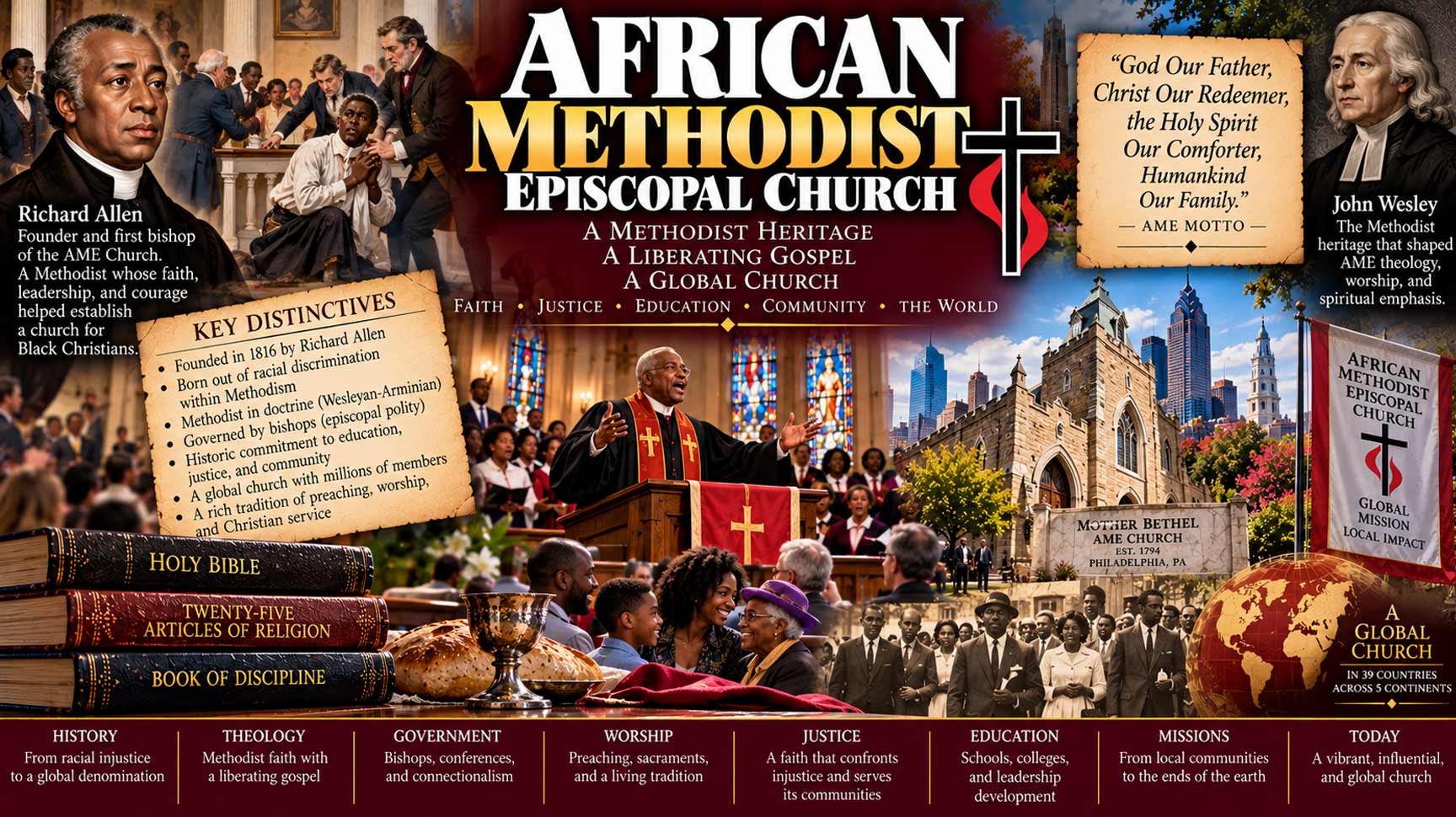
The African Methodist Episcopal Church has one of the most remarkable origin stories in American Christianity. The AME Church wasn’t created because its founders rejected Methodist theology, discovered a new interpretation of baptism, or decided John Wesley wasn’t sufficiently Wesleyan. It was born because Black Methodists who wanted to worship God alongside white Methodists discovered that racial equality apparently stopped at the church door.
That makes the AME story both inspiring and deeply embarrassing for American Christianity. Richard Allen and the people who eventually formed the denomination didn’t leave Methodism because they wanted different doctrine. They left because they wanted the freedom to worship, govern their own churches, and be treated as Christians rather than second-class members of somebody else’s congregation. The AME Church still describes itself as thoroughly Methodist in doctrine while tracing its independent existence directly to racial discrimination within the church.
Richard Allen
Richard Allen was born enslaved in Delaware in 1760. He experienced Christian conversion as a young man and became convinced by Methodist preaching. After obtaining his freedom, Allen became an itinerant Methodist preacher and eventually arrived in Philadelphia, where his preaching attracted growing numbers of Black worshipers.
Allen wasn’t trying to create a separate Black Christianity. He was a Methodist. The problem was that racial attitudes within American Methodism made genuine fellowship increasingly difficult.
Allen, Absalom Jones, and other Black Philadelphians organized the Free African Society in 1787. It functioned as a mutual-aid organization serving Philadelphia’s Black community, helping people through sickness, poverty, death, and other hardships. The organization wasn’t originally a denomination, but it provided an institutional foundation from which independent Black churches could emerge.
Then came the incident that became inseparable from AME history.
Pulled from Their Knees
Allen and other Black Christians worshiped at St. George’s Methodist Episcopal Church in Philadelphia. As the number of Black worshipers increased, church officials imposed greater racial separation. According to the traditional account preserved in AME history, Black worshipers were directed toward segregated seating, and during prayer white church officials attempted to remove Absalom Jones and others from the place where they were kneeling.
Think about that scene for a moment. They weren’t disrupting the service. They weren’t arguing theology. They were praying.
The men waited until the prayer was finished and then walked out. Allen later described the episode as a decisive moment after which the Black worshipers no longer attended St. George’s in the same way. The AME Church’s official history remembers the incident bluntly: Black Christians were pulled from their knees while praying because white Methodists were enforcing racial segregation.
There are moments in church history when lengthy theological analysis isn’t really necessary. This is one of them.
Bethel Church and the Fight for Independence
The people leaving St. George’s didn’t all travel in the same ecclesiastical direction. Absalom Jones eventually became an Episcopal priest, while Richard Allen remained committed to Methodism. Allen believed Methodist theology and worship were fundamentally sound even though some Methodists had behaved disgracefully.
In 1794, Allen’s congregation dedicated Bethel Church in Philadelphia. The name survives today in Mother Bethel African Methodist Episcopal Church. Yet independence wasn’t immediately secure. White Methodist authorities continued attempting to exercise control over Bethel, leading Allen into a prolonged struggle for congregational autonomy.
Allen eventually took the matter to court. Pennsylvania judicial decisions in 1807 and 1815 confirmed Bethel’s right to operate independently of white Methodist control. That’s an extraordinary part of the story. Before Allen could build an independent Black Methodist denomination, he first had to establish legally that Black Christians could control their own church.
The AME Church Is Born
Other Black Methodist congregations in the Middle Atlantic states were experiencing similar problems. Allen therefore invited representatives to Philadelphia, and in 1816 they organized the African Methodist Episcopal Church. Richard Allen was elected and consecrated its first bishop.
Every word in the name tells us something. African identified a church organized by people of African descent in response to racial discrimination. Methodist announced that they retained Wesleyan Methodist theology. Episcopal described their form of government through bishops.
The AME Church wasn’t claiming Christianity belonged to one race. Its very existence was a protest against churches behaving as though it did.
Methodist Theology
The AME Church’s theology remains recognizably Methodist. Its official doctrinal foundation includes the Apostles’ Creed and the Twenty-Five Articles of Religion, inherited from American Methodism. Those articles affirm the Trinity, deity and humanity of Christ, his atoning death and resurrection, original sin, justification by faith, the authority of Scripture, the Church, the sacraments, resurrection, and final judgment.
That means we shouldn’t treat the AME Church as though “African Methodist” represents a separate theological system from Methodism. Its founders weren’t rejecting Wesley. They were insisting that Wesleyan Christianity ought to apply to Black Christians too.
That distinction matters. Some denominations originated because of theological disagreements. AME originated because Christians who substantially agreed theologically couldn’t live together ecclesiastically because of racism.
Wesleyan Salvation
Like Methodism generally, AME theology stands within the Wesleyan-Arminian tradition. God’s grace reaches toward fallen humanity, Christ’s saving work is offered to all, people must respond to grace through faith, and the Christian life should produce actual holiness rather than merely intellectual agreement with Christian doctrine.
That places the AME Church on the non-Calvinist side of the Protestant family we’ve been mapping. Its theological instincts are much closer to John Wesley than John Calvin. Salvation is entirely dependent upon God’s grace, but Wesleyan theology emphasizes a genuine human response to that grace and rejects the idea that Christ’s saving provision was intended only for an eternally predetermined elect.
The Methodist concern with sanctification is equally important. Christianity isn’t supposed to end with conversion. God’s grace continues transforming believers so that holiness becomes increasingly visible in their lives.
Faith That Does Something
The AME tradition has always had difficulty separating spiritual ministry from people’s actual circumstances. That makes sense once we understand its history. A church born among people facing slavery, segregation, poverty, and racial discrimination was unlikely to conclude that Christianity should concern itself exclusively with getting souls into heaven.
The denomination describes its mission as ministering to the spiritual, intellectual, physical, emotional, and environmental needs of people. It speaks of spreading Christ’s “liberating gospel” through both word and deed and explicitly connects its modern ministry with the Free African Society’s original commitment to seek the lost and serve people in need.
That language can sound political to Christians accustomed to a sharp distinction between evangelism and social action. Historically, however, the distinction would have been difficult for African Methodists to maintain. Richard Allen could preach salvation while simultaneously confronting a society in which people who looked like him could legally be property.
Slavery and Abolition
The AME Church became deeply connected with the struggle against slavery. Allen himself had been enslaved, and independent Black churches created spaces in which African Americans could organize, educate their communities, preach, publish, and challenge a social order that denied their equality.
AME congregations became part of a much larger network of Black religious and civic institutions during the nineteenth century. Ministers frequently became community leaders because the church was one of the relatively few institutions Black Americans could control for themselves.
The denomination’s expansion therefore carried significance beyond Sunday worship. Establishing an AME church could mean establishing a center for education, mutual assistance, political organization, economic cooperation, and community leadership. The church building was sometimes doing considerably more work Monday through Saturday than outsiders realized.
Denmark Vesey
One of the more complicated figures associated with early AME history is Denmark Vesey, a formerly enslaved man connected with the African Church in Charleston, South Carolina. Vesey was accused of organizing a massive slave uprising planned for 1822. Authorities arrested him and dozens of others, and Vesey was executed.
The episode terrified white authorities throughout the South. Charleston’s African Church was suppressed, and suspicion of independent Black religious gatherings intensified. Whether every detail attributed to Vesey and the alleged conspiracy can be reconstructed confidently remains a matter historians have debated, but the episode demonstrates why independent Black churches appeared threatening within a slave society.
A congregation where enslaved and free Black people could gather without white supervision wasn’t merely a religious institution. It represented independent organization—and in a society built upon racial control, independence itself could appear dangerous.
Daniel Alexander Payne
If Richard Allen gave AME its institutional beginning, Daniel Alexander Payne helped give it intellectual depth. Payne became an AME bishop, educator, historian, and one of the most influential figures in nineteenth-century African-American Christianity.
He strongly emphasized an educated ministry. Payne believed emotional religious experience and sincere faith weren’t substitutes for intellectual preparation. Ministers needed biblical knowledge, theological education, disciplined character, and the ability to teach their congregations.
That conviction helped connect AME with higher education. Payne became associated with Wilberforce University in Ohio, which AME purchased in 1863. He served as its president, making him one of the earliest African Americans to lead an American college.
AME Christianity wasn’t simply creating churches. It was creating institutions.
After Emancipation
The end of slavery opened enormous opportunities for African-American denominations. Freed people throughout the South wanted churches they could control, ministers who understood their experience, schools for their children, and institutions independent of the white denominations that had so often defended or accommodated slavery.
AME missionaries moved aggressively into the former Confederacy. The denomination’s official history remembers the evangelistic cry “I Seek My Brethren” as emblematic of its expansion through Georgia, Florida, Alabama, Texas, and elsewhere. By 1880, AME membership had reached approximately 400,000.
This helps explain why historically Black denominations became such powerful institutions after the Civil War. Freedom wasn’t merely the removal of chains. Communities needed institutions through which free people could worship, learn, organize, own property, train leaders, and participate in civic life. The Black church became one of those institutions.
Henry McNeal Turner
Few AME personalities were more colorful than Henry McNeal Turner. Turner was a preacher, missionary, politician, newspaper editor, Civil War chaplain, and eventually an AME bishop. During Reconstruction he served in the Georgia legislature before being expelled along with other Black legislators.
Turner also became an outspoken advocate of Black dignity at a time when racist ideology routinely portrayed African people as inferior. Some of his statements were deliberately provocative, including his famous insistence that people had every right to imagine God in their own image just as Europeans had spent centuries depicting biblical figures as white.
Later in life, Turner became increasingly pessimistic about racial equality in the United States and supported African emigration. He also pushed AME expansion overseas. Under his leadership, African Methodism established important connections in Liberia, Sierra Leone, and South Africa during the 1890s.
AME was becoming something Richard Allen couldn’t have lived to see: an international denomination.
Bishops and Connectional Government
The word Episcopal in AME isn’t decorative. The denomination is governed through bishops who exercise substantial oversight within a connectional system. Bishops are elected by the General Conference, which meets every four years, and they supervise Episcopal Districts containing annual conferences and local congregations.
This gives AME a very different structure from Baptists and other congregational traditions. A local AME church belongs to a larger ecclesiastical system in which pastors, congregations, annual conferences, bishops, and the General Conference are interconnected.
The structure also reflects its Methodist ancestry. Methodism has historically emphasized connection rather than congregational independence. Christians and congregations aren’t supposed to function as isolated islands; they’re joined together in a larger mission.
Women in Ministry
Women have played important roles throughout AME history, although their path into formal ordained leadership developed gradually. Today women serve as clergy and bishops, and the denomination maintains a formal Women in Ministry structure. Its current denominational commissions include women clergy serving throughout its Episcopal Districts.
A landmark came in 2000 when Vashti Murphy McKenzie became the first woman elected bishop in the AME Church. Her election also made her the first woman elected to the episcopacy in the denomination’s history. Women have subsequently continued serving at the highest levels of AME leadership. The denomination’s current roster of bishops includes women overseeing Episcopal Districts.
For Christians who hold complementarian convictions, this is an obvious point of disagreement with AME polity. But it should be understood within the denomination’s larger history of expanding access to leadership among people who had previously been excluded from it.
Worship in an AME Church
AME worship retains its Methodist heritage while also reflecting centuries of African-American Christian experience. Services may include hymns, gospel music, congregational responses, Scripture readings, prayer, preaching, Communion, and the rhythms of worship associated with the historic Black church.
Preaching occupies an especially important place. The Black preaching tradition developed partly in communities where the pulpit served simultaneously as theological classroom, prophetic voice, community forum, and source of encouragement. The sermon wasn’t merely the transfer of religious information.
Anyone accustomed to extremely restrained worship may therefore notice that an AME congregation can be considerably more verbally responsive. “Amen” isn’t necessarily reserved for the final word of the prayer.
Baptism and Communion
AME retains the Methodist understanding of the sacraments. It recognizes Baptism and the Lord’s Supper as sacraments instituted by Christ and describes sacraments as more than mere badges of Christian profession. They are signs of grace through which God works to strengthen faith.
Like Methodists generally, AME practices infant baptism as well as the baptism of converts. That separates it from the Baptist tradition we’ve just finished studying. Baptists normally understand baptism as following an individual’s profession of faith, while Methodists understand baptism within a broader theology of grace and the covenant community.
The Lord’s Supper likewise carries more theological weight than a purely memorial interpretation would suggest. Wesleyan Christianity traditionally understands Communion as a means of grace through which believers encounter God’s sustaining work.
Civil Rights and Public Life
The AME Church’s involvement in public life didn’t end with slavery. AME congregations and leaders participated in the long struggle against segregation and racial discrimination, while Black churches generally became indispensable organizational centers during the civil-rights movement.
Perhaps the most famous example is Mother Emanuel AME Church in Charleston, South Carolina. Founded in the early nineteenth century and historically connected with Denmark Vesey, Emanuel became one of the most important Black congregations in the South.
In 2015, a white supremacist entered a Bible study at Mother Emanuel and murdered nine people, including the church’s pastor, South Carolina State Senator Clementa C. Pinckney. The response of victims’ relatives, several of whom publicly expressed forgiveness toward the killer while grieving unimaginable loss, drew worldwide attention.
Nearly two centuries after white authorities had suppressed the congregation’s predecessor, racial hatred once again entered the church. It didn’t destroy it.
The AME Church Goes Global
Despite its origins in African-American Christianity, AME today isn’t confined to the United States. The denomination reports a presence across twenty Episcopal Districts, thirty-nine countries, and five continents. Its official site currently reports more than 2.7 million members and 7,000 congregations worldwide.
This international expansion is one of the least appreciated aspects of the AME story. The denomination that began because Black Christians in Philadelphia were denied genuine ecclesiastical equality eventually planted churches throughout Africa, the Caribbean, Europe, and other regions.
The word African therefore has acquired an interesting double significance. It originally identified the racial community that created an independent church in America. Today the denomination also maintains substantial ministry on the African continent itself.
History sometimes enjoys irony.
The AME Motto
The denomination summarizes its identity with the motto:
“God Our Father, Christ Our Redeemer, the Holy Spirit Our Comforter, Humankind Our Family.”
Even that sentence has a history. Bishop Daniel A. Payne proposed an earlier version in 1856. The wording changed over time, including the addition of a reference to the Holy Spirit in the early twentieth century and the adoption of the present inclusive wording in 2008.
The motto captures something fundamental about AME theology. The denomination’s emphasis upon racial dignity isn’t supposed to replace Christian theology; it grows from it. If God is Father, Christ Redeemer, and the Holy Spirit Comforter, then Christians can’t simultaneously construct a church in which race determines whose prayers matter or who gets to stand where.
Richard Allen had learned that lesson before some of his white Methodist brethren had.
Social Justice and Politics
The AME Church remains strongly engaged with racial justice, voting rights, economic inequality, education, criminal justice, health, and other public concerns. That emphasis is deeply rooted in its history rather than being a recent attempt to make Christianity politically relevant. A denomination created because of racial oppression was engaged with social questions before anyone invented the modern terminology of the “culture war.”
That doesn’t mean every political position associated with AME follows automatically from Scripture, nor does it mean Christians have to agree with every policy advocated by AME leaders. Churches can move from legitimate moral principles to debatable political prescriptions just as easily on the left as on the right.
But dismissing AME’s social engagement as though somebody recently introduced politics into an otherwise apolitical denomination would miss the point entirely. The church itself was born because American racial politics had already invaded Christian worship.
Marriage and Sexuality
AME’s engagement with contemporary sexuality has produced internal debate. Historically, its denominational discipline has defined marriage according to the traditional male-female understanding and has prohibited clergy participation in same-sex marriage ceremonies. In recent years, however, the denomination has undertaken formal discernment concerning sexual ethics, and proposals have been introduced to reconsider portions of existing denominational policy.
This is an area where precision matters. AME shouldn’t simply be grouped with PC(USA) or the post-2024 United Methodist Church as though all three currently occupy identical positions. They don’t. At the same time, the presence of organized debate demonstrates that questions surrounding sexuality are active within contemporary African Methodism.
For our purposes, that’s more informative than trying to force the denomination into a convenient conservative-or-progressive box.
The AME Church Today
AME currently operates as a worldwide connectional church with twenty Episcopal Districts. Bishops serve as its chief connectional officers, while denominational departments and commissions oversee missions, Christian education, social action, health, church growth, ministry development, women in ministry, and other areas of church life.
Its current quadrennial emphasis includes the theme “Revive Us Again,” with attention to renewing the church’s connection to Jesus Christ. That emphasis is worth noticing because AME is sometimes discussed almost exclusively as a historical or political institution. The denomination itself continues to describe its central mission in explicitly Christian terms: seeking the lost, serving those in need, teaching biblical principles, and spreading the gospel of Christ.
The social mission is there. So is the gospel mission. Understanding AME requires taking both seriously.
Why the AME Church Matters
The African Methodist Episcopal Church matters for reasons extending far beyond denominational statistics. Its history forces us to confront one of the ugliest contradictions in American Christianity: people could confess that Christ had made believers one family while simultaneously humiliating fellow Christians because of the color of their skin.
Richard Allen’s response wasn’t to abandon Christianity. He didn’t conclude that Jesus had failed because Christians had behaved badly. He built churches, preached the gospel, educated ministers, fought for independence, and created institutions through which Black Christians could worship and serve without asking white Christians for permission.
From a group of people walking out of a Philadelphia Methodist church came a denomination that eventually crossed continents. That’s quite a walk.