

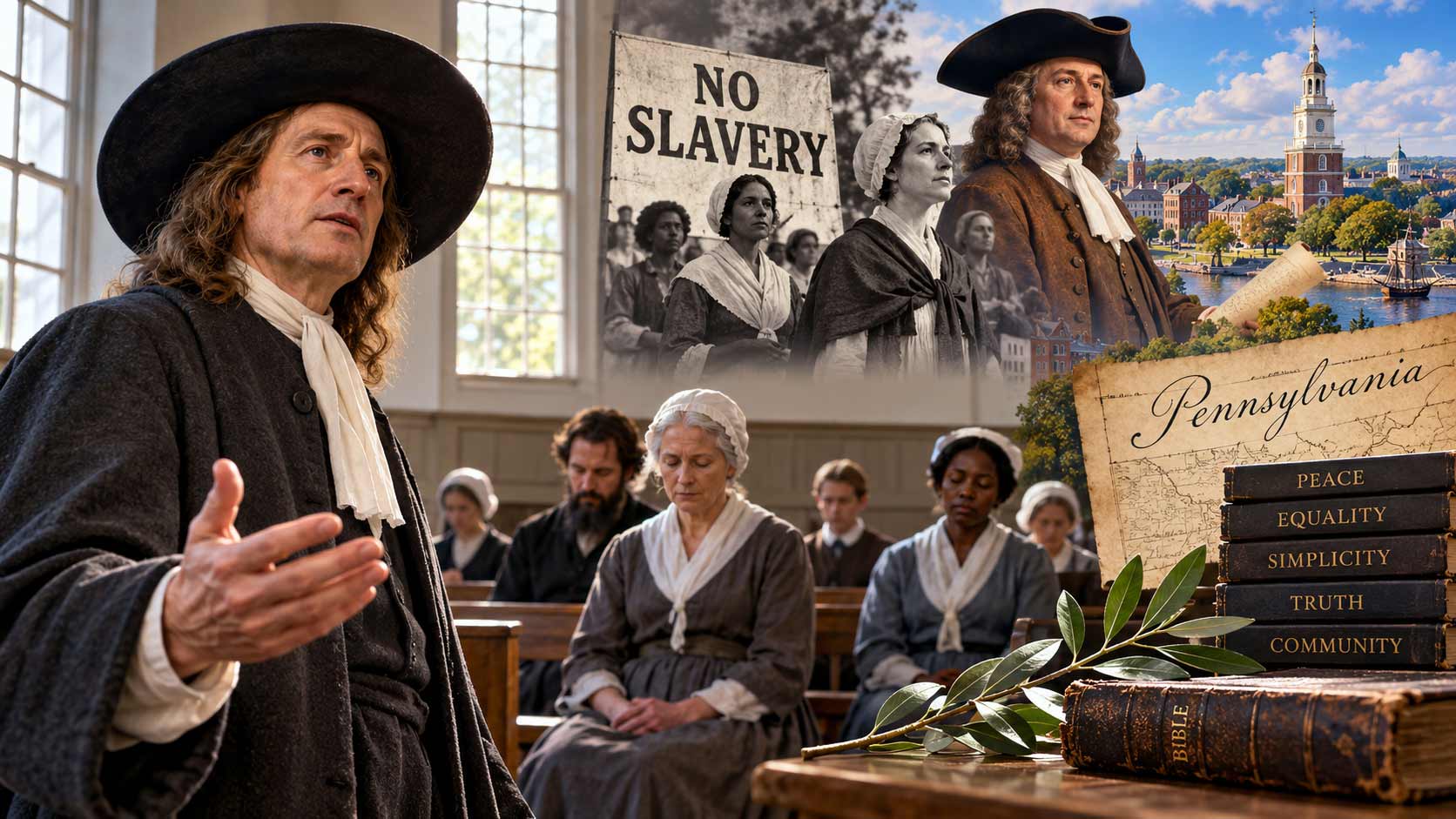
Quakers are one of those Christian groups almost everyone has heard of but relatively few people know much about. For some, the word brings to mind a man in old-fashioned clothes on a box of oatmeal. For others, it means pacifists, abolitionists, or people who sit quietly in a room waiting for somebody to say something. None of those associations is completely useless, although the oatmeal people have no actual connection to Quakerism. The real story is considerably more interesting. The Religious Society of Friends emerged from the religious turmoil of seventeenth-century England with a remarkably radical proposition: ordinary Christians could experience the presence and guidance of God directly, without priests, elaborate ceremonies, or even a prepared sermon.
That conviction shaped nearly everything else about the movement. Quakers became known for silent worship, simplicity, pacifism, opposition to slavery, religious liberty, equality of men and women, and an unwillingness to swear oaths. Some of those positions eventually became considerably less shocking than they were in the seventeenth century. Others remain distinctive even today. But modern Quakerism is also remarkably diverse, ranging from evangelical Christians with pastors and sermons to liberal Friends whose theology may bear little resemblance to historic Christianity. To understand how all of that ended up under the same name, you have to start with George Fox.
George Fox and the Beginning of the Friends
George Fox was born in England in 1624, at a time when English Christianity was undergoing enormous upheaval. The Church of England had broken with Rome during the previous century, Puritanism was challenging the established church, and the English Civil War opened the door to all sorts of religious movements that previously would have been suppressed. Fox was deeply dissatisfied with the Christianity he encountered. He sought advice from ministers and religious leaders but came away convinced that none of them could answer the spiritual questions troubling him.
Fox eventually became convinced that Christ Himself could speak directly to the believer. That experience became foundational to what developed into the Quaker understanding of the “Inner Light” or “Inward Light.” Fox wasn’t initially trying to create another denomination. In fact, the whole idea of constructing another religious institution would have seemed rather contrary to what he was preaching. He believed Christianity had become buried beneath professional clergy, ceremonies, theological systems, and religious customs that could substitute for actually knowing and obeying God.
Beginning in the late 1640s and especially during the 1650s, Fox traveled throughout England preaching his message. His followers initially called themselves Friends, drawing on Jesus’ language about His disciples as friends. The name “Quaker” began as a term of ridicule, apparently associated with trembling or quaking before the power of God, but eventually the Friends adopted the nickname themselves. Religious insults have a way of becoming denominational names if you give them enough time.
Margaret Fell became another enormously important figure in the early movement. She provided leadership, organizational support, and a home that became an important center for Friends. She also defended the right of women to preach, arguing that the Holy Spirit could speak through women just as He could through men. She eventually married Fox in 1669. From its earliest years, therefore, Quakerism gave women opportunities for religious ministry that were unusual in seventeenth-century Christianity.
The Inner Light
The most important idea in Quaker spirituality is the conviction that God can communicate directly with human beings. Early Friends spoke of the Light of Christ, the Seed, the Inward Teacher, or the Inner Light. The terminology has changed somewhat over the centuries, and different branches of Quakerism understand it differently, but the central idea remains that God’s presence and guidance aren’t restricted to clergy or mediated exclusively through religious institutions.
This shouldn’t be misunderstood as simply “follow your feelings.” Early Quakers were thoroughly immersed in the Bible and understood the Inner Light in explicitly Christian terms. They believed the same Christ revealed in Scripture could speak and lead through the Holy Spirit in the present. Because revelation was continuing, however, Friends resisted the idea that religious authority could be reduced entirely to creeds, institutions, or formal theological systems.
That created a tension that has followed Quakerism ever since. If the Spirit speaks directly to people, how do you determine whether someone has actually heard from God? And what happens when an inward leading appears to conflict with Scripture or with another person’s inward leading? Historically, Friends attempted to answer that through communal discernment rather than radical individualism. A claimed leading of the Spirit was tested within the worshiping community.
Over time, however, different Quaker groups placed different weight on Scripture and inward experience. Evangelical Friends generally emphasize biblical authority and understand the Spirit’s guidance within an explicitly Christian framework. Liberal Friends may give much greater authority to personal spiritual experience and may understand the Inner Light in ways that aren’t specifically Christian at all. That difference is one of the reasons it can be surprisingly difficult to answer the seemingly simple question, “What do Quakers believe?”
Meeting for Worship
Traditional Quaker worship is unlike the typical Protestant church service. There may be no pastor, sermon, choir, worship band, liturgy, or predetermined order of service. Instead, Friends gather for what is called a “meeting for worship” and sit together in expectant silence. The silence isn’t intended merely as meditation or a chance to enjoy some peace and quiet. Historically, Friends understood themselves to be waiting together for the Holy Spirit.
If someone believes the Spirit is prompting him or her to speak, that person may stand and offer what Friends call vocal ministry. Then the meeting returns to silence. Several people may speak during a meeting, or nobody may speak at all. In traditional Quaker thought, the absence of a sermon doesn’t mean nothing happened. The point is to encounter God rather than to make sure somebody fills fifty-eight minutes of scheduled church programming.
Not all Quakers worship this way today. “Unprogrammed” Friends preserve the traditional silent meeting without a pastor or prepared sermon. “Programmed” Friends, particularly many evangelical congregations, may have pastors, hymns, Scripture readings, sermons, and services that look much more like those of other Protestant churches. There may still be a period of silence or open worship, but someone walking into an Evangelical Friends church might be surprised at how familiar the service feels.
No Clergy, No Creeds, and No Sacraments
Early Friends rejected the distinction between clergy and laity because they believed the Holy Spirit could minister through any believer. They were particularly suspicious of a professional ministry in which someone was paid to preach whether or not the Spirit had actually given him anything to say. Traditional Quakerism therefore developed without an ordained priesthood, although pastoral branches of the movement eventually adopted paid ministers.
Friends also became known for rejecting formal creeds. That doesn’t mean early Quakers believed doctrine was irrelevant. George Fox, Robert Barclay, William Penn, and other early Friends wrote extensively about Christian theology. Their objection was to making assent to a humanly constructed creed the basis of Christian fellowship. They preferred a living faith demonstrated through obedience to God.
Quakers also generally don’t practice water baptism or the Lord’s Supper as outward ordinances. They believe the realities represented by baptism and communion are inward and spiritual rather than dependent upon ceremonies. From a traditional evangelical or sacramental Christian perspective, this is one of the more striking Quaker departures from historic church practice. Most Protestants may disagree over how baptism should be performed or what exactly happens during Communion; Quakers rather dramatically solved the argument by declining to perform either one.
Simplicity, Truth, and Equality
Quaker beliefs weren’t supposed to remain inside the meetinghouse. Friends spoke of “testimonies,” meaning ways their experience of God should become visible in everyday life. Over time these came to be associated especially with simplicity, peace, integrity, equality, and community.
Simplicity originally affected everything from clothing to speech. Friends avoided elaborate dress and social displays of wealth. They also refused to use honorific titles that reinforced social rank. Their famous use of “thee” and “thou” wasn’t an attempt to sound biblical. At the time, those forms could function as familiar singular pronouns, and Friends objected to changing their speech according to a person’s social standing.
The testimony of integrity led Quakers to refuse to swear oaths. Jesus had told His followers to let their yes be yes and their no be no, so Friends reasoned that a Christian shouldn’t require a special oath before telling the truth. If you’re truthful only after putting your hand on a Bible, there would seem to be a larger problem.
Their belief in spiritual equality also had important consequences. If God could speak through anyone, then social rank, wealth, education, and sex couldn’t determine who was qualified to minister. Women consequently exercised significant leadership among Friends from the beginning. The movement didn’t instantly erase every social prejudice of seventeenth-century England, but it contained theological principles that repeatedly pushed Friends toward questioning established hierarchies.
Peace and Pacifism
The Quaker peace testimony became one of the movement’s best-known characteristics. Friends rejected participation in war and increasingly embraced nonviolence as an implication of following Christ. Their position wasn’t merely that war was unfortunate or should be avoided whenever possible. Historic Quakerism developed a much stronger conviction that Christians shouldn’t kill their enemies.
This sometimes placed Friends in difficult situations. Governments expect citizens to defend the nation, particularly during wartime, and pacifists have rarely been especially popular when armies are being raised. Quakers became conscientious objectors, sometimes suffering imprisonment or other penalties for refusing military service. Friends have nevertheless been heavily involved in humanitarian relief during wars, attempting to serve people without taking up weapons.
Not every individual Quaker has been a pacifist, and some Friends have served in the military. Nevertheless, opposition to war remains one of the strongest historical Quaker testimonies. It also helped push Friends toward broader efforts at reconciliation, humanitarian relief, and social reform.
William Penn and Pennsylvania
One of the most famous Quakers was William Penn, who became a Friend after being born into a prominent English family. Penn received a large grant of land in North America from King Charles II in 1681 and established Pennsylvania. He envisioned the colony partly as a “holy experiment” where religious liberty and representative government could be practiced and persecuted religious minorities could live without the restrictions common in Europe.
Pennsylvania consequently became closely associated with Quaker principles of religious toleration. Philadelphia developed into an important center of American Quakerism, and Friends played a significant role in the colony’s political and economic life. Penn’s relationship with Native Americans was also notably more peaceful than many colonial encounters, although later dealings by his heirs were far less admirable.
Penn himself presents some of the complications that arise whenever history gets turned into stained glass. Although remembered as an advocate of liberty and tolerance, he also owned enslaved Africans. Quaker opposition to slavery developed gradually, not instantaneously, and some early Friends participated in slavery and the slave trade. The later Quaker testimony against slavery is important precisely because Friends eventually had to apply their own principle of human equality more consistently than some of their predecessors had done.
Quakers and Slavery
Some Quakers became among the earliest organized Christian opponents of slavery in the English-speaking world. The 1688 Germantown petition against slavery, produced by Quakers and Mennonites in Pennsylvania, was an early protest against the practice. During the eighteenth century, Friends such as John Woolman and Anthony Benezet relentlessly challenged fellow Quakers to recognize that owning another human being was incompatible with their profession of Christian equality.
Eventually, Quaker meetings moved against slaveholding among their own members. Friends then became prominent in the broader abolitionist movement in both Britain and the United States. Quakers were involved in antislavery societies, petitions, political activism, and assistance to people escaping slavery. Lucretia Mott, one of the best-known American abolitionists and later an advocate for women’s rights, came from the Quaker tradition.
The story is worth telling carefully because the simplified version—Quakers were always abolitionists—isn’t true. They had to confront slavery within their own communities first. Their eventual opposition became powerful partly because they treated abolition not simply as a political preference but as a consequence of what they already claimed to believe about God and humanity.
Divisions Among the Friends
For a movement suspicious of denominations, Quakers eventually developed an impressive collection of branches. The most important American division occurred in 1827 and 1828 between followers of Elias Hicks and the Orthodox Friends. Hicks emphasized the Inner Light and resisted some of the increasingly evangelical theology appearing among Friends. His opponents emphasized traditional Christian doctrine, the authority of Scripture, and the divinity of Christ. The split produced Hicksite and Orthodox yearly meetings.
The Orthodox side later divided again. Joseph John Gurney represented a more evangelical direction that emphasized Scripture and increasingly resembled other Protestant evangelical movements. John Wilbur and his followers resisted what they saw as departures from traditional Quaker faith and practice. Later developments produced additional evangelical, conservative, and pastoral branches.
Those divisions help explain the extraordinary range found among Friends today. Friends General Conference is generally associated with liberal and unprogrammed Quakerism. Friends United Meeting includes a broader range of Friends, many with programmed worship and pastors. Evangelical Friends are explicitly Christian and evangelical and may look much more like conventional Protestant churches. Conservative Friends attempt to preserve older Quaker theology and practice.
This diversity means that statements about “what Quakers believe” require some caution. A liberal unprogrammed meeting in an American city and an evangelical Friends church may share Quaker history and certain inherited practices while differing substantially on the Bible, Jesus Christ, salvation, sexuality, and even what is meant by God. Some contemporary liberal Friends don’t identify as Christians at all, while evangelical Friends affirm recognizably orthodox Christian beliefs. They belong to the same historical family, but it is a family with some very distant cousins.
Quakers Today
Quakerism remains much smaller than major Protestant traditions such as Baptists, Methodists, or Lutherans, but its influence has always been disproportionate to its size. Friends helped shape discussions about religious liberty, conscientious objection, abolition, prison reform, humanitarian relief, women’s participation in ministry, and nonviolent social action. Their emphasis on conscience and direct spiritual experience has also influenced Christian thought well beyond formal Quaker institutions.
Perhaps the most distinctive contribution of the Friends is the insistence that Christianity must be more than correct words about God. Early Quakers weren’t particularly interested in winning theological arguments while living exactly like everyone else. If Christ truly speaks and leads, they reasoned, then the evidence should eventually appear in the way Christians treat their neighbors, enemies, employees, women, prisoners, people of other races, and those with whom they disagree.
Christians from other traditions have good reasons to question parts of Quaker theology, particularly the relationship between continuing revelation and biblical authority and the rejection of baptism and Communion. At the same time, Quaker history raises an uncomfortable question for Christians who possess perfectly orthodox statements of faith: what difference does any of it make if our lives never bear witness to what we say we believe? The Friends call that witness a testimony, and at their best they have spent nearly four centuries trying to make the outward life agree with the inward faith.