

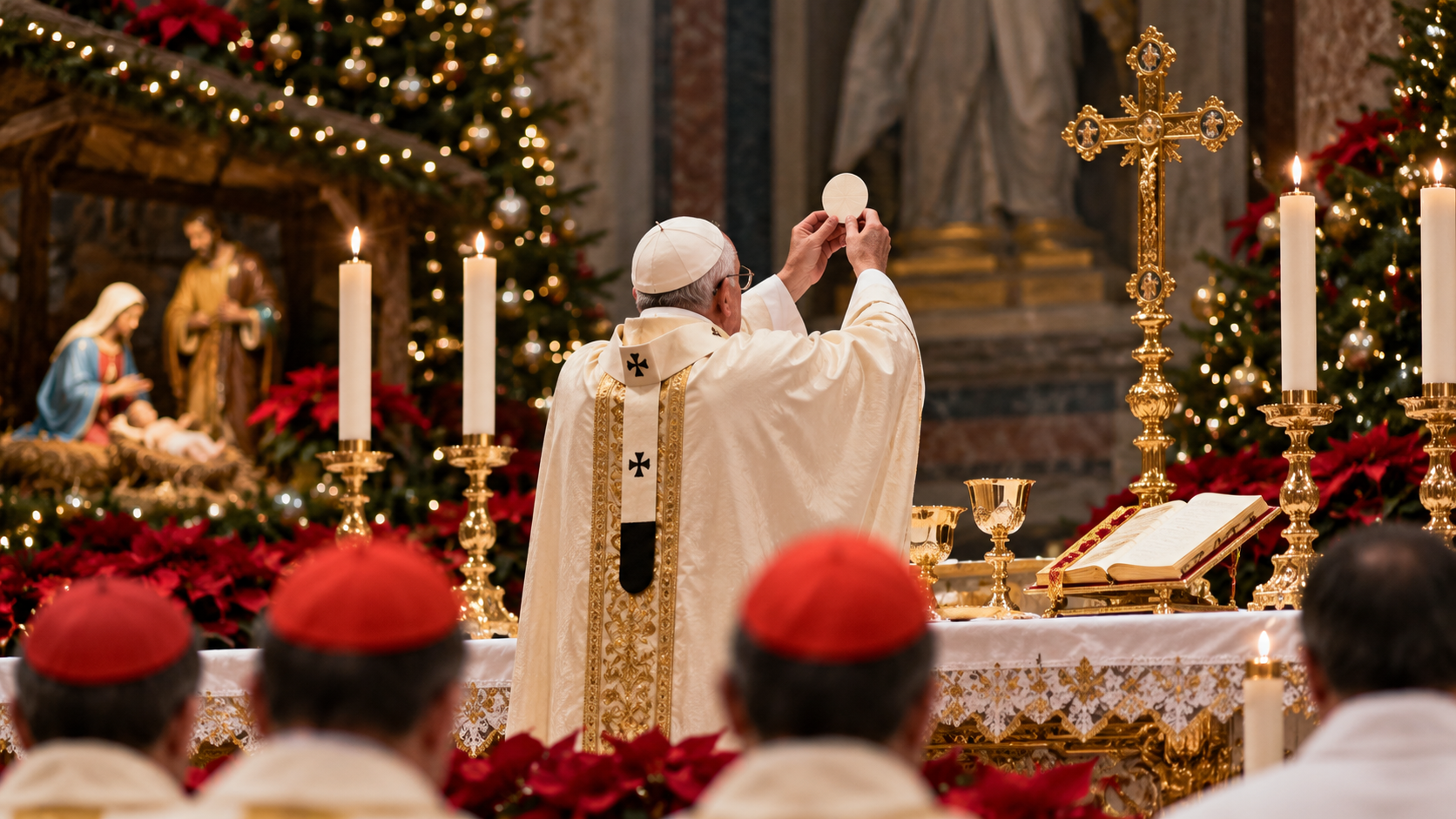
Few subjects illustrate the differences between Christian traditions more clearly than the papacy. For Roman Catholics, the pope is not simply the administrative head of the world’s largest Christian organization. He is the bishop of Rome and successor of the apostle Peter, entrusted with a particular responsibility for preserving the unity and teaching of the church. For Eastern Orthodox and Protestant Christians, however, the authority claimed for the pope is one of the principal reasons they remain separated from Rome.
The disagreement therefore isn’t primarily about whether the bishop of Rome should be respected. Historically, Rome occupied an important place in Christianity very early. The real question is what kind of authority belongs to the bishop of Rome, and whether Jesus intended that authority to pass from Peter to his successors.
Peter and the Rock
The most important biblical passage in the Catholic case for the papacy is [Matthew 16:16–19], where Peter confesses that Jesus is “the Christ, the Son of the living God.” Jesus responds by calling him Peter, speaking of the rock upon which He will build His church, and giving him the “keys of the Kingdom of Heaven.”
Catholic interpretation sees this as more than a compliment to Peter’s confession. Jesus gives Peter a distinctive role among the apostles, and the imagery of the keys is commonly connected with [Isaiah 22:22], where the key represents authority within the royal household. Catholics also point to [Luke 22:31–32], where Jesus specifically prays that Peter’s faith will not fail and tells him to strengthen his brothers, and [John 21:15–17], where the risen Jesus repeatedly commands Peter to feed and tend His sheep.
There is certainly no difficulty recognizing that Peter occupies a prominent position in the New Testament. He frequently speaks for the apostles, preaches the sermon at Pentecost, plays an important role in the opening chapters of Acts, and is instrumental in the inclusion of Gentiles through the conversion of Cornelius. The more difficult question is whether Peter’s prominence establishes the later claims of the papacy.
Was Peter the First Pope?
Roman Catholic tradition regards Peter as the first bishop of Rome and understands subsequent bishops of Rome as his successors. There is strong early Christian tradition connecting both Peter and Paul with Rome and with martyrdom there during the reign of Nero. What is considerably less obvious is whether Peter functioned as “pope” in the later sense of that office.
The New Testament never calls Peter pope or explicitly describes him as bishop of Rome. When the apostles and elders gather to consider the Gentile controversy in Acts 15, Peter speaks importantly, but James also plays a prominent role in the final deliberation. Paul can even describe an occasion when he publicly opposed Peter at Antioch because he believed Peter’s conduct was wrong ([Galatians 2:11–14]).
That doesn’t prove Peter lacked a distinctive role. It does mean that we have to be careful about reading the fully developed medieval or modern papacy backward into the first century.
From the Bishop of Rome to the Pope
The papacy did not appear in its mature form overnight. Rome was an important Christian center from very early in church history, and its church was associated with both Peter and Paul. The city’s importance as the capital of the Roman Empire also gave the Roman church considerable visibility and influence.
Over the centuries, bishops of Rome increasingly asserted authority beyond their own local church. Some Christians accepted those claims more readily than others. The collapse of imperial government in the West also increased the practical importance of the Roman bishop, while the churches of the Greek-speaking East developed under very different political and ecclesiastical circumstances.
By the medieval period, the papacy had become one of the most powerful institutions in Western Europe. Popes exercised not only religious authority but sometimes enormous political influence. Disputes over the extent of papal authority contributed to the growing separation between Eastern and Western Christianity and later became one of the major issues of the Protestant Reformation.
In other words, asking, “When did the first pope appear?” sounds like a simple historical question, but the answer depends considerably on what we mean by pope. Peter doesn’t look much like a medieval pope, and a medieval pope doesn’t look exactly like a modern one either.
Papal Primacy and Papal Supremacy
An important distinction in discussions of the papacy is the difference between primacy and supremacy. Christians in the ancient church could recognize Rome as possessing a special honor or prominence without necessarily accepting the later Catholic understanding of universal papal jurisdiction.
Eastern Orthodox Christians generally acknowledge that the bishop of Rome historically possessed a primacy among the major bishops of Christianity. They dispute, however, that this primacy gave him universal jurisdiction over the entire church. The disagreement between Rome and Constantinople therefore isn’t simply over whether Rome was important. It concerns what Rome’s importance actually meant.
Protestants generally go further, rejecting the idea that Christ established an ongoing office of universal church leadership to be inherited by the bishops of Rome. Many Protestants recognize Peter’s prominence among the apostles while seeing no biblical basis for transferring his particular role to an indefinite succession of Roman bishops.
What Is Papal Infallibility?
Papal infallibility is probably one of the most misunderstood Catholic doctrines. It does not mean that Catholics believe the pope is sinless, knows everything, or cannot make mistakes. History would make all three positions rather difficult to maintain.
The doctrine was formally defined at the First Vatican Council in 1870. It teaches that under particular circumstances the pope is preserved from error when, exercising his office as shepherd and teacher of all Christians, he definitively teaches a doctrine concerning faith or morals that is to be held by the whole church. This is commonly described as speaking ex cathedra, meaning “from the chair.”
Catholics understand this protection as a work of God preserving the church from doctrinal error, not as a personal ability possessed by the pope in everything he says. Critics question both the biblical foundation for such an authority and whether the historical development of the doctrine supports the claim.
How Is a Pope Chosen?
When a pope dies or resigns, the College of Cardinals gathers to elect his successor. The election takes place in a conclave, traditionally held in the Sistine Chapel. A candidate must receive the required supermajority of the participating cardinal electors before being chosen.
The familiar smoke from the Vatican chimney announces the progress of the election. Black smoke indicates that no pope has been elected; white smoke announces that an election has succeeded. The new pope then chooses a papal name and is presented publicly from the balcony of St. Peter’s Basilica.
This electoral system developed over time. Peter, needless to say, was not elected by a conclave of cardinals in the Sistine Chapel. Understanding that development is important because the office, claims, procedures, and institutions surrounding the papacy have all developed during Christian history.
Why the Papacy Matters
The papacy ultimately raises a much larger question than the identity of the man wearing the white cassock: How did Christ intend His church to be governed?
If Christ gave Peter an office of universal leadership that was intended to continue through his successors in Rome, then the papacy has enormous theological significance. If Peter possessed an important but unique apostolic role that was never intended to become a permanent office held by successive bishops of Rome, then the Catholic claim goes considerably beyond what the New Testament establishes.
That is why disagreements about the papacy cannot be reduced simply to disagreements about individual popes. The real debate concerns apostolic succession, church authority, biblical interpretation, and the relationship between Scripture and Christian tradition. Those questions have helped shape Christian history for nearly two thousand years, and they remain among the most important differences separating Roman Catholicism from Eastern Orthodoxy and Protestant Christianity.