

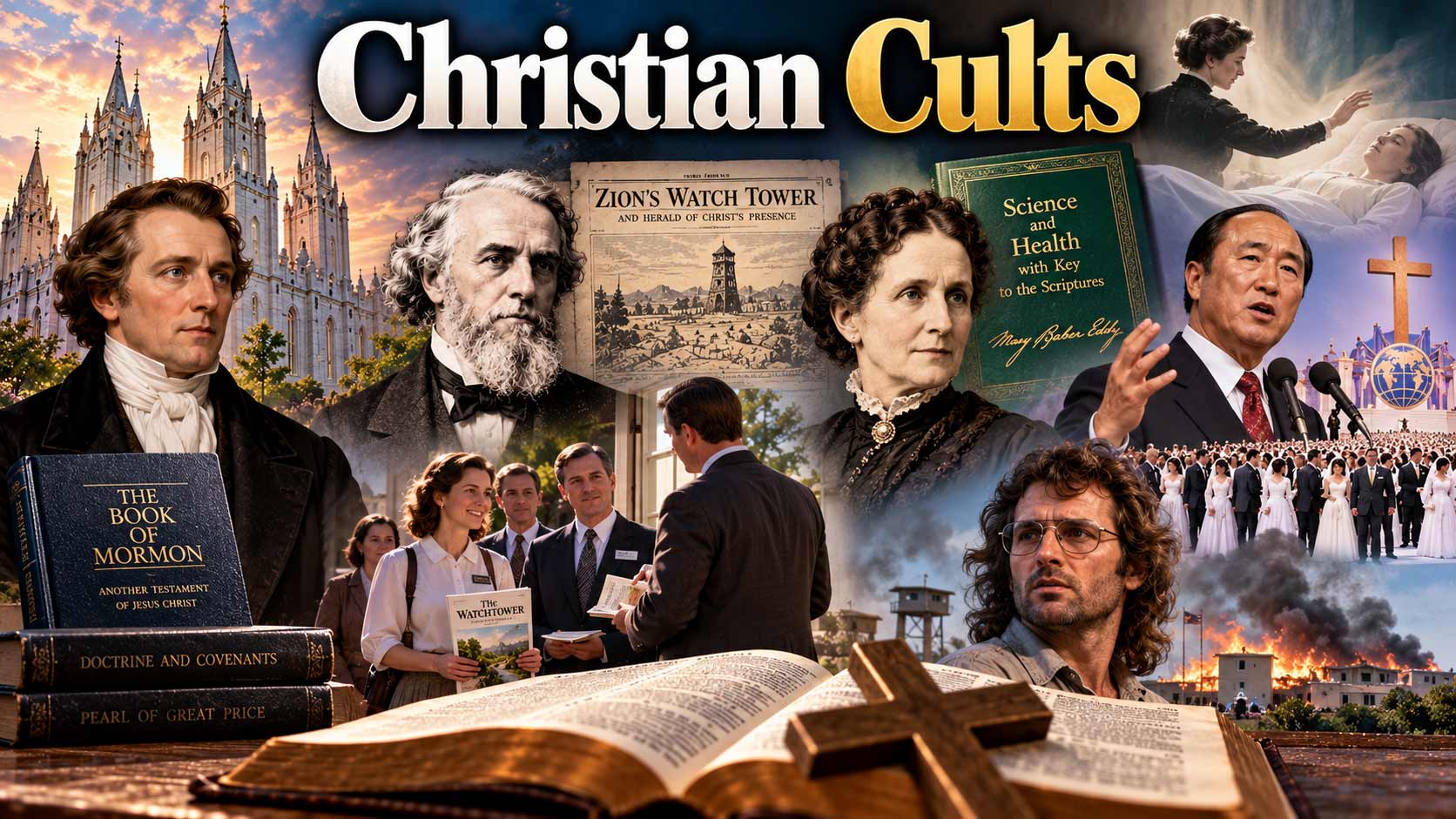
The word cult is one of those religious terms that can start an argument before anyone has defined what they’re arguing about. To some people, a cult is any religious group with a strange leader, unusual beliefs, or members who seem a little too enthusiastic. In popular culture the word brings to mind compounds, matching clothes, mind control, and occasionally a disastrous encounter with federal law enforcement. Christians have traditionally used the term somewhat differently. In Christian theology and apologetics, a cult is generally a movement that identifies itself with Christianity or draws substantially from it while rejecting or radically redefining doctrines that have historically defined the Christian faith.
That distinction is important for Jew & Greek because we’re not putting every unconventional religion into the same theological box. Scientology isn’t a Christian cult in this sense because it didn’t begin as an attempt to restore Christianity and doesn’t derive its central theology from the Bible. Hare Krishna belongs to a Hindu religious tradition rather than Christianity. Jehovah’s Witnesses and the Latter-day Saint movement are different cases. Both emerged in predominantly Christian settings, use Christian terminology, speak extensively about Jesus, and claim in different ways to represent restored religious truth. The question isn’t whether their members sincerely consider themselves Christian. The question is how their teachings compare with the beliefs Christians historically regarded as essential to Christianity.
What Makes a Movement a Christian Cult?
There is no universally accepted checklist that automatically turns a religious movement into a cult. Protestants, Catholics, and Orthodox Christians disagree about plenty of important doctrines, but disagreement itself isn’t enough. If it were, Christianity would consist largely of Christians declaring everyone in the church across the street a cult, which wouldn’t leave us with a particularly useful definition.
Historically, Christianity developed certain boundaries concerning the identity of God, the person of Jesus Christ, salvation, and the authority of the apostolic faith. The early ecumenical creeds didn’t settle every Christian disagreement, nor were they attempting to. They addressed questions that Christians believed went to the heart of who God is and who Christ is. The Nicene tradition, for example, confessed one God and affirmed that Jesus Christ shares the divine nature of the Father rather than being a created supernatural being.
That gives us a better theological starting point. A Christian cult typically retains substantial Christian vocabulary while redefining one or more foundational doctrines so dramatically that familiar words no longer necessarily mean familiar things. A group may speak about God, Jesus, salvation, resurrection, Scripture, and eternal life while assigning those terms meanings that Catholic, Orthodox, and historic Protestant Christianity would reject.
This is why theological comparison matters more than simply attaching a label. Saying “Jehovah’s Witnesses are a cult” tells the reader very little by itself. Explaining that Witnesses reject the Trinity, identify Jesus in His prehuman existence with Michael the archangel, and deny that Christ is Almighty God tells the reader exactly where the theological disagreement lies. The explanation is more useful than the label.
Restoration Is a Recurring Theme
Many Christian-derived movements begin with a restoration story. The basic argument is that original Christianity was true, but the institutional Church eventually corrupted it. God therefore raised up a person or movement to restore truths that had been lost for centuries.
The details vary considerably. Joseph Smith claimed that existing churches had departed from the true faith and introduced new scripture and prophetic revelation as part of the restoration of Christ’s Church. Charles Taze Russell and the early Bible Students believed historic Christianity had absorbed false doctrines such as the Trinity, the immortal soul, and eternal torment. Later Jehovah’s Witnesses developed an increasingly distinctive organization that regarded itself as representing true Christianity in contrast with what they called Christendom.
Restoration claims shouldn’t automatically be dismissed merely because they challenge tradition. The Protestant Reformation itself involved enormous arguments over whether inherited church practices were faithful to Scripture. The Restoration Movement associated with Alexander Campbell and Barton Stone also attempted to move behind denominational traditions and recover New Testament Christianity. Simply saying “the established churches are wrong” doesn’t make somebody a cult leader.
The more important question is what supposedly had to be restored. If the claim is that medieval Christianity accumulated unbiblical traditions, Christians can argue about those traditions from Scripture and history. If the claim is that the Church lost the true identity of God, corrupted the nature of Christ, abandoned the true gospel, and remained fundamentally wrong for more than a thousand years until a nineteenth- or twentieth-century movement recovered the truth, the historical problem becomes much larger. At that point the restoration requires us to believe that central elements of Christianity effectively disappeared from Christianity itself.
New Revelation and Additional Authority
Another recurring feature of Christian cults is an authority structure that extends beyond the ordinary Christian appeal to Scripture. This can take the form of new scriptures, a modern prophet, an authoritative organization, continuing revelation, or a leadership body possessing a unique ability to interpret the Bible correctly.
The Latter-day Saint tradition provides the clearest example of additional scripture. Alongside the Bible, it accepts the Book of Mormon, Doctrine and Covenants, and Pearl of Great Price as scripture and recognizes continuing prophetic authority. Mormonism therefore doesn’t merely offer a different interpretation of several difficult biblical passages. It places those passages within a larger revelatory system.
Jehovah’s Witnesses approach the question differently. They don’t add a Book of Mormon to the biblical canon, but their Governing Body exercises enormous influence over how Scripture is interpreted and how doctrine develops within the organization. Witnesses are encouraged to study the Bible, but that study occurs within an interpretive framework supplied through Watch Tower publications and organizational teaching.
The problem isn’t simply that religious communities have teachers. Every Christian tradition has pastors, theologians, creeds, confessions, councils, commentaries, and inherited interpretations. Nobody opens a Bible in a historical vacuum. The important question is whether those authorities can themselves be tested and corrected, or whether the system eventually becomes circular: the organization is God’s organization because the organization correctly interprets Scripture, and we know it correctly interprets Scripture because it is God’s organization.
Who Is Jesus?
Christology provides one of the clearest dividing lines between historic Christianity and many Christian cults. The New Testament forced early Christians to wrestle with an extraordinary collection of claims. Jesus is genuinely human, yet He forgives sins, receives worship, exercises divine authority, participates in creation, and is described in language associated with God. At the same time, He prays to the Father and distinguishes Himself from the Father.
The doctrines of the Trinity and Incarnation developed as the Church attempted to account for all of that biblical material without simply throwing inconvenient passages overboard. Christians certainly argued about how the language should be formulated, sometimes with an enthusiasm that makes modern denominational squabbles look almost relaxing. But the resulting orthodox confession maintained that Jesus is neither the Father nor a lesser created god. He is truly divine and truly human.
Christian cults frequently revise that identity. Jehovah’s Witnesses regard Jesus as God’s first creation and identify His prehuman existence with Michael the archangel. Latter-day Saint theology uses Christian language about the divinity of Christ but places Jesus within a very different understanding of God, humanity, premortal existence, and exaltation. Other movements have presented Jesus primarily as an enlightened teacher, a specially anointed human being, or one manifestation within a broader spiritual system.
That is why asking whether a group “believes in Jesus” doesn’t settle very much. Muslims believe in Jesus. New Age writers talk about Jesus. Plenty of religions can incorporate a figure named Jesus into their worldview. The historically Christian question is more specific: Who do they say Jesus is?
What Is God?
Closely connected with Christology is the doctrine of God. Historic Christianity confesses one God who eternally exists as Father, Son, and Holy Spirit. The doctrine of the Trinity is difficult, and Christians haven’t helped matters by occasionally explaining it with analogies that accidentally reproduce heresies the Church rejected fifteen centuries ago. Nevertheless, the doctrine is intended to preserve both biblical monotheism and the full deity of the Father, Son, and Spirit.
Christian cults frequently reject or substantially reconstruct this doctrine. Jehovah’s Witnesses are explicitly non-Trinitarian. The Father alone, Jehovah, is Almighty God; Jesus is subordinate and created, while the Holy Spirit is God’s active force rather than a divine person.
Latter-day Saint theology moves in another direction. The Father, Son, and Holy Ghost are understood as distinct beings united in purpose rather than one divine being in the Nicene sense. Mormon teachings concerning human exaltation and God’s relationship to embodied existence also move considerably beyond traditional Christian theology.
Again, simply identifying these differences is more helpful than shouting cult. If two religious groups use the word God but mean substantially different things by it, readers need to know what each one means.
Salvation and the Organization
Questions about salvation also reveal significant differences. Historic Christian traditions disagree about predestination, baptism, perseverance, sacraments, sanctification, and the relationship between faith and works. Those disagreements are substantial, but they generally occur within a shared story: humanity is fallen, salvation comes through Jesus Christ, His death and resurrection are decisive, and reconciliation with God is ultimately the work of divine grace.
Christian cults can retain portions of that story while embedding salvation within a distinctive organizational or theological system. Membership, ordinances, loyalty to a restored church, obedience to organizational teaching, or acceptance of new revelation may assume a role that isn’t found in historic Christianity.
This doesn’t mean that every demanding church is a cult or that Christianity requires nothing from believers. Jesus wasn’t exactly vague about discipleship costing something. The New Testament contains church discipline, moral commandments, leadership, doctrinal boundaries, and expectations for Christian conduct.
The warning sign appears when access to God becomes inseparable from submission to a particular modern organization or exclusive movement claiming to be God’s sole authorized representative. Christianity has always confessed that salvation is found in Christ. When that effectively becomes “Christ as available through our organization,” something significant has changed.
Christian Science
Christian Science demonstrates how widely a movement can use Christian language while interpreting it through a substantially different metaphysical system. Founded by Mary Baker Eddy in the nineteenth century, Christian Science teaches from the Bible but also gives a central place to Eddy’s Science and Health with Key to the Scriptures.
Eddy’s understanding of reality, matter, sickness, sin, and healing differs sharply from historic Christian teaching. Christian Science emphasizes the ultimate spiritual reality of God’s creation and interprets sickness and material existence in ways connected with mistaken human perception. Spiritual healing consequently became one of the movement’s best-known characteristics.
Christian Science shouldn’t be confused with Scientology merely because both names contain the word Science. Their histories and beliefs are unrelated. Christian Science emerged from a Christian environment and interprets Jesus and the Bible through Eddy’s theological system. Scientology emerged from L. Ron Hubbard’s ideas about the human mind and spiritual existence. The similarity of their names has probably caused more confusion than either organization would prefer.
The Unification Church
The Unification Church, founded by Sun Myung Moon in Korea, provides another example of a movement incorporating Christianity into a new revelatory framework. Moon taught that Jesus had an essential messianic mission but that the crucifixion prevented the complete fulfillment of God’s original purpose for Him, particularly the establishment of an ideal family.
Moon’s teachings presented himself and his wife, Hak Ja Han, within a larger program of restoring what had been lost through the Fall and left incomplete in Jesus’ earthly mission. The movement’s theology was set out particularly through the Divine Principle. Its mass wedding ceremonies became its most recognizable public image, although they make considerably more sense when understood within the movement’s theology of marriage, lineage, and restoration.
The Unification movement therefore isn’t merely a Korean denomination with unusual wedding ceremonies. Its understanding of Jesus, the Fall, redemption, messianic fulfillment, and the role of Moon places it outside historic Christian orthodoxy despite its extensive use of biblical themes.
Branch Davidians
The Branch Davidians show another route by which a Christian-derived movement can develop. Their history runs through the Seventh-day Adventist environment, then the Davidian movement associated with Victor Houteff, and eventually the Branch Davidian community that became associated with David Koresh near Waco, Texas.
Koresh’s community is now remembered almost entirely through the disastrous 1993 federal siege, which ended with the deaths of Koresh and many of his followers. But reducing the Branch Davidians to the final images of the burning Mount Carmel compound misses the religious ideas that held the community together. Koresh presented himself as possessing unique insight into biblical prophecy, particularly the Seven Seals of Revelation, and his authority over the community became increasingly extraordinary.
The Branch Davidians also demonstrate why theological and sociological definitions of cult sometimes overlap. A movement can depart from historic Christian doctrine while simultaneously becoming centered around a charismatic leader whose authority controls increasingly large portions of members’ lives. Those are related questions, but they aren’t identical ones, and responsible discussion should distinguish them.
Theology and the High-Control Question
Modern discussions frequently define cults less by theology than by behavior. Researchers and former members may focus on authoritarian leadership, information control, social isolation, manipulation, financial exploitation, sexual abuse, fear of leaving, or severe consequences for dissent. Under that definition, a group could be theologically orthodox and still behave in cult-like ways.
That’s a legitimate issue, but it is a different issue. A church can affirm the Nicene Creed on Sunday morning and still have an abusive pastor. Correct Christology doesn’t magically prevent spiritual manipulation. Conversely, a religious group can hold beliefs historic Christianity considers heretical without fitting every popular model of a coercive or high-control cult.
Jew & Greek therefore uses Christian cult primarily as a theological and historical category while taking questions of control seriously where the evidence warrants it. We shouldn’t diagnose a movement’s social behavior merely because we reject its doctrine, and we shouldn’t excuse abusive behavior merely because a church’s doctrinal statement looks orthodox.
Keeping those categories separate allows criticism to become more precise. We can say that Jehovah’s Witness Christology contradicts Nicene Christianity without claiming that every Witness family has the same experience. We can examine Mormon scripture and theology without pretending every Latter-day Saint congregation functions identically. And when a movement genuinely does exhibit coercive practices, we can discuss those practices on their own evidence rather than treating cult as a word that does all the argumentative work for us.
Why Study Christian Cults?
Studying Christian cults isn’t mainly about assembling a catalog of religious oddities. These movements raise questions that Christians need to ask about their own faith. What makes Christianity Christian? Which doctrines are central and which permit legitimate disagreement? How much authority should religious leaders possess? How do we distinguish continuing theological development from changing the identity of the faith itself?
They also demonstrate why knowing Christian vocabulary isn’t enough. Two people can use the words God, Jesus, Bible, salvation, and resurrection while believing very different things. Good apologetics begins by discovering those differences rather than assuming them.
There is also a human reason to get this right. Jehovah’s Witnesses, Latter-day Saints, Christian Scientists, Unificationists, and members of other Christian-derived movements aren’t merely entries in an apologetics handbook. They’re neighbors, relatives, coworkers, and occasionally the people standing at the front door on Saturday morning. Christians who believe these movements are seriously mistaken have more reason, not less, to represent their beliefs accurately.
The purpose of identifying a Christian cult should therefore never be to end the conversation. It should tell us where the conversation needs to begin.