

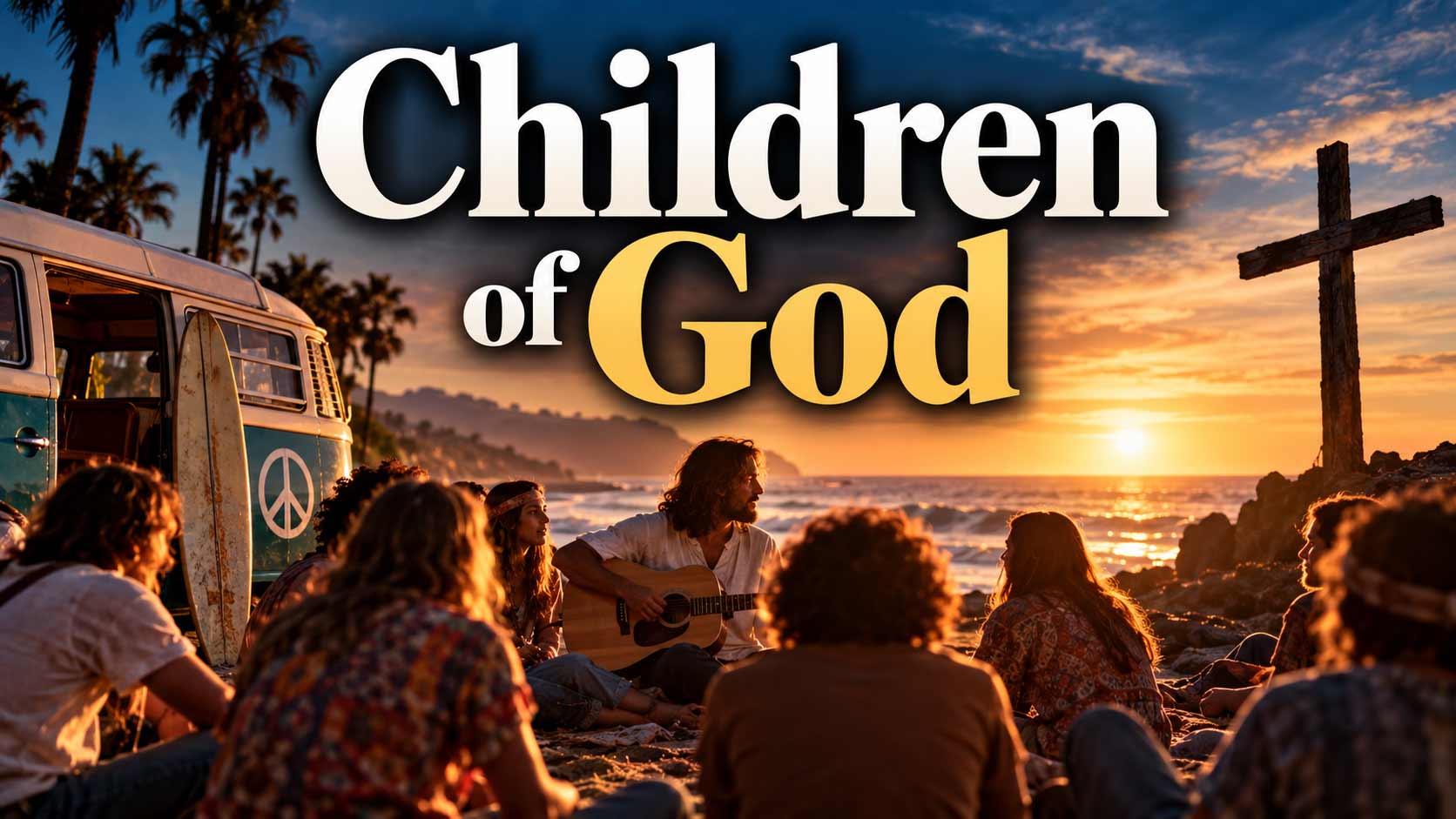
Some cults begin with an obviously strange idea. The Children of God didn’t. It began during the late 1960s with young people, Jesus, evangelism, communal living, and the conviction that conventional churches had become too comfortable to reach a generation that was dropping out of conventional society. That put the movement close enough to the larger Jesus Movement to look familiar at first, but under the leadership of David Berg it traveled in directions that most of the Jesus Movement never remotely contemplated.
The story eventually included apocalyptic prophecy, absolute loyalty to Berg’s teachings, unconventional sexual doctrines, communal control over family life, and a missionary practice known as “Flirty Fishing,” in which sex could be used as a means of evangelism. Even more seriously, teachings and practices during part of the movement’s history failed to protect children from sexual exploitation and abuse. The organization that survives today as The Family International has repudiated many of those practices, apologized for harm caused during its earlier history, and bears little organizational resemblance to the communal movement Berg created. That distinction is important, but so is understanding how a movement that began by talking about radical discipleship managed to get there.
David Berg and the Jesus People Era
David Brandt Berg was born in 1919 into a Christian family with connections to evangelism and ministry. By the 1960s he had become deeply dissatisfied with established Christianity, which he increasingly regarded as spiritually dead, compromised, and ineffective. The cultural upheaval of the decade gave him an audience that was unusually receptive to that message.
In 1968 Berg and members of his family began ministering among young people in Huntington Beach, California. Hippies, runaways, drug users, and other members of the counterculture were precisely the people many conventional churches had difficulty reaching. Berg’s ministry offered them an intense alternative: Jesus, community, evangelism, rejection of materialism, and separation from the values of mainstream society.
This was also the world from which the broader Jesus Movement emerged. Young converts were being baptized in the Pacific Ocean, Christian communes were forming, contemporary Christian music was developing, and ministries such as Calvary Chapel were reaching people who wouldn’t have looked especially comfortable in the average Sunday morning congregation of 1969.
The similarities, however, shouldn’t obscure an important difference. Most Jesus People eventually became part of ordinary churches or organizations that retained recognizable forms of Christian accountability. Berg increasingly moved in the opposite direction. The institutional church wasn’t merely ineffective in his thinking; it became part of a corrupt religious system from which genuine disciples needed to separate.
By late 1969 Berg’s followers numbered around one hundred, and the press began calling them the Children of God. Growth came quickly. By 1972 the movement had established more than a hundred communities around the world. Young converts left jobs, possessions, families, and conventional expectations behind to become full-time missionaries.
For an idealistic twenty-year-old convinced that ordinary Christianity had compromised with the world, it could be a powerful proposition.
Moses David
Berg increasingly presented himself under the name Moses David, or simply “Mo,” and communicated with followers through thousands of writings known as the Mo Letters. These became far more than inspirational newsletters. They provided spiritual teaching, organizational instructions, prophecy, commentary on current events, sexual teaching, and Berg’s interpretations of Scripture.
That created one of the central problems in the movement. The Children of God continued to use the Bible and regarded themselves as Christians, but Berg’s interpretations acquired extraordinary authority. His prophetic claims made disagreement increasingly difficult because challenging Berg could amount to resisting God’s chosen messenger.
The pattern is familiar from several movements we’ve already examined. A leader doesn’t necessarily announce on the first day that his teachings will effectively become the lens through which Scripture must be understood. Authority accumulates gradually. The leader explains the Bible, then uniquely understands the Bible, then receives revelation concerning the Bible, and eventually questioning the leader becomes evidence that the questioner has the spiritual problem.
Berg’s writings also contained increasingly severe attacks on established churches, governments, social institutions, and eventually former members. The outside world was often portrayed as hostile to God’s work, which strengthened the movement’s internal identity while making criticism easier to dismiss.
Forsaking All
The Children of God placed enormous emphasis on Jesus’ commands concerning discipleship, particularly passages about forsaking possessions, leaving family, and preaching the gospel. Members commonly lived communally, shared resources, evangelized extensively, and depended heavily upon the group for their social and economic lives.
There was a genuine biblical question underneath this. Jesus did tell His disciples to place loyalty to Him above possessions and even family relationships. The early Christians also demonstrated remarkable generosity and shared material resources with one another.
The problem comes when radical discipleship becomes radical dependence upon an organization. Giving up possessions may sound like liberation from materialism, but if the result is that a person owns nothing, earns little independent income, lives in housing controlled by the movement, works primarily with other members, and has strained relationships with outsiders, leaving becomes extraordinarily difficult.
That distinction matters when discussing high-control religious groups. People don’t always remain because someone has physically locked the door. Sometimes the door is technically open while nearly everything on the other side has been taken away.
End-Time Christianity
Berg’s theology was intensely apocalyptic. He believed the world was approaching the events described in biblical prophecy and expected the rise of the Antichrist, the Great Tribulation, the return of Christ, and the establishment of God’s kingdom.
End-times expectation gave missionary work tremendous urgency. If history was rapidly approaching its conclusion, conventional careers and ordinary middle-class ambitions could appear almost absurd. Why spend decades building a comfortable life if the Antichrist was practically warming up backstage?
Apocalyptic expectation isn’t itself evidence of a cult. Christianity has always expected Christ’s return, and many perfectly orthodox Christians have believed they were living near the end of the age. The danger appears when speculative interpretations become prophetic certainties and the leader who interprets current events claims unusual divine authority.
Berg made predictions and interpretations that didn’t always develop as expected, but failed expectations didn’t destroy the movement. Like many apocalyptic groups, it was capable of adjusting its understanding while preserving confidence in the larger prophetic system.
The Law of Love
The most controversial aspect of Berg’s theology developed from what he called the Law of Love. Berg emphasized Jesus’ commands to love God and one’s neighbor and increasingly argued that actions motivated by genuine, unselfish love weren’t necessarily bound by conventional moral restrictions.
There is a recognizable Christian idea buried underneath that reasoning. Jesus did place love of God and neighbor at the center of the Law, and Paul taught that love fulfills the Law. But neither Jesus nor Paul treated love as permission to redefine sexual morality according to individual judgment. Biblical love fulfills God’s moral purposes; it doesn’t function as a theological eraser whenever a command becomes inconvenient.
Within the Children of God, however, Berg’s understanding of love became connected with increasingly permissive sexual teachings. Conventional expectations of marital exclusivity were weakened, sexual sharing among adults was encouraged during portions of the movement’s history, and sexuality could be interpreted as a means of demonstrating God’s love.
Once the movement accepted that logic, an even more controversial practice followed.
Flirty Fishing
Beginning in the mid-1970s, some female members were encouraged to practice what became known as Flirty Fishing, usually abbreviated “FFing.” The idea was that romantic and sexual relationships could be used evangelistically to reach men who might otherwise never respond to conventional preaching.
Members involved in the practice might meet men in bars, restaurants, hotels, or other settings, develop relationships with them, share the movement’s message, and in some cases have sex with them. Berg justified the practice through his expansive understanding of sacrificial Christian love.
From inside the system, this could be presented as extraordinary devotion: a missionary willing to use even her sexuality to reach someone with God’s love. From outside it, the obvious question was how a Christian leader had managed to transform evangelism into organized sexual activity.
The answer lies partly in the authority structure already established. Once followers accept that a leader possesses special revelation from God, practices that would otherwise trigger immediate moral objections can be reinterpreted as tests of faith. The question changes from “Is this consistent with Scripture?” to “Am I spiritual enough to obey?”
Flirty Fishing continued for years before being discontinued in 1987. Estimates of the number of sexual encounters connected with the practice vary considerably, but it became one of the defining features of the Children of God’s public reputation.
Children and Sexual Abuse
The most disturbing part of the movement’s history concerns children.
Berg’s sexually permissive teachings didn’t remain confined to relationships among consenting adults. Some of his writings and movement practices during the late 1970s and 1980s failed catastrophically to maintain appropriate boundaries between adults and minors. Former members have described sexual abuse, inappropriate exposure to adult sexuality, and environments in which children were inadequately protected.
This is an area where careful wording matters because the history has been contested, individual experiences differed, and the present organization disputes some broader descriptions made by its critics. At the same time, The Family International itself now acknowledges that Berg’s writings misapplied its Law of Love doctrine to sexual contact between adults and minors, that abusive actions occurred, and that children were harmed. Its present leadership has apologized to former members and specifically placed responsibility on Berg for promoting sexually liberal doctrines without adequate protections for children.
The organization prohibited sexual contact between adults and minors in 1986 and later made violations grounds for expulsion. Berg subsequently repudiated material that permitted or suggested such behavior, and offending material was eventually removed from the movement’s publications.
Those reforms matter when describing what The Family International teaches today. They don’t erase what happened before them.
The larger lesson goes beyond one organization. When a religious leader claims authority to suspend ordinary moral boundaries in the name of a higher spiritual principle, the people with the least power become especially vulnerable. A doctrine called the Law of Love should have produced greater protection for children, not fewer boundaries around them.
Family Life Inside “The Family”
The movement’s communal structure also affected ordinary family relationships. Children were often raised within tightly controlled communal environments, and the needs of the movement could take precedence over the autonomy of individual families.
The Family International has since acknowledged problems in this area as well. Its leadership has apologized for situations in which husbands and wives, parents and children, or teenagers and their families were separated because organizational priorities were placed above family stability. It has also acknowledged that some second-generation members received education too narrowly focused on preparing them for continued missionary life rather than giving them adequate preparation for higher education or careers outside the movement.
This illustrates another characteristic frequently found in high-control groups: the organization becomes the primary family. Biological relationships continue to exist, but loyalty to the movement determines how those relationships are permitted to function.
Christianity certainly calls believers into a new spiritual family. It doesn’t therefore follow that a religious organization acquires ownership of someone’s marriage or children.
Berg, Prophecy, and Spiritual Authority
Berg’s authority rested partly on the belief that God communicated through him prophetically. His followers received extensive teachings and predictions through the Mo Letters, and after his death the movement continued to place significant emphasis on prophecy and revelation.
Claims of prophecy require a little more care than simply saying, “They believed in prophecy, therefore they were a cult.” Pentecostals and charismatics believe prophetic gifts continue, and the New Testament itself discusses prophecy in the church. The issue isn’t whether God can speak. The issue is what happens when someone claims that He has.
Biblical prophecy isn’t supposed to eliminate testing. Paul tells believers to weigh prophetic speech, and John tells Christians to test the spirits. A leader who becomes increasingly difficult to question while simultaneously producing new revelation has reversed that process. Instead of revelation being tested by the Christian community and Scripture, the leader’s revelation begins determining how Scripture and the community will be understood.
That distinction helps explain why the Children of God belongs in a discussion of Christian cults even though much of its basic Christian vocabulary remained recognizable.
Salvation and Christianity
Unlike movements such as Mormonism or the Jehovah’s Witnesses, the Children of God didn’t construct an entirely new account of God and salvation. Berg retained many evangelical beliefs, including faith in Jesus Christ, salvation by grace, biblical authority in principle, evangelism, the return of Christ, and eternal life.
That makes classification more complicated. The movement’s cultic character wasn’t primarily based on denying every central Christian doctrine. It arose from the extraordinary authority given to Berg, continuing revelation through his teachings, radical separation from outside society, organizational control, and moral innovations justified through his interpretation of Scripture.
This is precisely why the term Christian cult needs more than one definition. Some groups are classified that way principally because their theology departs from historic Christianity concerning God, Christ, or salvation. Others retain much orthodox Christian language while developing an authoritarian structure in which a leader or organization acquires power that Christianity doesn’t give it.
The Children of God is especially important because it demonstrates the second category.
From Children of God to The Family
By the late 1970s the movement was already changing. Berg reorganized the Children of God in 1978, and the organization eventually became known simply as The Family and later The Family International.
Berg remained the central spiritual authority until his death in 1994. Leadership afterward was associated particularly with Karen Zerby, known within the movement as Maria, and Steven Kelly, known as Peter Amsterdam.
The organization gradually introduced rules and reforms addressing some of the practices that had generated its worst controversies. A formal charter adopted in 1995 defined members’ rights and responsibilities more clearly, and subsequent years brought further changes.
Former members, particularly those raised within the movement, also began telling their stories publicly. Their accounts brought renewed attention to childhood experiences, sexuality, discipline, education, family separation, and the difficulties some encountered when attempting to build lives outside the organization.
Those testimonies form an essential part of the movement’s history, even while individual experiences and interpretations differ.
The Second Generation
Children born into high-demand religious movements experience them very differently from adults who voluntarily joined.
The original converts often remembered choosing an exciting alternative to conventional society. Their children didn’t choose the alternative. It was simply the world into which they were born.
That distinction became increasingly important as the Children of God’s second generation reached adulthood. Some remained committed to the movement, while others rejected it and became among its strongest critics. Former second-generation members have described the challenges of adapting to outside society after growing up with limited exposure to conventional education, careers, relationships, and institutions.
The movement itself eventually acknowledged significant failures involving some second-generation members and issued apologies addressing sexual misconduct, excessive discipline, inadequate education, family separation, and stigmatization of people who left.
An apology can’t rewrite childhood. It can, however, establish something historically important: many of the criticisms weren’t simply inventions of hostile outsiders. The organization itself eventually recognized that serious aspects of its earlier culture had caused harm.
The 2010 Reboot
The most dramatic organizational transformation came in 2010, when The Family International dismantled most of the communal structure that had characterized it for more than forty years.
Members were no longer expected to live primarily in Family communities, and the organization became a much looser international network. The change has sometimes been called the Reboot. It substantially reduced centralized control and allowed members greater independence in employment, housing, relationships, education, and ordinary life.
The Family International today describes itself as a small online Christian network devoted to evangelism, Christian teaching, and humanitarian work. Its contemporary statement of faith presents much more conventional Christian positions on marriage, family, sexuality, and the protection of children than those associated with its controversial past.
That creates an unusual historical situation. The present organization shouldn’t simply be described as though Flirty Fishing were still occurring or as though Berg were still issuing Mo Letters from headquarters. He died more than thirty years ago, Flirty Fishing ended decades ago, communal life was largely dismantled in 2010, and the organization has explicitly repudiated adult sexual contact with minors.
But neither should its present form be projected backward and used to sanitize the Children of God that actually existed. Both parts belong to the story.
Why People Joined
It would be easy to tell the history as though thousands of foolish people simply encountered an obviously dangerous cult and inexplicably joined it. That explanation doesn’t explain much.
The movement offered things people genuinely wanted: community, purpose, spiritual intensity, missionary adventure, rejection of materialism, international travel, music, friendship, and the conviction that one’s entire life mattered to God. It reached people whom respectable churches sometimes ignored and demanded a level of commitment that could make ordinary Christianity look halfhearted.
Some members spent years evangelizing, caring for others, raising families, producing music and literature, and performing humanitarian work because they sincerely believed they were serving Christ. Recognizing that doesn’t excuse the movement’s abuses. It helps explain why intelligent and idealistic people could become deeply committed to it.
Dangerous religious systems rarely advertise themselves as dangerous religious systems. They usually begin by offering something people consider good.
Christianity, Authority, and the Children of God
The Children of God raises an important apologetic question because the movement used the Bible, preached Jesus, evangelized aggressively, expected Christ’s return, and spoke constantly about love.
None of those things guaranteed that its leadership was healthy.
Christian authority has limits precisely because human leaders have limits. Pastors can be wrong. Prophets can be tested. Teachers can be challenged by Scripture. Churches can be left. No Christian leader acquires the right to redefine sexual morality because he claims revelation, to subordinate marriages to organizational goals, or to treat questions about his teaching as rebellion against God.
The New Testament’s qualifications for Christian leadership are remarkably ordinary compared with the things religious celebrities often use to establish authority. Character, faithfulness, self-control, sound teaching, family responsibility, and a good reputation don’t sound as impressive as prophetic revelations and revolutionary missions. They are considerably harder to fake for forty years.
Children of God Today
The original Children of God no longer exists in the form that made it notorious. The Family International survives as a much smaller, decentralized online network, and contemporary members shouldn’t automatically be held personally responsible for practices abandoned decades ago. Historical fairness requires recognizing genuine organizational change.
Historical fairness also requires remembering why the changes became necessary.
The Children of God began with a legitimate Christian concern: churches could become comfortable, institutional, and disconnected from people who desperately needed the gospel. Berg was also right that Christian discipleship should demand more than respectable Sunday attendance.
But recognizing a real problem doesn’t make every proposed solution biblical. A movement that began by challenging institutional Christianity eventually concentrated extraordinary spiritual authority in one man. A movement preaching freedom from conventional society created its own mechanisms of control. A movement that made love its supreme principle developed practices that harmed some of the very people it should have protected.
That is what makes the Children of God worth studying. The warning isn’t simply that strange people sometimes create strange religions. It is that Christian language, missionary zeal, spiritual gifts, sacrifice, community, and even sincere devotion can all exist in a movement while the ordinary safeguards of Christian accountability are being dismantled.
The question is never merely how passionately a leader tells people to follow Jesus. It is what happens when following Jesus and following the leader gradually become the same thing.