

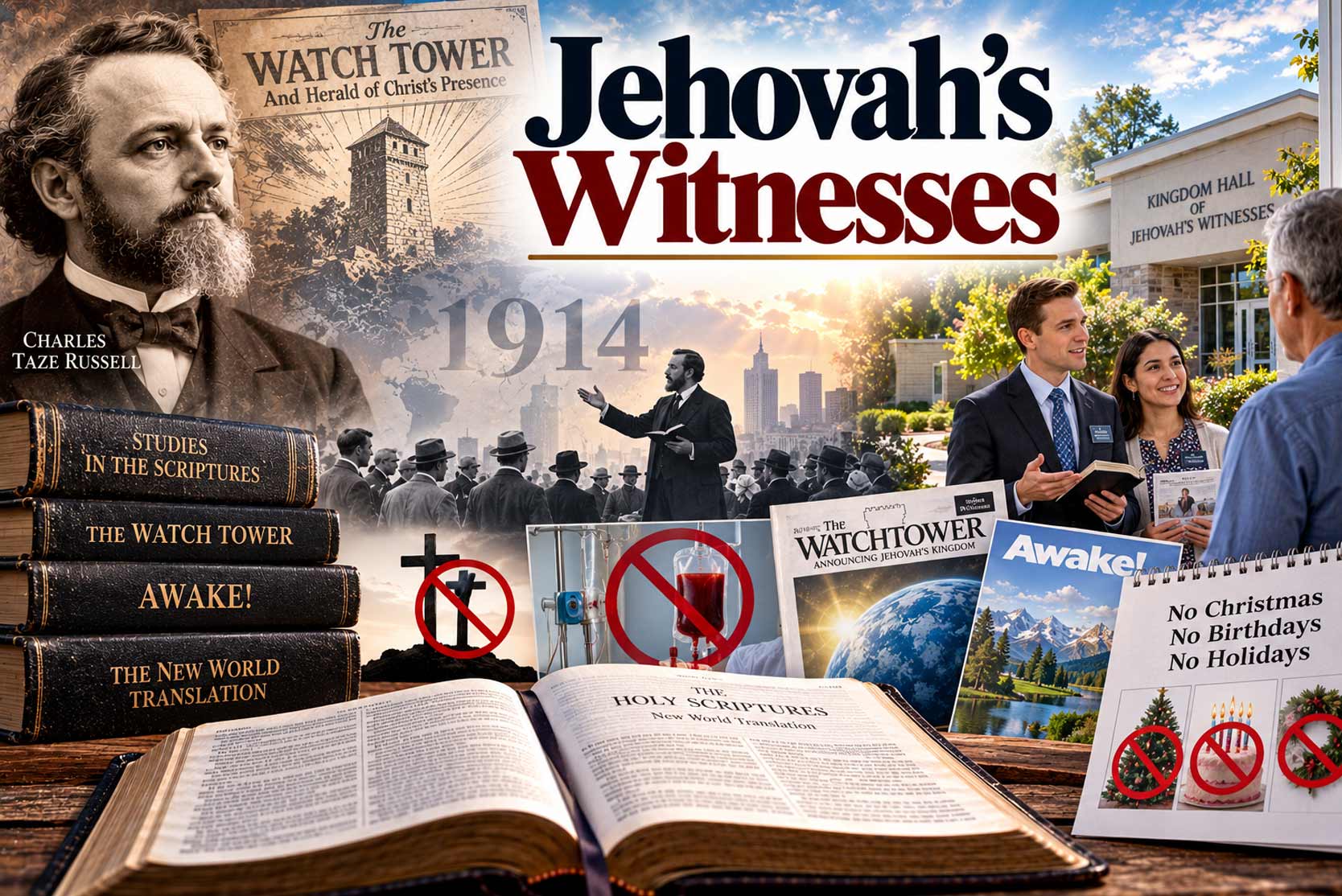
Few religious groups are as familiar to the public and as poorly understood as Jehovah’s Witnesses. Most people know them as the people who knock on doors, distribute The Watchtower, don’t celebrate Christmas, refuse blood transfusions, and somehow have something to do with 144,000 people going to heaven. That collection of facts is accurate as far as it goes, but it doesn’t explain the religious system that connects them. Jehovah’s Witnesses aren’t simply Christians with a handful of unusual practices. They represent a distinctive restorationist movement that emerged from the nineteenth-century American Bible Student movement and eventually rejected several doctrines that historically have defined orthodox Christianity.
Jehovah’s Witnesses consider themselves Christians and believe that they have restored the teachings and practices of first-century Christianity. They accept the Bible as inspired, preach Jesus as the Son of God and Savior, practice baptism, emphasize moral living, and devote enormous effort to evangelism. At the same time, they reject the Trinity, deny that Jesus is Almighty God, reject the traditional doctrine of the immortal soul and eternal conscious punishment, and teach that only 144,000 Christians will rule with Christ in heaven while the great majority of faithful people hope for everlasting life on a restored paradise earth. Those differences aren’t theological footnotes. They form an entirely different framework for understanding God, Christ, salvation, death, and the future.
Charles Taze Russell and the Bible Students
The story begins with Charles Taze Russell, born in Pennsylvania in 1852. Russell grew up in a religious home but became deeply troubled by traditional Christian teaching about hell and eternal punishment. Like many Americans during the nineteenth century, he lived in an environment filled with revivalism, Adventist expectation, prophetic speculation, and new attempts to reconstruct Christianity directly from the Bible.
During the 1870s Russell began meeting with others for systematic Bible study. He became convinced that established churches had incorporated doctrines that couldn’t be supported from Scripture, including the Trinity, the inherent immortality of the soul, and eternal torment. He also became intensely interested in biblical chronology and the return of Christ. The group surrounding Russell came to be known simply as Bible Students.
In 1879 Russell began publishing Zion’s Watch Tower and Herald of Christ’s Presence, the ancestor of today’s Watchtower. The Watch Tower Tract Society was subsequently organized to distribute literature and coordinate the growing movement. Russell traveled extensively, preached to large audiences, wrote a series eventually known as Studies in the Scriptures, and used newspapers and other mass-media methods with considerable success.
Russell shouldn’t simply be dropped into the later Jehovah’s Witness organization as though nothing changed after his death. Some of his theology differed from positions the Witnesses eventually adopted, and the organizational structure under Russell was considerably looser. Modern Jehovah’s Witnesses trace their history through him but don’t regard him as the founder of a new religion; they describe Jesus Christ as the founder of Christianity and Russell as an important leader in the modern restoration of biblical truth.
1914 and the Prophetic Timetable
Biblical chronology occupied an important place in the early Bible Student movement. Russell and his associates believed that prophetic calculations pointed to 1914 as a year of enormous significance. Their expectations surrounding that date developed and changed, but 1914 never disappeared when the anticipated events failed to unfold in the manner many Bible Students expected.
World War I began in 1914, which gave the date continuing prophetic importance in the movement. Jehovah’s Witnesses eventually came to teach that Jesus began ruling invisibly as King in heaven in 1914 and that the world entered its last days. In their theology, Christ’s presence therefore isn’t primarily a future event waiting to begin. His invisible royal presence has already begun, while the visible destruction of the present world system remains future.
The handling of 1914 illustrates an important feature of Witness history. Prophetic expectations have been revised when events didn’t occur as anticipated, while the broader theological system was adjusted to retain significance for the date. Critics regard this as failed prophecy followed by reinterpretation. Witnesses understand their history differently, describing it as progressive clarification as God’s people gradually came to understand biblical prophecy more accurately.
That distinction matters because Jehovah’s Witnesses don’t see doctrinal development as evidence that the organization lacks divine guidance. They frequently speak of spiritual understanding becoming progressively clearer. Critics naturally ask how many substantial revisions can occur before claims of unique divine direction become difficult to sustain. The argument between those two perspectives has followed the movement for much of its history.
Joseph Rutherford and the Transformation of the Movement
Russell died in 1916, leaving behind a movement that soon entered a serious leadership crisis. Joseph Franklin Rutherford became president of the Watch Tower Society in 1917. Rutherford was forceful, organizationally aggressive, and considerably different from Russell. Conflict followed almost immediately, including disputes over control of the Society and divisions among the Bible Students.
Under Rutherford, the movement became more centralized and developed a much more distinctive identity. Many people who had followed Russell rejected Rutherford’s leadership and formed other Bible Student groups. Those who remained with the Watch Tower organization gradually became the movement we now recognize as Jehovah’s Witnesses.
The name “Jehovah’s Witnesses” was adopted in 1931, drawing on Isaiah 43:10: “You are my witnesses,” says Jehovah. The new name helped distinguish Rutherford’s followers from the various Bible Student groups that continued to claim Russell’s heritage. It also expressed something increasingly central to the movement: the conviction that God’s personal name, Jehovah, had been neglected by Christendom and needed to be proclaimed throughout the world.
Rutherford also intensified the movement’s public evangelism and opposition to traditional churches. Witness literature frequently portrayed organized Christianity as corrupt and clergy as participants in a false religious system. The movement’s identity became increasingly defined not merely by what Witnesses believed but by the conviction that they stood outside a religious world that had departed from true Christianity.
Jehovah and the Trinity
Jehovah’s Witnesses strongly emphasize the personal name of God. They believe the divine name represented by the Hebrew consonants YHWH should be rendered “Jehovah” and used regularly in worship. Their insistence on the name is so central that it became part of their identity.
They reject the doctrine of the Trinity. Jehovah alone is Almighty God, while Jesus Christ is His Son and is subordinate to Him. The Holy Spirit isn’t understood as a divine person but as God’s active force. Witnesses therefore reject the historic Christian confession that the Father, Son, and Holy Spirit are distinct persons who share the one divine being.
Their understanding of Jesus goes further than simply saying that He is subordinate to the Father. Jehovah’s Witnesses identify the prehuman Jesus with Michael the archangel. Jesus existed before His human birth, participated in creation as God’s first creation and agent, became genuinely human, died as a ransom sacrifice, and was raised as a spirit creature. He is exalted above every other creature but isn’t Jehovah God.
This is the point at which historic Christianity and Jehovah’s Witness theology decisively part company. Christians have argued about church government, baptism, spiritual gifts, predestination, Communion, and almost everything else imaginable, but the deity of Christ and the triune identity of God became foundational boundaries of historic Christian orthodoxy. From that standpoint, Jehovah’s Witnesses aren’t simply another Protestant denomination because their doctrine of God differs fundamentally from the historic Christian confession.
The New World Translation
Jehovah’s Witnesses publish their own Bible translation, the New World Translation of the Holy Scriptures. It has been translated into numerous languages and is widely distributed through their evangelistic work. Witnesses believe it accurately restores God’s name and corrects renderings influenced by traditional theology.
Critics have focused particularly on passages involving the deity of Christ. John 1:1 is the best-known example. Where most English translations say that “the Word was God,” the New World Translation renders the clause “the Word was a god.” Witnesses argue that the Greek grammar supports a qualitative or indefinite understanding and distinguishes the Word from the God with whom He was. Trinitarian scholars generally respond that the Greek construction distinguishes the persons without reducing the Word to a lesser divine being and that “a god” misrepresents John’s meaning.
The translation also inserts “Jehovah” into the New Testament even though the surviving Greek manuscripts don’t contain the divine name there. Witnesses argue that New Testament writers would have preserved God’s name when quoting Old Testament passages containing it and that the name was later removed from copies. Critics respond that this reconstruction isn’t supported by the extant Greek manuscript evidence.
The disagreement therefore goes beyond translation style. The New World Translation reflects theological judgments about God and Christ that distinguish Jehovah’s Witnesses from historic Christianity.
The Kingdom and the 144,000
The Kingdom of God stands at the center of Witness preaching. Jehovah’s Witnesses don’t understand the Kingdom primarily as God’s rule in the hearts of believers or simply as another name for heaven. They regard it as an actual heavenly government ruled by Jesus Christ that will replace human governments and establish God’s righteous rule over the earth.
Witnesses teach that 144,000 people, drawn from Revelation 7 and 14, are specially chosen to reign with Christ in heaven. These are commonly called the “anointed.” They constitute the heavenly class and participate in what Witnesses understand as the new covenant in a distinctive way.
The majority of faithful Jehovah’s Witnesses don’t expect to go to heaven. They belong to what is commonly called the “great crowd” and hope to live forever on a restored paradise earth. This distinction explains a practice that can be startling to visitors attending the annual Memorial of Christ’s death. Bread and wine are passed through the congregation, but most Witnesses don’t partake because they don’t consider themselves members of the anointed heavenly class.
The resulting picture differs considerably from the common Christian idea that every believer expects to die and go to heaven. For most Jehovah’s Witnesses, everlasting human life on a perfected earth isn’t a consolation prize for people who missed heaven. It is what they believe God originally intended for humanity.
Death, Hell, and Resurrection
Jehovah’s Witnesses reject the idea that human beings possess inherently immortal souls that continue consciously after death. They understand the soul primarily as the living person rather than an immortal spiritual component inhabiting the body. When people die, they cease conscious existence and await resurrection.
They therefore also reject eternal conscious torment in hell. They believe the biblical terms commonly translated “hell” frequently refer to the grave or destruction rather than a place where immortal souls suffer forever. The wicked who finally reject God face permanent destruction rather than everlasting conscious punishment.
This teaching connects directly with Russell’s original objections to nineteenth-century Christian preaching about hell. It remains one of the features that can initially attract people who find eternal conscious punishment morally or theologically troubling. But the Witness alternative comes as part of a much larger theological system involving their understanding of human nature, resurrection, judgment, and the two destinies of the heavenly and earthly classes.
Armageddon and the New World
Jehovah’s Witnesses believe the present world system is approaching its end. They interpret biblical prophecy as describing a coming confrontation at Armageddon in which God will destroy the existing wicked system and establish righteous rule over the earth. Satan will be restrained, and Christ’s Kingdom will govern during the Millennium.
The earth will then be transformed into paradise. The dead who are resurrected will have an opportunity to learn God’s ways, while faithful survivors will participate in restoring the earth. At the conclusion of the thousand years, Satan will be released for a final test, after which rebellion will be permanently eliminated.
This expectation gives Witness evangelism a strong sense of urgency. Door-to-door preaching isn’t merely a program for recruiting church members. Witnesses believe they’re announcing God’s Kingdom before the present system reaches its end. Their famous persistence makes considerably more sense once their eschatology is understood.
Blood Transfusions
One of the most controversial Jehovah’s Witness practices is the refusal of blood transfusions. Witnesses interpret biblical commands to abstain from blood, including Acts 15:28–29, as applying not only to eating blood but also to receiving blood through transfusion. Consequently, committed Witnesses refuse transfusions of whole blood and certain major blood components even when doctors believe transfusion is medically necessary.
The policy has produced difficult medical and legal cases, especially when children are involved. Courts in various countries have had to balance parental religious liberty with the state’s responsibility to protect minors. Witnesses have also worked with physicians and hospitals to develop bloodless surgical techniques, some of which have proved useful for patients who aren’t Jehovah’s Witnesses.
The issue illustrates how seriously Witnesses take obedience to their understanding of Scripture. Critics may regard the interpretation as dangerously mistaken, while Witnesses regard accepting prohibited blood as a matter of faithfulness to God. It isn’t merely a dietary preference extended into medicine; within their theological system it is an issue of obedience.
Holidays, Birthdays, and Political Neutrality
Jehovah’s Witnesses don’t celebrate Christmas or Easter because they believe these observances contain traditions and customs not established by the apostles and influenced by pre-Christian religion. They also don’t celebrate birthdays, citing biblical examples and the absence of birthday celebrations among early Christians.
Witnesses maintain strict political neutrality. They don’t endorse political candidates, participate in partisan politics, or salute national flags. Historically, they have also refused military service on grounds of Christian neutrality. These practices have sometimes brought severe persecution, particularly under governments demanding absolute political loyalty.
In the United States, Jehovah’s Witnesses played an unexpectedly important role in the development of modern religious-liberty law. Their refusal to salute the flag and their determination to distribute religious literature produced numerous Supreme Court cases during the twentieth century. Americans who disagree profoundly with Witness theology nevertheless benefit from constitutional protections strengthened through cases Jehovah’s Witnesses were willing to fight.
Their experience under Nazi Germany was far more severe. Witnesses were imprisoned in concentration camps because they refused military service, Nazi salutes, and allegiance to Hitler’s regime. Unlike many prisoners targeted because of ethnicity, some Witness prisoners could have obtained release by renouncing their faith, yet many refused. Whatever theological disagreements Christians have with Jehovah’s Witnesses, that history deserves to be remembered honestly.
The Governing Body and the Organization
Jehovah’s Witnesses are highly organized internationally. Their worldwide headquarters is in Warwick, New York, and overall direction is provided by the Governing Body, a small group of men who oversee teaching, publishing, evangelism, personnel, and other aspects of the organization. Local congregations are supervised by bodies of elders rather than a paid clergy.
Witnesses emphasize worldwide doctrinal and organizational unity. Congregations throughout the world study coordinated material and receive direction through the same organizational structure. This produces a degree of uniformity unusual among religious movements of comparable size.
That unity also gives the organization substantial authority over the religious lives of members. Jehovah’s Witnesses believe God uses the “faithful and discreet slave” of Matthew 24:45 to provide spiritual instruction. The understanding of exactly who constitutes that slave has changed over the movement’s history, but in current Witness teaching it is closely associated with the anointed Christians serving on the Governing Body.
Critics argue that this gives a small leadership group extraordinary interpretive authority while simultaneously allowing teachings to be revised as “new light.” Jehovah’s Witnesses respond that the Governing Body doesn’t claim inspiration or infallibility and that increased understanding is consistent with God’s gradual clarification of truth. Once again, the central disagreement isn’t whether teachings have changed. Both sides know they have. The disagreement is what those changes mean.
Disfellowshipping and Shunning
Jehovah’s Witnesses practice congregational discipline for serious wrongdoing. A baptized member who commits what the organization considers serious sin and doesn’t demonstrate repentance may be removed from the congregation. Witness terminology and procedures have changed somewhat over time, but separation from unrepentant members has long been an important part of maintaining congregational discipline.
The practice becomes particularly controversial because Jehovah’s Witnesses frequently exist within close family and social networks. Losing one’s standing in the congregation can therefore affect much more than Sunday worship. Former members and critics have described the social consequences as severe, particularly when nearly all of someone’s family and friends remain Witnesses.
Jehovah’s Witnesses defend congregational discipline as biblical and point to New Testament instructions about removing unrepentant wrongdoers from Christian fellowship. Other Christian traditions practice church discipline as well, although the degree of social separation varies enormously. The real issue isn’t whether the New Testament teaches discipline; it is how far that discipline should extend beyond participation in the church itself.
Evangelism and Witness Life
Whatever else may be said about Jehovah’s Witnesses, they take evangelism seriously. For generations, door-to-door ministry became one of their most recognizable practices. Witnesses distributed enormous quantities of books, magazines, and tracts and became particularly identified with The Watchtower and Awake!.
Their methods have changed with technology. The organization now makes extensive use of its website, videos, electronic publications, literature carts, and other forms of public witnessing. But the underlying expectation remains that ordinary members should participate personally in proclaiming the Kingdom. Evangelism isn’t reserved for professionals.
That feature is worth noticing because many churches affirm evangelism enthusiastically while leaving most of it to pastors, missionaries, or the unusually outgoing person who actually enjoys talking to strangers. Jehovah’s Witnesses built personal witnessing into the ordinary expectations of membership. Historic Christianity may reject their message, but it can’t accuse them of being particularly shy about delivering it.
Are Jehovah’s Witnesses Christians?
The answer depends heavily on what is meant by “Christian.” Jehovah’s Witnesses unquestionably identify themselves as Christians. They believe in Jesus Christ, study the Bible, preach in His name, practice baptism, and seek to follow His teachings. It would therefore be inaccurate simply to describe them as a non-Christian religion in the same sense as Buddhism or Hinduism.
Historic orthodox Christianity, however, has used more specific theological boundaries. The early church’s controversies over the identity of Christ eventually produced the Nicene confession that the Son isn’t a created being but shares the divine nature of the Father. Jehovah’s Witnesses explicitly reject that understanding, along with the Trinity and the personal deity of the Holy Spirit.
For that reason, Catholic, Orthodox, and the great majority of Protestant traditions don’t recognize Jehovah’s Witness theology as orthodox Christianity. This is why they are commonly discussed within Christian countercult studies rather than simply cataloged as another Protestant denomination. Calling them a cult can be useful if the word is being used theologically to describe a movement that arose from Christianity while rejecting central historic Christian doctrines. It becomes less useful when “cult” is used merely as an insult or as a substitute for actually explaining what a group believes.
Jehovah’s Witnesses deserve the same treatment we should give any religious movement: understand their beliefs before criticizing them. Their members aren’t theological caricatures standing on front porches holding magazines. Many are sincere people who have made substantial sacrifices because they believe they are obeying God. The serious Christian response isn’t ridicule but careful comparison. Once the doctrines are placed side by side, the disagreement becomes clear enough: Jehovah’s Witnesses and historic Christianity use much of the same biblical vocabulary, but they tell significantly different stories about who God is, who Jesus is, what salvation means, and what God intends to do with the world.